"Graduated in UK. An Arakanese, Advocating for social progress and peaceful coexistence in Arakan. AYE's SHOW reflects the ground truth of Arakan. Stay tuned"
2 million at risk of starvation in Myanmar state amid ‘total economic collapse’
Exclusive: a UN report will accuse the military of imposing ‘collective punishment’ on Rakhine state, more than three years after seizing power in a coup
Two million people in Myanmar’s Rakhine state could face starvation within months because fierce conflict and trade blockades have led to a “total economic collapse” and the imminent risk of famine, a senior UN official has warned.
Rakhine state, which borders Bangladesh in the west, is on the brink of disaster, as people’s incomes crater, rice cultivation plummets, and military-imposed trade restrictions lead to severe food shortages and hyperinflation, according to forthcoming research from the United Nations Development Programme (UNDP), which accuses the military of inflicting “collective punishment” on civilians.
Some people have resorted to eating rice bran, normally used as animal feed, to stave off hunger.
Kanni Wignaraja, UN assistant secretary general and regional director for the UNDP told the Guardian the situation was unprecedented in Myanmar. “We’ve not seen this [before] – such a total … economic collapse.
“If this projects into 2025, which seems very likely, then you’re going to see close to 2 million people at starvation point,” she said. “A lot of the households we surveyed are cutting rations now to a single meal a day – some even less.”
There has also been increased borrowing, she said, though even money lenders have little to loan.
UNDP’s research suggests that more than half of households in Rakhine, about 1.4 million people, will have seen their monthly income plunge from 66,600 kyat ($31.70) to about 46,620 kyat ($22.21) after the escalation in fighting late last year. This is barely enough to cover the cost of rice, without even factoring in other food items or expenses related to their rent or shelter, transport or health needs.
Food prices soar ten-fold
Myanmar has been gripped by a spiralling conflict and economic crisis since the military seized power in February 2021. The coup was met with determined resistance from the public, and many took up arms to fight for the return of democracy. Older, ethnic armed groups that have long sought greater autonomy have also fought against the junta, sometimes in coordination with newer groups.
The conflict in Rakhine state, on Myanmar’s border with Bangladesh, re-erupted late last year, and the state remains gripped by intense fighting between the military and the Arakan Army, an ethnic Rakhine group that wants an autonomous state.
The UNDP report said restrictions put in place by the military were “clearly aimed at isolating Rakhine from the rest of the country and exacting ‘collective punishment’ on an already vulnerable population”.
Junta chief Min Aung Hlaing has previously rejected the accusations, blaming instead the Arakan Army for “destroying the socio-economic life of residents, education and health sector”. The interior ministry has been contacted for further comment.
The situation is especially desperate for the 511,000 displaced people in Rakhine, including Rohingya, who rely on aid from humanitarian agencies and the community.
Access was “severely limited” for aid agencies, Wignaraja said, hampered by military-imposed bureaucratic hurdles, such as requirements for special permits, as well as the intensity of the conflict.
Basic health programmes such as immunisation campaigns have stopped, HIV patients cannot access antiretroviral medicines.
In July, more than three dozen children were confirmed to have died during a diarrhoea outbreak, according to the UNDP. The real number of deaths could be higher.
Even paracetamol is essentially unobtainable because it is so expensive. A single blister – a strip of 12 capsules - is sold at between 6,000 to 7,000 kyat ($2.86-3.33).
The conflict has brought the construction sector, a major source of employment, to a standstill, and driven hundreds of thousands of people from their homes.
At the same time, the cost of essential foods such as rice and cooking oil has skyrocketed nearly ten-fold in the worst-hit areas, according to UNDP.
It has predicted that only 97,000 tons of rice will be produced this year, enough to cover just 20% of the population’s needs. This is down from 282,000 tons last year, which even then met only 60% of the need.
The number of trade routes bringing supplies into Rakhine has fallen to two from 8-10 routes that existed prior to October 2023. Wignaraja said this fall was due to a mix of factors including military-imposed restrictions, the intensity of the conflict, the collapse in demand as incomes have disappeared and the growth in illegal economic activities.
This is much larger than a famine’
To avert the very worst scenario, UNDP has called for all restrictions to be lifted so commercial goods can flow in and out of Rakhine, including through Myanmar’s borders with India and Bangladesh, and for unimpeded access for aid workers. Funding was needed to urgently to allow operations to expand, UNDP’s report said.
However, Wignaraja said the crisis in Myanmar had reached a point where day to day relief work could not do more than “stave off hunger maybe till the next day”.
“This is also much larger than a famine. It’s a political disaster and a collapse,” she added. “It needs an all-out politically mediated settlement – which has to be the rest of the world coming together, [it] could be led by the immediate regional players and Asean [Association of Southeast Asian Nations], with the UN support.”
The lack of international attention given to Myanmar, she said, was “very, very troubling given the intensity of what’s going on”.
The number of Rohingya taking dangerous boat journeys to try to reach Indonesia last month rose sharply compared with the same period last year. At least 395 Rohingya refugees, including 173 children, arrived in Indonesia by boat in October, compared with 49 recorded in the same month in 2023, according to UN figures cited by Save the Children.
Wignaraja said the situation for Rohingya in Rakhine state was “absolutely desperate”. “Everything that the general population faces, you can extend that 10 times or more to the Rohingya population,” she said.
“When people are desperate, they’re going to try everything,” said Wignaraja. “Once you put your children on a boat you know you have lost all other hope,” she said.
This news was written by The Guardian.
@UN@UNDP@POTUS@realDonaldTrump@elonmusk@Refugees@UNHumanRights@UNDPasiapac
Muslim activists should consider working together with the people of Arakan to promote harmony and peace in Arakan. It is saddening to witness some Muslim activists making threats against the ULA/AA and the people of Arakan. In a recent post that appeared on social media, a Muslim activist named Hla Shwe reportedly threatened the people of Arakan. He claimed that they had recruited a force of 50,000 Muslim fighters to fight against Arakan and repeatedly stated that there would be no peace in Arakan unless the people of Arakan cooperated with them. Such statements suggest the risk of a religious conflict, similar to what has occurred in the past.
It is deeply disheartening that the suffering of the Arakanese people has largely been ignored by the international community—how they have been killed, displaced, and how they lost their ancestral land due to waves of Bengali settlers. Despite this painful history, the people of Arakan have continued to show empathy and goodwill, and many still believe in working together in harmony for the development and progress of Arakan.
In return, however, we have often faced humiliation, threats, disrespect, and even attempts at historical distortion. I sincerely hope that those promoting anti-Arakanese agendas will come to their senses, as such approaches are not helpful for the future. I also hope they will choose to become part of a peaceful coexistence. Unfortunately, the demonstration that took place in front of the ICJ was highly discouraging and undermines efforts toward peace and mutual understanding.
@BBC@UN@ICJ_org@ICC@CNN@ArakanHeritage@DMGEnglish@POTUS46Archive@realDonaldTrump@WhiteHouse46
ARSA Jihadist Terrorists abduct and sexually assault three Indigenous women in Chittagong Hill Tracts, Bangladesh
AB News – November 29, 2025
Amara
Three Indigenous Daignet women were abducted and subjected to sexual violence by armed militants of the Arakan Rohingya Salvation Army (ARSA) in the Chittagong Hill Tracts of Bangladesh, according to Hill Voice media reports.
The attack occurred on November 25 in Nat Chhari Upazila, Bandarban District, where 10 armed ARSA fighters seized the three women while they were bathing at a stream located about 200 meters east of Gojaparnia Village in the Rijhu area.
The victims are local residents — a 60-year-old woman, a 45-year-old woman, and a 42-year-old woman — all belonging to the Daignet Indigenous community.
Eyewitnesses said the women were detained for the entire day, tied up and subjected to sexual assault before being released later in the evening.
“One of the women was badly beaten. Their eyes were blindfolded with cloth, and their hands were tied behind their backs. All three were restrained and abused,” local residents told reporters.
ARSA’s pattern of terror in the Hill Tracts
Residents noted that the latest atrocity follows a series of ARSA abuses against Indigenous communities in recent months — including kidnappings, killings and sexual violence. Despite repeated complaints to local police and authorities, community members say no effective action has been taken to stop ARSA activities in the region.
Indigenous leaders warn that ARSA’s expanding presence in the Chittagong Hill Tracts poses a direct threat to ethnic minorities living there, especially isolated communities such as the Daignet, Marma and Chakma peoples.
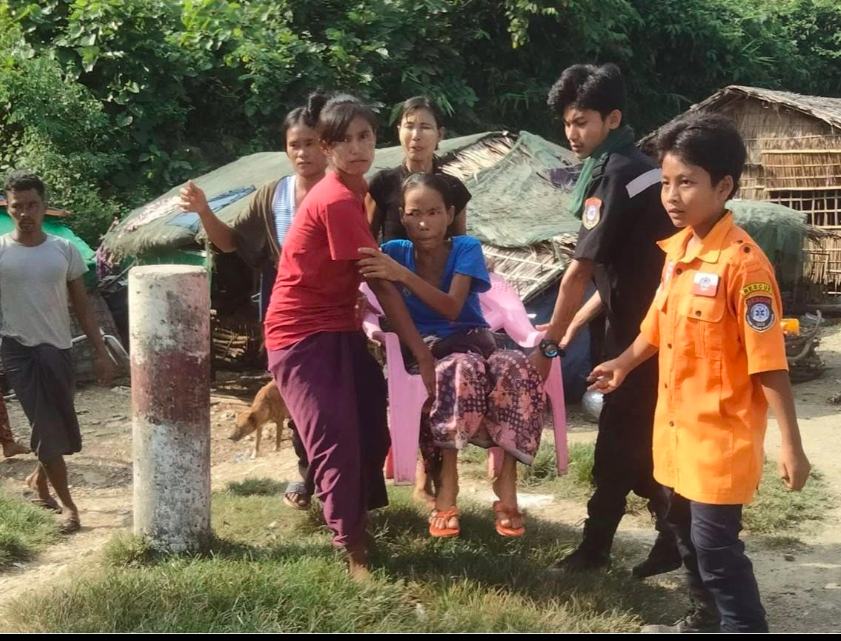
Arakan’s Youngest Volunteer, Aged 14, Dies in Myanmar Military Drone Strike
Hate Aung Hein, a 14-year-old volunteer from Arakan, tragically died in a Myanmar military drone strike while assisting with emergency aid.
According to local Arakan news outlets, the teenager had been serving as a volunteer since the age of 10. The incident took place in Kyon Daung Village, Ponagyun Township, Arakan, when a Myanmar military-operated drone targeted a vehicle he was about to use to transport a sick patient.
The news has deeply shaken his family, friends, colleagues, and the wider Arakan community. Reports indicate that Myanmar military air and drone strikes continue to claim civilian lives, with an estimated 20 to 30 people killed each week across the region.
@UN@POTUS46Archive@realDonaldTrump@cnnbrk@BBCBreaking@BKK_POST@govsingapore@VOANews
Arakan Army Urges Bangladesh to Stop Supporting ARSA Terrorists Along the Arakan–Bangladesh Border
The Arakan Army (#AA) released a statement today urging the Bangladeshi government to stop supporting #ARSA terrorists operating along the Arakan–Bangladesh border.
After Bangladesh reportedly denied any involvement in supporting ARSA Muslim militants, the Arakan Army called on the Bangladeshi government to take action against certain high-ranking officials allegedly connected to the group. The AA further stated that continued support for ARSA terrorists could negatively affect relations between the two regions.
The ULA/AA also highlighted the potential impact on @ASEAN security if Bangladesh continues to support ARSA and other terrorist groups along the border.
The statement concluded that this situation could be part of the Myanmar military’s strategy to weaken the Arakan Army, with some corrupt Bangladeshi high-ranking officers allegedly involved as well.
@UN@POTUS46Archive@POTUS45@govsingapore@PMOIndia@BBC@CNN@CNBCnow@NewsArakanArmy@BKK_POST
The Unheard Story of Arakan: Suffering, Sacrifice, and the Struggle for Dignity
Written By an Arakanese Historian
For centuries, the story of Arakan has been told by others - by conquerors, colonial officers, and central rulers who saw our land as a periphery and our people as subjects. But the true story of Arakan (Rakhine) is not one of rebellion or violence; it is a story of endurance. It is the story of a people who have suffered in silence and still found the strength to rise, to organize, and to dream again.
The long shadow of neglect
Our tragedy began long before any modern conflict. In 1784, the Arakan Kingdom of Mrauk-U - a proud and flourishing civilization - fell to the Burmese Konbaung dynasty. Temples were desecrated, families were deported, and our sacred images were carried away as trophies.
The British colonization that followed replaced royal domination with economic exploitation. When independence came in 1948, Arakan found itself absorbed into a new Burmese state that continued the same old centralization, only now under the name of nationalism.
For decades, Arakan was left behind - its roads unpaved, its youth unemployed, its culture ignored. Government projects bypassed our towns; even our natural resources benefited outsiders more than locals.
The military regimes treated Arakan/Arakanese as a security zone rather than a community of human beings. Villages were raided, land confiscated, young men arrested under suspicion of "insurgency." In such a climate, bitterness was not born out of hatred but out of humiliation.
The birth of the Arakan Army
It was from this long, unending pain that the Arakan Army (AA) was born in 2009. It did not arise from ambition or ideology alone, but from a shared sense that Arakan people had no future unless they stood up for themselves.
The founders of the AA were not warlords; they were sons of original citizens, farmers and fishermen who grew tired of kneeling. They trained far from home, under harsh conditions in the northern mountains, often with little food or medicine. Many never returned. But those who did carried something more powerful than weapons - they carried the conviction that Arakan must never again live in humiliation.
By 2015, the AA's name had begun to spread. To the government, it was a threat. To the Arakanese people, it was a symbol of pride. For the first time in living memory, an Arakanese organization spoke boldly of equality, dignity, and self-determination.
Villagers who once felt invisible began to feel seen. Mothers who had lost sons to the Tatmadaw now saw their younger children walk proudly under the Arakanese flag. In their eyes, the AA was not a rebel army; it was a restoration of lost honor.
Why the world misunderstands us
The world often looks at Arakan through headlines - violence, fighting, displacement. What it does not see is the depth of our collective wound. When international organizations speak only of human rights violations and not of the decades of suffering that shaped this movement, they miss the moral essence of the story. The AA did not emerge in a vacuum. It is the natural response of a people pushed to the edge of despair.
It is easy for distant observers to say "non-state actors must follow human rights." Of course, that principle is right and necessary. But those same observers rarely mention the structural violence that created the conflict in the first place - the economic exploitation, the decades of military occupation, and the silence of the world when Arakan villages were burned long before the AA ever existed.
Arakanese people fought not for dominance, but for dignity. That distinction is crucial. We do not seek to conquer others, only to reclaim a place where we can breathe freely, teach our language, and live without fear.
A people rising from sorrow
When the AA says it wants to build an administration based on "good governance" and "moral order," it is not rhetoric. In many towns where the AA has influence, disputes are settled fairly, corruption is minimal, and ordinary people feel safer than before. Schools reopen, roads are repaired, and cultural festivals flourish again.
These may seem small things to outsiders, but to us - a people long denied agency - they are miracles of self-reliance.
Of course, there are difficulties. Any movement born in war faces misunderstanding and hardship. But hardship is the language Arakan people know best. We have been punished for simply demanding to be treated as equals; yet even in the midst of poverty, our people continue to give food, shelter, and trust to the young men and women of the AA who defend them. That is not fear - that is faith.
Our moral compass
As a historian, I see the AA not merely as an army but as an awakening. It represents the spiritual rebirth of a people once convinced that history had forgotten them. Yet power, even justly earned, must be guided by wisdom. The Arakan struggle should never lose its humanity. Our true enemy has never been another community, but injustice itself.
The people of Arakan know too well what it means to be dehumanized. Therefore, we must ensure that our pursuit of justice never repeats the mistakes of those who oppressed us. Dignity cannot be built upon another's humiliation. The greatness of a liberation movement lies not only in how fiercely it fights, but in how fairly it governs.
Recognition long overdue
The international community must learn to listen before it judges. It must understand that Arakan's yearning for autonomy is not extremism but survival. It must see that the AA's rise is not the cause of instability - it is the result of decades of broken promises and central arrogance.
When the Tatmadaw monopolized power, the world criticized but still engaged. Yet when a local movement rooted in popular support rises to claim self-rule, the world reacts with suspicion. This double standard wounds us deeply.
If the world truly desires peace in Arakan, it must respect the Arakan people's agency. It must talk to us, not about us. It must see the AA not as a problem to be solved, but as a political reality - a product of legitimate grievance and genuine sacrifice.
A legacy of endurance
The Arakan Army's story is not just about guns and uniforms. It is about the fisherman who gives his last bowl of rice to a soldier, the mother who prays for her son's safe return, and the teacher who tells children that the Arakan language will live again. It is about a people who refused to vanish, who carried the flame of pride through centuries of darkness.
When future historians write about this era, they should not see only battles and accusations. They should see a people reclaiming their voice after centuries of silence. They should see the AA as the living expression of Arakan resilience - a reminder that even the most oppressed can rise with discipline, organization, and moral conviction.
The dignity of endurance
Arakan's journey is one of immense suffering and extraordinary courage. Our people have endured conquest, poverty, and decades of humiliation, yet they have produced a movement rooted in loyalty, discipline, and hope. The Arakan Army stands as the embodiment of that hope - not perfect, but profoundly human.
The world may not understand our pain, but it should at least recognize our perseverance. For the Arakan, the struggle has never been about vengeance; it has always been about dignity - the right to live as equals on our own land.
History may judge us by the power we wield, but it should also remember the suffering that made us strong. And if the world cannot yet see that, we will keep walking forward - with discipline, with compassion, and with the quiet pride of a people who have finally stood up after centuries on their knees.
@UN@POTUS46Archive@elonmusk@TheEllenShow@BBCBreaking@BBCWorld@BBCNews@cnni@cnnbrk@govsingapore@BKK_POST@ArakanBaynews@PMOIndia@DRDO_India@World@WorldHistory101@DMGEnglish@DerekTonkinUK
Bangladesh-Based Militant Group Attacks Civilians in Maungdaw — Video Surfaces Online
October 5, 2025 | Maungdaw, Arakan
A video circulating on social media shows an attack on three local civilians in northern Maungdaw Township, reportedly carried out by an Islamist militant group called Rohingya Islami Mahaz (RIM).
The civilians were returning home from shopping in the Taung Pyo area when the attackers used improvised explosive devices (IEDs) followed by small-arms fire, injuring one person.
Local sources say RIM operates from safe havens inside Bangladesh, infiltrating across the border to carry out attacks against civilians in Arakan.
Security observers warn that such cross-border militant activity poses growing risks to border communities and regional stability.
Urgent Appeal: Protect Minority Communities in the Chittagong Hill Tracts
We call on the Government of Bangladesh to take immediate action to end the ongoing violence and sexual crimes committed against minority communities in the Chittagong Hill Tracts (CHT).
A deeply disturbing incident occurred just a day ago when a Grade 8 schoolgirl was brutally gang raped by three Bengali settlers. In addition, verified video footage shows armed settlers invading a village in the CHT, wielding knives and swords, and attacking innocent villagers.
This is not an isolated case. For decades, the Buddhist minorities and indigenous peoples of the Chittagong Hill Tracts have endured systemic mistreatment, land grabbing, and violence at the hands of Bengali settlers. Despite repeated appeals, their calls for justice and protection remain largely unanswered.
Local voices on social media are urgently pleading for protection and calling for the withdrawal of military forces from their land, as they believe the presence of the army has failed to provide security and has instead worsened their plight.
We urge the Bangladesh government to:
Immediately investigate this latest incident and bring all perpetrators to justice.
Ensure protection and safety for the minority and indigenous communities in the CHT.
End impunity for crimes committed against vulnerable groups and implement stronger measures to prevent further violence.
The suffering of the people in the Chittagong Hill Tracts must not be ignored. Justice delayed is justice denied.
@UN@BBCWorld@ArakanBaynews@hrw
It is saddening to witness that some Bangladeshi border guard police are supporting Muslim militant groups such as ARSA, ARA, RSA, and others. Bangladesh should cooperate with the ULA government to bring harmony and security along the Arakan–Bangladesh border. I hope this is not the interest or official policy of the Bangladeshi government to destabilize the border, but rather the actions of opportunistic individuals within the border guard police who are creating problems. Bangladesh should take the necessary action against these forces and implement a more effective approach to eliminate the presence of Muslim militants.
Pai-Nyar-Pann-Khun is the name of the private school that was struck by Myanmar military airstrikes on 12 September 2025. The name of the school simply means “Educational Garden” in English.
Twenty innocent students, who were thirsty for knowledge and education, were instead fed with debris from the bombs that fell from the night sky. Their hopes of serving their people and communities were stolen by the war crimes of the Myanmar military. These innocent souls, aged only between 12 and 18, did not deserve to say goodbye to a world they had only just begun to know.
Arakan (Rakhine State) has been suffering from war for nearly 10 years—largely unnoticed by the world. Amidst the intense fighting between the Arakan Army and the Myanmar military, more than half a million Arakanese civilians have become homeless and are living in IDP camps. Unlike the support received by Muslim refugees in neighboring countries, Arakanese IDPs have received very little help from the international community.
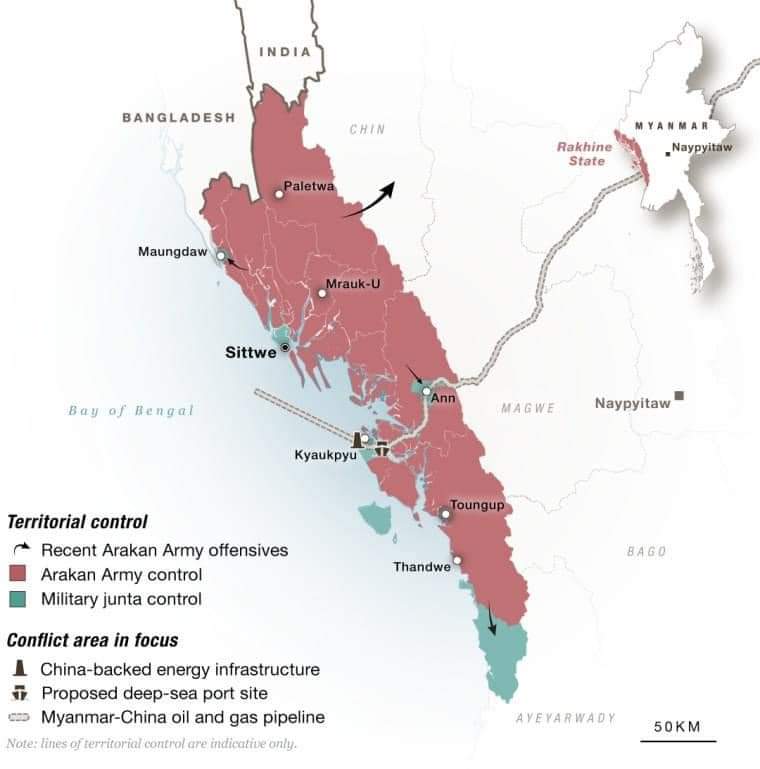
Although the Arakan Army has replaced Myanmar military rule with ULA administration over 90% of Arakan land, civilians continue to live in fear of Myanmar military airstrikes. The military regularly conducts artillery attacks from the navy and drops bombs weighing as much as 500 pounds on civilian areas, killing 30 to 40 people on a weekly basis.
We urge the international community not to neglect the suffering of our people, and to take necessary action against the Myanmar military for war crimes and crimes against humanity.
@UN@elonmusk@cnnbrk@BBCWorld #Warcrime @USWarWatch@VOANews@AlJazeera@ABC@govsingapore@PMOIndia@ThaiPBS
According to my understanding, educated Muslims from outside Myanmar began agitation after the Arakan Army (AA) successfully carried out operations against the Myanmar military in Maungdaw and Buthidaung districts, Arakan/Rakhine State. I fully sympathise with the Muslim struggle over the decades in Arakan and acknowledge the Myanmar military’s brutal crackdowns on Muslims (self-identified as Rohingya). Nothing can justify forcing people out of their homes. However, I am very disappointed that educated Muslims abroad, along with well-paid Westerners and Americans, have begun pointing fingers at the AA/ULA government since it started administering its own fatherland. The AA/ULA is the only organisation that has spoken up against atrocities committed against Muslims in Arakan. They even cooperated with the ICJ by sending two Myanmar soldiers as witnesses to testify about the mass killings of Muslims carried out by the Myanmar military government. The AA/ULA also notified all Muslims to move to safer ground before launching operations against the Myanmar military in Muslim-populated areas. Apart from areas such as Maungdaw and Buthidaung, the rest of the population did not receive such requests. I am confused as to why so many continue to point fingers at the AA/ULA while ignoring the facts on the ground, spreading false propaganda, and misleading the world about our revolutionary progress. The AA has openly invited all concerned parties to come into Arakan and investigate the situation directly. So far, however, no one has responded, and instead they continue to blame the AA/ULA.
Arakan Army Commander-in-Chief Twan Mrat Naing on the Future of Rakhine State by Rajeev Bhattacharyya - The Diplomat (Sep 06, 2024)
Q: What are your views on the allegations that the Arakan Army is committing atrocities on the Rohingya populace?
A: Since we established our administration in Arakan a few years ago, our ULA government has always focused on promoting social cohesion, inclusive governance, and equal and transparent treatment among various communities in the region. The ULA represents all ethnic and religious groups in Arakan, and observers can see staff and officers from all backgrounds in our administration at various levels. More importantly, it is our mission to promote greater participation from minority groups in our governmental institutions. There will be judges, police officers, and party cadres from all communities.
Regarding the Muslim residents in Arakan, we recognize that there are challenges such as unfounded and distorted accusations and attempts to create more mistrust between us. The AA is a well-organized and disciplined organization fighting in many parts of Myanmar, including northern Shan state and Kachin state. However, we have never been accused of or found guilty of committing any serious atrocities.
Since the beginning of our armed struggle in Arakan, we have never targeted any particular ethnic or religious group in the region. We have operated in many areas with large Muslim populations, and observers can see that our relations with the concerned Muslim community have been smooth.
Therefore, we can assure that there is no reason for our members to perpetrate any serious crimes against members of the Muslim or other communities in Arakan, despite accusations from some Muslim diaspora or interest groups. Indeed, like other professional militaries in the world, if there are minor deviations among our soldiers, we handle these cases seriously. If there is credible evidence proving violations by our members, we always welcome addressing them in line with our rules and regulations.
Ref: @Arakanbay
Read More:
https://t.co/BpMKb9dZFs…
#AA #Rakhine #Arakan #Rohingya #Myanmar
@cnni@FoxNews@CTVNews@WSJ@BloombergAsia@globalnews@NikkeiAsia@guardiannews@Le_Figaro@Reuters@ABC@NOS@Diplomat_APAC@timesofindia@euronews@BBCWorld@AlJazeera@dwnews@telegraaf@dailystarnews@DhakaTribune@Weltwoche@UN@UNHumanRights
Arakan Army Commander-in-Chief Twan Mrat Naing on the Future of Rakhine State by Rajeev Bhattacharyya - The Diplomat (Sep 06, 2024)
Q: What are your views on the allegations that the Arakan Army is committing atrocities on the Rohingya populace?
A: Since we established our administration in Arakan a few years ago, our ULA government has always focused on promoting social cohesion, inclusive governance, and equal and transparent treatment among various communities in the region. The ULA represents all ethnic and religious groups in Arakan, and observers can see staff and officers from all backgrounds in our administration at various levels. More importantly, it is our mission to promote greater participation from minority groups in our governmental institutions. There will be judges, police officers, and party cadres from all communities.
Regarding the Muslim residents in Arakan, we recognize that there are challenges such as unfounded and distorted accusations and attempts to create more mistrust between us. The AA is a well-organized and disciplined organization fighting in many parts of Myanmar, including northern Shan state and Kachin state. However, we have never been accused of or found guilty of committing any serious atrocities.
Since the beginning of our armed struggle in Arakan, we have never targeted any particular ethnic or religious group in the region. We have operated in many areas with large Muslim populations, and observers can see that our relations with the concerned Muslim community have been smooth.
Therefore, we can assure that there is no reason for our members to perpetrate any serious crimes against members of the Muslim or other communities in Arakan, despite accusations from some Muslim diaspora or interest groups. Indeed, like other professional militaries in the world, if there are minor deviations among our soldiers, we handle these cases seriously. If there is credible evidence proving violations by our members, we always welcome addressing them in line with our rules and regulations.
Ref: @Arakanbay
Read More:
https://t.co/BpMKb9dZFs…
#AA #Rakhine #Arakan #Rohingya #Myanmar
@cnni@FoxNews@CTVNews@WSJ@BloombergAsia@globalnews@NikkeiAsia@guardiannews@Le_Figaro@Reuters@ABC@NOS@Diplomat_APAC@timesofindia@euronews@BBCWorld@AlJazeera@dwnews@telegraaf@dailystarnews@DhakaTribune@Weltwoche@UN@UNHumanRights
According to my understanding, educated Muslims from outside Myanmar began agitation after the Arakan Army (AA) successfully carried out operations against the Myanmar military in Maungdaw and Buthidaung districts, Arakan/Rakhine State.
I fully sympathise with the Muslim struggle over the decades in Arakan and acknowledge the Myanmar military’s brutal crackdowns on Muslims (self-identified as Rohingya). Nothing can justify forcing people out of their homes. However, I am very disappointed that educated Muslims abroad, along with well-paid Westerners and Americans, have begun pointing fingers at the AA/ULA government since it started administering its own fatherland.
The AA/ULA is the only organisation that has spoken up against atrocities committed against Muslims in Arakan. They even cooperated with the ICJ by sending two Myanmar soldiers as witnesses to testify about the mass killings of Muslims carried out by the Myanmar military government. The AA/ULA also notified all Muslims to move to safer ground before launching operations against the Myanmar military in Muslim-populated areas. Apart from areas such as Maungdaw and Buthidaung, the rest of the population did not receive such requests.
I am confused as to why so many continue to point fingers at the AA/ULA while ignoring the facts on the ground, spreading false propaganda, and misleading the world about our revolutionary progress.
The AA has openly invited all concerned parties to come into Arakan and investigate the situation directly. So far, however, no one has responded, and instead they continue to blame the AA/ULA.
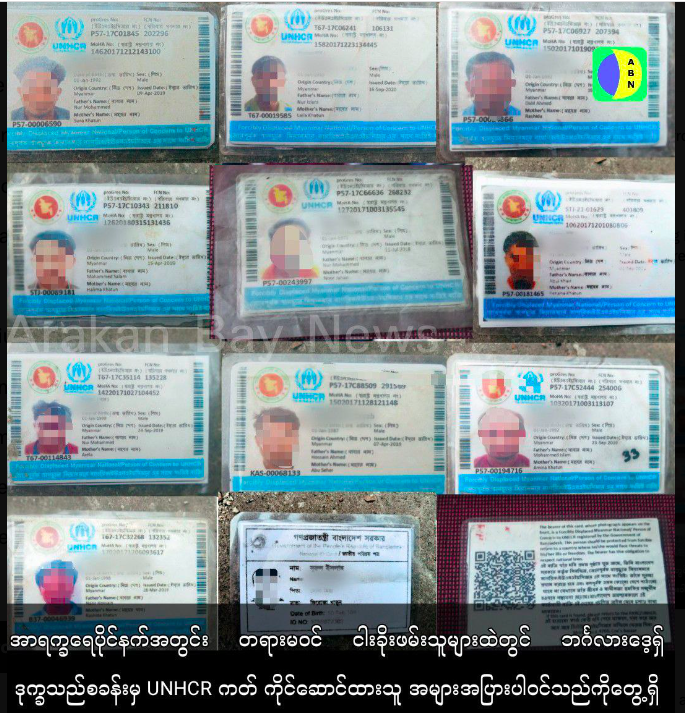
Illegal Fishermen in Arakan territorial Waters Found Carrying UNHCR Cards from Bangladeshi Refugee Camps
AB News – August 30, 2025 It has been discovered that many of the illegal fishermen operating in Arakan territorial waters are holders of UNHCR cards issued from refugee camps in Bangladesh. The Arakan Army (AA) has repeatedly detained illegal fishermen and handed them back to Bangladeshi authorities.
However, AB News has observed that among those detained, many were carrying refugee cards. On February 11, 2024, Arakan Bay News reporters witnessed AA forces seizing two fishing boats and 10 fishermen near Nose Short Refugee Camp in Maungdaw Township. Among those arrested, 5 were Bangladeshi nationals and 6 were UNHCR cardholders.
Similarly, on February 20, 2024, AA seized four Bangladeshi fishing boats with 19 fishermen near Alethankyaw beach, of whom 7 were Bangladeshi nationals and 12 carried UNHCR refugee cards, according to AB News field reporting.
Kofit Ullah, a resident of Kutupalong Refugee Camp No. 13, told AB News in an interview that although the Bangladeshi government prohibited refugees from fishing in Arakan waters, many were compelled to do so due to hardship: “I’m from Camp No. 13. Because of difficulties with food and livelihood, I came out fishing. In Arakan waters, we can catch more fish, so we fish there. Yesterday at around 9 a.m., we were arrested by AA. Along with our boat, three other boats were also seized. Altogether, 19 fishermen were detained.”
Bangladeshi authorities restrict refugees in the camps from leaving freely or working legally. On August 29, 2025, the Bangladesh Coast Guard arrested 122 fishermen and 19 boats that had entered Arakan waters illegally. According to TTN News, 93 of those detained were Muslim refugees carrying UNHCR cards.
Meanwhile, it has been observed that in Bangladeshi refugee camps, extremist armed groups such as ARSA, ARA, RSO, and RIM have been openly recruiting and mobilizing. These groups have been forcing refugees into recruitment, carrying out killings, and collecting new members. Armed clashes between rival militant groups inside the camps have also been reported by Bangladeshi media. A Muslim resident of Kutupalong Camp, who requested anonymity, told AB News that these militant groups are seeking to dominate the camps, extorting money from refugees, and killing those who oppose them.
Ref: Arakan Bay News
@UN@BBCWorld@AJENews@PMOIndia@Arakanarmy1Army
It is saddening to learn that Rohingya activists are once again misleading the world with false claims and propaganda. The Arakan Army (AA) has come under pressure after being accused of killing 600 Muslims (self-identified as Rohingya) in Maungdaw Township. The AA/ULA have denied these accusations, further proving that the bodies found were in fact those of Myanmar soldiers.
Not long after the Rohingya lobbyists’ accusations, countless videos and photos emerged from Arakan in which AYE’s SHOW observed a significant amount of military equipment around the remains. Arakan is facing a very complex situation amid the ongoing war and heavy clashes between the Arakan Army and the Myanmar military.
To my knowledge, only Muslims were notified to leave their villages before the AA began its operations against the Myanmar military. Meanwhile, the rest of the Rakhine/Arakanese civilians are usually left stuck in the war.
Since the morning of the 17th, Bangladeshi news channels have been broadcasting footage of ARSA operatives being arrested in Mymensingh - a location far from Cox’s Bazar. I mean very far!
The reports showed two young men, two burqa-clad women, and children being taken away, surrounded by RAB. Rumours also circulated about the capture of Ataullah Jununi, though no video evidence surfaced to confirm it.
Then, about six hours ago, a blurry photograph appeared, showing Mv Mustak and Ataullah Jununi close to the camera, with RAB in the background. Is it real? The answer: don’t know. But in a curious coincidence (or not?!), Fortify Rights is holding a meeting in Dhaka on crimes committed by "Rohingya Militant Groups".
Warning: This video contains disturbing content.
A video has been circulating on social media showing two young captives being tied up. A group of people can be seen brutally beating the two young men, who are speaking the Bengali language (self-identified as #rohingyas ).
Netizens have suggested that the two boys may be Arakanese civilians or from the Mro ethnic group, as their screams of pain indicate severe torture.
Many local reports indicate that Muslim militants often target civilians in Arakan, particularly in the Maungdaw and Buthidaung areas.Recently, the Arakan Army carried out a counter-terrorism operation along the Mayu mountain range in Arakan.
The perpetrators shouted Allahu Akbar, and one of them was clearly visible through the phone camera as he recorded the torture.
This video should be thoroughly investigated, and the perpetrators must be brought to justice.
@FortifyRights@JusticeMyanmar@UN@elonmusk@BKK_POST@BBCWorld@VOABurmese@RFABurmese@UNHumanRights@USWarWatch@ICC@CIJ_ICJ@ArakanBaynews@Arakanarmy1Army@mrattkthu








![AYEShow98874's tweet photo. 2 million at risk of starvation in Myanmar state amid ‘total economic collapse’
Exclusive: a UN report will accuse the military of imposing ‘collective punishment’ on Rakhine state, more than three years after seizing power in a coup
Two million people in Myanmar’s Rakhine state could face starvation within months because fierce conflict and trade blockades have led to a “total economic collapse” and the imminent risk of famine, a senior UN official has warned.
Rakhine state, which borders Bangladesh in the west, is on the brink of disaster, as people’s incomes crater, rice cultivation plummets, and military-imposed trade restrictions lead to severe food shortages and hyperinflation, according to forthcoming research from the United Nations Development Programme (UNDP), which accuses the military of inflicting “collective punishment” on civilians.
Some people have resorted to eating rice bran, normally used as animal feed, to stave off hunger.
Kanni Wignaraja, UN assistant secretary general and regional director for the UNDP told the Guardian the situation was unprecedented in Myanmar. “We’ve not seen this [before] – such a total … economic collapse.
“If this projects into 2025, which seems very likely, then you’re going to see close to 2 million people at starvation point,” she said. “A lot of the households we surveyed are cutting rations now to a single meal a day – some even less.”
There has also been increased borrowing, she said, though even money lenders have little to loan.
UNDP’s research suggests that more than half of households in Rakhine, about 1.4 million people, will have seen their monthly income plunge from 66,600 kyat ($31.70) to about 46,620 kyat ($22.21) after the escalation in fighting late last year. This is barely enough to cover the cost of rice, without even factoring in other food items or expenses related to their rent or shelter, transport or health needs.
Food prices soar ten-fold
Myanmar has been gripped by a spiralling conflict and economic crisis since the military seized power in February 2021. The coup was met with determined resistance from the public, and many took up arms to fight for the return of democracy. Older, ethnic armed groups that have long sought greater autonomy have also fought against the junta, sometimes in coordination with newer groups.
The conflict in Rakhine state, on Myanmar’s border with Bangladesh, re-erupted late last year, and the state remains gripped by intense fighting between the military and the Arakan Army, an ethnic Rakhine group that wants an autonomous state.
The UNDP report said restrictions put in place by the military were “clearly aimed at isolating Rakhine from the rest of the country and exacting ‘collective punishment’ on an already vulnerable population”.
Junta chief Min Aung Hlaing has previously rejected the accusations, blaming instead the Arakan Army for “destroying the socio-economic life of residents, education and health sector”. The interior ministry has been contacted for further comment.
The situation is especially desperate for the 511,000 displaced people in Rakhine, including Rohingya, who rely on aid from humanitarian agencies and the community.
Access was “severely limited” for aid agencies, Wignaraja said, hampered by military-imposed bureaucratic hurdles, such as requirements for special permits, as well as the intensity of the conflict.
Basic health programmes such as immunisation campaigns have stopped, HIV patients cannot access antiretroviral medicines.
In July, more than three dozen children were confirmed to have died during a diarrhoea outbreak, according to the UNDP. The real number of deaths could be higher.
Even paracetamol is essentially unobtainable because it is so expensive. A single blister – a strip of 12 capsules - is sold at between 6,000 to 7,000 kyat ($2.86-3.33).
The conflict has brought the construction sector, a major source of employment, to a standstill, and driven hundreds of thousands of people from their homes.
At the same time, the cost of essential foods such as rice and cooking oil has skyrocketed nearly ten-fold in the worst-hit areas, according to UNDP.
It has predicted that only 97,000 tons of rice will be produced this year, enough to cover just 20% of the population’s needs. This is down from 282,000 tons last year, which even then met only 60% of the need.
The number of trade routes bringing supplies into Rakhine has fallen to two from 8-10 routes that existed prior to October 2023. Wignaraja said this fall was due to a mix of factors including military-imposed restrictions, the intensity of the conflict, the collapse in demand as incomes have disappeared and the growth in illegal economic activities.
This is much larger than a famine’
To avert the very worst scenario, UNDP has called for all restrictions to be lifted so commercial goods can flow in and out of Rakhine, including through Myanmar’s borders with India and Bangladesh, and for unimpeded access for aid workers. Funding was needed to urgently to allow operations to expand, UNDP’s report said.
However, Wignaraja said the crisis in Myanmar had reached a point where day to day relief work could not do more than “stave off hunger maybe till the next day”.
“This is also much larger than a famine. It’s a political disaster and a collapse,” she added. “It needs an all-out politically mediated settlement – which has to be the rest of the world coming together, [it] could be led by the immediate regional players and Asean [Association of Southeast Asian Nations], with the UN support.”
The lack of international attention given to Myanmar, she said, was “very, very troubling given the intensity of what’s going on”.
The number of Rohingya taking dangerous boat journeys to try to reach Indonesia last month rose sharply compared with the same period last year. At least 395 Rohingya refugees, including 173 children, arrived in Indonesia by boat in October, compared with 49 recorded in the same month in 2023, according to UN figures cited by Save the Children.
Wignaraja said the situation for Rohingya in Rakhine state was “absolutely desperate”. “Everything that the general population faces, you can extend that 10 times or more to the Rohingya population,” she said.
“When people are desperate, they’re going to try everything,” said Wignaraja. “Once you put your children on a boat you know you have lost all other hope,” she said.
This news was written by The Guardian.
@UN @UNDP @POTUS @realDonaldTrump @elonmusk @Refugees @UNHumanRights @UNDPasiapac](https://pbs.twimg.com/media/GcAv9A1aQAAALJw.jpg)