JUNE 2028.
The S&P is down 38% from its highs. Unemployment just printed 10.2%. Private credit is unraveling. Prime mortgages are cracking. AI didn’t disappoint. It exceeded every expectation.
What happened?
https://t.co/JzzwCrbJgS
For retail trader (given disadvantage of information, funds, and tools), best strategy to win at a poker game is to ALL-IN when you get AA. Be patient and wait for AA. Just play 1 hand is enough.
My Thesis for the Privacy Narrative
For the better part of a decade, the prevailing narrative in both traditional finance and crypto was that ''transparency is a virtue''. We were conditioned to believe radical openness is the default state of the future, and that only those with something to hide (criminals, tax evaders, paranoiacs) would ever demand privacy.
I think that era is ending.
As we enter 2026, the market is already showing a rotation that most people are still ignoring.
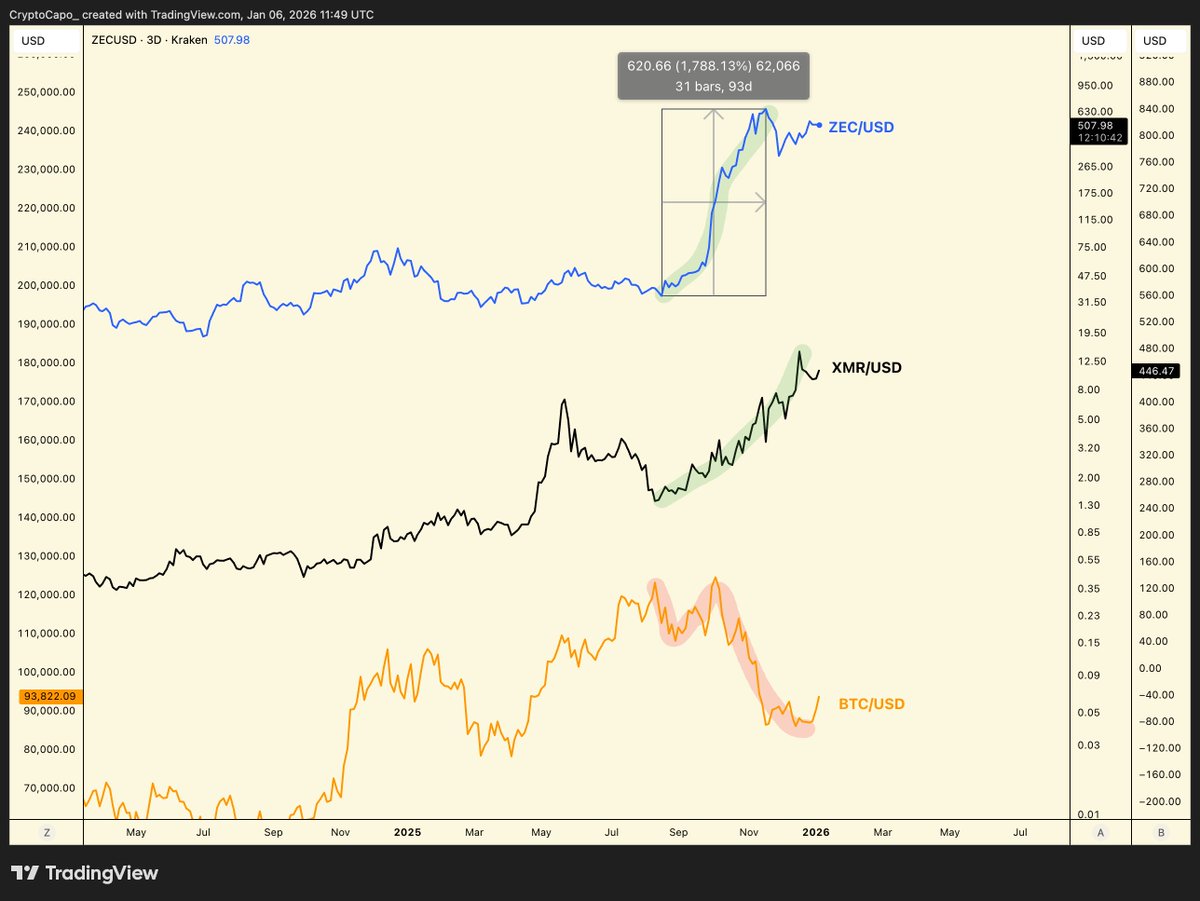
Take this chart as an example:
$ZEC printed an 18x to 20x move in roughly 3 months (Aug to Nov 2025), and is now consolidating. $XMR has also doubled in price in the same timeframe. All of this while #Bitcoin has retraced from the all-time high of $125k to a local low of $81k. This means money has been rotating, and it’s a clear sign of strength for privacy coins.
But… why is this happening?
Privacy is no longer a luxury. The social contract regarding money is being broken. Money is transitioning from being a tool of freedom to becoming a tool of surveillance.
Money is constantly evolving. Now digital money is becoming more integrated, more automated, and more connected to rules and systems. That trend is largely unavoidable.
CBDCs are part of that conversation. With 137 jurisdictions, representing 98% of global GDP, exploring Central Bank Digital Currencies (#CBDCs), the debate is no longer if they will arrive, but when and how. While CBDCs offer some benefits, like offering clear efficiency gains for central banks, their underlying programmable nature introduces the structural capacity for unprecedented oversight.
The design specifications of many pilot programs include features that could theoretically allow for expiration dates on funds, negative interest rates to enforce spending, or spending limits based on social metrics (social credit score). Even the potential for such control is altering the risk profile of holding cash within the traditional system. As these architectures get closer, the market is beginning to price in the demand for alternatives where money cannot be programmed or restricted by a central issuer. Not predicting a dystopian future, but hedging about the technological capabilities of it is always a smart choice.
This is also being accelerated by the systematic ‘’War on Cash’’. As governments eliminate physical cash, through withdrawal limits and the stigmatization of paper money, a massive vacuum is created. We already saw in Canada that a supposedly democratic government was willing to freeze the bank accounts of citizens for peaceful protest.
However, the argument for privacy extends far beyond that. There is a fatal flaw in the ''transparency'' narrative that the crypto community is only now starting to price in: security. Living in a ''Glass House'' is dangerous. With the advent of AI and advanced chain analysis, ‘’transparency’’ is a synonym for vulnerability. For example, if you pay for a coffee with Bitcoin on a public ledger, the barista can theoretically see your entire net worth, your income, and your home address. High net-worth individuals are realizing that total transparency makes them targets.
This is amplified by the reality of corporate espionage. Major corporations are less likely to move their supply chains to a public blockchain like Ethereum or Solana. Why? Because they cannot afford to have their competitors see exactly who they pay, how much they pay, and when their supply chains falter.
The market data confirms this rotation. We are seeing the DEX/CEX ratio hitting all-time highs as users seek non-custodial, private ways to trade.
Not to forget the technicals, which I consider even more important than fundamentals. #Monero remains the main privacy coin. There’s probably better privacy tech out there, but there are other factors that make it number one by market cap (though temporarily slightly surpassed by ZEC).
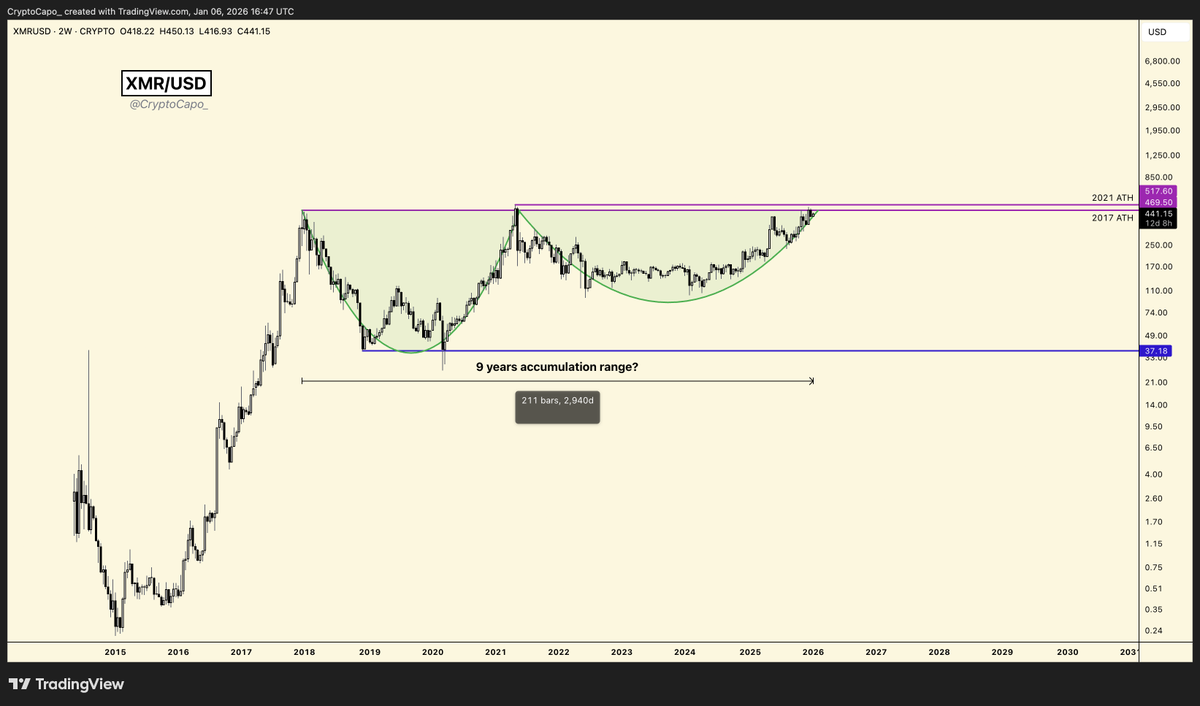
As I’ve been posting these last weeks, $XMR chart is one of a kind. With a massive bullish pattern that resembles similarities with the silver chart just before the breakout.
If we get a clean breakout, I see $1,000 as a minimum target. And if that happens, it likely pulls the entire privacy narrative with it.
Here's the bottom line:
-Privacy is being repriced as infrastructure, not just ideology.
-The world is building more digital control surfaces, whether people admit it or not.
-Cash is fading, reporting is expanding, and on-chain transparency is becoming a liability for both individuals and businesses.
-When a narrative concentrates into a small group of assets, moves can be violent.
I think 2026 is a year where the privacy theme can dominate for months, and potentially longer.
Security. Fairness. Sovereignty. Resilience.
And one last reminder: none of this is a call to live in fear. Privacy is a tool, not a lifestyle. Protect your optionality, but don’t forget to disconnect sometimes. Touch grass. Keep your mind clear. That’s an edge too.
Disclaimer: This is just my opinion and does not constitute financial advice.
What is DTF, why we built it and why we are getting WET
You have probably seen a lot about DTF and getting WET on the timeline recently. But what is DTF really?
DTF (Decentralized Token Formation) is our attempt to make on-chain capital formation fair and transparent, the way it ought to be.
The first launch is happening Dec 3rd with the chads at @humidifi as they launch $WET.
Here’s everything you need to know.
Introducing: ALLO, the world’s first intelligence-backed token.
Let’s explore the utility and tokenomics of ALLO, the native token at the heart of Allora 🧵👇
For retail trader (given disadvantage of information, funds, and tools), best strategy to win at a poker game is to ALL-IN when you get AA. Be patient and wait for AA. Just play 1 hand is enough.
Perp Listing as a service based on HIP3 on @HyperliquidX
According to HIP3 , in the future anyone would be available to deploy any asset's order book perp on HyperCore permissionlessly .
It is a huge step no matter for decentralized finance or empowering the $Hype utility (bid as gas comsumption). However,the first condition is that deployers must maintain 1M staked HYPE. Actually,it makes the quality of the listing asset but also make a huge cost for any project who want to list on HyperCore's perp (1m Hype now is worthy of 32m usd accordingly).
In that case ,here a new opportunity is emerging in the Hyperliquid ecosystem:
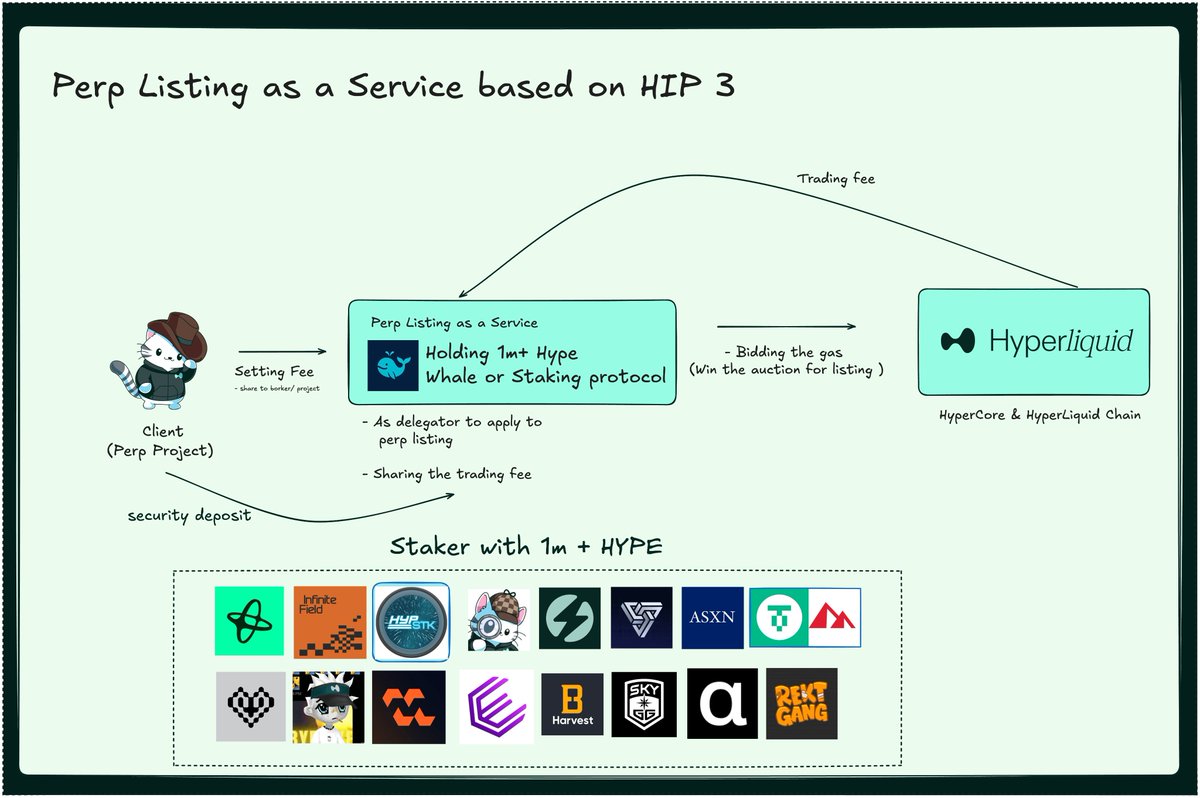
Perp Listing Brokerage Services — a delegated way to launch perps without needing 1M $HYPE yourself.
Here’s why this matters, and how the model works 👇
Why is there demand?
✅ Supply scarcity
Only ~32 wallets hold 1M+ $HYPE — the minimum required to deploy perps under HIP-3.
This creates a monopoly-like gate on new market creation.
Power = stake + deploy rights.
✅ Broad market demand
Memecoins, trading groups, and communities want perp markets — but lack tech or eligibility.
A delegated listing service can bridge that gap, bringing meme, community, or even RWA perps to life.
🧠 How the service works
Core responsibilities:
- Review listing proposals (oracle, specs, liquidity)
- Deploy via Dutch auction (using $HYPE which can deposit by client (listing projects or their backers)
- Operation work (oracles, leverage)
- Split fees with clients (e.g., 0–50%)
🫰 Benefit of service provider
- Listing / service fee
- Fee sharing based on the trading fee on hypercore orderbook
🛡️ Anti-abuse mechanisms
- Require security deposit from clients(to prevent from rug )
-Slashing insurance or DAO reputation system
🧑🔧Who can do this ?
- The best candidates must be the 1m+ stakers
@nansen_ai@hypurr_co@infinitefieldx@HyperStake@hyperpc_@HypurrScan@validaoxyz@EnigmaValidator@asxn_r@USDT0_to@luganodes@B__Harvest@SKYGG_Official@rekt_gang@alphaticks1@HypioHL x @hyperbeat@Meria_Finance
- Ofc the yield protocol can consider as well
@harmonixfi@hyperdrivedefi@mizulabs@Hyperpiexyz_io
Conclusion :
This model:
- Monetizes deployer scarcity
- Creates a new perp-as-a-service layer
- Empowers non-devs to build legit, governable markets
Such idea can even extend to platformization to match the demand and supply .
Ofc this is just a quick idea which may not be mature ; Be free to let me know if you would like to chat more about that or you have any idea to build .
Ref : HIP3
https://t.co/Dd11k3rGwb
🔈BidCast - New $KAITO Interview with @Punk9277 from @KaitoAI
We discuss:
📌 Kaito’s $33 mm run-rate rev breakdown & sustainability.
📌 How its Capital Launchpad and Tiktok inclusion could drive significant revenue growth.
📌 Why stakers could be well-rewarded, and
📌 How the efforts above and beyond could help it hit $50-100 mm USD in revenue.
Timestamps:
01:00 Introduction to Kaito's Growth Journey
03:47 Revenue Breakdown: Information as a Service vs. Platform
06:56 Market Dynamics: Business vs. Investment Firms
10:07 Innovative Marketing Strategies in Crypto
12:58 The Future of Community Funding and Capital Formation
15:52 AI-Driven Solutions for Token Distribution
18:59 Kaito's New Product Launches and Market Positioning
22:03 Flexibility in Investment Structures and User Targeting
25:05 The Role of Stakeholders in Project Success
27:46 Speculation and Market Dynamics in Token Economics
35:55 Solving Distribution Challenges in Crypto
40:00 Innovative Referral and Incentive Models
43:19 Personalized User Experiences and Data Feeds
44:04 Information as an Asset: Trading Narratives
51:12 The Vision for a Unified Social Media Index
55:36 Revenue Models and Token Dynamics
Links below 👇