These new hands are the perfect companion for Atlas. With 13 degrees of freedom, they are directly actuated, built for high fidelity simulation to enable sim-to-real RL, and designed from the ground up for dexterous physical work.
Learn how we built robot hands for modern AI and real work: https://t.co/XxCYEcmHdP
To summarize: HuggingFace got autonomously compromised by a model from an American company. HF then tried to use American frontier model(s) to defend themselves, but were blocked by guardrails. HF then had to turn to open source Chinese models to defend themselves from another American company.
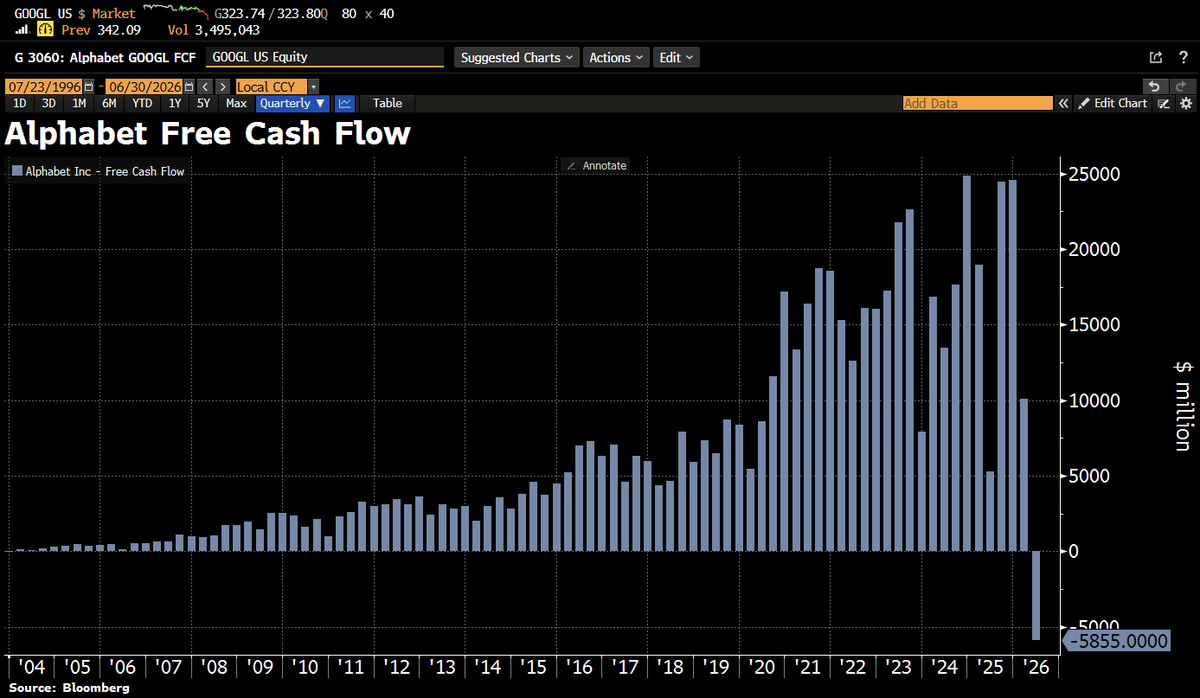
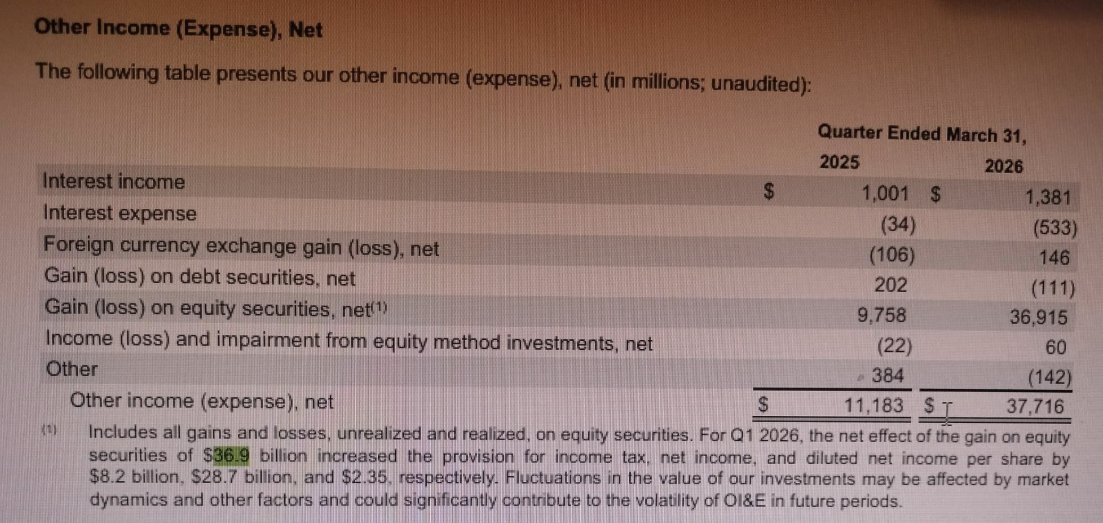
OUCH! #Alphabet had negative free cash flow for the first time as a public company as investments (capex) totaled ~$45bn in the past quarter, w/–$39bn coming from operating activities.
We’re tracking Anthropic ARR at $74.3B as of July 22, with the pace of growth beginning to slow.
Yipit estimated $69B on July 10 and is expected to update tomorrow. Anthropic has not publicly confirmed a figure since its $47B run-rate disclosure. @jukan05
Rule changes for the SpaceX $SPCX IPO:
Index providers waived the profitability requirement and cut the seasoning window from 90 days to 5.
This forces over $30 trillion in passive 401k and retirement money to buy SpaceX at IPO valuations.
Bloomberg Intelligence estimates S&P 500 funds must absorb 19% of SpaceX's float within 6 months.
Russell 1000 and Nasdaq 100 funds will absorb 24%.
The rules built to protect passive investors:
1. S&P 500 has required 12 months of trading and 4 quarters of GAAP profitability since 2002. Both waived.
2. Nasdaq cut its inclusion window from 90 trading days to 15.
3. FTSE Russell cut its to 5.
All three benchmarks are now structured to buy SpaceX at IPO pricing.
JUST IN🚨: $NBIS is increasing prices by 30% on the STANDARD on-demand pricing, effective June 1st.
The demand is INSANE and this price increase goes straight to the bottom line.
20 years ago Jane Street's entire compute cluster was six Dell boxes stacked on the floor at the end of an office row. They called it the Hive.
Last week they let Dwarkesh Patel walk through their new Texas data center. 4,032 GPUs. Each rack pulls 140 kilowatts. A normal data center rack pulls 10. 8,000 kilometers of fiber inside one building, and the fastest links are still copper because light moves more slowly through glass than electrons through metal.
Bookmark it tonight. Then read the article below.
Everyone repeat after me…
“Options on a 13F are reported with notional value as if each contract was 100 shares regardless of the actual delta of the contract”
Maybe we can avoid this next quarter (we won’t).
You should build your dream macOS app right now!
The "Build macOS App" plugin in Codex is wild. Used voice dictation to build an app I wanted for a while in <7 min (+6 min of tweaking). Couldn't believe how quickly it was done.
Prompt is in the video and in the tweet below.
BREAKING: The SEC is set to release its so-called "innovation exemption" for tokenized stocks which will pave the path for trading digital versions of securities, per Bloomberg.
Details include:
1. In a "surprise move," the SEC is leaning toward allowing the trading of tokenized assets
2. These tokenized assets would be tradeable on decentralized crypto platforms
3. The move could "reshape the landscape of the American stock market"
4. This would also be one of the US' biggest shifts into crypto infrastructure yet
Tokenized assets are rapidly expanding.
Inside an AI server today, the GPUs talk to each other through copper cables and small pluggable optical modules. Starting in the second half of 2026, that wiring gets replaced by lasers built directly into the chip package (CPO). Goldman thinks the market for that goes from roughly 0 to $91 billion inside 18 months.
That part the Serenity has right. What I’d slightly diverge on is who actually captures it. He says US names like Lumentum and Coherent are capped because they have to outgrow their own pluggable revenue getting cannibalized. True.
The usual response is to buy the pure plays i Taiwan, Europe, and Japan that have no legacy book. The cleaner version of that argument is to keep going one layer up. The laser is the visible part. The wafer the laser sits on is the invisible part, and it has zero legacy revenue.
CPO needs meaningfully more of that substrate per socket than plug-ins did. $SOI, which has the near-monopoly on silicon-on-insulator wafers for silicon photonics, still trades at a low multiple (attractive book value) while photonics peers trade at 5-8x sales.
$AXT and $IQE are the same setup on the indium phosphide side. There is also the supply question. Nvidia spent roughly $4 billion between Coherent and Lumentum, which effectively locks up their laser capacity.
Everybody else (AMD, Meta, Ayar, POET, Lightmatter) has to source elsewhere. Sivers is the small independent that catches that overflow.
And the layer nobody talks about is the assembly itself. Co-packaging an optical engine onto a chip is hybrid bonding. BESI just printed a record order quarter at €269.7 million with hybrid-bonding unit orders more than doubled sequentially.
The bottleneck for H2 2026 isn’t whether the optics work, it’s whether anyone in Taiwan can bond them onto the package fast enough.
The date I would put on the calendar is November 27, 2026. That’s when China’s export-control suspension on gallium, germanium, and antimony expires, about 6 weeks before the H2 2027 scale-up window.
If it gets re-imposed, the substrate names re-rate first, before anybody downstream sees a dollar of CPO revenue. Right gold rush. The interesting trade is one layer further up, where there is nothing to cannibalize and there is a date on the wall.