former head of SR conflict resolution & neighborhood affairs bureau. cryptocurrency expert, businessman. Founder & CEO of DIRIE BUSINESS GROUP. @yaxyeiyomoorif
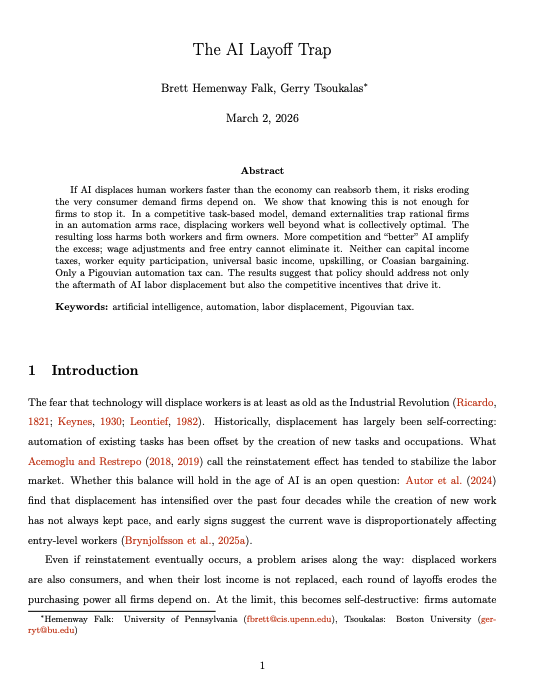
🚨BREAKING: Two researchers from UPenn and Boston University just published a paper that should be uncomfortable reading for every CEO automating their workforce right now.
The argument is straightforward. Every company replacing workers with AI is also eliminating its own future customers. Laid off workers stop spending. Enough of them stop spending and nobody can afford to buy anything. The companies that fired everyone end up selling into an economy with no purchasing power left.
Every executive can see this. The math is not complicated. But here is why nobody stops.
If you do not automate, your competitor does. They cut costs, lower prices, take your market share, and you collapse anyway. So every company automates knowing it is collectively destructive because the alternative is dying alone while everyone else survives. The researchers proved this is a Prisoner's Dilemma playing out in real time.
The numbers are already moving. Block cut nearly half its 10,000 employees this year. Jack Dorsey said AI made those roles unnecessary and that within the next year the majority of companies will reach the same conclusion. Salesforce replaced 4,000 customer support agents with AI. Goldman Sachs deployed a coding tool that lets one engineer do the work of five. Over 100,000 tech workers were laid off in 2025 and AI was cited as the primary driver in more than half those cases. 80% of US workers hold jobs with tasks susceptible to AI automation.
The researchers tested every proposed solution. Universal basic income does not change a single company's incentive to automate. Capital income taxes adjust profit levels but not the per-task decision to replace a human. Collective bargaining cannot hold because automating is always the dominant strategy.
They also identified what they call a Red Queen effect. Better AI does not solve the problem, it accelerates it. Every company chases faster automation to gain market share over rivals but at the end everyone has automated equally, the gains cancel out, and the only thing left is more destroyed demand.
The one thing the math says could work is a Pigouvian automation tax. A per-task charge that forces companies to account for the demand they destroy each time they replace a worker.
The conclusion is that this is not a transfer of wealth from workers to owners. Both sides lose. Workers lose income. Companies lose customers. It is a deadweight loss with no market mechanism to stop it on its own.
(Link in the comment)
The Revolution In Ethiopia’s Sea Acess/Port Policy
Ethiopia’s policy regarding the Red Sea was more focused on having a friendly power overseeing it—preferably a European— than actually owning it. Abiy’s turning of that on its head—no, really, I want it: I don’t want to rent what I can own—is a departure.
A departure going all the way back to Emperor Menelik II, the creator of the modern map of Ethiopia when rulers were more focused on expanding the contiguous space of the country than owning useless seas you can’t tax nor recruit soldiers from.
This is consistent with the behavior of all Inland Empires, some of the greatest in history being Russian, Persian and the champ of them all, by land mass, the Mongol—the standard-bearer.
That’s a tall claim, you say. Well, let’s go on our Time Machine, the history section of the library to the reign of Menelik II, Haile Selassie I, Mengistu, Meles, Hailemariam Desalegn.
1. Menelik II. At the height of his pan African fame, a year after the Battle of Adwa, when he had all the leverage, he negotiated with the French on the Ethiopian-Djibouti Treaty.
He would concurrently negotiate with the Brits and Italians on Somalia, Sudan, and Eritrea. It was all exhausting.
So the newly continentally-revered emperor, the Great Black Hope (“ጥቁር ሰው) told the French: I would like to be left alone as I expand Ethiopia’s territories westward and southward. Also, you are now my gun dealer. Also I would like a strip of land inside sovereign Djibouti that goes all the way to…the salt mines.
https://t.co/KqaNJ7JEuQ
I mean I am not exactly quoting but you find a different conclusion from a 582 page book (free).
That was the economic model: taxation is maximized with conquest of land not sea. The port was only relevant to the extent of knowing who controlled it. Europeans would be the best custodians—in addition to their Christianity, they have the added benefit of knowing how to make cool guns.
The kind of guns that protects you from even them.
And off went the emperor in his conquest, creating the modern political map.
2. Haileselassie I. The Franco-Ethiopian Treaty had a companion treaty more focused on commerce and that one was negotiated with the then Ras Teferi now a crowned emperor Haile Selassie.
There is a legend of the emperor leading a 1,000 year long quest to return Ethiopia her coast. Too bad it’s only a legend. In reality, he took it as a given that the Europeans would continue to run the ports—I mean: look at the neighborhood: it’s Arabs and Arab wannabes wherever you gaze.
We prefer for you the Europeans to run the ports but if you won’t we will be the inheritors.
Ther emperor would meet with France’s General DeGaulle regarding French Somaliland (Djibouti):
His Majesty: so, what are your plans for Djibouti?
DeGaulle: we will run a referendum and abide by the WISH of the people.
It just so happens the 1967 referendum showed the Djiboutians would very much like for the French to stay.
To help bring about this unlikely story, Ethiopia dispatched its ambassador to Mogadishu to its consulate in Djibouti to coordinate the No vote, a feat accomplished with a little help from the French who deported 10,000 Somalis and imported Afar nomads from Ethiopia.
This is chronicled in Seyoum Haregot’s “The Bureaucratic Empire: Serving Emperor Haile Selassie”. Well yeah Seyoum Haregot is Eritrean, and of the wenbede persuasion but his father was Ethiopianist Extraordinaire and his children are half Amhara. So you know put that in your consider-the-sourcing.
Goal: Dont’ let Djibouti fall to a Greater Somalia project or drifted into the Arab orbit
Similarly, regarding Bad el Mendeb, Haile Selassie never called for Ethiopia’s ownership of it. He called for its internationalization. Anything to protect Ethiopia from hostile Arabs.
On to Lt General Mengistu 👇🏾
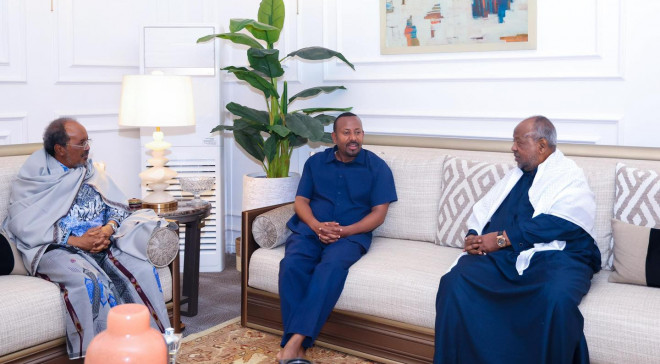
According to claims surrounding the recent meeting in Djibouti attendedby President Ismai Omar of Djibouti, PM Abiy Ahmed of Ethiopia and President Hassan Sheikh Mohamud of Somalia , the proposal centered on a significant withdrawal and reconfiguration of borders across the Horn of Africa involving the three countries.
Under the suggested arrangement, Djibouti would transform into a fully Somali state by incorporating territories from Diridawa, Sitti, Harawo, Djibouti city and Awdal region of Somalia effectively bringing together all Issa and Gadabuursi regions under new Djibouti state.
Ethiopia, in turn would gain control of the Afar regions currently within Djibouti which is 80% of total landmass of Djibouti, thereby securing direct access to the Red Sea and Afar communities in Djibouti will reunite their Afar brothers in Ethiopia.
Additionally, the entire Somali state of Ethiopia would be transferred to Somali republic, potentially reshaping political, ethnic, and economic dynamics across the region in a profound and lasting solution.
Potemkin Party's antics and theatrics seem to increasingly transcend the bounds of rationality.
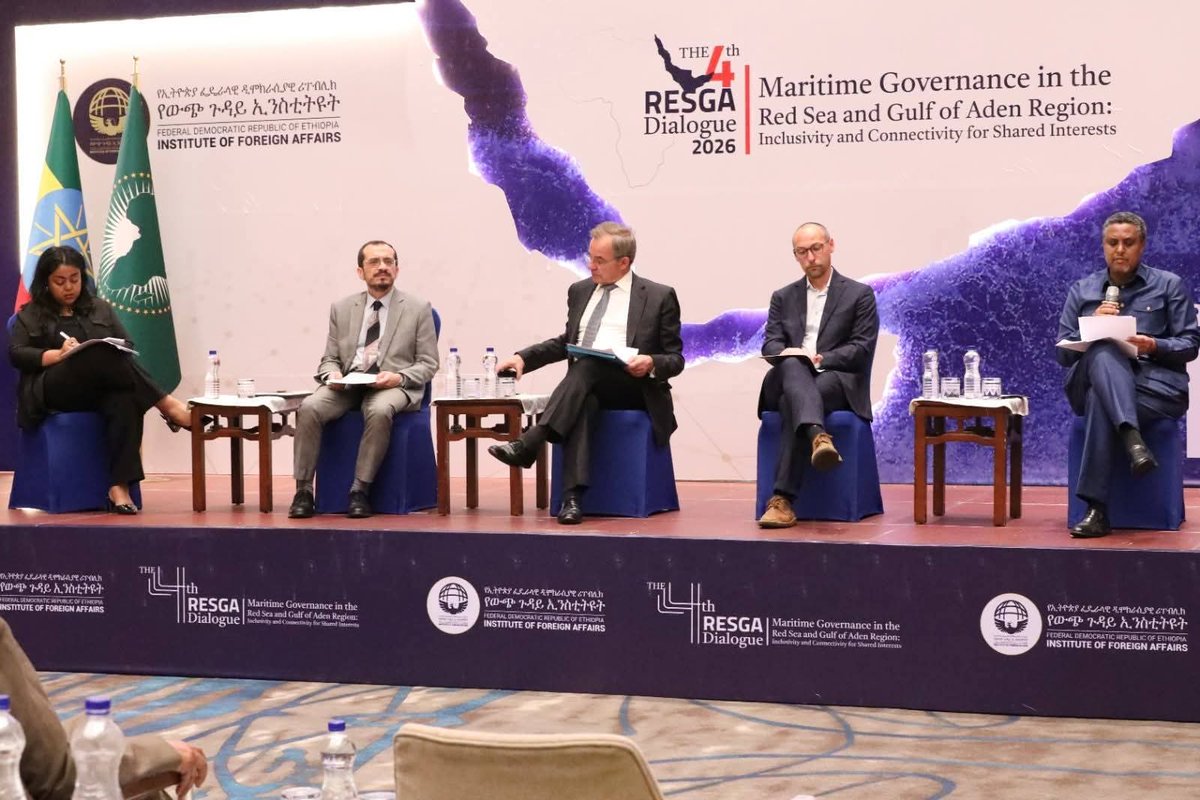
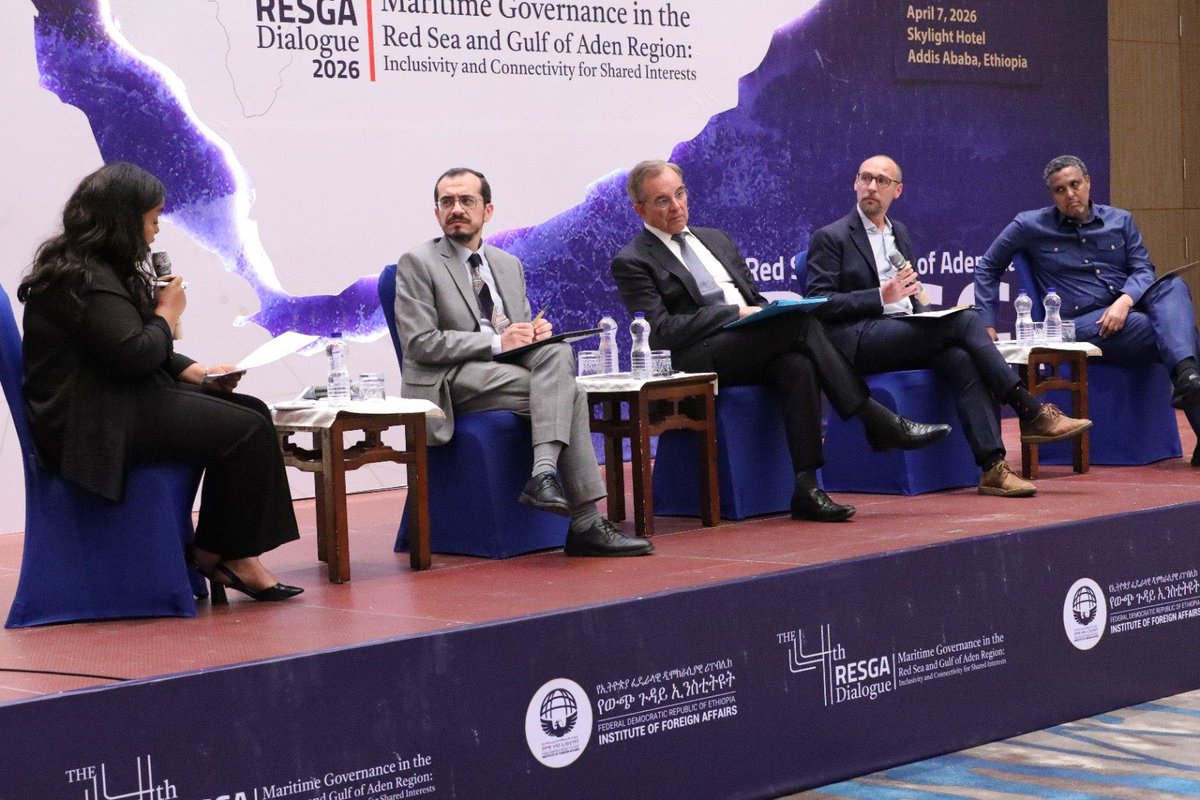
This is the only explanation for the bizarre conference that the Institute of Foreign Affairs convened this week under the theme: "Inclusive Maritime Governance". Speakers included some obscure and hired "pundits" as well as the senior officials of a Ghost Navy.
The Horn of Africa countries have roundly and firmly rejected, without equivocation or ambivalence, the Potemkin Party's quest for "sovereign access to the Sea" as toxic and avoidable threat to regional peace and security.
The response from the international community has, likewise, been the same.
And yet, Potemkin Party officials and minions seem to double down and indulge on this perilous path.
The multi-layered ramifications of this delusional policy are otherwise very evident as the attached link elucidates: "ካብ ጉይይ ምውዓል፥ ክሳድ ምሓዝ"!
===
The “Sovereign Sea Gate” Delusion: Ethiopia’s Expansionist Narrative Disguised as Strategy https://t.co/DG4hJR0kFW
China Did Not Rise Because Engineers Became Leaders. Engineers Became Leaders Because China Decided to Rise.
=======
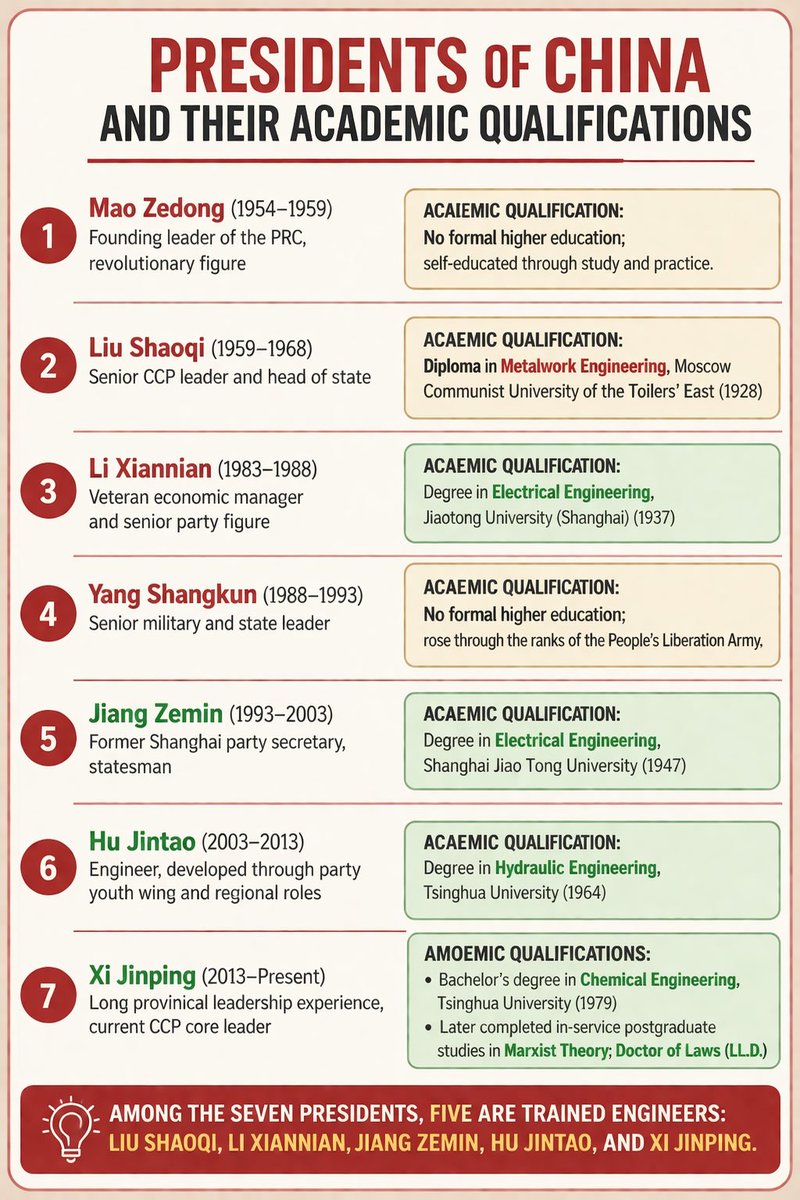
I recently found myself believing, and even sharing, the argument that China transformed because engineers rose to leadership. It sounded convincing. Five of the seven presidents in China’s recent history had engineering backgrounds, and for those of us in technical fields, that idea is naturally appealing. It feels like evidence that once engineers get close to power, national transformation follows. But the more I have reflected on it, the more I see that this gets the order of causation wrong.
China did not become powerful simply because engineers arrived at the top. China first made a political and economic decision to build. It decided that a nation cannot develop on speeches alone. Skills had to be grown at home. Technology and knowledge had to be learned, adapted, and eventually owned. Institutions had to become capable of organizing production, not just managing ceremony. Once a society commits itself to producing, building, and upgrading technologically, engineering thinking stops being a side issue and becomes a political asset.
This is where the lesson becomes very relevant for countries like ours. Real transformation does not come from rented development, where the money is borrowed abroad, the designs are imported, the contractors are foreign, the machinery is foreign, the experts are foreign, and the local population remains mainly spectators, guards, drivers, and casual labourers on projects taking place in their own country. That model can produce impressive photographs, but it does not build deep national capacity. It builds dependence.
A country becomes strong when each project leaves behind more than a structure. It must leave behind trained people, stronger firms, local suppliers, practical know-how, managerial confidence, and domestic technical institutions that can do even more next time. That is how national capacity compounds. Development must not just deliver an asset. It must grow the builders.
China became lucky with Deng Xiaoping. Deng was not the engineer-president figure I had in my thesis, but he was the strategic architect of the era that changed China’s direction. He changed the rules of the game. After that, technically trained leaders became more useful, more visible, and more promotable. Leaders like Jiang Zemin, Hu Jintao, and Xi Jinping reflect the rise of technocratic authority, yes, but they were not the original cause. They were the consequence of a system that had already chosen industrial seriousness.
The deeper lesson is bigger than China. Nations do not rise because they accidentally elect clever people with technical degrees. Nations rise when they build institutions that reward production, learning, discipline, execution, and technological competence. Once that happens, engineers stop looking politically irrelevant. They start looking necessary.
So, China’s transformation did not come because engineers led. Engineers led because transformation had become the national priority.
What this means is that if we want builders to lead, then we must first build societies that respect building, and projects that build local capacity instead of renting development.
No Comment!
Mar 3: "We won the war."
Mar 7: "We defeated Iran."
Mar 9: "We must attack Iran."
Mar 9: "The war is ending almost completely, and very beautifully."
Mar 11: "We must attack Iran."
Mar 12: "We did win, but we haven't won completely yet."
Mar 13: "We won the war."
Mar 14: "Please help us."
Mar 15: "If you don't help us, I will certainly remember it."
Mar 16: "Actually, we don't need any help at all."
Mar 16: "I was just testing to see who's listening to me."
Mar 16: "If NATO doesn't help, they will suffer something very bad."
Mar 17: "We neither need nor want NATO's help."
Mar 17: "I don't need Congressional approval to withdraw from NATO."
Mar 18: "Our allies must cooperate in reopening the Strait of Hormuz."
Mar 19: "US allies need to get a grip - step up and help open the Strait of Hormuz."
Mar 20: "NATO are cowards."
Mar 21: "The Strait of Hormuz must be protected by the countries that use it. We don't use it, we don't need to open it."
Mar 22: "This is the last time. I will give Iran 48 hours. Open the strait"
Mar 22: "Iran is Dead"
Mar 23: "We had very good and productive talks with Iran."
Mar 24: "We’re making progress."
Mar 25: No major quote
Mar 26: "Make a deal, or we’ll just keep blowing them away."
Mar 27: "We don’t have to be there for NATO."
Mar 28: No major quote
Mar 29: Claimed talks were progressing
Mar 30: "Open the Strait of Hormuz immediately, or face devastating consequences."
Mar 31: Claimed a deal was "very close" and that Iran would "do the right thing"
Apr 1: "We’ll see what happens very soon."
Apr 2: Repeated that a deal was likely, while warning of continued strikes if not
Apr 3: "Something big is going to happen."
Apr 4: Said Iran must comply "immediately" or face further consequences
Apr 5: "Open the fuckin' Strait, you crazy bastards, or you'll be living in Hell - JUST WATCH! Praise be to Allah.
The revolution started by Sinwar has culminated in a catastrophic defeat for the US, an end to the US empire, and a derailing of the Greater Israel project.
Ask yourself this:
Over the past two centuries, how many times have Muslims inflicted such a damaging defeat on an enemy of this strength?
How many times have they completely destroyed both the enemy's moral authority and perceived power?
The munafiqs allied with the Zionists said it was impossible - but Sinwar said that with Allah, all things are possible.
I found this article to be very honest and what Abiy and his predecessors have been hiding from addressing, Ethiopia’s real existential threat and fundamental questions of politics. Instead they create distractions like Red-Sea, corridors, ...
---‐-------------------------------
Fractured Foundations: Ethiopia’s struggle with state legitimacy
Structural fragmentation in #Ethiopia is not solely a product of recent political developments. While contemporary arrangements have amplified divisions, the underlying tensions predate the current political order. They are rooted in competing historical narratives about state formation, identity, and political legitimacy, a dynamic explored in Merera Gudina’s analysis of Ethiopia’s nation-state-building process.
These are not merely differences of interpretation; they reflect fundamentally different understandings of how the Ethiopian state was formed, whose authority it embodies, and on what basis it claims legitimacy.
The divergence generally takes shape within two primary historical frameworks. The Continuity Narrative views the Ethiopian state as an ancient, evolving entity with a long history of statehood, providing a natural foundation for national unity. In contrast, the Expansionist Narrative interprets modern Ethiopia as the product of 19th-century imperial expansion, portraying the state as a structure shaped by late-stage colonial dynamics.
Where internal authority remains fragmented, political representation becomes personalized, and negotiation is conducted by individuals rather than institutions.”
These narratives are not merely historical disagreements; they represent competing claims about the legitimacy of the state itself. As long as these foundational questions remain unresolved, political actors operate from incompatible premises.
https://t.co/RwlvaDHOFP
#NEWS — «Landlocked» Ethiopia really hosted a full-on Red Sea conference like it has beachfront property on the Red Sea.
“Inclusive maritime governance,” was the theme … then proceeded to exclude every country that actually has a navy, a port, or, you know, access to a sea. No #Eritrea, no #Djibouti, no Saudi Arabia, no #Egypt, no #Yemen, no #Sudan, no #Somalia. Just a landlocked TED Talk about waves.
At this point it’s like hosting a ski summit in the desert and not inviting a single country with snow. Or running an aviation conference without pilots, planes, or airports, just strong opinions and Google Maps screenshots.
They didn’t just miss the point, they scheduled a whole conference around it. 😆
Ethiopia, country without a coastline, decides to host a high-level discussion on Red Sea affairs. Slogan? “Inclusive maritime governance.” Whats the reality? Most of the actual Red Sea stakeholders didn’t make the guest list. No Eritrea, no Djibouti, no Saudi Arabia, no Egypt, no Yemen, no Sudan, no Somalia.
So what you get isn’t really a maritime forum it’s more like a policy roundtable about the sea, held far from any shore, where the concept matters more than the reality.
Professor Jiang Xueqin on how this war is likely to go and what happens to the world.
(0:00) How Will the Iran War Be Resolved?
(7:33) The 3 Major Trends We Will See Due to This War
(11:28) Will Japan Become a Nuclear-Armed Power?
(16:06) The Future of South Korea
(20:12) The Energy Crisis
(25:23) The Future of the GCC and Iran
(29:57) The Greater Israel Project
(35:11) How US Ground Troops Will Change the War
(36:46) Prof. Xueqin’s Advice to Donald Trump
(38:49) Is It Possible for the US to Get Israel Under Control?
(45:03) What Role Does Trump Play in All This?
(48:21) The Future of North America
(54:59) Are We Seeing the End of Europe?
(1:00:58) How Many Americans Truly Understand What’s Happening in the World?
(1:03:50) The Effort to Destroy Western Civilization
Mustafe Mohamed Omer,, President of the #Somali Region (Ogaden), has reportedly stated: "#Ethiopia will fall apart without Abiy expelling me" and "I do not believe that free and fair elections will be held in Ethiopia."
The conflict and rivalry between Somali Region President Mustafe Mohamed Omer,and Prime Minister Abiy Ahmed has intensified in recent months. Ethio Forum has obtained an audio recording of Mustafe addressing his key cadres, in which he claimed that Abiy Ahmed would resign before attempting to remove him. Mustafe asserted that the Somali people have achieved a century-long goal through peaceful struggle.
He further stated that upcoming elections will not bring meaningful change without violence, as opposition parties would allegedly be barred from participating. Mustafe expressed confidence that, once the Somali Region forms its own government, he will be elected unopposed from Degehabur.
Recently, Abiy Ahmed met with the presidents of Djibouti and Somalia. Reports suggest that he criticized Mustafe, claiming that during his seven-year tenure as Somali Region president, Mustafe accomplished only 2% of his responsibilities.
In the recording, Mustafe also said that although Abiy aimed to remove him, he warned that Ethiopia would collapse in the process. Mustafe stated: "Ethiopia will collapse, and when it does, we will not be trapped; we will establish our own government. Then there will be no such thing as the Prosperity Party." The audio recording is available on Ethio Forum.
Reports indicate that two distinct blocs, supported by various backers, have emerged in the ongoing war in Ethiopia and Sudan, as well as in the anticipated confrontation in Tigray, and between Ethiopia and Eritrea.
The first bloc is said to include Fano, TPLF, OLA, Eritrea, and the al-Burhan government of Sudan, along with external backers such as Saudi Arabia, Turkey, Egypt, the Federal Republic of Somalia, Djibouti, and others.
The second bloc is said to comprise Abiy Ahmed’s regime in Ethiopia, Sudan’s Rapid Support Forces (RSF), external backers such as the United Arab Emirates, Israel, Somaliland and others.