I appreciated the chance to have a real dialogue regarding the topic, and thank you for moderating @RealRogerGros
I’m not sure I would categorize the takeaway the same, however. I think I was able to nip a few important talking points in the bud.
Namely:
1. It was suggested on the panel that CFTC regulated registrants such as FCMs do no KYC or AML. I called out this accusation, at which point those who espoused it claimed they didn’t say it. (The articles author indeed has recorded that it was said).
Let me be clear: To claim that the CFTC nor its registrants employ strict KYC or AML procedures demonstrates an alarming level is misinformation.
2. It was suggested on the panel that CFTC registered DCMs are not “peer to peer”. I proved this to be false by account of my own use of submitting limit orders on venues like @Kalshi or @Polymarket. Peer to peer, or all to all, is a term that’s been used, for decades, to describe any electronic market. The presence of market makers has always been, and will always be, an important facet of electronic markets.
3. It was suggested that “participants aren’t given a fair shake” on DCMs, particularly in relativity to a Sportsbook or casino in Nevada.
I pushed back with facts:
On a federally regulated exchange, all participants can see the order book - what’s available, and at what quantity. Registered exchanges must publish to the public a record of all trades made, and a summary of activity of every listed contract.
Nevada regulated entities are not required to do any of the above. I’m not sure I would categorize those absences “a fair shake”.
Nice recap of our prediction markets panel at @EastCoastGaming. @a_kane47 tried his best to defend PMs, but with Mike Dreitzer, head of @NevadaGCB, he didn't have a chance.
https://t.co/4I5ZqDn8PQ
Good. Hopefully the use of promotions become yet another key point of real differentiation between state-regulated sportsbooks and federally-regulated boards of trade.
SCOOP: The CFTC is conducting a sweep of incentive programs offered by prediction-market platforms over concerns that some are using misleading promotions to attract traders, @FOS has learned.
An “action” of some kind is expected by the end of this week.
https://t.co/vHXzfrbyNO
Nice try boss, but read my tweet again.
I’m saying those that make the laws and regulations could brainstorm with those who operate to come up with ways to create new laws and new regs that allow for prediction market-like features within states.
Nevada would be a great example, since it’s been successful in putting PMs out.
I wonder if there’s a single soul attending G2E thinking:
“Gee, customers seem to really enjoy using prediction markets. What tools are at regulators / legislators’ disposal that can allow operators to offer similar features such that they can compete for those users?”
G2E KICKS OFF WITH PEP RALLY Now at Odds On News, this year's @G2Eshows began Monday and featured tribal and commercial gaming leaders discussing how they will defeat prediction markets that offer contracts on sporting events
https://t.co/2tl7E4OTdS
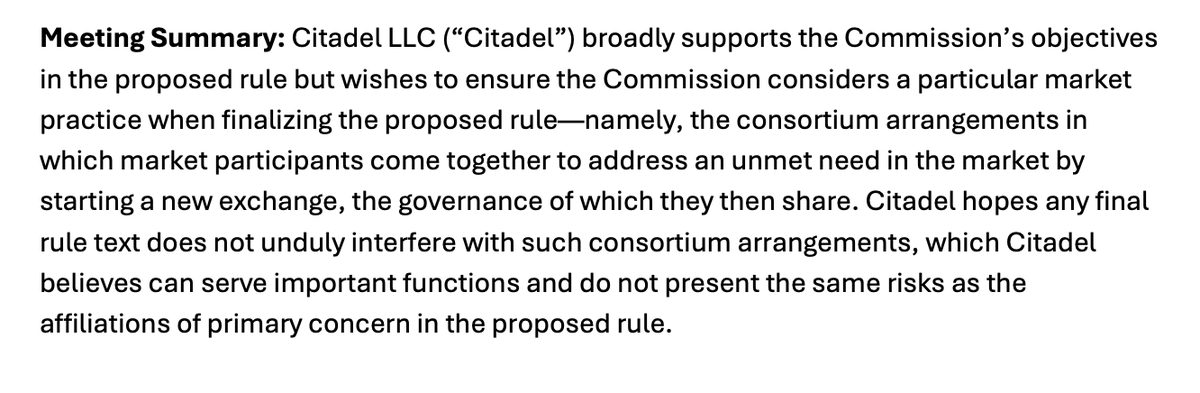
This seems reasonable. Consortium implies shared diversely shared ownership rather than total vertical integration.
Several reg-nms equity venues have minority owners that are market makers.
Citadel sent its Deputy U.S. Head of Government and Regulatory Policy to the CFTC last week to discuss the agency's rulemaking on affiliated market makers.
Unfortunately must OSB laws are made the exact same way. In fact, NC did worse in 2023 with a budget-stuff in September that drastically limited the access dynamics to the benefit of land-based companies there.
Sara, I will try to help out here: The North Carolina prediction markets tax was done not through any kind of serious legislative process and was done through backchannels.
Hope that helps.
The CFTC today issued an advisory that addresses the listing and trading of event contracts for "mentions markets" such as if a specific person will attend an event or mention certain words during an event.
CFTC declares the contracts "present a heightened risk of manipulation."
About a year ago I had a call with a journalist at a major publication, who had obtained a public figure’s betting records. The man had wagered ten times his (publicly available) salary in the past year, and the journalist was planning an expose. They called me to learn about money laundering, how one could use stolen funds to gamble, and what tools gambling companies had to ensure people didn’t lose more than they could afford.
About three minutes in, I asked them how much the man had deposited and lost. The journalist was confused; “I just told you, he’s gambled more than $4 million.” “Yes,” I responded, “but how much did he LOSE? If I bet $100 on red twice and win once, I will have gambled $200 but netted $0. Amount gambled is a worthless statistic on its own.” We went back and forth for a few minutes, and the call was ended after I told them I couldn’t comment until I had more details.
I never heard from the journalist again, and the story never ran. I’m not sure exactly what happened, although after asking around about the guy my best guess is that he was churning through some sort of online promotion, meaning the “$4 million wagered” had almost no correlation to the amount he won or lost gambling.
Of course, the vast majority of people who gamble, in any form, will lose. At roulette and blackjack they’ll probably lose between 2-5% of what they wager, usually the same for sports betting or prediction markets unless they’re betting parlays in which case it’s likely between 10-20%. More people gambling necessarily means more people losing, and gambling losses all too frequently substitute for saving, investment, and other important expenses, meaning the spread of gambling is associated with widespread financial harm.
But please, journalists, if you are going to cover gambling well you need to understand and articulate the difference between gambling LOSSES and gambling HANDLE. The guy in the video below is obviously gambling in a way likely to endanger his finances; one should never put their whole paycheck on the line. But *even if he does* gamble his entire salary in a year, that’s very different than spending his entire salary on drugs or alcohol, because he’s likely to get at least 80-90% back of what he puts in.
Firefighters at the World Trade Center site raise an American flag over the rubble for the first time.
Photographer Thomas E. Franklin captures the dramatic moment.
Twenty five years ago today, a 62 year old man with cancer in his bones walked 2,687 people out of the South Tower, and then he went back inside.
Rick Rescorla was born in Hayle, Cornwall in 1939. British Parachute Regiment in Cyprus at 18. Colonial police in Northern Rhodesia. Then he came to America, enlisted in the US Army in 1963, and in November 1965 he went into the Ia Drang Valley as a platoon leader with the 2nd Battalion, 7th Cavalry.
Hal Moore called him the best platoon leader he ever saw. His men called him Hard Core. He sang to them in the dark, Wild Colonial Boy in an Australian accent, because he had worked out that men who are singing are not men who are panicking. That is Rescorla on the cover of We Were Soldiers Once and Young, bayonet fixed.
Thirty five years later he was head of security for Dean Witter, later Morgan Stanley, in the South Tower of the World Trade Center.
In 1990 he brought in his old friend Dan Hill and the two of them walked the basement. He warned the Port Authority that the parking garage was wide open, that somebody could drive in a truck full of explosives, walk out and light it off. Nothing was done. Three years later the 1993 bomb went off about thirty feet from the spot he had flagged.
After that he told Morgan Stanley the towers were still a target and the next attack would come out of the sky. He wanted the firm to leave Manhattan. The lease ran to 2006, so they stayed. Twenty two floors of the South Tower, roughly 2,700 people.
So he drilled them. Every three months, everyone, no exceptions, down the stairwells two abreast while he stood there with a stopwatch. Traders pulling seven figures resented being marched down concrete stairs by a Cornishman with a clipboard. He kept doing it anyway.
8:46 a.m. The North Tower is hit. Port Authority comes over the South Tower loudspeakers and tells everyone the building is secure and to go back to their desks. Rescorla picks up a bullhorn and tells his people to get out.
He phones Dan Hill. "The dumb sons of bitches told me not to evacuate. They said it's just Building One. I told them I'm getting my people out of here."
9:03 a.m. The second plane hits the South Tower, floors 77 through 85. His people are already in the stairwells, moving exactly the way they had been drilled, and Rescorla is on the bullhorn singing to them. Cornish songs. A version of Men of Harlech he had rewritten for Cornwall. Men of Cornwall stop your dreaming, can't you see their spearpoints gleaming.
He called his wife Susan from the stairs. They had been married two and a half years, met jogging in New Jersey. He told her to stop crying, that he had to get these people out safely, and that if something happened to him he wanted her to know he had never been happier, that she made his life.
Someone told him to get out. He said, as soon as I make sure everyone else is out.
2,687 Morgan Stanley employees went home that day. Thirteen did not, and four of those were Rescorla and the men who stayed in the building with him: Wesley Mercer, Jorge Velazquez, Godwin Forde.
He was last seen on the 10th floor, walking up.
The South Tower fell at 9:59. They never found him.
Idk where to even start…the BBB 90% loss cap, the fact that most handle comes from sharp users who aren’t welcome at sportsbooks, the fact that handle is a poor stat to compare on for that reason…
The @AmericanGaming predicts no increase in regulated sports betting handle for the NFL 2026 season. Every season has seen an increase in handle since the 2018 legalization of sports betting.
AGA believes sports event contracts are to blame for plateau.
https://t.co/PaDAFw1SXV
@ShipTheJustice This analogy is too smart for me haha
Poker is generally a terrible metaphor to prediction markets because in poker, the sharps don’t have to compete away edge that goes directly to their counterparty.
*if Phil Ivey had first bid down his starting chip count in a competitive auction with other professionals in an effort to “win” sitting down at the table with the other guy, to the benefit of the other guy.
They are correct. The state regulatory system makes it impossible to run an exchange.
Fragmented markets, completely different interface, audit, tax, accounting, and reporting rules state by state, and a tax rate/cost dynamics that “assume” you’ll take advantage of the benefits a state license affords an operator- ability to limit players, increase limits on others, offering different prices to different users, etc.
Impossible.