Data Scientist & AI Engineer with a statistics background. Applied GenAI, machine learning, deterministic verification, and production-oriented Python systems
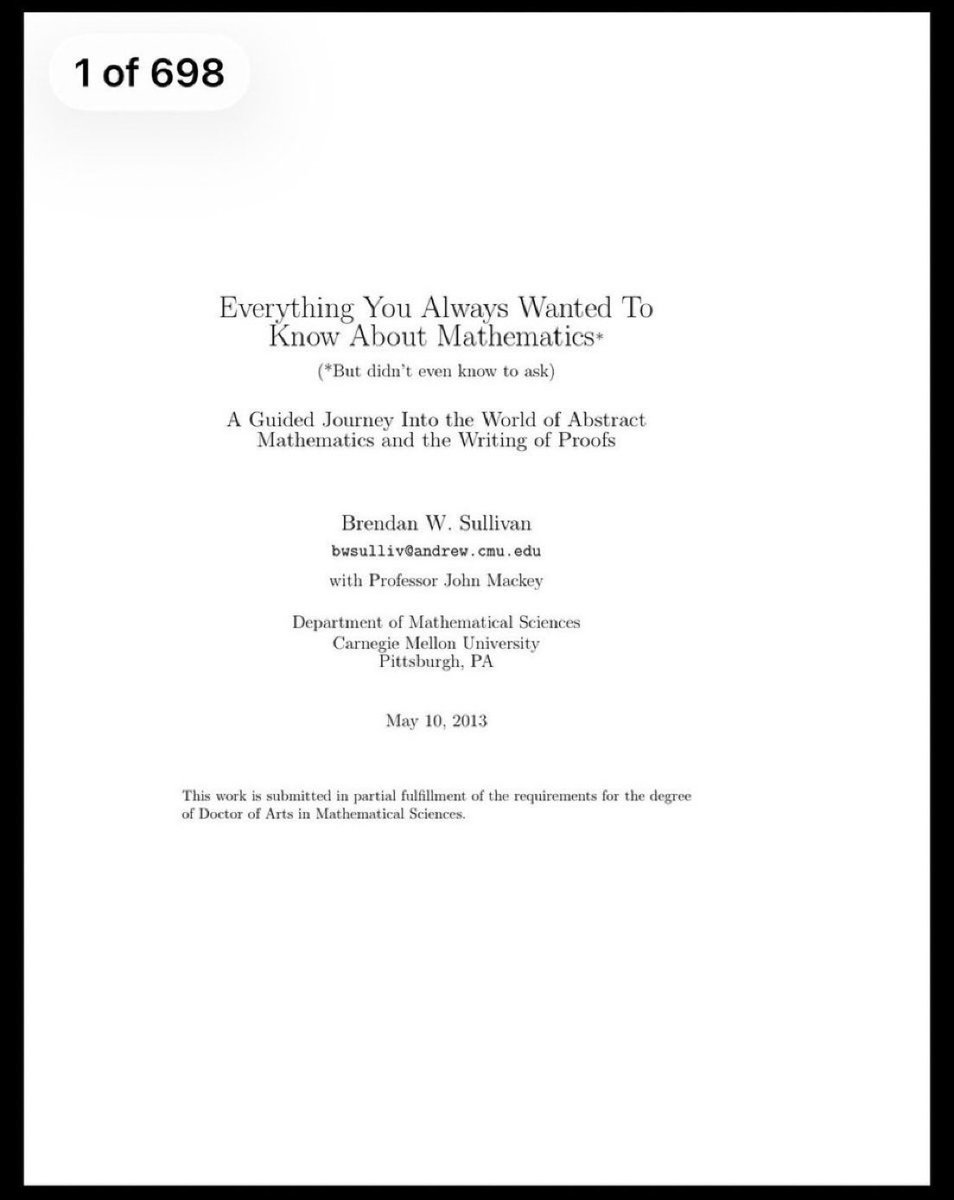
Download 698-page PDF eBook…
Everything You Always Wanted To Know About Mathematics* (*But didn’t even know to ask)
A Guided Journey Into the World of Abstract Mathematics, Theorems, and the Writing of Proofs: https://t.co/JLsDOmpP1q
Connections between individuals scale nonlinearly in fully linked groups.
A sequence of complete graphs starts with 3 people and 3 lines, then 4 people and 6 lines, building up to 14 people and 91 lines.
The line totals follow the formula n(n-1)/2 exactly.
Total handshakes in a room full of people or the connection requirements in a complete social or computer network can be determined by it.
The circular diagram presents the C major scale, its seven diatonic triads (I–vii°), and the corresponding relative modes in a single, integrated view. At its center lies C, from which the primary triads radiate outward:
CM (I), Dm (ii), Em (iii), FM (IV), GM (V), Am (vi), and Bdim (vii°),
each formed by stacking every other note of the C–D–E–F–G–A–B scale. Encircling these are the seven modes:
Ionian, Dorian, Phrygian, Lydian, Mixolydian, Aeolian, and Locrian
aligned with their respective parent roots and annotated with their characteristic scale degrees and interval patterns.
This unified layout enables musicians to quickly visualize harmonic relationships, making it a practical reference for composition, improvisation, modulation, and transposition across keys.
Located in far south of Sardinia 🇮🇹, ancient city of Nora, a veritable open-air museum of priceless wonders. This locality, built in 8th Century BC, was the first Phoenician settlement on the island; used for trade, it soon became an important hub, attracting the attention of other civilisations. It came under Punic rule in 238 BC, and then under Roman rule in 1st Century AD, and reached the peak of its splendour in the following centuries, mainly due to its strategic position from which it was easy to set sail, thanks also to often favourable winds and currents. Through the remains in the archaeological park, visitor is accompanied to discover a millennial history: the temple of the Carthaginian goddess Tanit, the Baths complex and the Forum are the main witnesses.
In his Description of Greece, Pausanias, a Greek-Roman geographer of 2nd Century AD, narrates mythological foundation of city: "After Aristaeus, Iberians crossed to Sardinia, under Norax as leader of expedition, and they founded the city of Nora. Tradition is that this was the first city in the island and they say that Norax was a son of Erytheia, daughter of Geryon with Hermes for his father." Solinus wrote that it was named Nora after Norax.
Early on the area was occupied by a village of indigenous Sardinians, but soon became an emporium and then a Phoenician city. Especially after the conquest by Carthage, Nora flourished, as (along with Bithia near Chia) it was the first stage on the sea route from Carthage to Sardinia and its most important city, Cagliari. Nora Stone, a Phoenician inscription found at Nora in 1773 AD, has been dated by palaeographic methods to between late 9th Century and early 8th Century BC, and has been interpreted as referring to a Phoenician military victory and conquest of the area.
After a period of domination by Carthage, town came under Roman control after conquest of Sardinia in 238 BC. The city is mentioned in the Tabula Peutingeriana, a Roman-period itinerarium. It went into decline from mid-5th Century AD after the Vandal conquest of Sardinia. The island was taken by the Eastern Romans in 535 AD, who ruled it for 300 years. According to Ravenna Cosmography, after Arab conquest of Carthage in 698 AD, the city lost its economic function and became a simple fort (Nora praesidium). Nora appears to have been abandoned during 8th Century AD. Its toponym, however, remained in name of a curadoria (main administrative division) of Judicatus of Caralis at beginning of 2nd Millennium.
Because the southern part of Sardinia is sinking into the Mediterranean Sea, a substantial part of the former town is now under water. A similar fate has befallen nearby Bithia, now completely submerged. Nora was an important trading town in its time, with two protected harbours, one on each side of the peninsula. Several different building styles can be seen in the excavated buildings.
The ancient ruins of Nora include an open-air museum and remains of a theatre, occasionally used for concerts in summer. A significant part of the town situated on land belonging to the Italian Army has not been excavated.
📷 : Roman Mosaic (2nd Century AD) at the House of the Tetrastyle in Pula Archaeological Park in Nora, Sardinia, Italy 🇮🇹
#archaeohistories
Stop wasting hours trying to learn AI. 📘📚
I have already done it for you.
With one list. Zero confusion. And no fluff
📹 Videos:
1. LLM Introduction: https://t.co/OBfDwz8tQm
2. LLMs from Scratch: https://t.co/oeOci6OcH6
3. Agentic AI Overview (Stanford): https://t.co/5POKytuEyb
4. Building and Evaluating Agents: https://t.co/E5FFlGVbq6
5. Building Effective Agents: https://t.co/kusHO3ejnN
6. Building Agents with MCP: https://t.co/cCEsddKJe2
7. Building an Agent from Scratch: https://t.co/8xWp3Cnd1P
8. Philo Agents: https://t.co/D4CENuhsrv
🗂️ Repos
1. GenAI Agents: https://t.co/4KZ9sJnjs0
2. Microsoft's AI Agents for Beginners: https://t.co/vPvgZwjZub
3. Prompt Engineering Guide: https://t.co/ZJPx57o4vn
4. Hands-On Large Language Models: https://t.co/awbIDVAPLM
5. AI Agents for Beginners: https://t.co/vPvgZwjZub
6. GenAI Agentshttps://lnkd.in/dEt72MEy
7. Made with ML: https://t.co/rvYry90bld
8. Hands-On AI Engineering:https://t.co/HjMTW5o3Lz
9. Awesome Generative AI Guide: https://t.co/qGocn6dMRt
10. Designing Machine Learning Systems: https://t.co/zZC31Io7QY
11. Machine Learning for Beginners from Microsoft: https://t.co/SBVf1FQeVN
12. LLM Course: https://t.co/OCAvim3QZP
🗺️ Guides
1. Google's Agent Whitepaper: https://t.co/VYeTNLSntH
2. Google's Agent Companion: https://t.co/4gy8NGQLUB
3. Building Effective Agents by Anthropic: https://t.co/WcMyxPSQCy.
4. Claude Code Best Agentic Coding practices: https://t.co/d01rxIEUhf
5. OpenAI's Practical Guide to Building Agents: https://t.co/fsQrbj2oKo
📚Books:
1. Understanding Deep Learning: https://t.co/zf0RZ1gIDC
2. Building an LLM from Scratch: https://t.co/rCEkYCdF3Q
3. The LLM Engineering Handbook: https://t.co/cHxt9qbNdj
4. AI Agents: The Definitive Guide - Nicole Koenigstein: https://t.co/No7Gopfa7H
5. Building Applications with AI Agents - Michael Albada: https://t.co/KxDWj7pGsU
6. AI Agents with MCP - Kyle Stratis: https://t.co/Pdaw6hnTCP
7. AI Engineering: https://t.co/kqEMbAYttm
📜 Papers
1. ReAct: https://t.co/gU23m8zAy4
2. Generative Agents: https://t.co/5CCFoHVkIB.
3. Toolformer: https://t.co/ux2vgBMozu
4. Chain-of-Thought Prompting: https://t.co/v6iOKX2GGr.
🧑🏫 Courses:
1. HuggingFace's Agent Course: https://t.co/njL6khAaM7
2. MCP with Anthropic: https://t.co/TWp2H7m1i7
3. Building Vector Databases with Pinecone: https://t.co/bPCar17oz2
4. Vector Databases from Embeddings to Apps: https://t.co/6AwTQ3YycN
5. Agent Memory: https://t.co/EZSaCFbftc
Repost for your network ♻️
Grant Sanderson, creator of 3Blue1Brown:
"For a lot of writing I consume, I find it's better to copy-paste it into an LLM and say 'explain this to me.'
The explanation will be better than the thing produced by the human."
93 minutes with Dwarkesh Patel, from the best explainer on the internet, on what AI is doing to every knowledge job.
Watch it, then read the full guide on loops below.
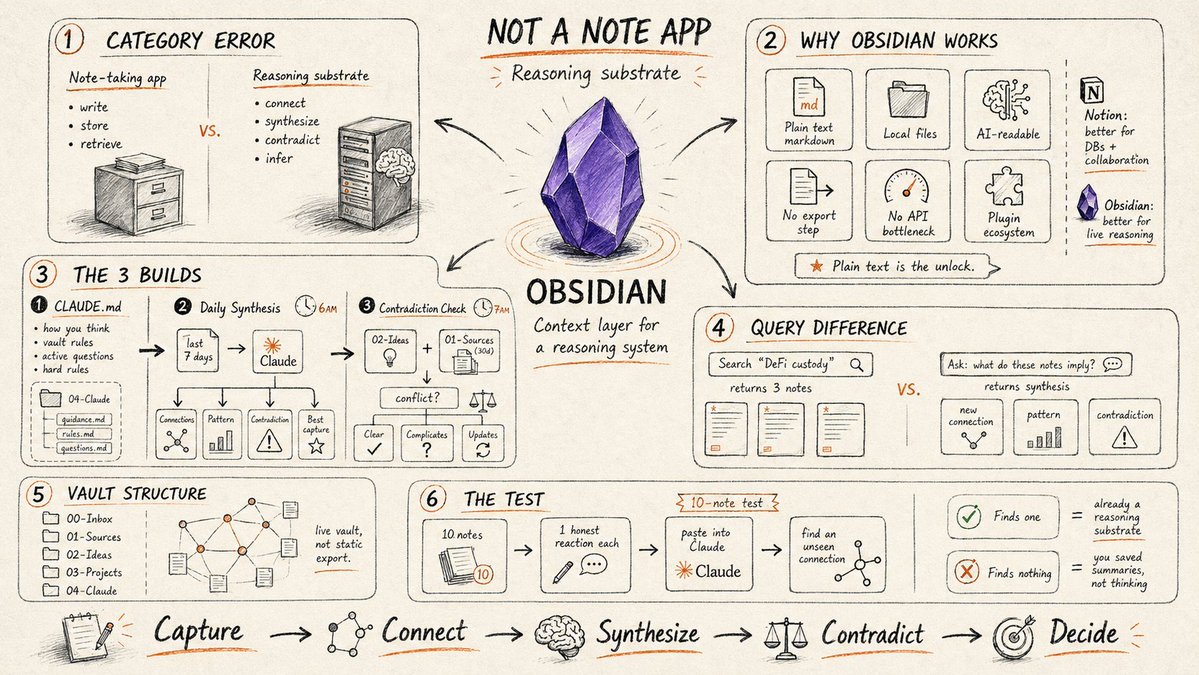
Obsidian is NOT a note-taking app.
That's the biggest misconception in AI productivity right now.
This article explains what it actually is: a reasoning substrate for AI.
Not a place to store information.
A place where AI thinks with your accumulated knowledge.
The best part isn't the theory.
It's the architecture.
Three systems that turn a folder of markdown files into an AI that surfaces connections, challenges your assumptions, and synthesizes ideas while you sleep.
Read it.
Then steal the exact setup for your own AI knowledge system below.
In nearly 5 years of modern generative ai, this is the first book I’m seeing with a super high level of coverage and comprehension.
> language modelling
> inference optimisation
> RL and its methods
> system scaling
> applied concepts like agentic ai, rag, memory
> environments and benchmarking
These fields have a subtle boundary differentiating them, but ultimately overlap in modern applications. Agents require system scaling, memory needs inference optimisation, rl requires understanding of environments and benchmarks.
For the first time in my exp, all in one place. Found this on paperswithcode[.]co
Best YouTube Channels To Learn AI in 2026 (No BS). Save it.
1. Fundamentals – 3Blue1Brown
2. Deep Learning – Andrej Karpathy
3. AI Research – Yannic Kilcher
4. Practical AI – AssemblyAI
5. LLMs – AI Explained
6. ML Theory – StatQuest
7. Papers Simplified – Two Minute Papers
8. GenAI – Matthew Berman
9. AI Agents – Nicholas Renotte
10. Applied ML – Krish Naik
11. PyTorch – Aladdin Persson
12. Math for ML – Serrano Academy
13. Industry Insights – Lex Fridman
14. Real-world AI – DeepLearningAI
IN 1999 MIT FILMED A MATH LECTURE THAT QUIETLY BECAME THE FOUNDATION OF EVERY AI MODEL YOU'VE EVER USED AND ALMOST NO ONE WAS TAUGHT TO SEE IT THAT WAY
39 minutes from Gilbert Strang, who taught this at MIT for over 60 years -- the linear algebra course an entire generation of engineers and data scientists grew up on.
-> The shift it creates: you stop seeing matrices as boring grids of numbers and start seeing them as the language of space, data, and motion itself.
School drilled you to crunch matrices by hand and never told you why. Strang shows you what they actually mean.
Every neural net, every embedding, every model you prompt is linear algebra running underneath. The math you skipped is the engine of the thing you use all day.
Memorizing the steps was never the skill -> seeing what the numbers do is. This is where it finally clicks.
Most people fear linear algebra and move on. The ones who watched this see straight into how AI actually works.
Bookmark & Watch it today, this one's a legend ↓
@RocketOTD You have the absolute worst automated "AI" system on the planet! I needed account payment details (more detail than your automated system discloses) and this was absolutely infuriating.
Jordan Peterson explained how you can become dangerously articulate:
1. Articulate does not just mean well spoken. It means differentiated. A joint that is articulated can move with precision and grace. A person who is articulated can move through the world the same way. Vague people are one solid useless mass. Articulate people have range.
2. Peterson calls articulate people the most dangerous people in the world. Not dangerous in a destructive way. Dangerous in the sense that they cannot be ignored, dismissed, or pushed around. The word is the most powerful tool a human being can carry.
3. It does not matter what you do for a living. A plumber who is articulate can negotiate better contracts, manage employees, advertise services, and think through complex problems. Articulation is not a luxury for intellectuals. It is a practical weapon available to everyone.
4. Jocko Willink is one of the most decorated special operations soldiers alive. Peterson uses him as his primary example of why articulation matters even in the most physically demanding environments. Jocko succeeded not just because he was tough. He succeeded because he could communicate clearly with the men under his command, explain situations to his superiors, and make the case for soldiers who deserved promotion. Toughness without articulation leaves half your power on the table.
5. Becoming articulate starts with paying attention to what you say. Peterson uses the image of crossing a swamp on a hidden stone path. You cannot see the path. You feel for it with each step. You test the ground before you commit your weight. That is exactly what you do with words. You feel whether what you are about to say is solid or whether it will make you dissolve.
6. He noticed 40 years ago that most of what he said made him feel weak. Not all of it. About five percent felt solid. The rest was instrumental language. Words used to win arguments, appear smart, gain small victories. That kind of language is hollow and people can feel it. The goal is to increase the percentage of what you say that actually feels true.
7. Stop filling silence with noise. The ums, the likes, the you knows, the ahs. These are not harmless verbal habits. They are signals that your thinking has not caught up with your speaking. Take the time to craft the word. Silence while thinking is not weakness. It is precision.
8. Peterson calls the pause a prayerful pause. When someone asks you a question, instead of immediately answering with what you think you should say, ask yourself what you actually think. Make it a real question. One you genuinely do not know the answer to yet. Then wait. The answer will come. And when you speak it, people will find you immediately interesting because you are saying something real.
9. Joe Rogan is one of the most successful communicators alive and his entire method is the opposite of instrumental language. He is not trying to appear smart. He is not trying to get something from his guests. He just genuinely wants to know more than he knows. That honesty makes every conversation magnetic. People can feel the difference between someone performing and someone actually thinking.
10. Read great writers. Write about the problems that obsess you. Practice saying only what you believe to be true. These are not quick fixes. They are a lifetime practice. But Peterson's promise is direct. If every word you say reflects what you genuinely believe, the path you walk becomes a golden path. Not because it sounds good. Because it is real. And real is the only thing that actually works.
That's not true. How these models work under the hood absolutely matters, and the numbers don't add up when you should be paying $8000 a month instead of $200 a month to pay for Claude Code. The explosion of business interest is still short run, and most enterprise deployments aren't showing an ROI. That's a serious issue!
@atmoio I lied! The hype abounds! Here is Andrej Karpathy saying you need to put in 10,000 hours to learn Claude. Claude has barely been around for that long. https://t.co/3TE0aggGFf
OpenAI co-founder Andrej Karpathy:
"You literally have to put in 10,000 hours to learn Claude"
11-min workshop from Goat of AI - how he's actually uses it
He reveales all the features that he use in this video
bookmark & watch - the most prodactive way for your evening
@atmoio Love this one! Miss the funnier ones, but to your point. Business leaders are beginning to see how foolish they sound pushing AI hype and histrionics. Thankfully no one of import has spoken about the "singularity" in a long time.
We've officially launched the TPU Developer Hub, your go-to resource for mastering Google Cloud TPUs. Unlock peak performance for your AI models today 🔗: https://t.co/cnGQpyXKNQ




![TheGlobalMinima's tweet photo. In nearly 5 years of modern generative ai, this is the first book I’m seeing with a super high level of coverage and comprehension.
> language modelling
> inference optimisation
> RL and its methods
> system scaling
> applied concepts like agentic ai, rag, memory
> environments and benchmarking
These fields have a subtle boundary differentiating them, but ultimately overlap in modern applications. Agents require system scaling, memory needs inference optimisation, rl requires understanding of environments and benchmarks.
For the first time in my exp, all in one place. Found this on paperswithcode[.]co](https://pbs.twimg.com/media/HLuhEeJbgAA1ukW.jpg)