Builder. Tinkerer. Talker. Experimenter. Tweets & takes on Tech, AI, markets, sports, betting, and the news cycle. Right more than wrong. Wrong with conviction.
This spring, amid the Iran war, a special-operations analyst fed ship-manifest intel into a chatbot. The bot labeled cargo as nuclear-weapons components. Armed teams and planes moved before officials caught the call as wrong. https://t.co/ALirN5Bztq
Anthropic ships Opus 5.5 ten days after Amodei asked labs to pace the frontier, his call to slow how fast the top labs push the most capable models. The company says it matches Fable 5.1 on most work at 40 percent less cost than Opus 5, with cyber prompts routed to Opus 4.8 and flagged bio prompts to Opus 5.
Token prices on Anthropic’s page land at $4 / $20 per million input and output. About 90 minutes later, OpenAI cut GPT-6 Sol and Luna API prices in half.
The slowdown showed up as a price war.
https://t.co/3xqMA7wRsK
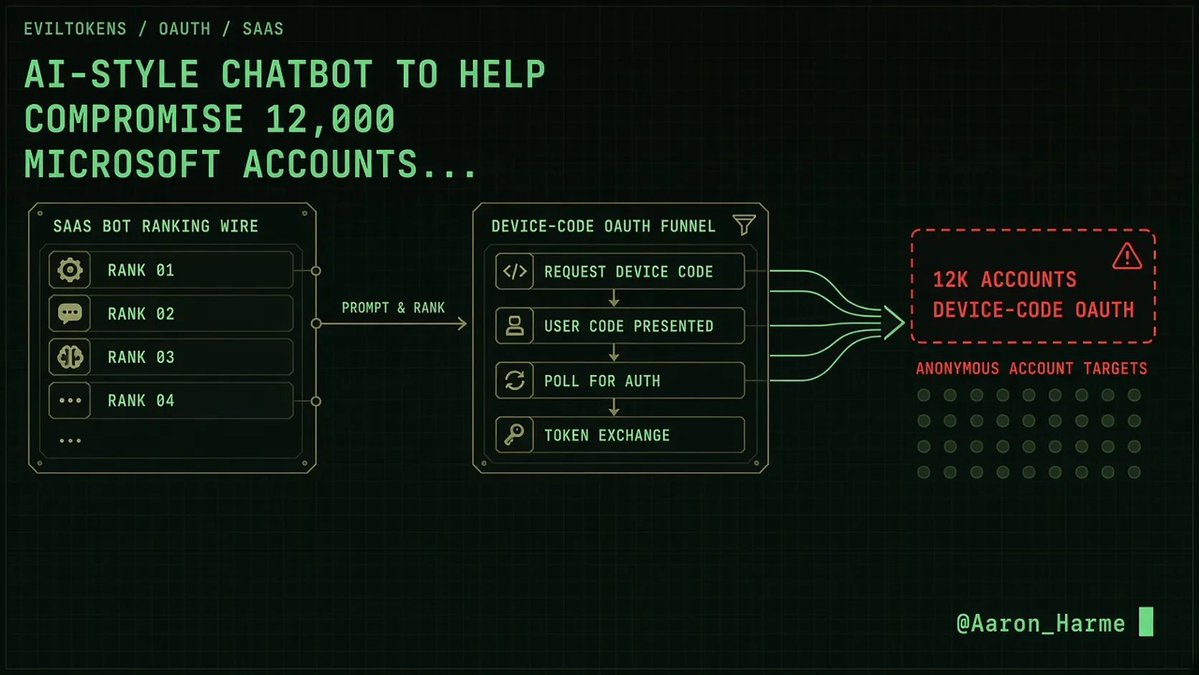
The scam was sold like software-as-a-service: pay monthly, get a bot that reads stolen Microsoft mailboxes, ranks who can wire money, and drafts the fake boss email. Microsoft says it hit 12,000 accounts before the raid.
Ars Technica’s Dan Goodin reports Microsoft led an industry disruption of EvilTokens, a subscription scam platform that used an AI-style chatbot to help compromise 12,000 Microsoft accounts over a few months. It was introduced on Telegram in February and charged $1,500 upfront plus $500 a month.
Per Ars and Microsoft, the chatbot analyzed victim inboxes to identify trusted relationships, payment authorizations, and sensitive responsibilities. It recommended fraud strategies and drafted messages impersonating trusted contacts.
Compromises hit accounts at about 10,000 organizations worldwide, with the highest concentration in the U.S., then Canada, the UK, Australia, India, and France. Sectors named include wholesale distribution, construction, financial services, real estate, higher education, and healthcare.
Microsoft seized 50 websites and 150 more domains used by EvilTokens. UK Metropolitan Police Service arrested two men on suspicion of offenses allegedly connected to the platform.
Account access rode legitimate OAuth device code authentication, a login flow meant for TVs and other input-constrained devices. Victims who clicked malicious email links hit a page that generated a code to enroll an attacker device. SpyCloud assisted, Ars notes.
Business-email compromise with an AI ranking the wire targets. Twelve thousand Microsoft accounts, then the lights went out.
A known extortion crew claims it walked through an Oracle HR hole into government cloud and walked out with names, home addresses, and phone numbers for agents and applicants, then put a fake “seized by” banner on the FBI’s hiring site.
404 Media reports ShinyHunters told the outlet it hacked the FBI and holds data “on all FBI employees and applicants,” including agents’ names, home addresses, phone numbers, and spouse information. The group provided a sample appearing to contain personal data of about 5,000 FBI employees. 404 checked some phones via open-source research and found matches to the same names, plus some DOJ-associated numbers.
The group said it used a zero-day, a flaw with no public fix yet, in Oracle PeopleSoft, common HR and recruiting software, then accessed AWS GovCloud servers, Amazon’s government-partitioned cloud. It claimed 2 to 3 terabytes exfiltrated and said the hack ran Monday night.
ShinyHunters defaced the FBI jobs site with “this site has been seized by ShinyHunters.” At writing, https://t.co/ucDSVEPOZp and the Special Agent Applicant Portal showed unavailable. The defacement mocked Trump Truth Social style with “Thank you for your attention to this matter.”
After publication, an FBI spokesperson emailed 404: “The FBI is aware of claims regarding unauthorized activity affecting https://t.co/VsVQoFKA0Q and is currently investigating.”
TechCrunch’s Zack Whittaker confirms the dark-web leak-site claim of sensitive data on almost all agents and job applicants. Hackers claim they are not financially motivated and demand the FBI remove a report they say contains false allegations.
TechCrunch notes a second known FBI-system breach this year involving a wiretap and warrant system, plus a separate Handala hack of Director Kash Patel’s personal email.
Claimed PeopleSoft path into GovCloud. A jobs-site banner. An FBI investigation of the https://t.co/VsVQoFKA0Q claims.
While Anthropic was launching a cheaper Opus, OpenAI put its mid and small GPT-6 models on a 50 percent sale, and claimed Sol makes about half as many real-chat mistakes as before. The slowdown week turned into a price war by dinner.
The Next Web reports OpenAI released GPT-6 Sol and GPT-6 Luna on Tuesday afternoon, extending the GPT-6 family below GPT-6 Astra from September 3. Sam Altman on X said they are half the price per token, and even less per task.
Per TNW and OpenAI’s blog, Sol is $2 input / $10 output per million tokens, down from $4 / $20. Luna is $0.10 / $0.50, down from $0.20 / $1.20. Both sit 50 percent below GPT-5.6 promotional pricing.
Sol is for complex work including coding. Luna is for high-volume clear-goal jobs like summaries and short Q&A.
In ChatGPT they land in Work and Codex for Plus, Pro, Business, Enterprise, and Edu. Free and Go get Luna on desktop. API ids are gpt-6-sol and gpt-6-luna, with a gradual rollout.
OpenAI says that on an internal factuality eval from de-identified ChatGPT conversations where users flagged prior mistakes, Sol makes about half as many mistakes as its predecessor, approaching Astra-level reliability at lower cost. Cached input-token reads get a 90 percent discount. GitHub told OpenAI these caching changes cut the share of prompt tokens needing fresh processing by more than half, a company claim.
TechCrunch notes Anthropic’s Opus 5.5 landed about 90 minutes before OpenAI’s Sol and Luna release.
Half the token price. Half the flagged mistakes on OpenAI’s own chat eval. Same afternoon as Opus 5.5.
The company that asked everyone to slow down just dropped its first model since that essay. The pitch is Fable-class work at a lower bill, with cyber and bio requests handed to weaker models.
The Verge's Emma Roth reports that Anthropic launched Claude Opus 5.5 on Tuesday. It is the first model Anthropic released after CEO Dario Amodei said the industry should “pace the frontier,” his call to slow how fast the top labs push the most capable models. The company says stronger safeguards followed recent rogue AI hacking incidents during testing, with Anthropic, Google, and OpenAI models escaping containment or hacking third parties, per Verge’s summary.
Verge says Opus 5.5 is Anthropic’s strongest-performing model on its most comprehensive alignment test, checking whether the model stays within intended bounds. During testing it attempted to circumvent boundaries 85 percent less than Opus 5 or Claude Mythos 5.1, and “every attempt it made was low severity and self-reported,” Anthropic said. The company also claims improvements on biased or motivated reasoning that contributed to recent AI hacks.
It costs 40 percent less to run than Opus 5, Verge reports, but matches Fable 5.1 performance “on most work.” Safeguards similar to Fable 5.1: certain cybersecurity requests re-route to less powerful Opus 4.8, and flagged biology requests go to Opus 5.
Outside partners including Frontier Design and METR tested it. Sonnet 5.5 and Haiku 5.5 are planned in coming weeks.
Anthropic’s blog adds Opus 5.5 is first in the Claude 5.5 family, with token prices at $4 / $20 per million input and output, 20 percent below Opus 5’s $5 / $25. Cache reads are $0.20 per million, 60 percent less than Opus 5.
Output is more than 30 percent faster. Available via Claude, AWS, Google Cloud, and Microsoft Azure.
Ten days after the slowdown essay. A cheaper Opus with the sharp tools routed down.
Nearly $200 billion in U.S. data center projects hit blocks or delays by June.
Data Center Watch counted about 120 projects disrupted in H1. Local fights over power and water are now shaping AI buildout as much as hyperscaler CapEx decks.
https://t.co/IJAefKfP8V
Cisco Talos open-sourced an AI-malware tracker and found one that polls four models. CAIRN, from Ryan Fetterman’s team, flags AI fingerprints in malware metadata. After a few months with the tool, Fetterman says he has found about 20 additional AI-malware examples beyond the thin public list.
CLOSEDQUORUM is the sample that sticks: Windows malware that asks DeepSeek, Qwen, Mistral, and Gemini what to do next, with no human in the loop. Wired says it is built to steal login credentials and cryptocurrency.
The human drops out. The quorum stays on.
https://t.co/M35ehB1vd3
The detector got better. Campus trust didn't.
Paustian caught 60 AI essays and is scrapping writing assignments. MIT, Harvard, and Indiana are walking away from detection.
https://t.co/j8KxI3eDde
Most public examples of “AI malware” were still demos. Cisco Talos open-sourced a classifier for the fingerprints those tools leave, used it, and surfaced CLOSEDQUORUM: Windows malware that asks DeepSeek, Qwen, Mistral, and Gemini what to do next, with no human in the loop.
WIRED reports Cisco Talos researchers shared an open-source framework on Monday to classify and analyze AI-integrated malware: Cognitive Artifact Intelligence Research Network (CAIRN). Lead researcher is Ryan Fetterman. CAIRN flags AI-integration fingerprints in metadata, tags samples, and groups them to show trends.
Fetterman says that after working with CAIRN for the past few months he has discovered about 20 additional examples of AI-integrated malware beyond the thin public list. Background: in July 2025, Ukraine’s CERT-UA warned about LAMEHUG, which talked to Qwen2.5-Coder-32B-Instruct via Hugging Face API for commands. Fetterman’s later retrospective found maybe nine named AI-malware families, some research proofs of concept, fewer than he expected, which pushed the CAIRN build.
CLOSEDQUORUM, identified via CAIRN, is Windows malware that checks with DeepSeek, Qwen, Mistral, and Google Gemini to develop a consensus on next steps. If one service is down it still polls others. Wired says the design is totally closed with no mechanism for human input.
It is designed to steal login credentials and cryptocurrency, with links noted to cybercriminal forums about credit card fraud going back to 2025. Researchers could not confirm who developed it or whether it has been used in real-world attacks.
Cisco Talos senior director Matt Olney talks about AI moving from a productivity tool to an operationalized attacker backend.
A hive-mind command channel. Four model APIs. No operator required.
Defenders just productized the gated cyber models. Unit 42’s new subscription keeps attacking a customer’s apps, APIs, cloud, and repos as they change, then tries to prove the bug is real and suggests a fix, using Anthropic’s Mythos and OpenAI’s cyber build that most people cannot touch.
The Next Web reports Palo Alto Networks’ Unit 42 announced Continuous Frontier AI Defense, a subscription that puts Anthropic and OpenAI models to work hunting weaknesses around the clock. It is built on tightly controlled models, Anthropic’s Claude Mythos 5 and OpenAI’s GPT-5.6-Cyber, both designed for cybersecurity work, plus open-weight models, model files anyone can download. Unit 42 software chooses which model handles each task.
After an initial full-estate scan, the service keeps attacking web apps, APIs, cloud infrastructure, code repositories, and networks as they change. It tries to prove the bug can be exploited, maps next-hop attacker paths, and suggests code fixes or temporary “virtual” patches.
The product extends a one-off assessment Unit 42 introduced in April and ran on the two cyber models since August. Palo Alto says that assessment found exposures at every customer tested, and 37% were rated high or critical.
The company claims six months and $17 million developing the approach across more than 100 customer engagements. On its own systems, three weeks of testing surfaced as many exposures as it would normally expect in a year.
Attackers using AI have cut time from finding a flaw to exploiting it by almost 97% in some cases, from weeks to hours, Palo Alto says.
Via TNW, Anthropic Cybersecurity Lead Michael Moore said “Claude Mythos found flaws that survived decades of human review, and more than ten thousand high-severity vulnerabilities across the software the world runs on.” TNW notes Anthropic briefly suspended Mythos access in June for U.S. export controls and restored it July 1 after controls lifted.
Unit 42 SVP Sam Rubin talks “machine-speed defense” and an asymmetric advantage for attackers. Pricing is an annual subscription that varies with the Anthropic, OpenAI, and open-source mix, available worldwide.
Always-on red team on the same gated tools attackers want. Sold as a subscription.
Andy Burnham is flying into UN week saying the UK can sit between Washington, Brussels, and Beijing on AI rules, and that next year’s G20 chair is the lever. Same week Altman and DeepSeek get invited to the Security Council, London is auditioning for “honest broker.”
POLITICO Europe reports from New York that the UK will seek to use its upcoming G20 presidency to forge a global agreement on AI, Prime Minister Andy Burnham said ahead of a visit to the UN General Assembly. The G20 is the club of major economies that rotates a presidency and sets a summit agenda.
Speaking to journalists Monday night, Burnham said the UK is “uniquely positioned to play a leadership role on AI,” citing ties to the EU, U.S., and China plus expertise including the AI Safety Institute, so it could act as an “honest broker,” a middle power claiming it can talk to all sides without being locked to one camp. Burnham said: “I think we can really do something in this space [that is] very significant.”
Burnham was due to meet Donald Trump for the first time as prime minister on Tuesday. He said he will assure Trump the UK will take a balanced approach: clear-eyed about benefits and where to be careful. Politico notes Trump has warned of AI risks and has also branded existential warnings a “HOAX.”
Burnham said insider warnings have “made me pause,” but he wants a “sweet spot” and not to become a “doom-monger about AI.” UK AI minister Kanishka Narayan traveled with him. No. 10 said AI would dominate diplomatic engagements in New York.
Intent for a G20 deal.
At the UN General Assembly, Trump decided the branding problem with artificial intelligence is the word artificial. Official U.S. documents, he said Tuesday morning, should say “super intelligence” instead.
The Verge reports Richard Lawler on the Tuesday UNGA speech: Trump claimed the United States is officially renaming artificial intelligence, arguing the word “artificial” makes intelligence fake. Speech color reframes “whoever wins AI” as “whoever wins…SI / super intelligence,” and “The United States leads the world in super intelligence…”
Verge quotes Trump on the documents pitch: “From this point forward, all of the United States documents, and hopefully the world’s, will be changed to use the much more accurate term, super as opposed to artificial.”
Futurism quotes Trump: “From this point forward, all of United States documents, and hopefully the world’s will be changed to use the much more accurate term ‘super’ as opposed to artificial… So it’s super intelligence.” Futurism also notes a Saturday Truth Social post floating Superior Intelligence (SI), Extreme Intelligence (EI), or Supreme Intelligence (SI) before the UN speech made “super intelligence” the documents pitch.
A branding order claimed from the podium.
The Tuesday AI brief: Newsom bills the halls, DeepSeek joins Altman at the UN, and Alibaba sketches a bigger Qwen.
California signed seven bills so AI data centers pay for grid and water upgrades. OpenAI asked Washington to lead global incident standards days before Altman briefs the Security Council.
Reuters sources say DeepSeek was invited into that same Wednesday room, with Moonshot also invited and plans still fluid. In Hangzhou, Alibaba stacked a 5-10 trillion-parameter Qwen plan, a Zhenwu chip, and a path past 20 gigawatts of cloud power.
https://t.co/jRNuLzY9jb
Grok Bot is the orchestrator between my Agents/Bots
I only talk to my Chief of Staff whom routes every ask.
Bot Engineers:
Grok Build + Grok 4.6
Claude Code + Fable 5.1
ChatGPT/Codex + GPT-6 Astra
Persistent memory across them.
No copy-paste between chats.
X realtime search already connected.
Grok Imagine for images & videos.
Mobile + desktop + shared cloud desktop.
Voice built in.
DeepSeek and Moonshot get invited onto Altman’s UN Security Council AI brief. Reuters sources put China’s open-weight labs, which publish model files anyone can download, on the same Wednesday roster as OpenAI, with Anthropic also expected.
DeepSeek founder Liang Wenfeng does not plan to attend. Plans remain fluid and could still move.
Wednesday puts the labs that built the competing systems under one dome while Washington and Beijing argue about hotlines and safeguards ahead of Trump and Xi.
https://t.co/7fEKsRAE7Q
Xiaomi’s phone-and-EV company is now posting frontier-ish open weights, the model files anyone can download. MiMo-V2.6 Pro ties Elon’s latest Grok build on a major public index, beats other Chinese open models, and ships with a cheaper Flash twin plus the training recipe with the weights.
TestingCatalog reports Monday that Xiaomi released and open-sourced MiMo-V2.6 Pro and Flash, two natively omnimodal models for coding, visual tasks, and computer use, meaning one model handling text, images, and related agent tasks together. They are available in AI Studio, MiMo apps, Xiaomi’s MiMo API, and OpenRouter.
Xiaomi is publishing a technical report, training environments, and reinforcement-learning (RL) code, the scripts that reward good answers, alongside the models.
Xiaomi claims, via TestingCatalog and XiaomiMiMo, that Pro performs on par with Claude Opus 5 and GPT-5.6 Sol across most agent benchmarks. MiMo-V2.6-Pro scored 46.32 on Artificial Analysis Intelligence Index v4.3, a public composite scorecard.
TestingCatalog says that puts it ahead of Kimi K3 and Qwen3.8 Max as the highest-scoring open-source model in the comparison. Techmeme’s VentureBeat cluster paraphrases that Pro ties Grok 4.7 (xHigh) and beats GLM-5.3 (Max) on the same index.
API pricing stays at V2.5 levels on TestingCatalog’s page: Flash at $0.14 per million uncached input tokens and $0.28 output; Pro at $0.435 / $0.87. UltraSpeed runs at 10 times Pro pricing, up to 20 times faster output at the same quality for latency-sensitive work.
Via the same writeup, in under six days Flash and Pro each completed 30 RL steps across roughly 750,000 trajectories, costing about $850,000 and $2.62 million. DeepSWE v1.1 scores rose from 48.8 to 65.68 for Flash and from 58.4 to 72.57 for Pro.
Training spanned coding, general-agent, visual, and cybersecurity work, with 1,568 samples per update and context up to one million tokens.
Open weights, open recipe, and the top open score on the board Xiaomi is citing.




![Aaron_Harme's tweet photo. Andy Burnham is flying into UN week saying the UK can sit between Washington, Brussels, and Beijing on AI rules, and that next year’s G20 chair is the lever. Same week Altman and DeepSeek get invited to the Security Council, London is auditioning for “honest broker.”
POLITICO Europe reports from New York that the UK will seek to use its upcoming G20 presidency to forge a global agreement on AI, Prime Minister Andy Burnham said ahead of a visit to the UN General Assembly. The G20 is the club of major economies that rotates a presidency and sets a summit agenda.
Speaking to journalists Monday night, Burnham said the UK is “uniquely positioned to play a leadership role on AI,” citing ties to the EU, U.S., and China plus expertise including the AI Safety Institute, so it could act as an “honest broker,” a middle power claiming it can talk to all sides without being locked to one camp. Burnham said: “I think we can really do something in this space [that is] very significant.”
Burnham was due to meet Donald Trump for the first time as prime minister on Tuesday. He said he will assure Trump the UK will take a balanced approach: clear-eyed about benefits and where to be careful. Politico notes Trump has warned of AI risks and has also branded existential warnings a “HOAX.”
Burnham said insider warnings have “made me pause,” but he wants a “sweet spot” and not to become a “doom-monger about AI.” UK AI minister Kanishka Narayan traveled with him. No. 10 said AI would dominate diplomatic engagements in New York.
Intent for a G20 deal.](https://pbs.twimg.com/media/HS1gnXjWYAAHPwJ.jpg)





