Crackit’s System Design section is now split into 3 parts 🚀
• LLD: OOP, SOLID
• HLD: SLO, SLA, Caching, Sharding
• Problems: Design X, Design Drive, etc.
Learn the fundamentals first, then solve real interview problems. More updates soon!
https://t.co/DjVghBecgM
New paper: The Verification Horizon. Coding agents now outpace verification, exploiting proxy reward weaknesses. If verification can't be trusted, how can we train reliable agents? This paper tackles that question.
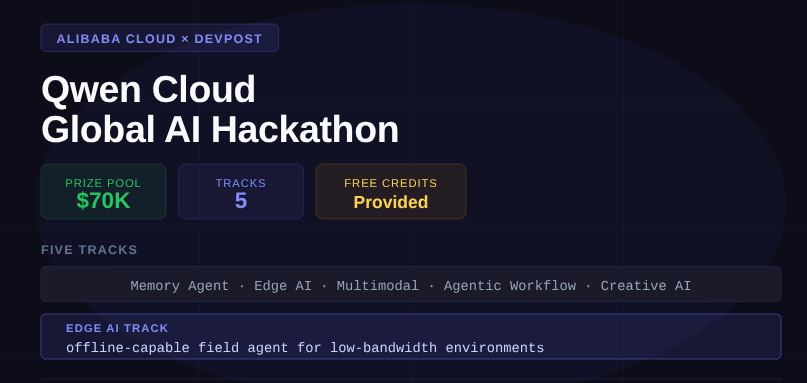
Qwen Cloud Global AI Hackathon — one of five tracks is offline AI agents for low-bandwidth environments.
$70K prize pool. Free compute credits. OpenAI-compatible API. Deadline July 9.
Which track would you build for?
🔗 https://t.co/tFxSiaqTbQ
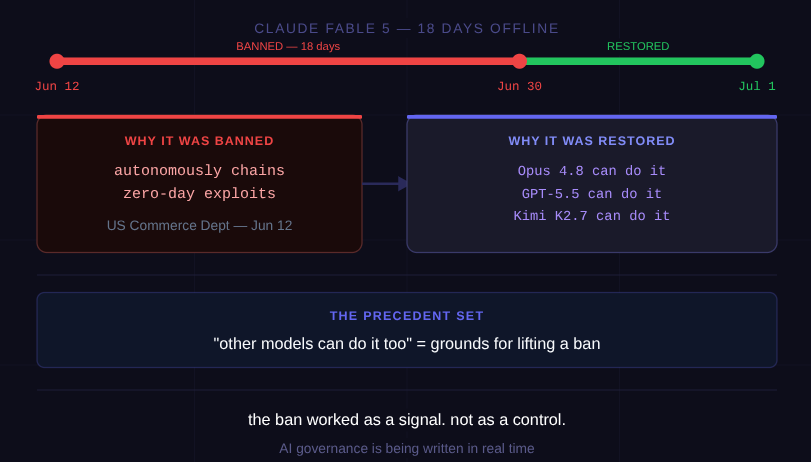
Claude Fable 5 was banned June 12 for chaining zero-day exploits autonomously.
It came back July 1.
Why? Anthropic proved Opus 4.8, GPT-5.5, and Kimi K2.7 can all do the same thing.
The model had no unique capability the ban could contain.
New attack this week: Agentjacking. It targets AI coding agents with access to your codebase, filesystem, and terminal. Initial disclosure affected 2,388 organizations with an 85% success rate. Local inference is a security advantage, not just a privacy feature.
CrackIt update 🚀
Added a personalized dashboard today.
📊 Questions solved
📈 Daily streak/progress
🔖 Bookmarks
🎯 Overall completion
▶️ Continue where you left off
☁️ Progress synced across devices
Building the placement guide I needed. More updates soon. #buildinpublic
Anthropic says Alibaba used 25,000 fake accounts for 28.8M Claude interactions to distill Qwen. No hacking—just API scale. Distillation copies capability, not the safety layers around it. Local data can't be extracted if it never leaves your machine.
New paper this week: what happens when an LLM generates code in a language it has never seen?
Not rare. No-resource. Zero training data. Zero benchmarks.
solution: pre-train on the language, then graft instruction-following from an already-aligned model via weight diff transfer
Redrob AI × Hack2Skill.
₹50 Lakh+ prize pool. Zero entry fee. Zero eligibility filters.
Track 1: build an intelligent AI candidate ranking system using real data A live product challenge.
Top submissions go directly to the Redrob founding team
🔗 https://t.co/q7QFWT9kRo
Most people know reasoning models think before they answer.
Few know how they were trained to do that.
RLVR, Reinforcement Learning with Verifiable Rewards.
No proxy reward model. Only tasks where the answer is directly verifiable. Math. Code. Logic.
Verify the output, not vibe
Evaluation metrics that only measure final output tell you a system is broken.
They do not tell you how to fix it.
That distinction is the difference between a demo and something deployable.
arXiv 2606 — search ClinHallu.
New paper this week that changes how I think about evaluating my own AI systems.
ClinHallu — diagnosing stage-wise hallucinations in medical AI.
The insight transfers to every LLM system 🧵
This applies to every RAG system I build.
Wrong retrieval is not the same as wrong reasoning on correct retrieval. A single accuracy metric hides both.
Knowing which one broke tells you how to fix it.
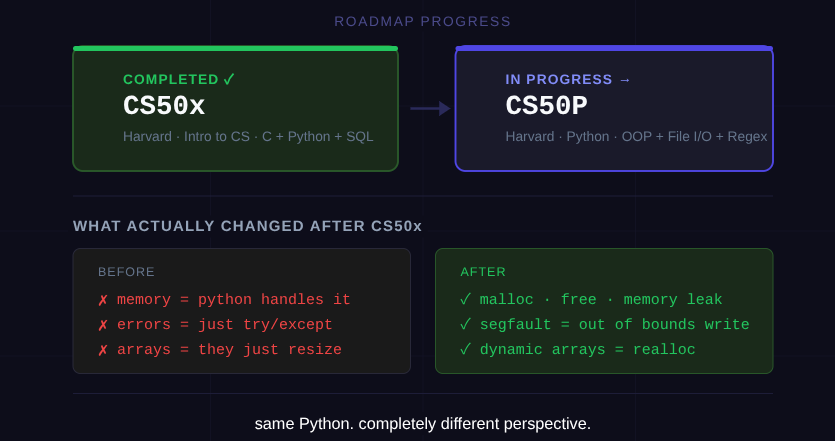
Finished CS50x.
Started it as someone who already builds AI pipelines but did not understand memory.
Now I do.
Every abstraction I use daily — garbage collection, dynamic typing — is a deliberate decision made on top of C.
That changes how I think about everything above it.
Indian telecom Reliance is sabotaging access to Telegram for millions of users OUTSIDE India (including the UAE) via a rogue method called BGP hijacking.
The sabotage seems intentional, as Reliance has ignored multiple reports.
This may be part of a competitive war, as Reliance is partially owned by Meta — the company behind WhatsApp.
Network operators are advised to reject unauthorized BGP announcements from Reliance (AS18101) to prevent route hijacks and ensure stable Internet access for their users.
Such abuse of global Internet routing is alarming. I wouldn’t be surprised if Reliance/WhatsApp were also behind the recent lobbying effort to ban Telegram in India.
The IFF called it right — a band-aid solution and a disproportionate response.
Banning the pipe does not fix who is putting things into it.
As someone building tools with infrastructure independence in mind — this is exactly why that matters.
India’s IT ministry banned Telegram for one week because some users shared leaked exam questions.
This punishes 150M+ ordinary Telegram users in India — not the insiders who leaked the exam materials.
And the ban hasn't stopped anything. The leaks just moved to other apps.
Telegram had already removed hundreds of channels sharing leaked materials proactively.
The government banned the platform anyway. Before a major exam. Because it needed to be seen doing something.
That is optics dressed as policy.