CHINA’S 🇨🇳 CXMT BEGINS MASS PRODUCTION OF FIFTH-GEN DRAM PLATFORM
CXMT says the platform reduces key memory-cell spacing to 11.95nm using quadruple patterning, allowing more memory to be packed onto each chip.
It also unveiled two new 24-gigabit LPDDR5X chips for smartphones and portable devices, each offering 50% more capacity than its previous comparable products.
The manufacturing improvement is also significant: CXMT says the new platform can produce at least 50% more gross chip dies per wafer than its fourth-generation process, based on an 8-gigabit chip.
That figure refers to the number of potential dies produced before defective chips are removed, not a 50% improvement in final manufacturing yield.
CXMT says critical parts of the process were developed through computer simulations and joint R&D with Chinese semiconductor-equipment makers, as China continues reducing its dependence on foreign chipmaking technology.
Source: Reuters
Last month I wrote about how we can build a positive and safe future for everyone: https://t.co/eoLGVY8yad
Every lab has the responsibility and incentive to move at the pace required to train its models safely, and the ability to take its own actions to ensure that happens.
The reality is:
- People won't want to use agents that are misaligned with them and that don't do what they ask, so labs have a strong natural incentive to make their models more aligned.
There is a lot of debate about slowing progress on capabilities until alignment catches up. My view is that trust and alignment are quickly becoming the most important capabilities that will differentiate agents and models. Any lab that doesn't focus on alignment will fall behind.
- Labs face significant liability if their models cause harm, so they have a strong incentive to prevent this as well.
Meta delayed shipping Muse for several months to focus on safety and security. We didn't call for everyone else to do this before we would. We just did it as part of our day-to-day work because it was clearly the right thing for people and for us. I'm proud of the security foundations we've built.
- Engaging independent evaluators and advisors is industry best practice. MSL already does this today in several areas because it helps produce better work. Other labs can just do this too. In general, it would be helpful for there to be a larger and more diverse ecosystem of evaluators.
- Committing the significant majority of compute towards serving people rather than racing towards recursive self-improvement is one of the best ways to ensure we develop this technology safely. Meta has made this commitment and other labs can do this as well.
I believe the key to building a positive future for everyone is maintaining the right balance of power. This is within our power to do.
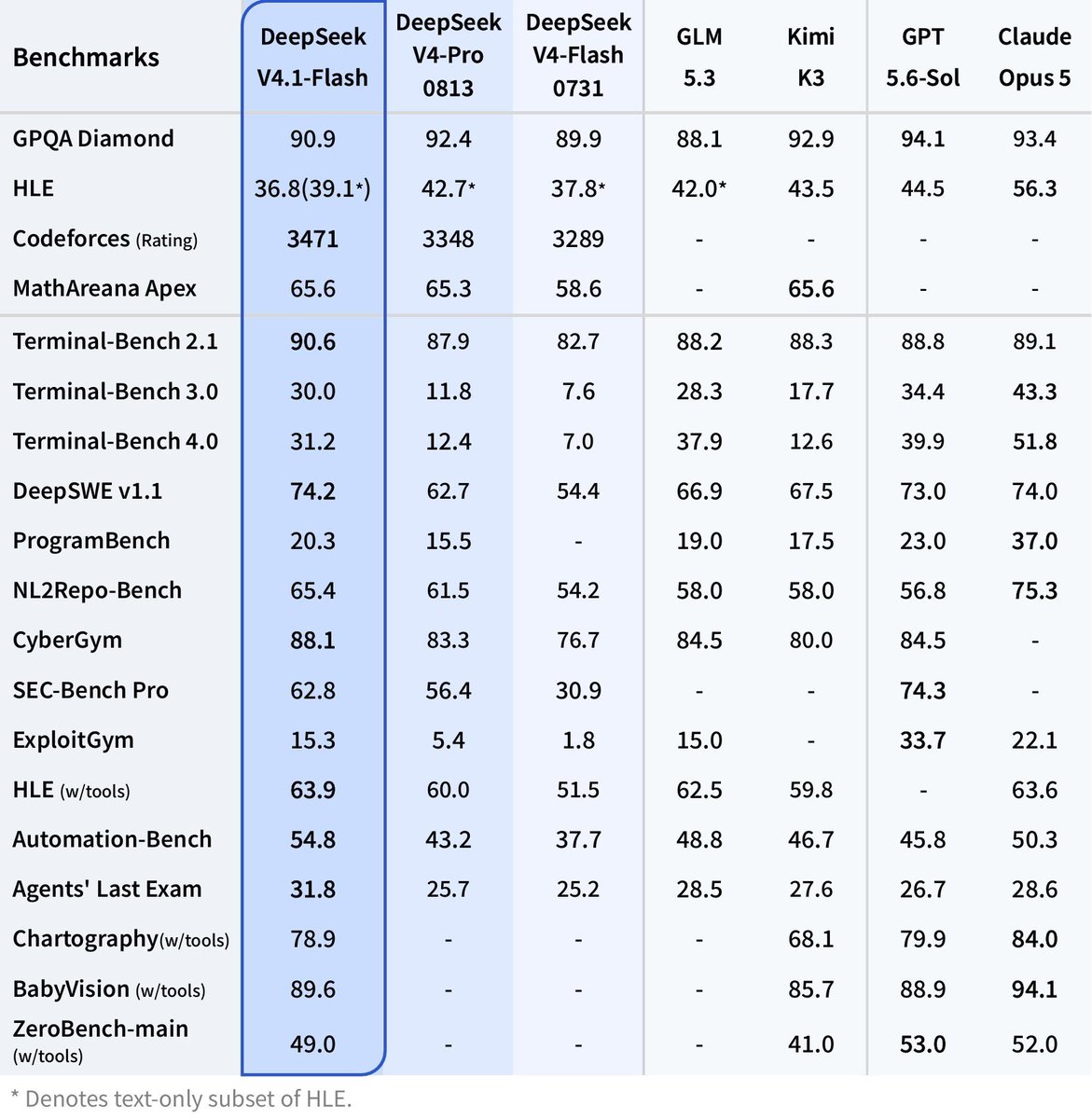
DeepSeek just launched V4.1-Flash, cutting KV-cache HBM requirements by roughly 75% and persistent SSD storage by 87.5% compared with V4-Flash.
Its global KV cache is down to 890 bytes per token, versus 3,514 for V4-Flash and 48,068 for V3.2. That is roughly 54x smaller than last December’s model.
V4.1-Flash has 552B total parameters, but its new Causal Encoder–Decoder architecture activates just 8B when processing inputs and 16B when generating outputs.
It also adds native image understanding, alongside new pretraining methods and larger-scale reinforcement learning.
The memory savings matter because AI agents repeatedly reuse context from conversations, documents, code and tool results.
The KV cache preserves earlier calculations so the model doesn’t have to redo all that work.
At 890 bytes per token, a million tokens would occupy about 890MB of global KV cache. That excludes model weights and other memory needed to run the system.
The SSD reduction comes from changing both what gets stored and where.
Previously, DeepSeek kept global attention data and short-lived sliding-window attention data in its persistent SSD cache. Both typically stayed there for more than 72 hours, even though the sliding-window data was mainly useful for minutes during an active session.
V4.1 moves that short-lived data into a shared pool using 10% of each server’s regular memory. Entries expire after minutes, while global context remains in persistent storage for at least 72 hours.
When short-lived data is missing, a new technique called “bounded replay” reconstructs it using a limited window of tokens instead of the much larger computation previously required. Removing that data from SSDs, combined with compressing the remaining global cache, produces the reported 8x storage reduction.
Reported benchmark scores include 63.9 on Humanity’s Last Exam with tools, 31.2 on Terminal-Bench 4.0 and 54.8 on Automation-Bench.
V4.1-Flash is live through the API as deepseek-flash, with off-peak pricing at half the peak rate. DeepSeek is also replacing V4-Pro with V4.1-Flash starting Sept. 14, ahead of a future V4.1-Pro release.
Note: These are reductions in cache requirements, not a 75% cut in total GPU memory or an 87.5% cut in all storage. They make retaining and reusing context substantially cheaper without eliminating the other costs of running an agent.
u can’t sell houses u don’t own
u can’t sell cars u don’t own
but
u *can* sell stock u don’t own!?
this is bs – shorting is a scam
legal only for vestigial reasons
INTEL CEO BUYS $10M OF $INTC
Intel CEO Lip-Bu Tan purchased 105,263 shares at $95 each, worth roughly $10M, according to a new SEC filing. The purchase lifts his total beneficial ownership to about 1.33M shares.
🚨 BREAKING:
95% OF THE $SPCX SPACEX STOCK SUPPLY IS LOCKED.
THE UNLOCK DATE: 👇👇
TODAY: 5%
AUG 11: 25%
AUG 21: 32%
SEP 10: 39%
SEP 25: 46%
OCT 10: 53%
OCT 25: 60%
NOV 9: 60%
DEC 9: 58–60%
JUN 13, 2027: 100%
SpaceX $SPCX IPO valuation at ~90x CY25 revenues at a IPO price of $135 is priced $TSLA, another Elon Musk company, is valued at 16x CY25 revenues as a comparison.
Bank of America claims 70% of bear indicators are active, but they keep a bullish 7,100 S&P target. History shows these signals hit early but the market can take it's time to peak.
Asia Stock Markets open: The benchmark S Korean KOSPI plunged sharply in early trading, falling as much as 8.37% triggering a circuit breaker and halting trading temporarily.