We’re publishing a new constitution for Claude.
The constitution is a detailed description of our vision for Claude’s behavior and values. It’s written primarily for Claude, and used directly in our training process.
https://t.co/CJsMIO0uej
Excited to have been part of the adventure behind Falcon-H1-Tiny series with @TIIuae !
A series of extremely small (below 100M parameters), language models with specialized versions in coding, function calling, SFT, Multilingual, reasoning ..
https://t.co/EJr0jWRQaP 🧵
Excited to have been part of the adventure behind Falcon-H1-Tiny series with @TIIuae !
A series of extremely small (below 100M parameters), language models with specialized versions in coding, function calling, SFT, Multilingual, reasoning ..
https://t.co/EJr0jWRQaP 🧵
Announcing - Falcon-Edge – a series of powerful, universal and fine-tunable Bitnet models for everyone!
We also release a Python fine-tuning toolkit library - `onebitllms`- specialized for Bitnet models.
Announcement blogpost: https://t.co/BrgkNCbas9
Falcon 3 is out! 1B, 3B, 7B, 10B (Base + Instruct) & 7B Mamba, trained on 14 Trillion tokens and apache 2.0 licensed! 🔥
> 1B-Base surpasses SmolLM2-1.7B and matches gemma-2-2b
> 3B-Base outperforms larger models like Llama-3.1-8B and Minitron-4B-Base
> 7B-Base is on par with Qwen2.5-7B in the under-9B category
> 10B-Base is state-of-the-art in the under-13B category
> Math + Reasoning: 10B-Base scores 24.77 on MATH-Lvl5 and 83.0 on GSM8K
> Coding: 10B-Base scores 73.8 on MBPP, while 10B-Instruct scores 45.8 on Multipl-E
> 10B-Instruct scores 86.3 on BFCL with a 32K context length
> 10B-Base scores 73.1/42.5 on MMLU/MMLU-PRO, outperforming 7B-Base (67.4/39.2)
> Release GGUFs, AWQ, GPTQ and Bitnet quants along with the release! 🔥
Kudos @TIIuae - this looks brilliant! 🤗
10 years ago, ML papers were math-heavy. Advice I got: less math, more empirics. Today, many ML/AI papers lack even a single math formula, let alone math thinking. My advice to young LLM researchers: do a little math if possible. It'll distinguish yours from the sea of LLM papers!
I've been making that point many times:
1. Intelligence is not a scalar quantity. The space of problems is gigantic and, for a given amount of computing resources, any intelligent system will only excel at a tiny subset of them. Any intelligent system has blind spots, hence vulnerabilities.
2. Intelligence does not imply an ability to dominate humans. It depends on *what* type of intelligence.
3. Intelligence does not imply a *desire* to dominate. Even *within* the human species, intelligent people rarely want to dominate others. If they did, Einstein and Feynman would have been rich and powerful. They were neither (also true of many of my scientist colleagues). In fact, Geoff points out that, until the election of Biden, the most powerful man in the world was not particularly smart (weakening his own argument).
4. Geoff mentions the fact that gaining power is an instrumental subgoal of achieving any goal. But it's easy to design guardrail objectives to prevent bad things from happening. We already do this all the time by making laws, including for superhuman entities such as corporations and governments.
Is human led mathematics over?
A discussion between @wtgowers and me, moderated by Joëlle Pineau (managing director of Meta-FAIR).
Short answer: no.
But 'AI for mathematics' is making fast progress.
https://t.co/wod1swcR3c
Less than 24 hours to go for the launch of our GANs Specialization and GANs for Good - a virtual live event featuring GANs experts!
Register now to hear what @AndrewYNg, @goodfellow_ian, @AnimaAnandkumar, Alexei Efros, and @realSharonZhou have to say: https://t.co/vpRYcHaqBI
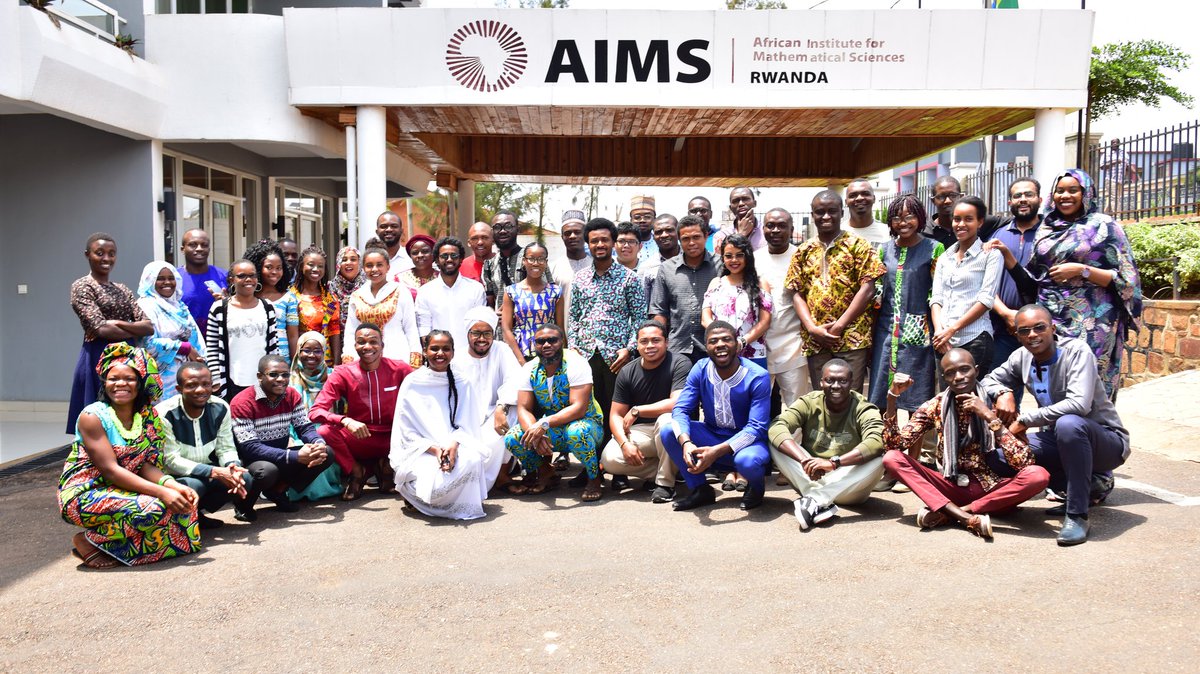
We're happy to announce that AIMS Rwanda recently received 44 young #Africans, (15 women and 29 men) under the African Master’s of Machine Intelligence (AMMI) program.
These come from 15 nations across the continent.
We wish them the very best during their stay at AIMS.