Daniel Abella López toma la palabra en el 48º Congreso SEBBM para hablarnos de:
“MiST-IC Tagging: Self-Assembling Protein-Only Nanospheres With Tunable Surfaces For Therapeutic And Industrial Applications”
#48CongresoSEBBM#ReuniónBiologíaSintéticaYBiotecnologíaMolecular
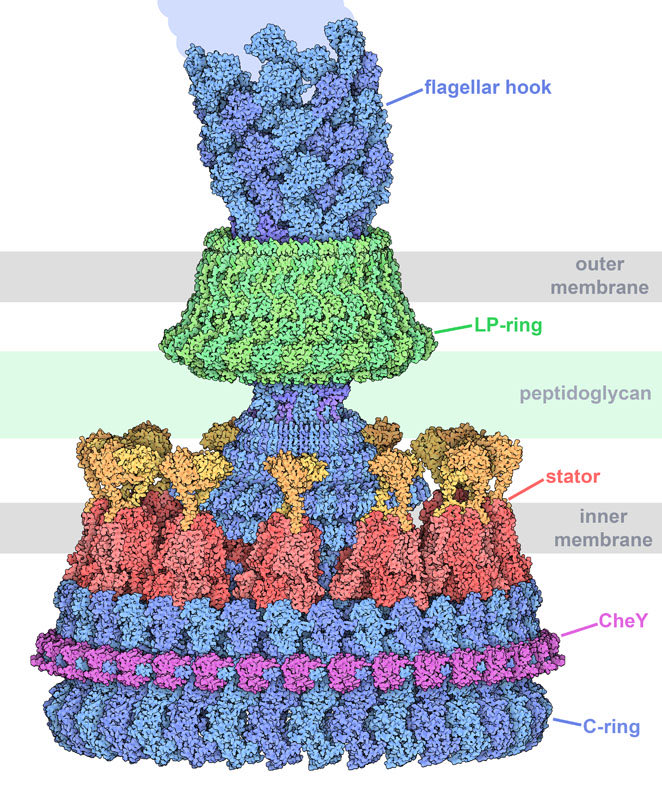
Bacteria move around using a molecular machine called the flagellar motor that rotates faster than the flywheel of a race car engine and switches directions in an instant. After 50 yrs, scientists have finally figured out how it works. “My lifelong quest is now fulfilled.” Link⤵️
What if AI could invent enzymes that nature hasn’t seen? 👩🔬🧑🔬
Introducing 🪩 DISCO: Diffusion for Sequence-structure CO-design
14 rounds of directed evolution and over a year of wet lab work. That's what it took to engineer an enzyme for selective C(sp³)–H insertion, one of the most challenging transformations in organic chemistry.
DISCO surpasses this with a single plate. No pre-specified catalytic residues, no template, no theozyme, no inverse folding, just joint diffusion over protein sequence and structure.
📝 Blog: https://t.co/j9Za0JigfO
📄 Paper: https://t.co/ficrYNBBrM
💻 Code: https://t.co/p81sSwoaPH
¿De dónde venimos?
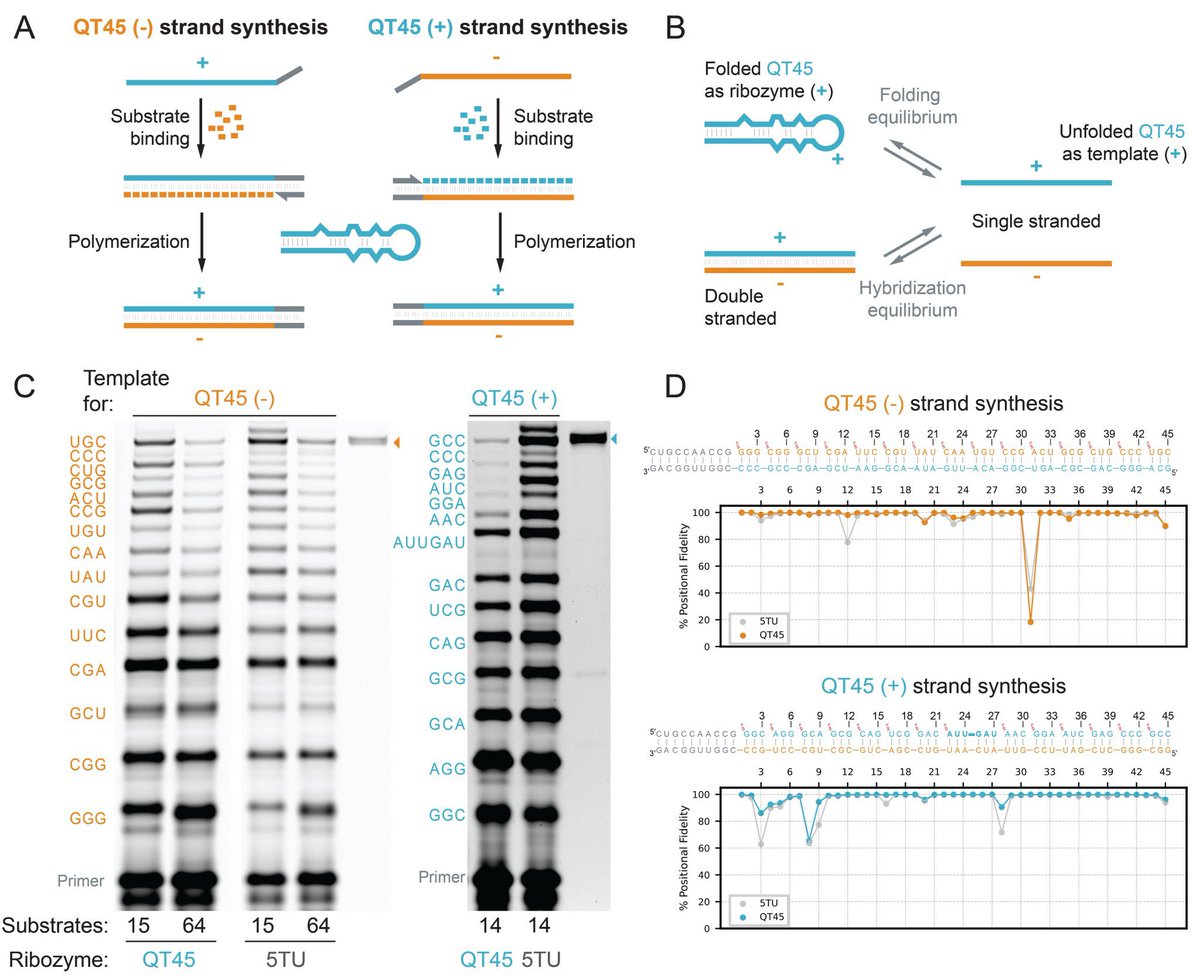
Antes de ayer, en el #DarwinDay, el grupo de P. Holliger (a quien conozco bien), publicó este artículo FUNDAMENTAL para el #MundoRNA y el #OrigenDeLaVida: ¡una ribozima de 45 nt capaz de auto-replicarse!
Seguiremos informando 😉
https://t.co/pMCH9DpaZk
El origen de la vida en la tierra podría haber ocurrido así,
con esta secuencia de tan solo 45 nucleótidos GGC AGG GCA GCG CAG UCG GAC AUU GAU AAC GGA AUC GAG CCC GCC
que se puede copiar a sí misma.
Impresionante!!
https://t.co/xBa4q5PnSw
This isn’t a random scientist who got lucky.
Mariano Barbacid discovered the first human oncogene in 1982. He isolated H-RAS from bladder cancer cells and proved a single point mutation could trigger cancer. That finding launched the entire field of molecular oncology.
KRAS mutations cause 90% of pancreatic cancers. For 43 years, oncologists called KRAS “undruggable” because the protein had no obvious binding pocket. Barbacid spent the last decade using genetically engineered mice to systematically test every node in the KRAS signaling pathway, looking for combinations that would work without killing the patient.
The triple therapy blocks KRAS three ways at once: the main growth signal, the escape routes through EGFR and HER2, and the stress-response backup through STAT3. Cut the engine, seal the exits, disable the emergency system. Tumors vanished in mice and didn’t return for 200+ days after treatment stopped.
Pancreatic cancer has a 13% five-year survival rate. 8% for the ductal adenocarcinoma type this therapy targets. Most patients live one year after diagnosis.
The catch: this is preclinical. Human trials are 3+ years away. One of the drugs, RMC-6236, might get approved this year, but the full triple combination has regulatory hurdles.
Still. The man who discovered human oncogenes in 1982 may have just figured out how to eliminate the cancer those genes cause. That’s a 43-year arc from first principles to potential cure. Science rarely works this clean.
LO QUE NADIE TE CUENTA
Este niño tiene un sarcoma osteogénico. Un tumor que te come el hueso. Hace 40 años: amputación directa. Hoy: le quitamos el trozo y ponemos hueso de cadáver.
¿Eso es nuevo? NO. Lleva haciéndose desde que yo no había nacido.
¿Entonces qué cambia? Que ahora antes de abrir hacemos un ensayo general con un muñeco de plástico. Útil, sí. Revolucionario, para nada.
LA NOTICIA REAL (que no vende)
Para salvar esa pierna necesitas:
3 cirujanos especializados
1 anestesista pediátrico
al menos 2 enfermeras
1 circulante
Quirófano
CERO prisa
CERO mirada al beneficio
¿Qué hospital privado puede permitirse esto?
NINGUNO. Porque no es rentable dedicar medio equipo toda una mañana a un crío.
EL PROBLEMA
Nos venden "tecnología futurista" cuando lo revolucionario es otra cosa: que tengamos un sistema que puede gastarse recursos infinitos en salvar la rodilla de un niño sin preguntar cuánto cuesta.
Eso NO lo hace una impresora.
RESUMEN: Gran cirugía. Equipazo. Resultado perfecto.
Pero dejad de vendernos la impresora 3D como si fuera el protagonista. El protagonista es un sistema público que puede hacer Tetris con huesos reales durante 8 horas sin mirar el reloj.
Viva la sanidad pública. Que es la única lo suficientemente loca para invertir todo eso en salvar UNA pierna.
Did you know?
A fly can accidentally twist its own head off, primarily as a result of over-grooming. While cleaning its legs, the fly's fast movements can cause the thin connection between its head and body to snap.
https://t.co/Rhp8s09EsH
Francis Mojica se empecina en buscar qué demonios son esas secuencias repetidas de las bacterias de las lagunas de Santa Pola… y unos años después ha cambiado el mundo…
Una de las 7 maravillas que destaca Nature.
¿Es o no una maravilla la ciencia?
https://t.co/l1YnIoFr3c
Publicar 120 papers en los últimos 2 años no es una hazaña científica.
Es un síntoma.
Un síntoma de cómo la autoría académica se ha convertido en una industria del nombre propio.
Abro hilo 🧵 sobre las malas prácticas de autoría que suelen sostener esta ficción 👇
Some people say nanotechnology is not achievable. But it already exists - biology is nanotechnology.
The bacterial flagellar motor is a perfect example. It’s a biological nanomachine, only a few dozen nanometers across, built from precisely arranged proteins that form a rotary engine.
It can spin at up to 100,000 revolutions per minute, powered by ion gradients across the bacterial membrane, just like an electric motor powered by voltage.
It even has equivalents of a rotor, stator, bearing, and drive shaft, all self assembled from molecular components.
With the help of AI, we’ll reach that level soon.