True! HNIs bring 1,00,000+ shares to the table, while retail investors bring 100 shares and a sense of entitlement. Truly unfair that the company doesn't treat both exactly the same!
I hold 5 shares and management isn't entertaining my request for a closed-door meeting. Where is the equality? Where is the justice? SEBI, please intervene!
BG 2.48
योगस्थः कुरु कर्माणि सङ्गं त्यक्त्वा धनञ्जय।
सिद्ध्यसिद्ध्योः समो भूत्वा समत्वं योग उच्यते॥
Perform your duties with dedication, abandoning attachment to outcomes. Remain balanced in success and failure. Such equanimity is called Yoga.
From bird's eye view both music Licensing cos seems similar how to choose one over other. We have some classic and simple metrics like Library, cost per music produced, IP rights and duration and many more of them.
Out of all these two metrics are crucial one ofc library (no. of songs that a co owns) and 2nd most important is copyrights (IPs).
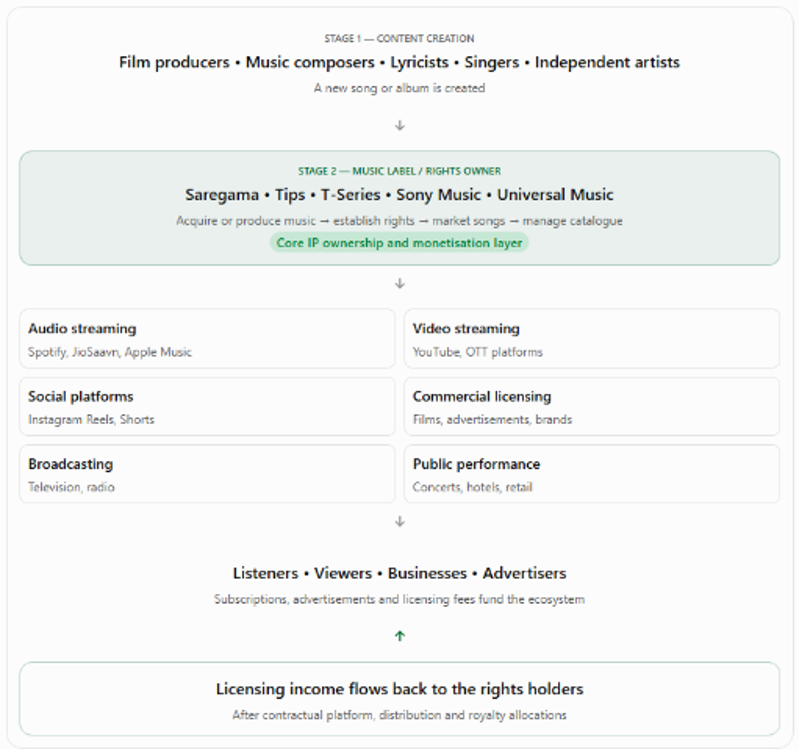
Suppose a popular song is created for a Hindi film. There are usually at least two distinct layers of copyright. (refer the attached image)
For example, if a brand wants to use the original recording of an old hit song in a commercial, it may need permissions covering both the sound recording and the underlying composition and lyrics.
However, if a new singer records a cover version, the original recording may not be used, but the underlying musical and literary rights remain relevant.
In India, IPRS administers rights in musical and literary works for its repertoire, while sound-recording permissions may be administered directly by labels or through bodies such as PPL India. The exact licences depend on the use, repertoire and contracts.
IP India+2
Investment implication? A label controlling both master and underlying economic rights can have more monetisation opportunities than a company holding narrowly defined recording rights. But investors must verify the exact contractual scope, royalty obligations, territories and duration.
For every material catalogue acquisition, the relevant questions are: Does the company own the rights or merely administer them? Are they exclusive? Are worldwide rights included? Are they transferable? And what royalties must still be paid?
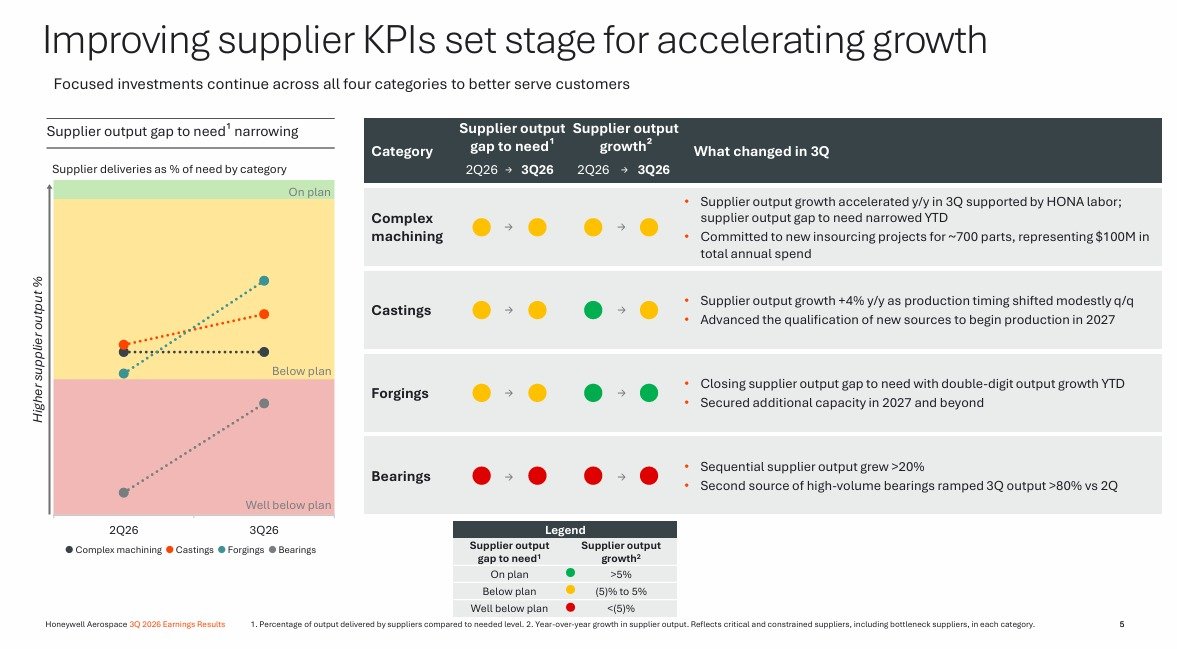
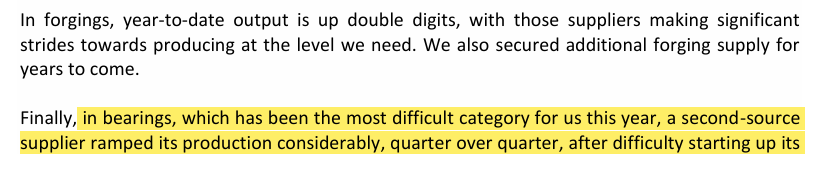
Bearing suppliers are still producing materially below the required level, despite a recovery in quarterly output.
Skilled labour and machining capacity are constraints.
This is why aerospace companies are increasingly investing directly in suppliers, qualifying alternative sources and securing manufacturing capacity years in advance (mental model learnt from my mentor).
For qualified suppliers, the opportunity is potentially more valuable than just stronger orders: it can mean multiyear programmes, higher entry barriers and deeper customer relationships.
I find these two verses from the Bhagavad Gita (2.62–63) incredibly relevant to the way we invest and the way businesses market themselves.
It starts with something as simple as attention.
You keep looking at something. Slowly, you become attached to it. Attachment creates desire. When that desire is challenged, anger follows. And eventually, your ability to think clearly disappears.
I see this play out in investing all the time.
You discover a stock, follow it, read about it, listen to management, and gradually fall in love with the story. Somewhere along the way, you stop evaluating the business objectively. You start defending your investment instead of questioning it.
And that's when things get dangerous.
Interestingly, marketing works on the very same psychology.
Brands fight for your attention because repeated exposure creates familiarity. Familiarity builds trust, trust creates preference, and preference eventually drives desire.
The same psychological process that makes a brand successful can make an investor irrational.
Perhaps the biggest lesson here is this:
In marketing, the objective is to create attachment. In investing, the discipline is to avoid it.
You can love studying a business. You can admire its management. But never fall so deeply in love with a stock that you lose the ability to question it.
When customers are willing to co-invest with the company on capex lines, it is usually a sign that tailwinds are strong.
Disclaimer - not a recommendation to buy/sell
I don't understand why people conveniently forget the concept of valuation.
If you're a momentum investor and choose not to give much weight to valuations, that's perfectly fine. At least you have a defined framework.
But the real irony is when people with no clear investment framework, no defined process, and little self-awareness confidently declare that “valuation is a waste of time.”
There's a difference between consciously choosing not to rely on valuations and dismissing valuations because you don't understand them.
Not having a framework is not an investment philosophy.
Management expects backward integration to add approximately 100–300 basis points to EBITDA margins, with benefits gradually appearing through FY28 and potentially reaching their full effect around FY29.
The company is integrating several components of the transformer value chain, including continuously transposed conductors (CTC), bushings, pressboard, fabrication and tanks.
Why is this attractive?
A transformer manufacturer traditionally purchases several critical components from third-party suppliers. By manufacturing these internally, TARIL could capture part of the supplier's margin, improve supply-chain control and potentially reduce production lead times.
https://t.co/DkOefECNPu
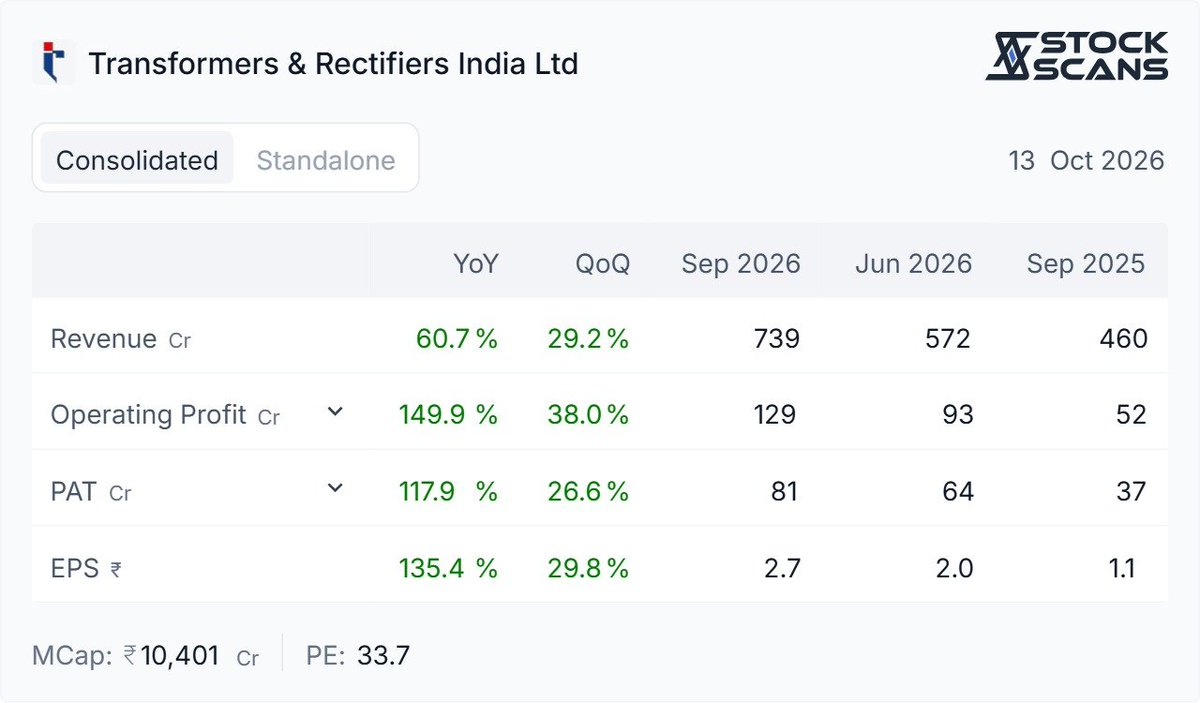
TARIL's story is shifting from capacity creation to capacity utilisation, while backward integration could become the next earnings driver.
During an investment cycle, a manufacturer first commits capital to expansion. Revenue follows only when the new capacity is commissioned, customer orders are executed, products are tested and deliveries are recognised.
TARIL is now demonstrating operating leverage from better execution and plant utilisation. The more interesting question is whether the upcoming backward-integration benefits can improve profitability beyond what greater manufacturing volumes alone can achieve.
Really a great podcast got a lot of learnings
• Components → sub-assemblies: expanding TAM & value addition
• Customer repeatability & scuttlebutt
• Vendors supporting businesses through extended credit
• Capability building vs capacity expansion
• Quality of R&D, beyond % of sales
• Building capabilities vs acquiring them
• Indigenisation & technology transfer
• CEO autonomy vs promoter control
• Bigger orders & working-capital traps
• Different portfolio approaches
And more........
The story behind the gift... 🎁
At 6:00 AM on podcast day, while meditating at a friend’s place, I opened my eyes and noticed a caricature hanging on the wall (of my friend, obviously)
Cut to later that day—@kushallodha548 actually gifted me one and that too in meditation pose! Talk about perfect timing. Thanks for making my day, Kushal and team! 🙌 #manifestation at play !
Some experiences teach you beyond what any book or research report can.
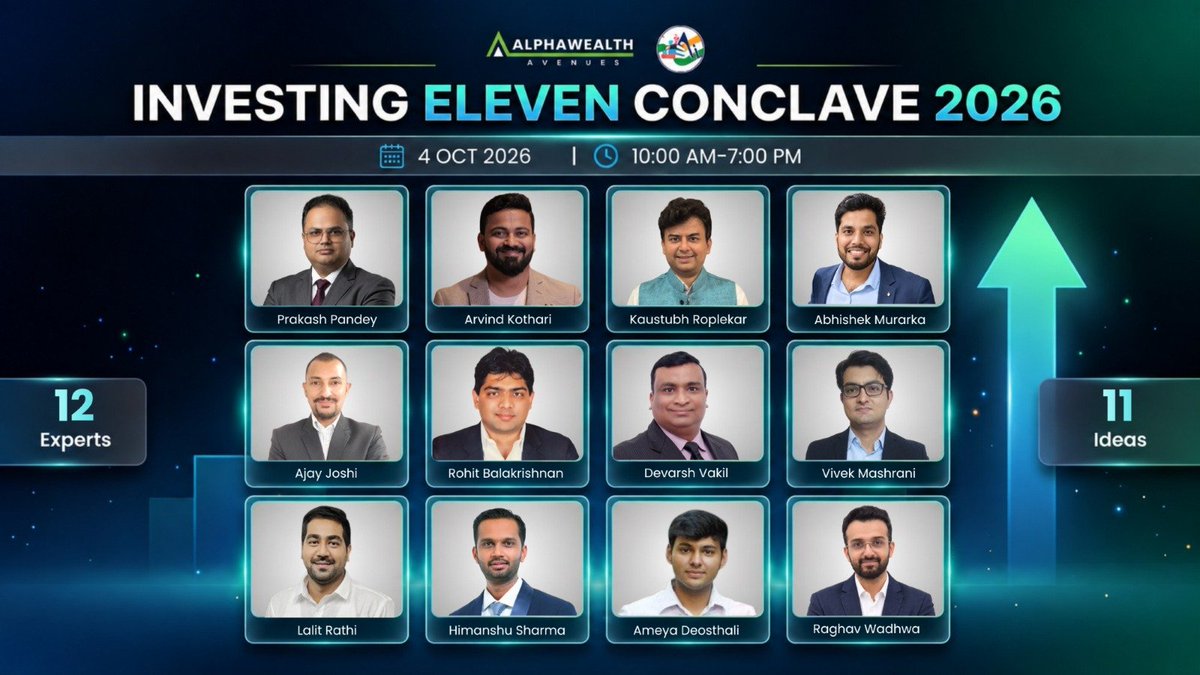
Again being part of IEC was one such experience. The opportunity to work behind the scenes, interact with people I have learned from, and witness the effort that goes into bringing such a platform together was truly valuable.
A lot more to learn, a lot more to build.
Don’t just chase the themes. Chase the themes which can sustain
Themes which give you time to accumulate, time to sit back and let the thesis play out, time to think when things don’t go as expected and most importantly, time to exit.
Because the best themes are not necessarily the ones which move the fastest. They are the ones which give you enough time to be wrong, learn, adjust and still make money.
Been an epic market for bottom up stock picker’s.
Index hasn’t been doing anything but selective themes are going bonkers. Those who have a process of capturing and exiting on time will do really well in this type of an environment ✅
India has produced national champions in categories you might expect and many you might not. Titan dominates watches and jewellery. Asian Paints has over 50% market share in decorative paints. Pidilite owns the adhesive category so thoroughly that its brand name Fevicol has become the generic Hindi verb for sticking things together. Britannia, Amul, and Nestlé define entire FMCG segments. Airtel and Jio have consolidated telecom into a near-duopoly. Tata, Reliance, and Adani have built sprawling organized retail empires. Even categories that seemed inherently fragmented mattresses, tiles, plywood, laminates have produced dominant or near-dominant players with genuine pricing power and national reach.
And then there is furniture.
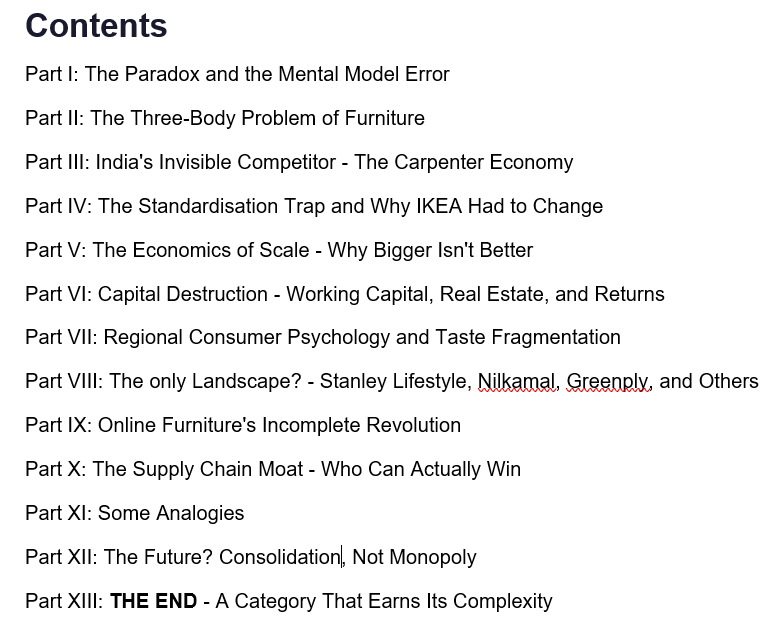
Why India Still Has No True Pan-India Furniture Giant?
Funny how some people present themselves as pharma experts, but don’t even know the basic difference between a CMO and a CDMO.
You don’t need to know everything about pharma. But if you’re building an investment thesis around the sector, at least understand what business the company is actually in.
WHAT LEVEL OF DECENTRALISATION IS GOOD? SHOULD ONE ADAPT TO DECENTRALISATION IN A SPACE WHERE TRUST IS THE ONLY FACTOR TO PROFITABILITY?
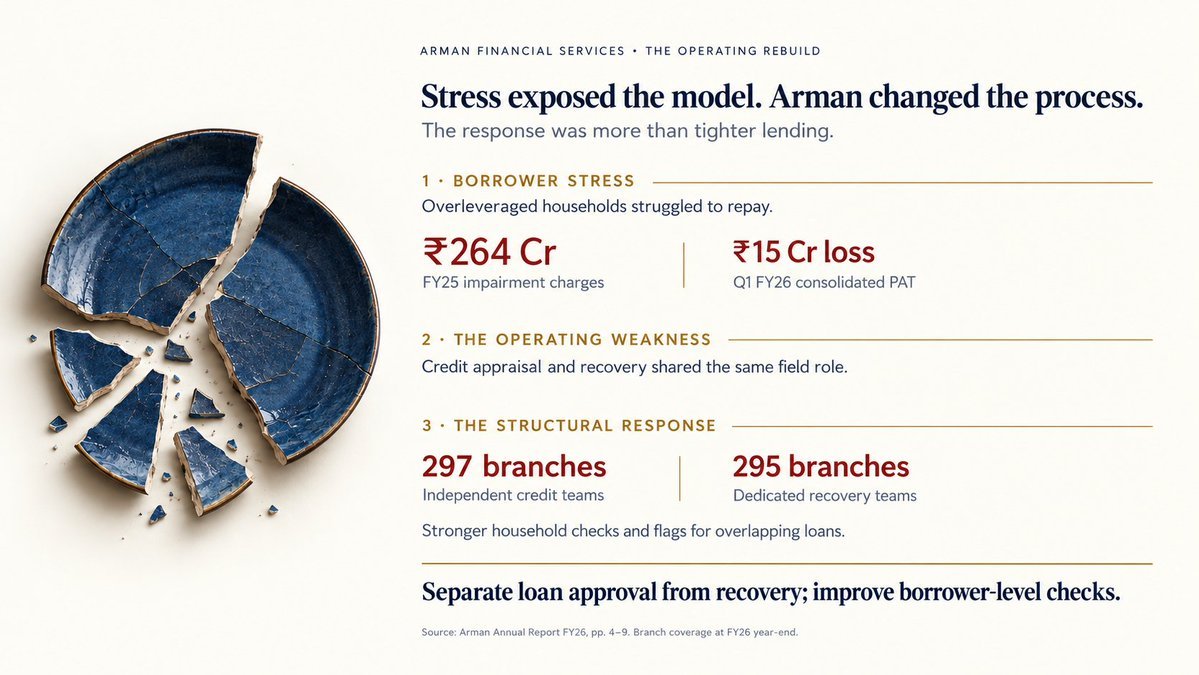
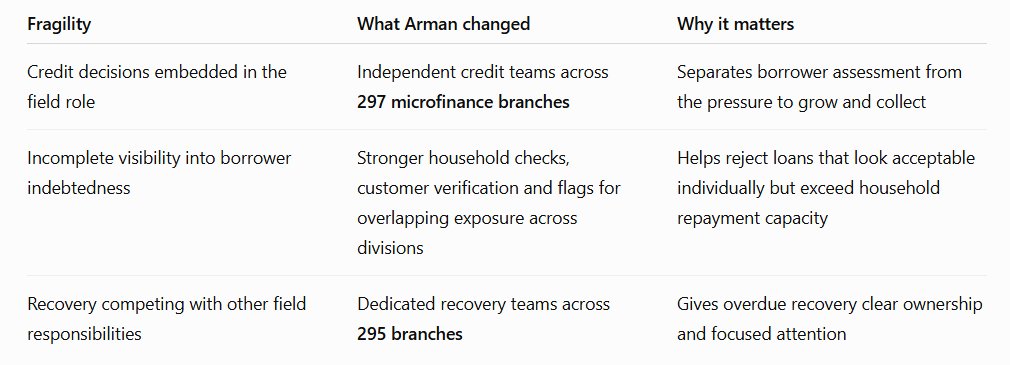
The fragility was that Arman’s ( NSE: ARMANFIN) lending model relied too heavily on repayment discipline holding up, rather than independently testing each household’s ability to repay. When borrowers became overleveraged and rural cash flows weakened, that weakness surfaced.
Two problems reinforced each other. Borrowers could take loans from multiple lenders, so an apparently regular payer could still have an overstretched household balance sheet. Meanwhile, credit appraisal and recovery sat within the same field role. That created competing priorities: growing the loan book, judging borrowers objectively and collecting overdue instalments. Good collections during benign years could hide weak underwriting.
Arman’s response changed the process at three points (attached image).
It also tightened lending in stressed geographies and expanded individual business loans with borrower-level cash-flow assessment. Changing a group loan into an individual loan alone does not solve the problem; better assessment does. The borrower may still face the same rural income shock.
The most relevant early evidence is management’s claim of 30–50% lower defaults in comparable cohorts originated under the separate credit structure. That is more directly connected to the redesign than the overall decline in impairment charges, which can also reflect changes in lending, portfolio mix and the credit cycle.
Arman used the crisis to replace a model dependent on group discipline and combined field responsibilities with independent borrower assessment and dedicated recovery