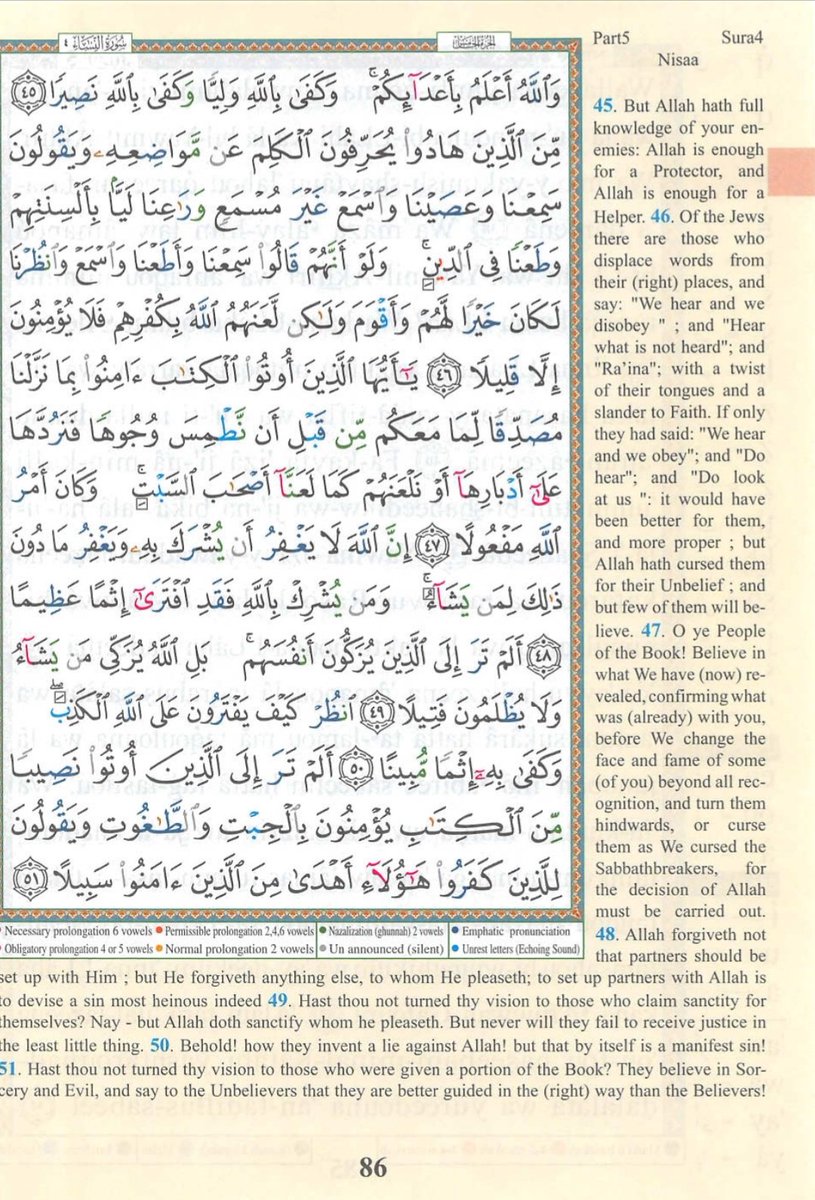
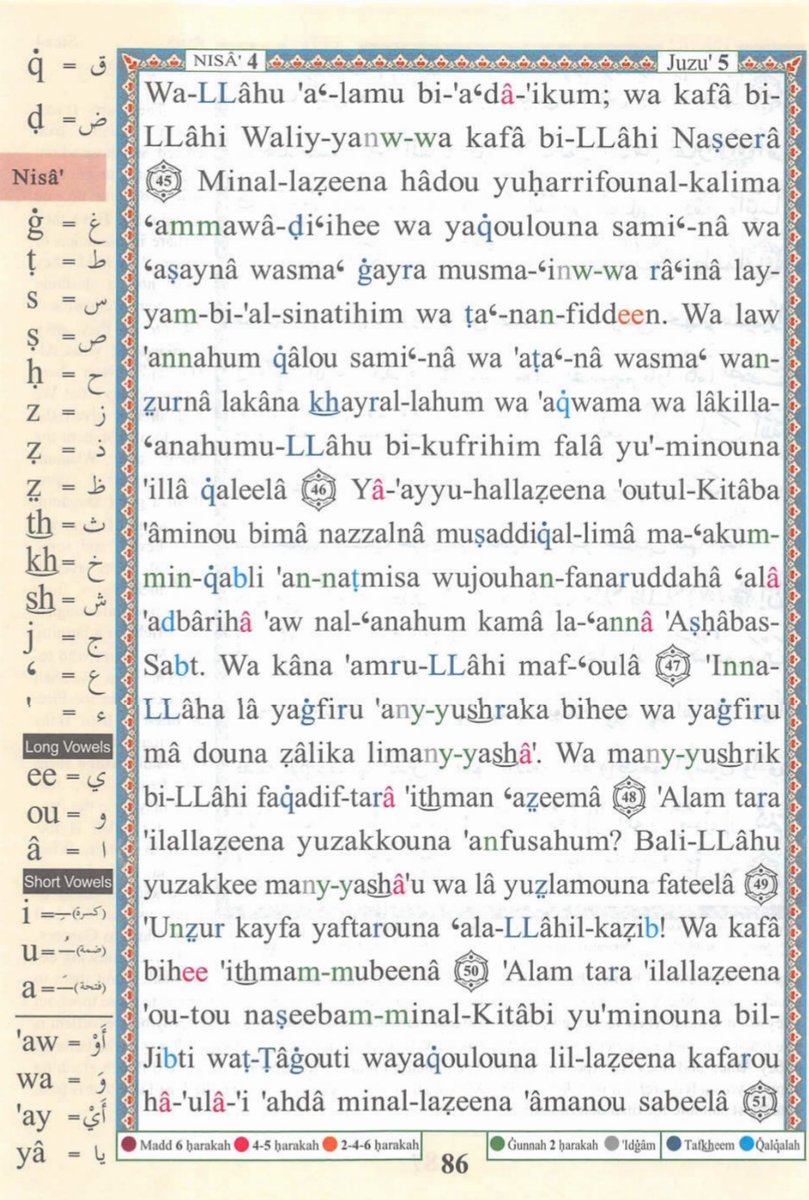
Pages of the Glorius Qur'ān today, Tuesday 5/5/26, Sūrah an-Nisā' (4): 38-51 tafakkur verse 4: 48
Theme: The Gravity of Shirk and the Vastness of Divine Mercy
{إِنَّ ٱللَّهَ لَا یَغۡفِرُ أَن یُشۡرَكَ بِهِۦ وَیَغۡفِرُ مَا دُونَ ذَ ٰلِكَ لِمَن یَشَاۤءُۚ وَمَن یُشۡرِكۡ بِٱللَّهِ فَقَدِ ٱفۡتَرَىٰۤ إِثۡمًا عَظِیمًا}
"Indeed, Allāh does not forgive association with Him, but He forgives what is less than that for whom He wills. And he who associates others with Allāh has certainly fabricated a tremendous sin".
LESSONS:
This verse establishes a foundational principle of Islamic theology: the absolute severity of shirk (associating partners with Allāh) and, in contrast, the expansiveness of Allāh’s mercy in forgiving all other sins for whom He wills. It draws a clear boundary between what undermines the very essence of faith (Tawḥīd) and what, though sinful, remains within the scope of possible forgiveness. The verse therefore calls the believer to guard the purity of his faith above all else while maintaining hope in the mercy of Allāh.
1. The Unforgivable Nature of Shirk (Without Repentance)
The verse makes it unequivocally clear that shirk is the gravest of all sins. If a person dies upon it without repentance, it is not forgiven. This highlights that Tawḥīd is the foundation upon which all acts of worship and righteousness are built. Without it, no deed can truly benefit a person in the Hereafter.
2. The Vast Mercy of Allāh Beyond Shirk
While shirk is singled out, the verse emphasises that all other sins, no matter how great, remain within the scope of Allāh’s forgiveness. This instils hope in believers and prevents despair. No sin should lead a servant to lose hope in returning to Allāh, provided that sincerity and repentance are present.
3. The Necessity of Protecting One’s Creed (ʿAqīdah)
The verse teaches that a Muslim must be vigilant in safeguarding his belief from both major shirk and subtle forms of association, such as showing off (riyā’) or relying on other than Allāh in a manner that compromises Tawḥīd. Sound belief is not assumed—it must be consciously preserved and nurtured.
4. The Danger of Fabricating Against Allāh
Describing shirk as a “tremendous sin” and a fabrication against Allāh indicates that it is not merely disobedience but a distortion of divine truth. It falsely attributes partners, equals, or intermediaries to Allāh, thereby corrupting the very understanding of His uniqueness and perfection.
5. Balance Between Fear and Hope
The verse beautifully balances khawf (fear) and rajā’ (hope). Fear arises from the warning against shirk, while hope emerges from the assurance of forgiveness for lesser sins. A believer must live between these two states, fearful of falling into disbelief and hopeful in Allāh’s mercy, which leads to a balanced and sincere spiritual life.
May Allah protect us from shirk, known and unknown, forgive our sins and grant us the grace to live and die only as Muslims with whom He is entirely pleased. Āmīn.
Tomorrow is Monday.
Fast if you are able to, if not earn reward by reminding others.
Remind, for indeed, the reminder benefits the believers (Q51:55).
Baarakallahu Feekum.
The Power of Istighfar (and How to Do It)
Istighfar (seeking forgiveness) is one of the most powerful acts a believer can hold onto. It heals, restores, and opens doors you didn’t even know existed.
What Istighfar Does
• Istighfar removes anxiety and distress.
• Istighfar increases dua acceptance.
• Istighfar opens the door of sustenance.
• Istighfar opens the door of mercy.
• Istighfar opens the door of knowledge.
• Istighfar is also gateway of productivity.
• Istighfar relieves you.
The Prophet ﷺ said that Allah is more pleased with the repentance of His servant than a man who finds his lost camel in the desert after losing hope (Muslim 2747).
How to Do Istighfar
1. The Shortest Form
Arabic:
أَسْتَغْفِرُ اللَّهَ
Transliteration:
Astaghfirullah
Meaning:
I seek forgiveness from Allah (Muslim 591)
2. A Daily Sunnah
Arabic:
أَسْتَغْفِرُ اللَّهَ وَأَتُوبُ إِلَيْهِ
Transliteration:
Astaghfirullaha wa atubu ilayh
Meaning:
I seek forgiveness from Allah and repent to Him(Bukhari 6307)
3. The First Istighfar (Adam & Hawwa)
Arabic: رَبَّنَا ظَلَمْنَا أَنفُسَنَا وَإِن لَّمْ تَغْفِرْ لَنَا وَتَرْحَمْنَا لَنَكُونَنَّ مِنَ الْخَاسِرِينَ
Transliteration:
Rabbana zhalamna anfusana wa illam taghfir lana wa tarhamna lanakunnanna minal-khasirin
Meaning:
Our Lord, we have wronged ourselves. If You do not forgive us and have mercy upon us, we will surely be among the losers (Qur’an 7:23)
4. Sayyid al-Istighfar (The Master of Forgiveness)
Arabic:
اَللَّهُمَّ أَنْتَ رَبِّي لَا إِلَهَ إِلَّا أَنْتَ، خَلَقْتَنِي وَأَنَا عَبْدُكَ، وَأَنَا عَلَى عَهْدِكَ وَوَعْدِكَ مَا اسْتَطَعْتُ، أَعُوذُ بِكَ مِنْ شَرِّ مَا صَنَعْتُ، أَبُوءُ لَكَ بِنِعْمَتِكَ عَلَيَّ، وَأَبُوءُ لَكَ بِذَنْبِي فَاغْفِرْ لِي، فَإِنَّهُ لَا يَغْفِرُ الذُّنُوبَ إِلَّا أَنْتَ
Transliteration:
Allahumma anta rabbi laaa ilaaha illa anta, khalaqtani wa ana abduk, wa ana ala ahdika wa wa'dika mastata'tu, a'oodhu bika min sharri ma sana'tu, aboo'u laka bini'matika alayya, wa aboo'u laka bidhanbi faghfirli, fa innahu la yaghfiru-dhunuba illa ant.
Meaning:
O Allah, You are my Lord. You created me, and I am Your slave. I will remain faithful to Your covenant and promise as much as possible. I seek refuge with You from the evil of what I have done. I acknowledge Your favor upon me, and I admit my sin. So, forgive me. Indeed, none can forgive sins but You (Bukhari 6306)
Whoever says it with sincerity in the morning or evening and dies that day enters Jannah.
5. A Powerful Comprehensive Istighfar
Arabic:
أَسْتَغْفِرُ اللهَ الَّذِي لاَ إِلَهَ إِلاَّ هُوَ الْحَيُّ الْقَيُّومُ وَأَتُوبُ إِلَيْهِ
Transliteration:
Astaghfirullah alladhi la ilaha illa Huwa,
Al-Hayyul-Qayyum, wa atubu ilayh
Meaning:
I seek forgiveness from Allah. There is no true deity except Him, the Ever-Living, the Self-Subsisting, and I turn to Him in repentance. (Abu Dawud 1517)
6. What the Prophet ﷺ Repeated Often
Arabic:
رَبِّ اغْفِرْ لِي وَتُبْ عَلَيَّ إِنَّكَ أَنتَ التَّوَّابُ الرَّحِيمُ
Transliteration:
Rabbighfir li wa tub alayya innaka antat-tawwabur-rahim
Meaning:
My Lord, forgive me and accept my repentance. Indeed, You are the Oft-Returning with compassion and Ever Merciful (Abu Dawud 1516)
7. The Dua of Yunus AS
Arabic:
لَا إِلَٰهَ إِلَّا أَنتَ سُبْحَانَكَ إِنِّي كُنتُ مِنَ الظَّالِمِينَ
Transliteration:
La ilaha illa anta subhanaka inni kuntu minaz-zhalimin
Meaning:
There is no deity except You; glory be to You. Indeed, I was among the wrongdoers (Qur’an 21:87)
No one says this in distress except that Allah answers.
8. For Yourself, Parents, and Believers
Arabic:
رَبَّنَا اغْفِرْ لِي وَلِوَالِدَيَّ وَلِلْمُؤْمِنِينَ يَوْمَ يَقُومُ الْحِسَابُ
Transliteration:
Rabbana-ghfir li wa liwalidayya wa lilmu’minina yawma yaqumul hisab
Meaning:
Our Lord, forgive me and my parents and the believers on the Day the account is established (Qur’an 14:41)
The 13th, 14th, and 15th of the Islamic calendar are here.. the blessed Ayyāmul-Bīd 🌙
Fasting these three days carries the reward of a lifetime.
It was a practice the Prophet Muhammad (S.A.W.) never neglected.
Don’t let these days pass you by. May Allah make it easy for us 🤍
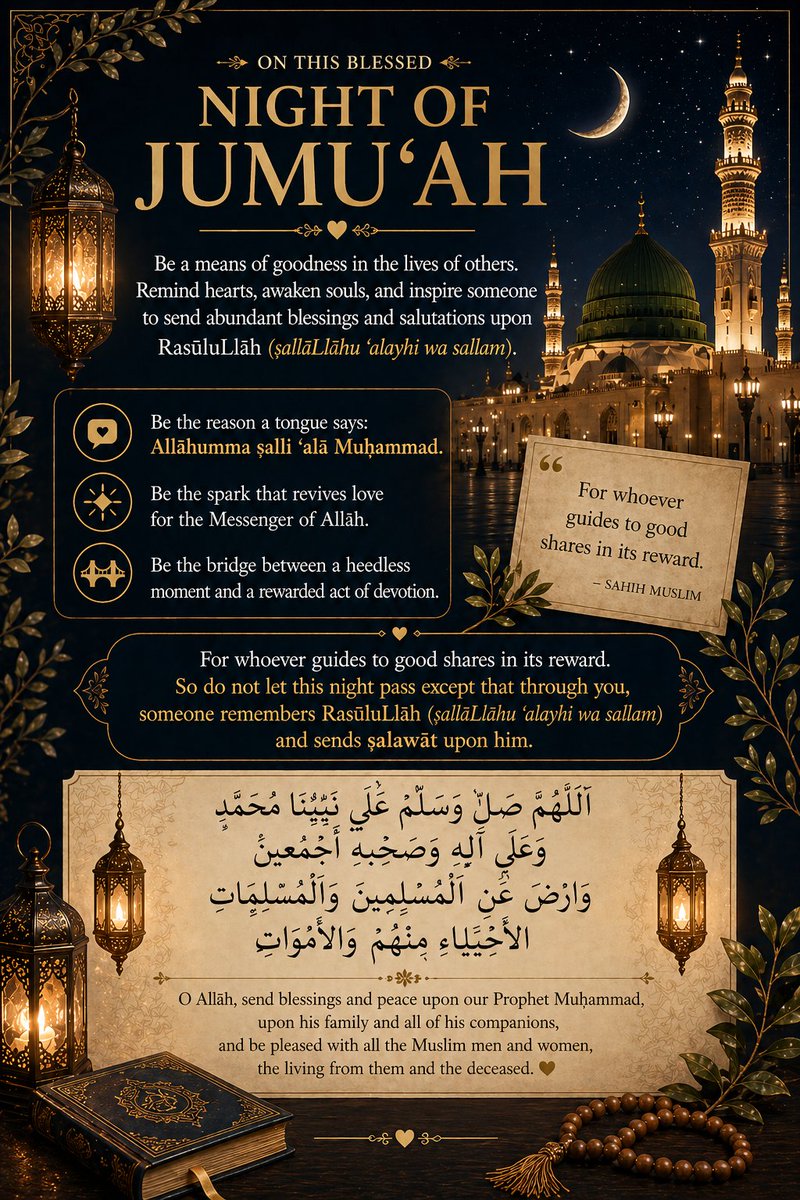
On this blessed night of Jumu‘ah, be a means of goodness in the lives of others. Remind hearts, awaken souls, and inspire someone to send abundant blessings and salutations upon RasūluLlāh (ṣallāLlāhu ‘alayhi wa sallam).
Be the reason a tongue says: Allāhumma ṣalli ‘alā Muḥammad wa 'alā ali Muḥammad wa sallim.
Be the spark that revives love for the Messenger of Allāh.
Be the bridge between a heedless moment and a rewarded act of devotion.
For whoever guides to good shares in its reward. So do not let this night pass except that through you, someone remembers RasūluLlāh (ṣallāLlāhu ‘alayhi wa sallam) and sends ṣalawāt upon him.
END POLICE BRUTALITY
The streets are not what they used to be,
Now there’s a price to pay for roaming free.
So when you’re out, stay alert, beware—
Bloodthirsty police are everywhere.
A system soaked in corruption and abuse,
Where the average Nigerian has little excuse.
You cannot speak, you cannot complain,
Power protects them, so you bear the pain.
Their affiliation to government grants them immunity,
While citizens suffer victimisation daily.
They hold the power and they can abuse,
They are the law—so you’re guilty of whatever you’re accused.
If you’re lucky, they’ll ask you to “donate,”
Else you’ll follow them to their station gate.
If you’re unlucky, they tie you and shoot you dead in daylight,
No regard for whether you’re wrong or right.
They don’t care about your parents, your children, your wife,
Guns meant to fight crime are used to take life.
Officers of the law, acting lawlessly,
Think of the dead—and their families.
Brothers keep dying,
Mothers keep crying,
And this cycle will never end
Until police brutality meets its end.
Tomorrow is Thursday.
Fast if you are able to, if not earn reward by reminding others.
Remind, for indeed, the reminder benefits the believers (Q51:55).
Baarakallahu Feekum.