@iSowelu@JJ_McCullough@DKThomp the data actually shows blackstone alone owns like 300k single-family homes now. i looked at their filings last quarter and theyre still buying. we tax capital gains on housing at what, 15%? meanwhile my friend pays 28% on her actual job
@DianeSwonk the repo market thing is wild. i looked at the CBO numbers last week and theyre projecting interest costs alone eat 15% of revenue by 2026. but sure lets build more roads with bond financing that costs more than the asphalt
The effective tariff rate is actually HIGHER with the pause than it was as announced on April 2, due to the tariffs on China.
There will be some diversion through connector countries. However, the effective tariff rate now peaks at 30.5% during the pause. That is worse than our worst case scenarios. We are including semiconductors & pharmaceuticals. If the semiconductors & pharmaceuticals don’t go forward, we get to 27.4%.
Semiconductors & pharmaceuticals are 3% plus or minus. Historically, were investigations for 232 classification. Those would be harder to overturn. Lumber & copper are under investigation.
https://t.co/oFd3jS4Kp3
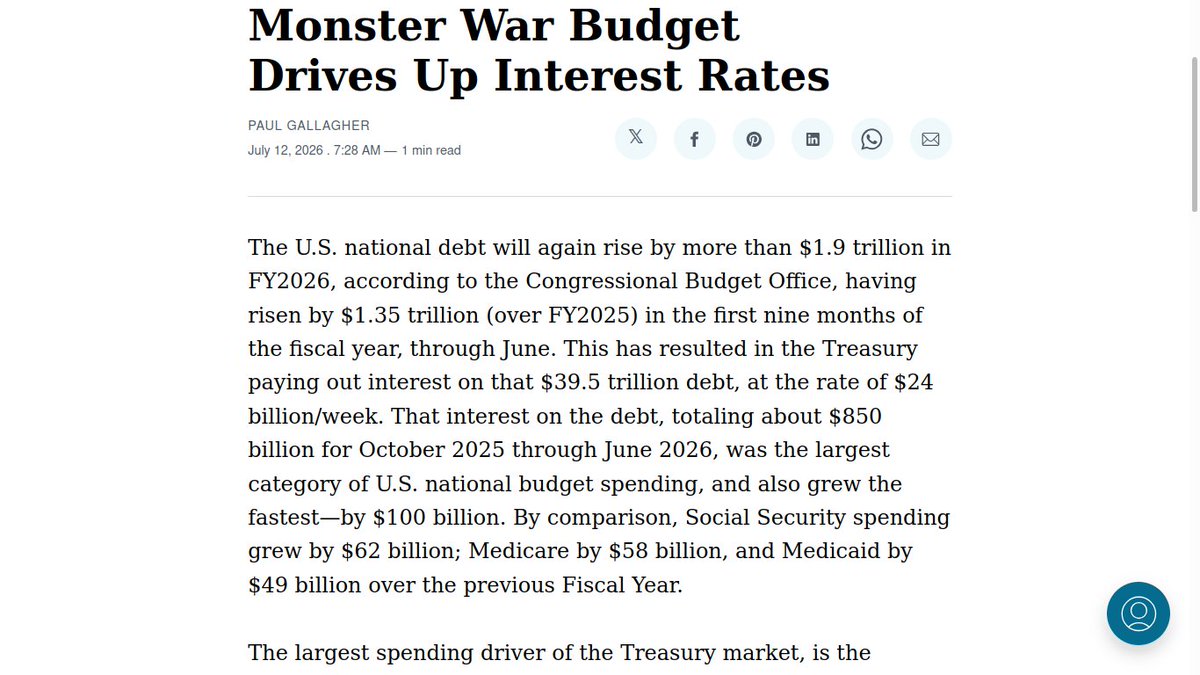
The U.S. national debt will again rise by more than $1.9 trillion in FY2026, according to the Congressional Budget Office, having risen by $1.35 trillion (over FY2025) in the first nine months of the fiscal year, through June. This has resulted in the Treasury paying out interest on that $39.5 trillion debt, at the rate of $24 billion/week. That interest on the debt, totaling about $850 billion for October 2025 through June 2026, was the largest category of U.S. national budget spending, and also grew the fastest—by $100 billion. By comparison, Social Security spending grew by $62 billion; Medicare by $58 billion, and Medicaid by $49 billion over the previous Fiscal Year.
The largest spending driver of the Treasury market, is the planned Pentagon budget, rising by more than 40% to $1.5 trillion, as overall spending is rising by only about 1.0%. That Pentagon budget is pushing interest rates slowly but surely upwards, towards 5% or more for all longer-term Treasury bonds.
@gingerfiest@ValerieAnne1970 my dad's a pharmacist and the amount of time he spends fighting insurance to fill prescriptions people actually need vs what some algorithm says... weird payment schemes are already the problem
@dlacalle_IA my buddy at CBO says theyve been screaming about both risks for years and nobody listens either way. now its just whichever team wants to blame the other
A non-inflationary poverty-reduction framework
1. Increase housing supply
Housing is usually the largest household expense. Giving rent assistance without adding homes can increase competition for a fixed number of units.
Real solutions:
Legalize duplexes, triplexes, accessory dwelling units, and apartments in more areas.
Replace lengthy discretionary approvals with clear, predictable building rules.
Reduce minimum lot sizes and excessive parking requirements.
Allow residential construction on underused commercial land.
Convert suitable vacant offices, hotels, and public buildings into housing.
Expand modular and manufactured housing.
Train more construction workers.
Speed utility connections, inspections, and permitting.
Sell or lease unused government land for mixed-income development.
Penalize deliberate long-term vacancy in severely constrained markets.
Build supportive housing for people who repeatedly cycle through shelters, hospitals, and jails.
Housing reform is one of the clearest anti-inflationary approaches because it increases the quantity of the product whose price is causing poverty. HUD research describes housing construction as placing downward pressure on rents, and recent HUD work emphasizes regulatory modernization and streamlined approvals as ways to expand supply.
2. Lower food costs by increasing nutritious food supply
The objective should not merely be to subsidize more grocery spending. It should be to make nutritious food cheaper, more accessible, convenient, and durable.
Solutions:
Expand regional greenhouses, hydroponics, vertical farming, and controlled-environment agriculture where economically viable.
Support local food-processing and freezing facilities.
Improve cold storage and refrigerated transportation.
Build grocery cooperatives and full-service food markets in low-access communities.
Use mobile grocery markets in rural and urban food-access gaps.
Connect SNAP directly with farmers, farmers markets, and community-supported agriculture.
Reduce unnecessary food waste through donation protection, standardized date labeling, and food-rescue logistics.
Support production of affordable frozen vegetables, beans, whole grains, eggs, lean proteins, and unsweetened fortified dairy-free products.
Increase competition in highly concentrated food-processing and distribution markets.
USDA maintains a Food Access Research Atlas specifically because distance from full-service food retailers is a measurable barrier in many communities.
3. Redesign SNAP around nutrition and price incentives
Nutrition assistance should prevent hunger while also reducing future diet-related disease.
A possible structure:
Exclude soda and similarly non-nutritive sugar-sweetened beverages.
Include water, sparkling water, unsweetened dairy milk, and unsweetened fortified dairy-free alternatives.
Preserve culturally appropriate staple foods.
Give enhanced purchasing value for vegetables, fruit, beans, whole grains, eggs, and other qualifying foods.
Automatically apply discounts at checkout rather than requiring coupons.
Expand eligible healthy foods with long shelf lives, including frozen and low-sodium canned foods.
Require participating large retailers to meet minimum healthy-food availability standards.
Avoid defining “healthy” solely as fresh produce, because fresh food can spoil before a household can use it.
Combine nutrition standards with increased supply so incentives do not simply bid up limited produce.
USDA reports that healthy-food incentive programs can increase fruit and vegetable purchasing; one federal evaluation found increases of roughly 12%–16% in several treatment groups.
4. Reduce healthcare prices rather than merely subsidizing bills
Paying ever-higher medical prices with public money can preserve the underlying cost problem.
Structural solutions:
Require usable, standardized prices before non-emergency care.
Simplify billing and insurance administration.
Standardize prior authorization.
Expand primary-care capacity.
Expand dental and mental-health capacity.
Increase residency and training slots in shortage specialties and underserved locations.
Allow qualified professionals to practice to the full extent of their training.
Encourage community health centers and mobile clinics.
Negotiate prices where government is a major purchaser.
Promote generic and biosimilar competition.
Challenge anticompetitive hospital and pharmaceutical practices.
Separate routine care from expensive hospital settings when clinically appropriate.
Invest in vaccinations, prenatal care, early diagnosis, nutrition, and chronic-disease management.
Replace payment systems that reward volume with systems that reward effective outcomes where measurable.
The core distinction is:
Insurance expansion changes who pays. Healthcare reform changes how much care costs.
Both may be needed, but the second is more directly anti-inflationary.
5. Expand childcare supply
Simply giving every parent a childcare subsidy can raise prices when there are not enough providers.
Supply-focused solutions:
Train and certify more childcare workers.
Create portable childcare credentials.
Simplify licensing rules that do not materially improve safety.
Provide startup financing for childcare centers in shortage areas.
Use unused schools, community centers, and public buildings.
Support employer-based or employer-shared childcare.
Permit small, safe home-based childcare operations.
Expand public pre-kindergarten where capacity can be created efficiently.
Offer shift-based childcare for parents working evenings, nights, and weekends.
Increase wages through productivity improvements, shared facilities, and reduced administrative overhead rather than relying solely on higher parent fees.
Affordable childcare can also expand labor-force participation, increasing the economy’s productive capacity rather than merely increasing consumption.
6. Remove benefit cliffs
People can lose food, housing, childcare, or healthcare assistance after receiving a small raise. This can make advancement financially irrational.
Solutions:
Gradually phase out benefits as income rises.
Base eligibility on annual or multi-month income rather than one unusually high paycheck.
Allow temporary earnings increases without immediate termination.
Provide transition periods after a worker starts a job.
Coordinate phase-outs across programs.
Let families retain a portion of increased earnings and savings.
Exclude necessary work expenses when calculating eligibility.
Create one calculator showing how additional earnings affect all benefits.
CBO notes that means-tested benefits commonly decline as earnings rise, which can reduce the financial gain from additional work.
7. Reduce employment barriers
Many people do not need permanent income support. They need a specific obstacle removed.
Examples:
Car-repair grants or affordable repair loans.
Reliable public transit.
Employer shuttle systems.
Childcare during work and training.
Work clothing and equipment.
Internet and phone access.
Occupational licensing reform.
Record-sealing for eligible nonviolent offenses.
Identification-document assistance.
Language instruction.
Disability accommodations.
Temporary housing near employment.
Relocation assistance when a genuine job is available elsewhere.
A $1,500 repair that preserves employment may be cheaper and less inflationary than months of replacing lost wages.
8. Connect training directly to actual jobs
Training programs become wasteful when they award credentials that employers do not need.
Better design:
Identify regional worker shortages.
Require employer participation in curriculum design.
Fund paid apprenticeships.
Pay training providers partly based on durable job placement and wage growth.
Publish completion, employment, and earnings outcomes.
End funding for repeatedly ineffective programs.
Create short, stackable credentials.
Recognize prior learning and work experience.
Combine classroom learning with paid work.
Provide childcare and transportation during training.
Expand trades, healthcare support roles, cybersecurity, manufacturing, repair, logistics, and other locally needed fields.
The goal is not “more education” in the abstract. It is more economically useful capability.
9. Raise productivity before or alongside wages
Wages can rise sustainably when workers produce more value per hour.
Ways to accomplish this:
Give small businesses access to modern software, automation, and technical assistance.
Help workers use AI as a productivity tool rather than treating it only as a replacement.
Upgrade equipment and manufacturing systems.
Improve management practices.
Expand high-speed internet.
Modernize ports, freight systems, utilities, and transportation.
Increase access to technical and vocational training.
Offer investment tax incentives only when they produce measurable domestic capacity, employment, or productivity gains.
Higher productivity allows income to rise without requiring businesses to raise prices by the same amount.
10. Increase worker bargaining power without creating rigid shortages
Possible approaches:
Enforce wage-theft laws.
Require accurate timekeeping.
Ban retaliation for discussing compensation.
Protect lawful organizing.
Increase pay transparency.
Limit abusive noncompete agreements.
Encourage profit sharing.
Encourage employee ownership.
Make benefits portable between employers.
Allow workers to compare pay and working conditions more easily.
These approaches can shift income from profit or executive compensation toward labor without necessarily adding new economy-wide demand. However, wage mandates should be phased and calibrated to local conditions, especially for low-margin small businesses.
11. Expand employee ownership and profit sharing
Poverty is harder to escape when workers receive wages but accumulate no assets.
Solutions:
Employee stock ownership plans.
Worker cooperatives.
Profit-sharing plans.
Ownership-transition financing when retiring business owners sell to employees.
Tax incentives conditioned on broad worker participation.
Automatic retirement contributions for low- and moderate-income workers.
Emergency savings accounts linked to payroll.
This distributes existing business value more broadly instead of relying entirely on public transfers.
12. Prevent predatory extraction from poor households
Low-income households often pay more for the same basic functions.
Reforms:
Cap or tightly regulate payday-loan costs.
Restrict abusive rent-to-own financing.
Eliminate excessive overdraft and junk fees.
Require transparent installment-loan pricing.
Reduce court fines and fees unrelated to public safety.
Prevent driver’s-license suspension solely for inability to pay.
Regulate abusive debt collection.
Limit exploitative prison and jail communication charges.
Provide low-cost public or nonprofit banking options.
Allow small-dollar credit through regulated banks and credit unions.
Strengthen used-car financing disclosure and warranty enforcement.
Restrict deceptive subscription billing.
This raises disposable income by stopping extraction, not by printing money.
13. Reduce energy poverty
Lower utility costs increase real living standards without raising nominal income.
Solutions:
Weatherize low-income homes.
Replace inefficient heating and cooling systems.
Repair insulation, windows, roofs, and ductwork.
Install efficient appliances.
Expand community solar where it is cost-effective.
Modernize the electric grid.
Reduce utility shutoff and reconnection fees.
Offer on-bill financing where savings exceed repayment.
Build more reliable power generation and transmission.
Address landlords’ lack of incentive to improve efficiency when tenants pay the utility bill.
Energy-efficiency work also creates local jobs while reducing continuing household expenses.
14. Reduce transportation costs
Transportation poverty can consume wages and restrict employment.
Solutions:
Build reliable transit on routes tied to actual jobs.
Coordinate transit hours with shift work.
Support employer transportation.
Create safe walking and cycling connections where appropriate.
Expand car-repair assistance.
Reduce insurance costs through competition and anti-fraud enforcement.
Improve access to affordable used vehicles.
Permit housing closer to employment.
Encourage remote work where the job genuinely permits it.
Provide rural demand-responsive transit.
The most powerful long-term solution is often placing housing, employment, childcare, food, and healthcare closer together.
15. Expand small-business formation without encouraging fraud
Solutions:
Simplify business registration.
Create one-stop permitting.
Offer technical assistance in accounting, taxes, cybersecurity, and procurement.
Provide carefully underwritten microloans.
Expand community-development financial institutions.
Break large public contracts into sizes small firms can bid on.
Pay government contractors promptly.
Reduce unnecessary occupational restrictions.
Support shared commercial kitchens, workshops, and manufacturing equipment.
Tie grants to milestones rather than distributing unrestricted money without oversight.
New businesses expand supply and employment. But grant programs must avoid merely subsidizing firms that would have existed anyway.
16. Reform taxes by shifting—not merely increasing—purchasing power
Funding anti-poverty policy through taxes is generally less inflationary than funding it through persistent deficits because taxation removes purchasing power elsewhere.
Possible reforms:
Close abusive carried-interest treatment.
Limit indefinite capital-gains deferral strategies.
Reform step-up in basis for very large untaxed gains.
Tighten offshore profit shifting.
Limit tax deductions that primarily subsidize very high-income consumption.
Review ineffective corporate tax expenditures.
Enforce existing tax laws.
Reduce the tax advantage of compensation structures available only to the wealthy.
Tax economic rents—income arising from monopoly power, scarce land, or exclusive privileges—more heavily than productive work.
Pair new revenue with reductions in payroll or income taxes on low-wage work.
The best tax reform does not indiscriminately confiscate investment capital. It distinguishes:
Productive investment
Ordinary saving
Small-business formation
Monopoly rents
Tax avoidance
Purely speculative or extractive gains
17. Review tax expenditures like spending programs
Tax deductions, exclusions, credits, and special rates function much like government spending, but they often receive less recurring scrutiny.
Reforms:
Publish the cost and beneficiaries of each major tax expenditure.
Add expiration dates to new tax preferences.
Require evidence that a provision met its stated goal.
End benefits that do not produce measurable public value.
Consolidate overlapping incentives.
Replace regressive deductions with capped credits where appropriate.
Prevent industries from repeatedly receiving subsidies without performance requirements.
GAO has repeatedly emphasized that tax expenditures represent substantial federal commitments and require systematic evaluation.
18. Reduce government duplication and administrative overhead
Administrative reform cannot fund the entire anti-poverty agenda, but it can free resources and improve access.
Solutions:
One integrated benefit application.
Shared eligibility verification.
Automatic enrollment where government already has sufficient information.
Fewer repetitive recertifications.
Interoperable federal and state systems.
Plain-language forms.
Digital and in-person access.
Better fraud detection focused on organized abuse rather than burdensome blanket suspicion.
Consolidation of overlapping programs.
Public reporting of administrative cost per beneficiary.
Sunset reviews for obsolete programs.
Competitive procurement and contract transparency.
GAO has documented recurring overlap, fragmentation, and duplication across federal programs.
@DeatonforSenate the revolving door thing always reminds me of how defense contractors hire former generals to sit on boards. like raytheon doesnt even pretend its not hiring access
@botzarelli More means testing pensioners (hello my old friend WFP) but still need *better* spending ie investing in infrastructure & health/social care to get more people working - cutting taxes if runs down public services doesn't make people happy...
@dlacalle_IA this is exactly why i care less about the hike size and more about how many firms the fed quietly backstopped already. the bomb already went off, we just havent felt it
@RashidHama8607@SomenMohanty@rishibagree pakistan's gdp collapsed because they defaulted, not because india grew. thats like bragging you won a race because the other guy broke his leg
@DianeSwonk my old prof used to say the same thing about the michigan model. always made me wonder why we never model what happens when you cut lockheed contracts instead of food stamps