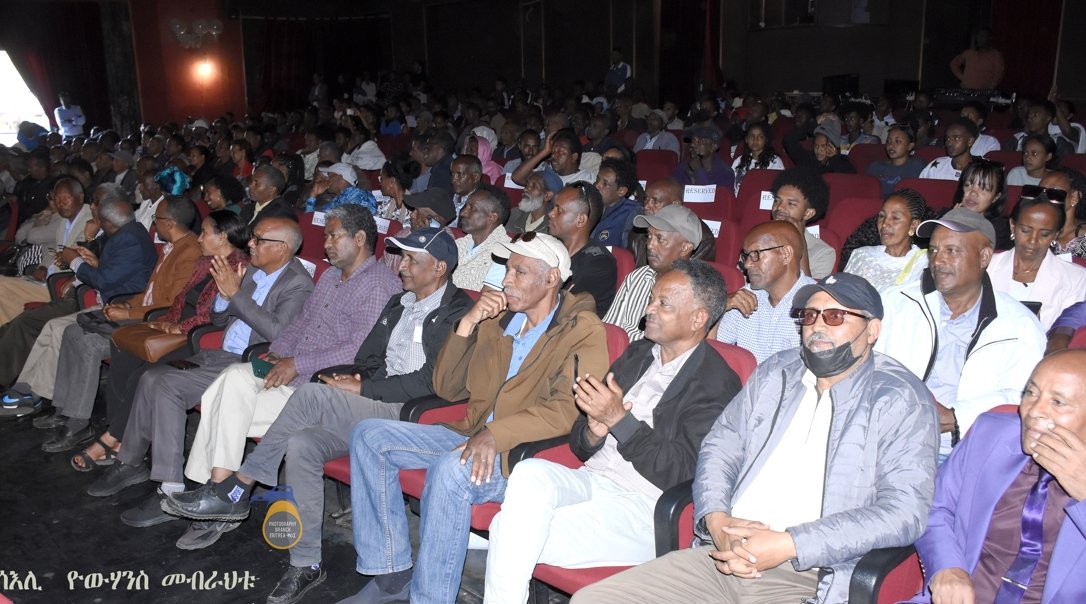
The Chairman of Sudan's Sovereign Council, General Abdel Fattah al-Burhan, arrived in Asmara in the mid-morning hours today for a working visit.
The current visit is part and parcel of the periodic consultative framework that is held between the two sisterly countries.
General Abdel Fattah al-Burhan and his entourage were accorded warm welcome by President Isaias Afwerki on their arrival at Asmara International Airport.
President Isaias Afwerki and General Abdel Fattah al-Burhan will discuss enhancement of bilateral ties as well as regional and international issues of mutual interest.
Potemkin Party's official and affiliated mouthpieces have switched to a "broken gramophone mode" these days.
Indeed, taking their cue from PP's senior political and military leaders, they are intensifying and have ramped up, by several notches, their hysterical campaigns of disinformation and vitriol against Eritrea.
The themes remain - with minor permutations here and there - constant and boringly monotonous to essentially revolve around:
i) historical revisionism to denigrate Eritrea's Statehood;
ii) mendaciously blaming Eritrea for the myriad internal woes of their own making; and,
iii) wholesale distortion of Eritrea's normative policies of regional cooperation in the Horn of Africa and the wider Middle East region.
These duplicitous political schemes are floated to camouflage and justify the agenda of reckless and destructive war that they have been contemplating for almost three years now in pursuit of, and to acquire, "sovereign access to sea" as well as project "maritime power with strategic depth in the Red Sea" in flagrant violation of international law, the UN Charter and the Constitutive Act of the African Union.
As we have underlined on various occasions before, the Potemkin Party's hollow and delusional pronouncements cannot deceive the peoples of the Horn of Africa and the international community at large.
In the event, our response remains the same as summarized in the link below: "ዘረባ ኣደይ ለቱ፡ ኣየውፍር ኣየእቱ!"
https://t.co/Ym2kAPEwMd
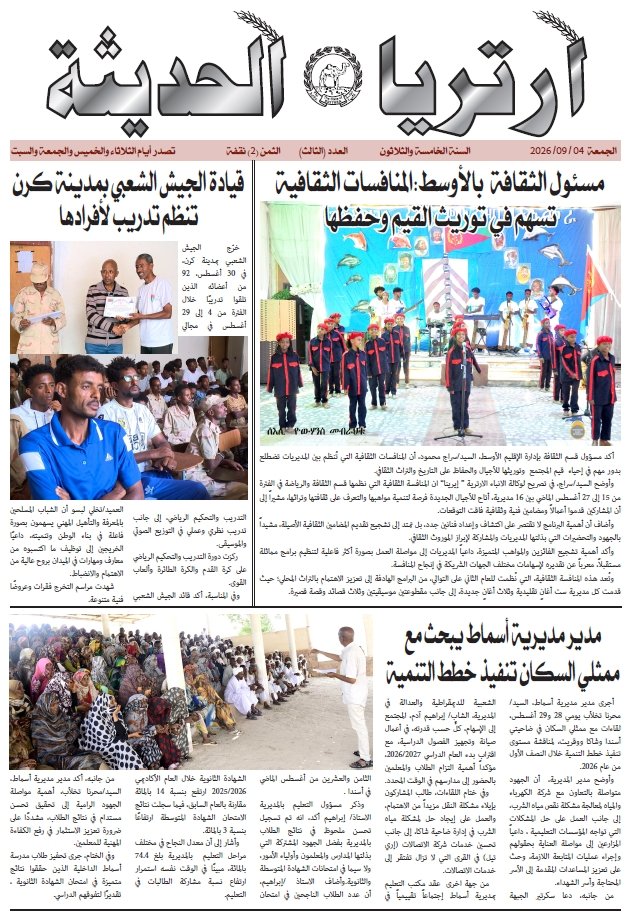
Central Region Schools’ Cultural Competition Concludes
The 2025/2026 academic year cultural competition among schools in the Central Region concluded on 3 September, under the theme “Culture: Fostering Values and Identity.”
The year-long cultural competition involved schools from the elementary to secondary levels and featured reading and calligraphy, general knowledge, photography and painting, innovation and creativity, debating, narration, short stories, poetry, dance, music and drama.
At the concluding event held at Cinema Roma, Mr. Mesfun Woldeselasie, head of administration and finance at the Ministry of Education branch in the Central Region, noted that culture reflects the aspirations and values of societies and called for nurturing committed and capable young people who adhere to noble societal values.
Mr. Solomon Barhe, head of culture, on his part, said that the program was aimed at instilling love of country and culture in the new generation, nurturing young people who are proud of their identity, and enabling them to inherit the values and culture of their forefathers and pass them on to future generations.
Mr. Solomon also called for organizing training programs for teachers who coordinate cultural activities and for strengthening parental participation.
At the event, awards were presented to the winning schools.
Outstanding Students Encouraged in Anseba Region
Outstanding students in the Keren and Elaberet sub-zones of the Anseba Region who attained high scores in the national examinations were presented with awards on 1 September.
Accordingly, Rora Junior and High School in Keren city recognized 10 outstanding students who scored 90 or above in the 2025/2026 eighth-grade national examination and 14 outstanding students who attained GPAs ranging from 3.0 to 4.0 in the national school-leaving examination.
Mr. Habtom Tesfatsion, director of the school, said that over the past three years, the pass rate in the eighth-grade national examination increased from 40% to 70%, while that of the national school-leaving examination rose from 18.5% to 31.2%.
Noting that the quality of education is showing measurable improvement, Mr. Yosief Okbaselasie, head of educational facilities, said that the encouraging outcome was the result of the coordinated efforts of the school community, the public and the students.
Similarly, Awet Secondary School in Elaberet sub-zone recognized 18 outstanding students who attained high scores in the 2025/2026 national school-leaving examination.
Indicating that students’ results are improving from year to year, Mr. Amanuel Zemicael, director of the school, expressed readiness to strengthen efforts to achieve better outcomes.
Mr. Solomon Neguse, head of educational facilities in the sub-zone, on his part, called for the continued recognition and encouragement of outstanding students.
Outstanding students in Anseba Region’s Keren and Elaberet sub-zones received awards for high scores in the 2025/26 national exams.
Rora School (Keren): 10 students 90+ in 8th grade; 14 with 3.0–4.0 GPA. Pass rates up: 40%→70% (8th) and 18.5%→31.2% (leaving exam).Awet School (Elaberet): 18 students recognized. Credit to students, teachers & community. #Eritrea #Education
https://t.co/FidgJV9THg
Siem Eyob-Abraha, a talented player for the Eritrean National Team, has officially completed a permanent transfer to Polish club KS Cracovia. This move marks an important step in his career as he prepares to play in Poland's top league. Siem Eyob-Abraha previously showcased his abilities with Sheffield United, a club within the EFL Championship renowned for its highly competitive atmosphere. His dedication and performance earned him a place in the July 2024 cohort of thirteen youth players awarded scholarship contracts by the club, reflecting both his potential and the confidence the coaching staff placed in him. With the formal announcement of his transfer to KS Cracovia, we extend our best wishes as he begins this new chapter with his club while continuing to serve the Eritrean National Team. #ENFF #DiscoverEritrea #AFCON
In 2019, I interviewed British documentary photographer and filmmaker Jenney Matthews. This interview commemorated the anniversary of Eritrea's struggle for independence. Our discussion provided valuable insights into her experiences during her visit to the Sahel in the 1980s. Jenney recounted her visit to Afabet—a pivotal site during the Eritrean War of Independence—where she took powerful photographs that captured the essence of the struggle. One key moment she shared came during her time at Nadew Izz. Her images not only documented the harsh realities of war but also highlighted the resilience and determination of the Eritrean people in their quest for freedom. Additionally, Jenney shared her harrowing experiences visiting Ethiopian prisoners of war in Hishkeb Sahel. Throughout her distinguished career, which spans over four decades, Jenney Matthews has documented numerous significant global events. Her body of work includes not only the independence struggle in Eritrea but also the fight for social justice in Nicaragua with the Sandinistas and the catastrophic events of the 1994 Rwandan genocide. Jenney’s unwavering commitment to capturing these critical moments in history has solidified her reputation as a highly respected figure in documentary photography and filmmaking. #DiscoverEritrea
Eritrean National Football Federation (ENFF) President and CECAFA President Paulos Weldehaimanot attended the final of the 2026 CAF Women’s Champions League CECAFA Qualifiers in Kigali, Rwanda. Paulos Weldehaimanot, the President of the Eritrean National Football Federation (ENFF) and CECAFA, attended the final of the 2026 CAF Women’s Champions League CECAFA Qualifiers in Kigali, Rwanda. During the closing and awards ceremony, President Paulos presented honours as the regional competition concluded. This marked his first year leading CECAFA, in addition to his role with the ENFF. The tournament featured Denden FC, an Eritrean women's club that represented the country among ten clubs from East and Central Africa, marking their second appearance in the CECAFA qualifiers. The competition is part of CECAFA’s ongoing efforts to strengthen women's football in the region. Throughout the tournament, President Paulos reaffirmed the organization’s commitment to expanding opportunities and development pathways for women in football. He took part in the closing and awards ceremony, presenting honours as the regional competition concluded in Kigali. He attended during his first year leading CECAFA, alongside his role as President of the Eritrean National Football Federation. The tournament also featured Eritrean women’s club Denden FC, who represented the country among ten clubs from across the East and Central African region, marking their second appearance in the CECAFA qualifiers. The competition formed part of CECAFA’s continued efforts to strengthen women’s football across the region, with President Paulos also reaffirming the organisation’s commitment to expanding opportunities and development pathways for women in football during the tournament.
https://t.co/A7JOhgQQyt
The Eritrean National Team is proudly reflecting on its incredible journey, showcasing the exceptional talent and deep camaraderie that define the squad. This unity shines as players consistently lift each other up, creating a positive atmosphere that elevates their performance. Excitement is building among fans as the team gears up to face Kenya on September 26th—a match that promises to be a thrilling showdown you won’t want to miss! Following that, the team will play against South Africa in Cairo, sparking even more anticipation. We warmly invite all fans to come out and support the team at Al-Salam Stadium on September 30th. The energy will be electrifying! #ENFF #DiscoverEritrea #EmbassyMedia
https://t.co/gqM42KLwU8
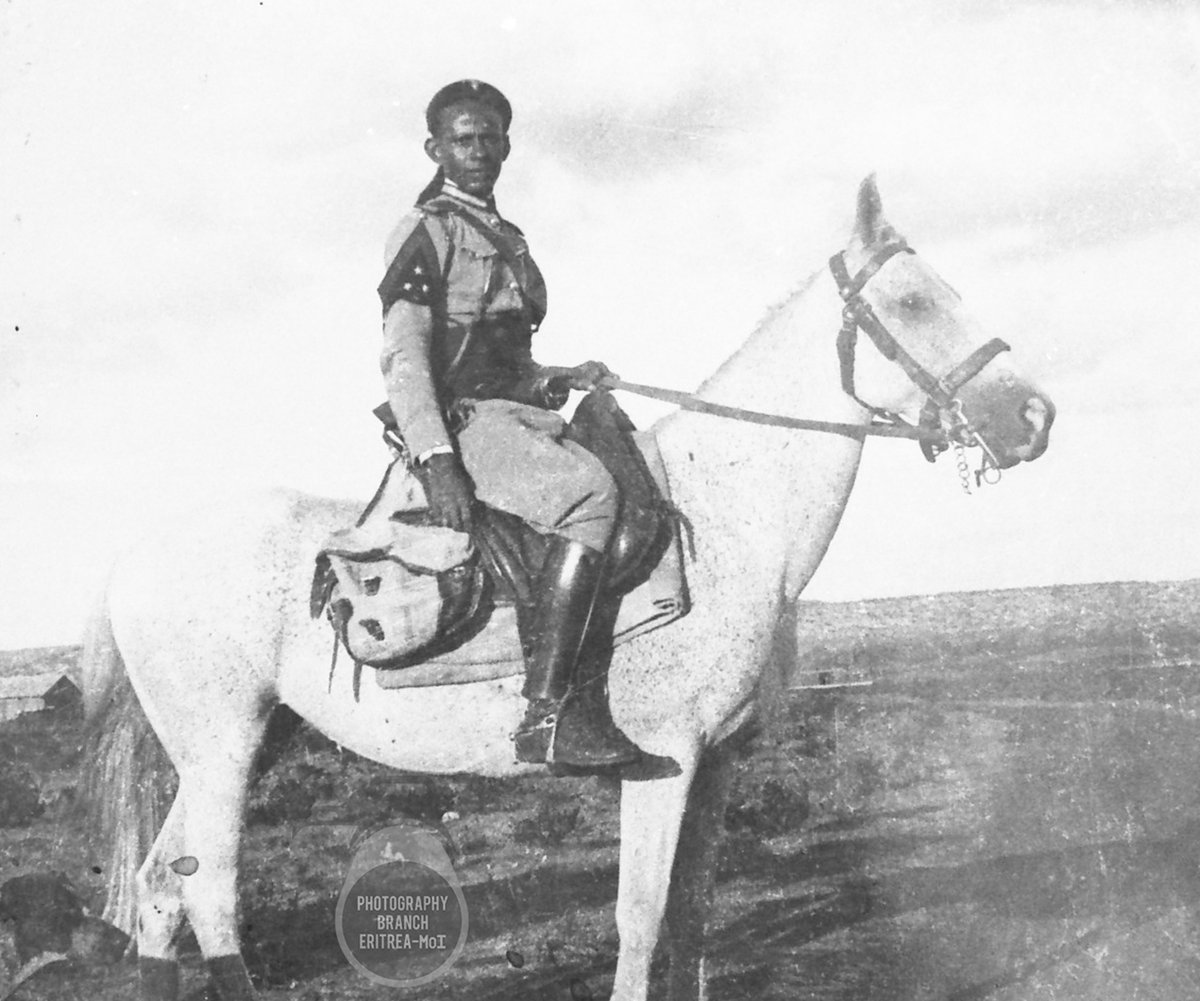
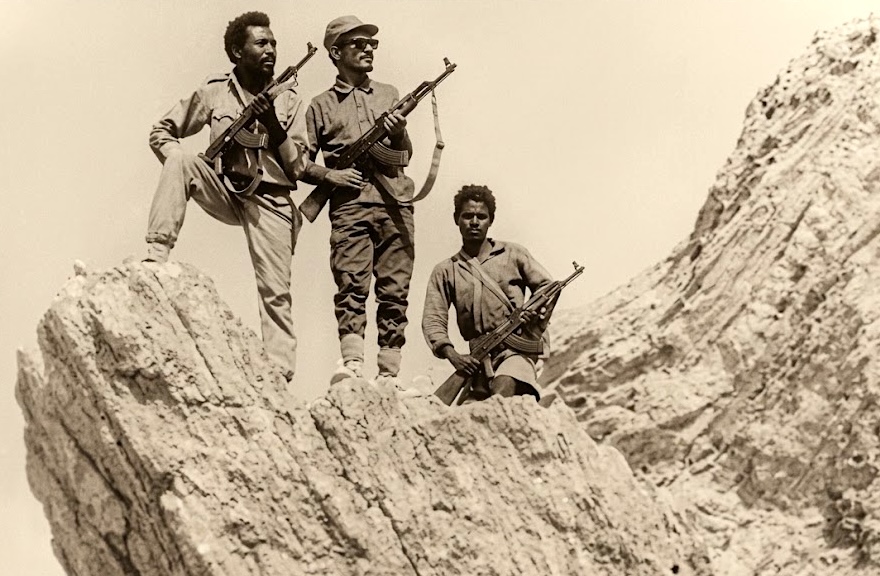
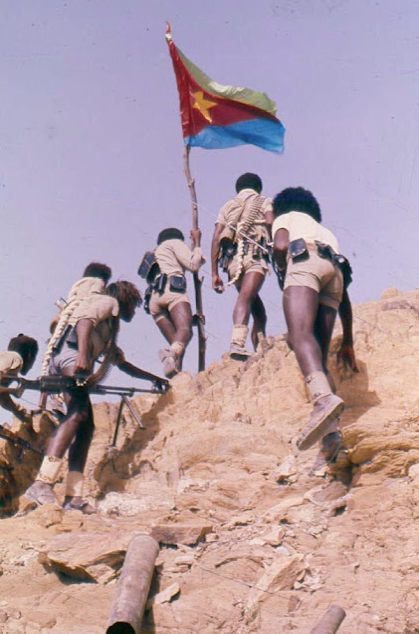
Today, Tuesday, September 1st, marks the 65th anniversary of the start of the armed struggle for independence in Eritrea, celebrated both within the country and in the diaspora. Following the end of European colonialism, Eritrea was placed under a federal arrangement with Ethiopia, a decision made against the wishes of the Eritrean people. This arrangement began when the United Nations passed a resolution on December 2, 1950. The federation lasted for ten years before Ethiopia proceeded to annex Eritrea. The violation of this federal agreement by Ethiopia, combined with the international community's silence, left the Eritrean people with no choice but to initiate an armed struggle for independence. On September 1, 1961, Hamid Idris Awate announced the beginning of the war of liberation. Awate is honored by Eritreans as the founding father of this struggle. In honor of his contributions, many government and private institutions have been named after him, and a statue has been erected in Haikota, located in the Gash Barka region.
Before the armed struggle began, the people of Eritrea had been fighting legally and politically against Ethiopian repression and international conspiracy. From 1941 to 1961, they sought the right to self-determination through peaceful means, but their efforts were in vain. On December 2, 1950, when the United Nations passed its federal resolution, Ethiopia's and its allies' interests took precedence over those of the Eritrean people. From the very beginning, it was evident that the right to self-determination for the Eritrean people was sacrificed to protect the interests of Ethiopia and her allies. This interest was clearly articulated by U.S. Secretary of State John Foster Dulles, who stated: “From the point of view of justice, the opinions of the Eritrean people must be taken into account. Nevertheless, the strategic interests of the U.S. in the Red Sea region, along with considerations of security and world peace, necessitate that our country remain allied with Ethiopia.” As a result, the establishment of an independent and sovereign Eritrea was obstructed to serve others' interests. The historical right of the Eritrean people to self-determination was overlooked, leading to a situation where, as African nations moved from colonial rule to independence, Eritrea transitioned from European colonialism to Ethiopian domination.
#DiscoverEritrea
After the United Nations implemented the resolution, Ethiopia used various means to undermine the federal agreement. The foundations of the federation were systematically eroded, freedoms were restricted, and Eritrean symbols and identity were obliterated. It became inevitable that the Eritrean people would eventually say, “enough is enough.” Thus, the Eritrean armed struggle began a year before Ethiopia’s unilateral dissolution of the federation in November 1962, and three years after the establishment of a clandestine movement known as the Eritrean Liberation Movement in November 1958. Hamid Idris Awate inspired the people, especially the revolutionaries, by demonstrating how the struggle should be fought and making them aware of their strength. His call for Eritreans to join the fight resonated throughout the country and shook the feudal establishment in Addis Ababa. This courageous, insightful initiative to begin the armed struggle instilled hope in the freedom-seeking population by clearly showing them a path to liberation. The liberation struggle against the heavily armed invading Ethiopian army—initially trained and supported by the USA and later by the USSR—was a battle against superior forces aligned with Ethiopian colonisation. Throughout the armed struggle for independence, Eritrea faced Africa's largest army. The Eritrean revolution transformed the entire society, serving as a catalyst for political and mental liberation in Eritrea. It was a mass social revolution with direct influence that extended even into Ethiopia. The Eritrean revolution significantly altered the course of history in both Eritrea and Ethiopia. Its impact did not end with Eritrea's liberation; it inspired Eritreans to rise against Emperor Haile Selassie and Mengistu, freeing the people of both countries from tyranny and laying the foundation for a peaceful, stable environment. The Eritrean people's long, bitter struggle for independence created a social bond, a collective memory, and a shared sense of glory—elements that now underpin a mutual commitment to living in harmony. #DiscoverEritrea
#Eritrea is solemnly commemorating today the 65th Anniversary of the beginning of the Armed Struggle for national liberation and human dignity.
As it will be recalled, a small people and nation had to suffer the ordeals of Africa's longest war of liberation, (1961-1991), simply because their inalienable right to decolonization, the pronounced provisions of international law, were brazenly compromised and subordinated to mollify the geopolitical interests of global powers and their regional surrogate.
In this respect, September 1st, 1961, epitomizes the noble determination, as well as history of resilience and heroism, of a small people who chose not to succumb to injustices and the logic of crude force or military power!