$NOK is STILL my next 1000% play – New price target $25 🎯
Since I dropped that post on April 29, the market has finally started catching on.
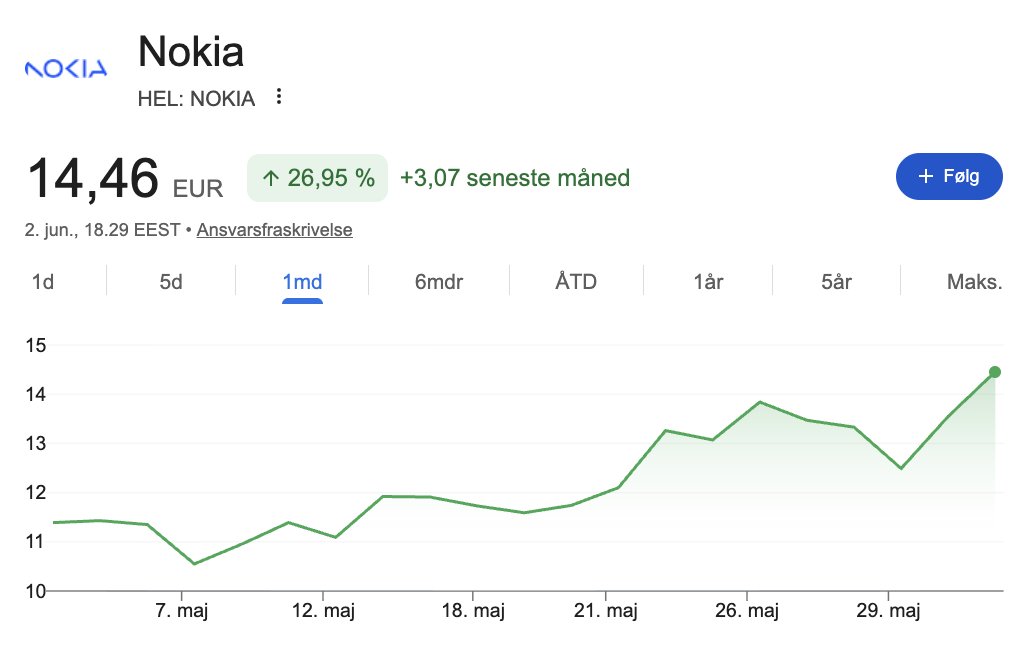
$NOK has ripped another ~20%+ higher, hitting fresh 16-year highs around $16.60 while most “AI pure-plays” are getting choppy. But we’re still early.
Nokia isn’t the flip-phone company anymore. It’s quietly becoming the picks-and-shovels backbone of the entire AI infrastructure boom, and the momentum is accelerating.
Here’s the updated thesis:
• AI-RAN + NVIDIA partnership is live and scaling
Nokia’s co-development with NVIDIA is already deployed with BT, Elisa, NTT DOCOMO, Vodafone and others. This isn’t future hype, it’s the bridge to AI-native 6G, and Nokia is years ahead of Ericsson and everyone else.
• Optical & data center explosion is just getting started
Q1 2026 already delivered +49% AI + cloud revenue. They raised their addressable AI fiber/hyperscale market to a 27% CAGR through 2028. The Infinera acquisition is paying off big time, hyperscalers are spending like crazy on optical networking for AI clusters, and Nokia is one of the few players that can actually deliver at scale.
• Earnings momentum keeps getting stronger
Beat Q1 estimates, operating profit +54%, gross margins expanding, full-year guidance reaffirmed and raised. Just this week they launched a new AI networking lab to accelerate co-innovation with partners. The flywheel is spinning.
• Valuation still has massive rocket fuel left
Even after the run, $NOK trades at a fraction of pure AI networking peers. A modest rerating to where those names sit (20-30x forward) puts us at $25+ per share in the next 12-18 months, before 6G really kicks in. From here, that’s another 50%+ leg higher, with multiple legs possible over the full cycle.
This isn’t a meme stock. This is real execution, real revenue inflection, and real AI tailwinds that the market is still underpricing.
I’m still loading the boat on every dip.
New price target: $25
(As always, this is my opinion, not financial advice. Do your own research.)
Northland's optical analyst Tim Savageux just raised $NOK PT to $20.
He is one of my favorites on the street and front ran photonics heavily before retail.
For example, he had bullish PTs on names like $SIVE and $MXL before a single name was on X.
Tim Savageux is a savage.
$NOK Nokia's new logo pretty much is telling you that they are in the AI networking game (optical/fiber), yet 99% of people still think they sell phones. We are still early.
The cherry on top is the massive AI RAN opportunity along with $NVDA as a partner, currently undergoing active field tests (major milestone with Nvidia to be announced later this year per Nokia CEO).
$NOK did you hear that Jensen mentioned Nokia directly during his Q&A?
His argument was that the base station today is mostly dumb, and that it should eventually get smart enough to adjust beams, signals, traffic and workloads on the fly, which would lift spectral efficiency and cut energy use. Then he added that $NVDA has a big partnership with Nokia to do exactly that.
Interesting times.
I believe $NOK is one the most overlooked setups right now, which is why I recently took a position in them.
To me, it has a simular setup as $OUST.
You remember $NOK as the company that made the phone everyone had, then lost it all, then spent a decade stumbling through acquisitions and identity crises while the world moved on without it.
That version is over NOW.
What's happening with Nokia right now is one of the most misunderstood setups I've seen in a long time and I hold it.
Here's the full thesis:
When people hear Nokia, they still think of the brick phone, 3310 or the game snake. Maybe they think of the Ericsson comparison. Maybe they think "slow European telecom equipment vendor."
None of that is the trade.
The trade is this: Nokia is quietly becoming the infrastructure layer for the AI-native wireless era and the market hasn't fully priced it yet.
The unlock happened in October 2025. Jensen Huang flew to Washington D.C. and, at NVIDIA's GTC event, announced a $1 billion equity investment in Nokia, at $6.01 per share, giving NVIDIA a 2.9% stake in the company. The announcement caused Nokia shares to surge 15-25% in a single session. It was Nokia's largest single-day gain in over a decade.
What many missed was NVIDIA's strategically allocate capital and putting a billion dollars behind their conviction that Nokia owns a critical piece of the AI infrastructure stack.
When Jensen bets a billion, I listen.
Let me explain the technology plainly, because this is where most investors glaze over and miss the opportunity.
The RAN — Radio Access Network — is the part of a wireless network that connects your phone, your car, your robot, your drone, to the broader internet. It's the "last mile" of connectivity.
For decades, RAN was hardware-defined: dumb antennas, proprietary chips, fixed performance. You got what you built. That was fine when the network just needed to move voice calls and streaming video.
AI breaks that model completely.
When AI-driven applications start running in the physical world; autonomous vehicles, robotic systems, edge inference, real-time sensing, the network demands become fundamentally different.
Latency isn't just important, it's deterministic. Jitter can't exist. The network has to be adaptive in real time, not just provisioned and left running.
Nokia launched its AI-RAN initiative in October 2025, demonstrated it with T-Mobile, and is now moving into commercial trials in 2026, targeting commercial release in 2027.
The core idea is transforming the RAN from a fixed hardware layer into a software-driven platform, one that uses AI to optimize itself continuously, responds to traffic patterns in real time, and can monetize spare GPU compute by offering AI inference capacity to external customers.
Read that last part again.
The base station becomes a revenue-generating AI compute node. Nokia's demonstrations at MWC26 in Barcelona showed exactly this: spare GPU capacity in the distributed AI-RAN network being offered to external customers as compute. The radio tower becomes a distributed edge data center.
This is the architectural shift. This is why NVIDIA cares.
Let me be precise about what the NVIDIA relationship means structurally.
NVIDIA introduced the Aerial RAN Computer Pro (ARC-Pro) a 6G-ready accelerated computing platform that combines connectivity, computing, and sensing in a single device.
Nokia is building its next-generation AI-RAN product line on top of this platform.
Dell Technologies is providing the PowerEdge servers.
The software stack runs on Red Hat OpenShift.
The ecosystem now includes Quanta and SuperMicro as hardware partners. BT, Elisa, NTT DOCOMO, Vodafone Group, and T-Mobile are all working with Nokia and NVIDIA on AI-RAN integration.
As of Q1 2026, Nokia has 10 publicly committed customers for its AI-RAN platform, including T-Mobile, Deutsche Telekom, Vodafone, SoftBank, and NTT Docomo.
Nokia's CEO Justin Hotard, who came in from Intel's data center division, put it plainly at MWC26:
"AI-RAN transforms RAN into a software-driven platform optimized for AI, and with NVIDIA and a growing ecosystem of partners we are progressing from validation to commercial deployment. This is a foundational step toward AI-native networks and 6G."
Jensen Huang said it even more plainly:
"AI is redefining computing and driving the largest infrastructure buildout in human history and telecommunications is next."
This is the AI infrastructure playbook being applied to the last uncaptured domain: the wireless edge.
Nokia delivered a strong Q1 2026. The company raised its full-year growth expectations for its Network Infrastructure business and reported a €1 billion order intake for the quarter. Net cash on the balance sheet stands at €3.8 billion, up from €3.4 billion at end of Q4 2025.
Remember what I said; simular to the $OUST setup, great cash balance.
For the full year, Nokia is targeting comparable operating profit of €2 to €2.5 billion in 2026, with a longer-term target of €2.7 to €3.2 billion by 2028. That's a meaningful step-up trajectory as AI-RAN revenues begin to compound.
The AI-RAN market itself, according to analyst estimates, is projected to exceed a cumulative $200 billion by 2030.
6G infrastructure spending is expected to reach $30 billion annually by 2033, growing at a 63.5% CAGR.
Nokia, as the lead equipment vendor in an NVIDIA-backed AI-native architecture, is positioned to capture a disproportionate share of that buildout.
The restructuring matters too. Nokia reorganized into two operating segments effective January 2026; Network Infrastructure and Mobile Infrastructure, simplifying the model and sharpening capital allocation.
This is not a company still searching for an identity. The pivot is complete.
The final brick in the puzzle is the detail that made me take a second look before I entered the position, and it matters more than most people give it credit for.
The insider buying at Nokia has been consistent and significant. Multiple Article 19 EU MAR disclosures have been filed; senior managers buying shares on the open market at RECENTLY highs and prices.
This is required public disclosure in the EU, which means we're seeing it unfiltered. When insiders file mandatory transaction disclosures showing open-market purchases at market prices, that's unambiguous directional signal from the people who know the most about where this company is going.
Outsiders react to headlines. Insiders act on conviction. To me, the disclosures are speaking.
It will take time to play out, but I believe Wall Street is about to slowly catch up. Morgan Stanley raised its price target from €11 to €14 in May 2026 and maintained a Buy rating.
SEB Equities upgraded from Hold to Buy.
73% of covering analysts are currently at Buy or equivalent.
The analyst community tends to be lagging indicators.
The entry zone has been constructive. The stock is now in the mid-teens. I'm watching the commercial trial results in 2026 and the 2027 commercial launch cadence closely. That's when this goes from a NVIDIA-backed thesis to a revenue story.
Here's what I want you to sit with.
Every AI infrastructure buildout conversation eventually hits a ceiling: where does the intelligence meet the physical world? Data centers get you to the edge of the cloud. Fiber gets you to the building. 5G gets you to the street. AI-RAN gets you to the device, the robot, the vehicle in real time, adaptively, without latency, at scale.
Nokia is building the bridge between the cloud and physical AI. That's not a niche play. That's infrastructure for the next twenty years of computing.
The Robotic AI Radio isn't a product name. It's a description of what every base station eventually becomes.
Nokia was dismissed for a decade because people couldn't see past what it used to be. That's exactly the kind of mispricing where the best returns live.
I hold it. I'm watching it closely. And I think the rest of the market is just starting to understand what NVIDIA understood in October.
Please note: As always this is not financial advice. This reflects my personal analysis and position as part of my portfolio. Do your own research. Know your risk.
—BP
I believe $NOK is one the most overlooked setups right now, which is why I recently took a position in them.
To me, it has a simular setup as $OUST.
You remember $NOK as the company that made the phone everyone had, then lost it all, then spent a decade stumbling through acquisitions and identity crises while the world moved on without it.
That version is over NOW.
What's happening with Nokia right now is one of the most misunderstood setups I've seen in a long time and I hold it.
Here's the full thesis:
When people hear Nokia, they still think of the brick phone, 3310 or the game snake. Maybe they think of the Ericsson comparison. Maybe they think "slow European telecom equipment vendor."
None of that is the trade.
The trade is this: Nokia is quietly becoming the infrastructure layer for the AI-native wireless era and the market hasn't fully priced it yet.
The unlock happened in October 2025. Jensen Huang flew to Washington D.C. and, at NVIDIA's GTC event, announced a $1 billion equity investment in Nokia, at $6.01 per share, giving NVIDIA a 2.9% stake in the company. The announcement caused Nokia shares to surge 15-25% in a single session. It was Nokia's largest single-day gain in over a decade.
What many missed was NVIDIA's strategically allocate capital and putting a billion dollars behind their conviction that Nokia owns a critical piece of the AI infrastructure stack.
When Jensen bets a billion, I listen.
Let me explain the technology plainly, because this is where most investors glaze over and miss the opportunity.
The RAN — Radio Access Network — is the part of a wireless network that connects your phone, your car, your robot, your drone, to the broader internet. It's the "last mile" of connectivity.
For decades, RAN was hardware-defined: dumb antennas, proprietary chips, fixed performance. You got what you built. That was fine when the network just needed to move voice calls and streaming video.
AI breaks that model completely.
When AI-driven applications start running in the physical world; autonomous vehicles, robotic systems, edge inference, real-time sensing, the network demands become fundamentally different.
Latency isn't just important, it's deterministic. Jitter can't exist. The network has to be adaptive in real time, not just provisioned and left running.
Nokia launched its AI-RAN initiative in October 2025, demonstrated it with T-Mobile, and is now moving into commercial trials in 2026, targeting commercial release in 2027.
The core idea is transforming the RAN from a fixed hardware layer into a software-driven platform, one that uses AI to optimize itself continuously, responds to traffic patterns in real time, and can monetize spare GPU compute by offering AI inference capacity to external customers.
Read that last part again.
The base station becomes a revenue-generating AI compute node. Nokia's demonstrations at MWC26 in Barcelona showed exactly this: spare GPU capacity in the distributed AI-RAN network being offered to external customers as compute. The radio tower becomes a distributed edge data center.
This is the architectural shift. This is why NVIDIA cares.
Let me be precise about what the NVIDIA relationship means structurally.
NVIDIA introduced the Aerial RAN Computer Pro (ARC-Pro) a 6G-ready accelerated computing platform that combines connectivity, computing, and sensing in a single device.
Nokia is building its next-generation AI-RAN product line on top of this platform.
Dell Technologies is providing the PowerEdge servers.
The software stack runs on Red Hat OpenShift.
The ecosystem now includes Quanta and SuperMicro as hardware partners. BT, Elisa, NTT DOCOMO, Vodafone Group, and T-Mobile are all working with Nokia and NVIDIA on AI-RAN integration.
As of Q1 2026, Nokia has 10 publicly committed customers for its AI-RAN platform, including T-Mobile, Deutsche Telekom, Vodafone, SoftBank, and NTT Docomo.
Nokia's CEO Justin Hotard, who came in from Intel's data center division, put it plainly at MWC26:
"AI-RAN transforms RAN into a software-driven platform optimized for AI, and with NVIDIA and a growing ecosystem of partners we are progressing from validation to commercial deployment. This is a foundational step toward AI-native networks and 6G."
Jensen Huang said it even more plainly:
"AI is redefining computing and driving the largest infrastructure buildout in human history and telecommunications is next."
This is the AI infrastructure playbook being applied to the last uncaptured domain: the wireless edge.
Nokia delivered a strong Q1 2026. The company raised its full-year growth expectations for its Network Infrastructure business and reported a €1 billion order intake for the quarter. Net cash on the balance sheet stands at €3.8 billion, up from €3.4 billion at end of Q4 2025.
Remember what I said; simular to the $OUST setup, great cash balance.
For the full year, Nokia is targeting comparable operating profit of €2 to €2.5 billion in 2026, with a longer-term target of €2.7 to €3.2 billion by 2028. That's a meaningful step-up trajectory as AI-RAN revenues begin to compound.
The AI-RAN market itself, according to analyst estimates, is projected to exceed a cumulative $200 billion by 2030.
6G infrastructure spending is expected to reach $30 billion annually by 2033, growing at a 63.5% CAGR.
Nokia, as the lead equipment vendor in an NVIDIA-backed AI-native architecture, is positioned to capture a disproportionate share of that buildout.
The restructuring matters too. Nokia reorganized into two operating segments effective January 2026; Network Infrastructure and Mobile Infrastructure, simplifying the model and sharpening capital allocation.
This is not a company still searching for an identity. The pivot is complete.
The final brick in the puzzle is the detail that made me take a second look before I entered the position, and it matters more than most people give it credit for.
The insider buying at Nokia has been consistent and significant. Multiple Article 19 EU MAR disclosures have been filed; senior managers buying shares on the open market at RECENTLY highs and prices.
This is required public disclosure in the EU, which means we're seeing it unfiltered. When insiders file mandatory transaction disclosures showing open-market purchases at market prices, that's unambiguous directional signal from the people who know the most about where this company is going.
Outsiders react to headlines. Insiders act on conviction. To me, the disclosures are speaking.
It will take time to play out, but I believe Wall Street is about to slowly catch up. Morgan Stanley raised its price target from €11 to €14 in May 2026 and maintained a Buy rating.
SEB Equities upgraded from Hold to Buy.
73% of covering analysts are currently at Buy or equivalent.
The analyst community tends to be lagging indicators.
The entry zone has been constructive. The stock is now in the mid-teens. I'm watching the commercial trial results in 2026 and the 2027 commercial launch cadence closely. That's when this goes from a NVIDIA-backed thesis to a revenue story.
Here's what I want you to sit with.
Every AI infrastructure buildout conversation eventually hits a ceiling: where does the intelligence meet the physical world? Data centers get you to the edge of the cloud. Fiber gets you to the building. 5G gets you to the street. AI-RAN gets you to the device, the robot, the vehicle in real time, adaptively, without latency, at scale.
Nokia is building the bridge between the cloud and physical AI. That's not a niche play. That's infrastructure for the next twenty years of computing.
The Robotic AI Radio isn't a product name. It's a description of what every base station eventually becomes.
Nokia was dismissed for a decade because people couldn't see past what it used to be. That's exactly the kind of mispricing where the best returns live.
I hold it. I'm watching it closely. And I think the rest of the market is just starting to understand what NVIDIA understood in October.
Please note: As always this is not financial advice. This reflects my personal analysis and position as part of my portfolio. Do your own research. Know your risk.
—BP
Nokia executives are buying their own stock like CRAZY
EllioTrades says insider buying like this is one of the most bullish signals in all of investing.
Is Nokia about to make a comeback from the dead?
$NOK insider buying is going vertical.
In the last 30 days:
> Konstanty Owczarek bought $500K at $15.35 on May 22
> Konstanty Owczarek bought $598K AGAIN at $15.99 on May 26
> CEO Justin Hotard bought €772K at €9.15 on April 28
> Board member Timo Ihamuotila bought €454K the same day
> Four senior managers bought May 15
Seven insiders. $2.5M+ of personal capital. Stock already doubled YTD and they kept buying higher.
Nobody is waiting for a pullback.
$NOK $NVDA $CIEN
Uppdatering ByggPartnerGruppen $BYGGP:
ByggPartner Gruppen avslutade starkt med högre omsättning och orderingång. Bolaget har vänt nettokassa och föreslår höjd utdelning. Prognoserna för 2026–2027 justeras upp och motiverat värde sätts till 50 kr.
https://t.co/eecgTHY3Id
Uppdatering ByggPartner Gruppen $BYGGP: Aktien lockar efter uppreviderad prognos
Q1-rapporten överträffade vår förväntan på samtliga punkter. Prognosen justeras upp och aktien är lockande.
https://t.co/njFYwiIEWv
För knappt ett år sedan kikade man på Byggpartner $BYGGP. Släppte sin Q1 för någon vecka sedan och verkar fortsatt leverera. Senaste årets kursresa hade man gärna varit med på.
Nordrest Q1 2026: Stark organisk tillväxt och god lönsamhet
Stark tillväxt, stärkt marginal och höjd utdelning präglar kvartalet.
#finanstwitter
$NREST
https://t.co/FmTrIT8Rjg