A few months ago, my dissertation advisor, Len Hawes, passed away. He gave handwritten feedback in fountain pen on draft after draft of my dissertation. His wife gave his collection of fountain pens to another former advisee, who shared a few with me. A very special gift.
@zenahitz The only way out of grade inflation is to reverse the pressure. Grad and professional schools need to indicate how they will consider grade inflation in admissions criteria. If inflation hurts instead of helping applicants things will change.
This is a collective action problem. If all the professors assign lots of reading, the students will rise to it. If there's competition over the ease of the class, it will be a race to the bottom.
Get a broad liberal arts education that challenges you. Take classes that teach skills in areas of weakness. Take classes outside your areas of interest and find ways to thrive. What you like, are good at, and want are not enough and don’t develop the resilience you will need.
I was thinking this morning about how AI is pretty good at starting research projects, but not very good (at least for now) at finishing them.
As a result, it’s become much easier for scholars to accumulate an unmanageable backlog of half-baked, AI-assisted projects.
Finishing research has always been the hard part. But I’m not sure our PhD training and professional development institutions have fully adjusted to a world where the gap between starting and finishing has grown exponentially.
@joshshepperd@DocDre Mere rhetoric is back in full force. I’ve noticed a rapid split between those who limit rhetoric to mere content and those who understand it in its full complexity. The former sees AI writing as disconnected from the labor of research. The latter sees it as integral.
FWIW, I would agree political beliefs and values to impact the academy today and that it has an effect on research. I do reject the notion that there was a time before political beliefs and values impacted research. Our world view impacts the questions we ask and research.
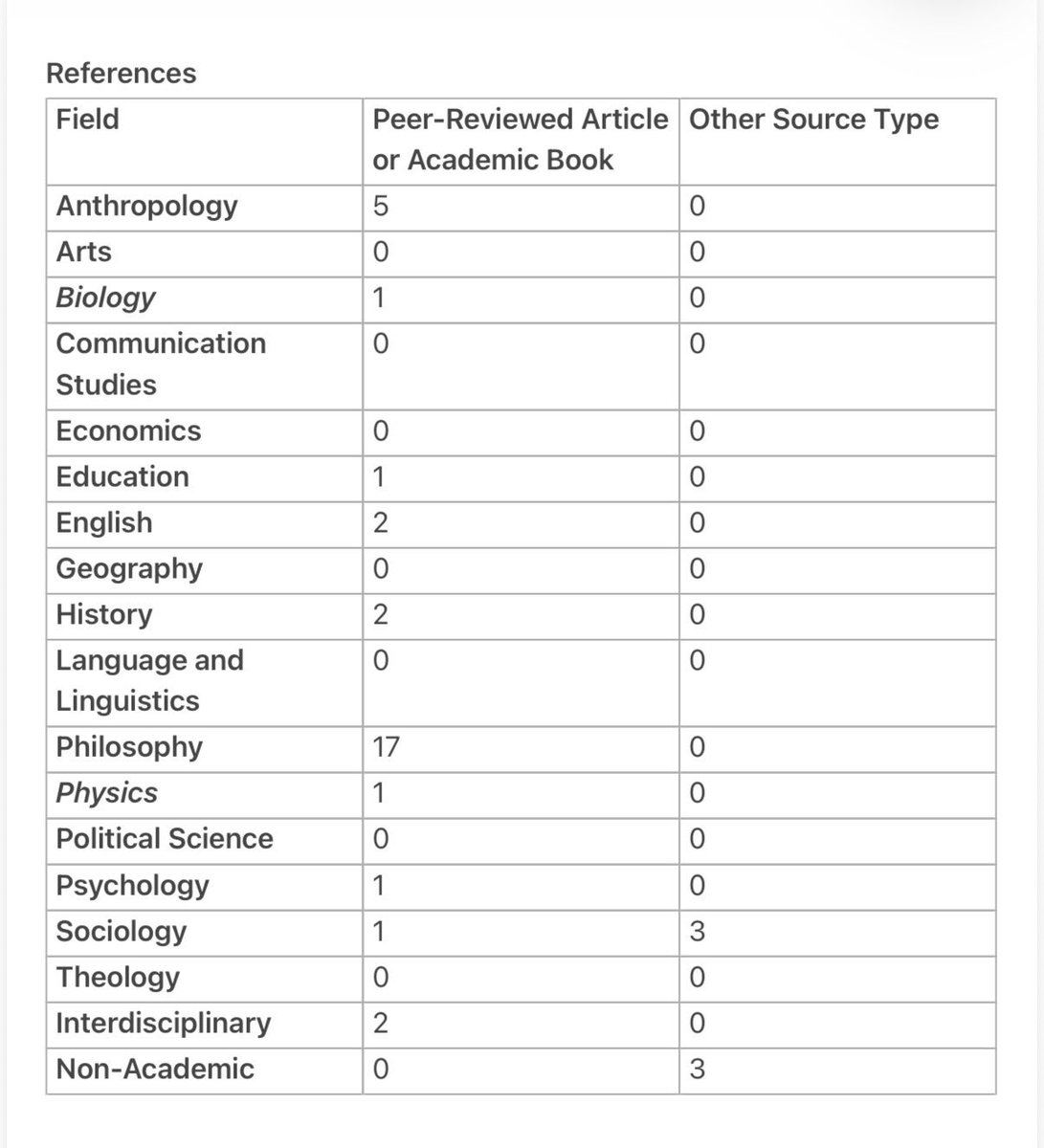
Dug in a bit to the references in that report. Given that they make claims about all of the humanities and social sciences, I wanted to see how various disciplines were represented. This is a quick count and I tried to group a source in the field it was published in.
Ya man, anthro needs to go back to its apolitical roots before it started deteriorating by bringing back phrenology and examining the effects of race mixing on the Aryans
Yesterday we held a memorial service for my father who passed a few days before Christmas. I wanted to share the eulogy I wrote.
https://t.co/4B8HmfKi4Q
@gollum133 That’s a bad faith argument. They didn’t even attempt to see if their belief was prevalent. To solve a problem, you need to understand its significance. It is not Sisyphean to ask people making claims about all of the humanities and social sciences to support their claim.
I want to scream. If you cannot claim it is prevalent or widespread, then you cannot establish that it is the problem you claim it is. What are we even doing?
Irony is dead.
Widely circulated report that slams the humanities for a lack of rigor is ... not itself rigorous.
Humanities certainly have lots of issues, but we can do better than this.
The sheer availability of full text scholarship in many fields makes it possible to build and analyze a huge corpus of scholarship and substantiate claims. That’s way more persuasive than 6 citations coming after 2020.
I am exhausted by the ideological capture argument about the liberal arts. If you are going to make that claim, especially as a sweeping indictment of all of the humanities and social sciences, you need systemic evidence. Old grievances don’t make for good contemporary analyses.