For my stro-peeps only. None of this will make sense to anyone else.
I really love PixInsight.
(See? Stop right here if you don’t already know what PixInsight is.)
I’ve loved it since I first discovered it. I didn’t have quite so hard a time with it as some of my friends because it worked much the way I might have written something like this myself. It felt natural to me.
I spent the 1990s as a computer graphics expert in a different industry, one I’ve returned to in recent years in my day job. At Lockheed Martin, I had a friend who would not shut up about wavelets and multiscale processing. I went to graphics conferences and attended lectures on tone mapping, tackling problems closely related to what astrophotographers call stretching.
When I worked at a medical imaging company, I was curious: “Why are you taking so many pictures and averaging them? How does that improve anything?” I learned about stacking—image integration—and so much more from a generously minded PhD (thanks Ed wherever you are). Convolution and deconvolution were techniques I already knew about, but there I learned how they were being used to model problems with eyesight and to simulate and sharpen images.
When I joined Software Bisque in 2003, they hammered into me—metaphorically—the importance of preserving linear data through the processing stages that depend on it. Much of the amateur processing discussion I encountered revolved around Photoshop. Coming from my background, I kept looking for more of the image and signal processing I knew from other fields. I found The Handbook of Astronomical Image Processing, which was an important discovery for me, published in 2000 and it was promisiing, but few were implementing the core ideas well. Then I discovered PixInsight and never looked back.
Finally. A product that approached these problems in a way that made sense to me. Even after that, I often found more useful, detailed information about the science of low-light imaging in medical papers than in online astro-forums. Thankfully, we had the PixInsight project bringing sophisticated scientific imaging tools to amateur astronomers.
Kudos. Congrats.
One of my favorite soapbox speeches is about how worthless ideas are without execution. The PixInsight team was doing the hard part. They were executing, and executing well. I was happy for them, proud of them, and impressed by them.
I still am.
Recently, they published an open letter making some pretty big claims about astronomical image processing and another application. The letter includes serious allegations that I don’t have firsthand knowledge of. I don’t know enough about that situation to contribute anything useful, and it certainly doesn’t need more noise and speculation from me.
My first thought was to stay out of it.
But there was something they led with, separate from those allegations, that really bugged me. After listing concepts including image integration, robust statistics, and multiscale processing:
“…we created all of them.”
Really? The concept of image integration? Multiscale processing?
Then they make the claim even broader:
“These concepts and techniques didn't exist outside PixInsight.”
That is simply not an accurate account of the history. And we don’t have to leave astronomy to find examples. Bates and Cady described aligning and superimposing astronomical speckle images in 1980. Murtagh, Starck, and Bijaoui published Multiresolution in Astronomical Image Processing: A General Framework, including wavelet methods, in 1995. Bates and Cady, 1980; Murtagh, Starck, and Bijaoui, 1995.
CCDSoft in the 1990's was doing image integration (they just called it sum), and Registax was doing multi-scale processing the day it was released in 2002.
This isn’t a matter of which software we like best. There is a published record. Now, did PixInsight develop original implementations? Build sophisticated tools? Bring these approaches to amateurs in an exceptionally useful way? Absolutely. That’s a huge achievement. It’s why I spent the first half of this post telling you how much I admire the product.
If that is what they meant, then say that.
But developing an implementation and inventing the underlying concept are different accomplishments. The wording in this letter claims the concepts themselves. The word “all” is doing a lot of work there. More than the historical record can support.
The few examples I know of does not settle the history of every item in their list. They don’t. Nor does any of this tell us whether someone copied PixInsight’s work. That is a separate question, and it needs its own evidence. But the blanket claim that these concepts didn’t exist outside PixInsight? That does not hold up.
Some of us encountered these techniques long before we encountered PixInsight. We learned them from other people, working in other fields, who had learned from people before them. That is part of what makes this work so interesting. Good ideas travel. People build on them. Sometimes someone does the hard work of turning them into a product that changes what the rest of us can accomplish.
PixInsight did that. They deserve an enormous amount of credit for it. They don’t need credit for inventing the foundations as well. PixInsight IS great. They DID break new ground for amateurs. We can recognize that, appreciate it, and support their work without rewriting the history.
Their actual achievements are enough.
@SebAaltonen I scored one just before the prices and availability went nuts. It’s a fantastic tool for R&D. Some of my simulations are wonderfully smooth on it compared to my Mac. The occasional game on an 8K monitor is also pretty okay ;)
@NoMansSky This still could be just the iOS release. Petal… metal…. Metal is the graphics API in Apple devices. Could be an engine optimization and iOS release only. I’d love a little spooky expedition though.
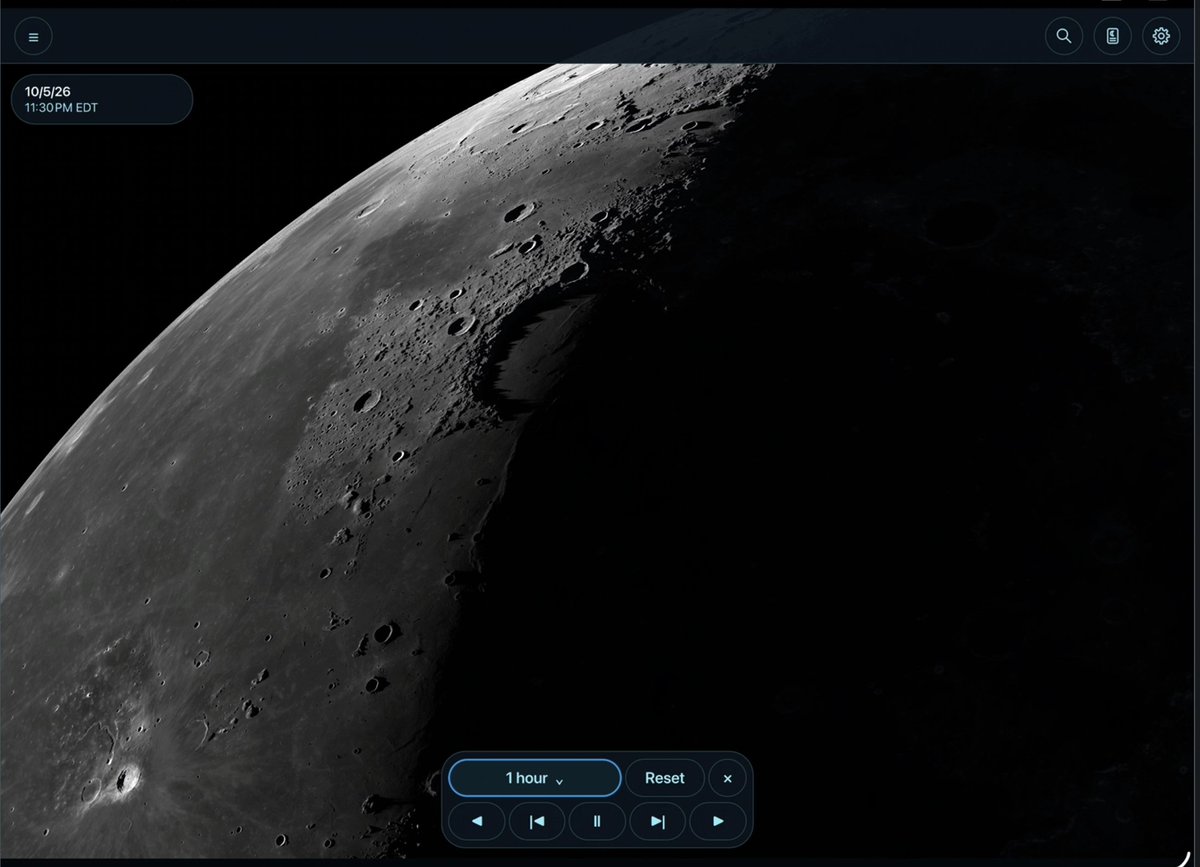
#TheLunartic uses @VulkanAPI for it's rendering and compute to simulate viewing the Moon with a telescope. I added a benchmark to the upcoming desktop version (currently iOS only) and compared performance between LavaPipe, MoltenVK, and KosmicKrisp. There's a lot of compute to trace the shadows, and there's a relief only option without shadows. KosmicKrisp is about twice as fast as MoltenVK for this use case for both modes.
We are a few months from prime Mars observing season, but I wanted to re-validate my Mars rendering in #TheWandersAlmanac. I spent a lot of time making sure Jupiters GRS was correct, so I wanted to make sure Martian features were right too. Here's some comparisons between some images I got from the BAA site taken from Earth by Amateurs and the rendering in my dedicated planet observing app. Okay, that'll do. #Astronomy #Mars
Here’s a sneak peek at a new feature coming soon for #TheWanderersAlmanac and #TheLunartic. You’ll be able to add your own observation logs while scope side. Manage equipment lists, etc.
Updated: The State of Vulkan on Apple – Oct 2026 🍎
KosmicKrisp has passed the Vulkan 1.4 CTS and is now a fully conformant Vulkan implementation on Apple Silicon (macOS 26+ / Metal 4).
Read the refreshed guide on developing for the Apple ecosystem with Vulkan (MoltenVK + KosmicKrisp):
https://t.co/WOTztFCxj0