This year, my mentees matched: Cardiothoracic/Thoracic Surgery (Integrated path), Gen Surg, Triple board certification Peds + Neuro + Developmental, Interventional Radiology, Derm, FM, IM, OBGYN, Anesthesia, PM&R, Child Neuro, Ophtho, Neurology & Psych.
What a year #MedTwitter
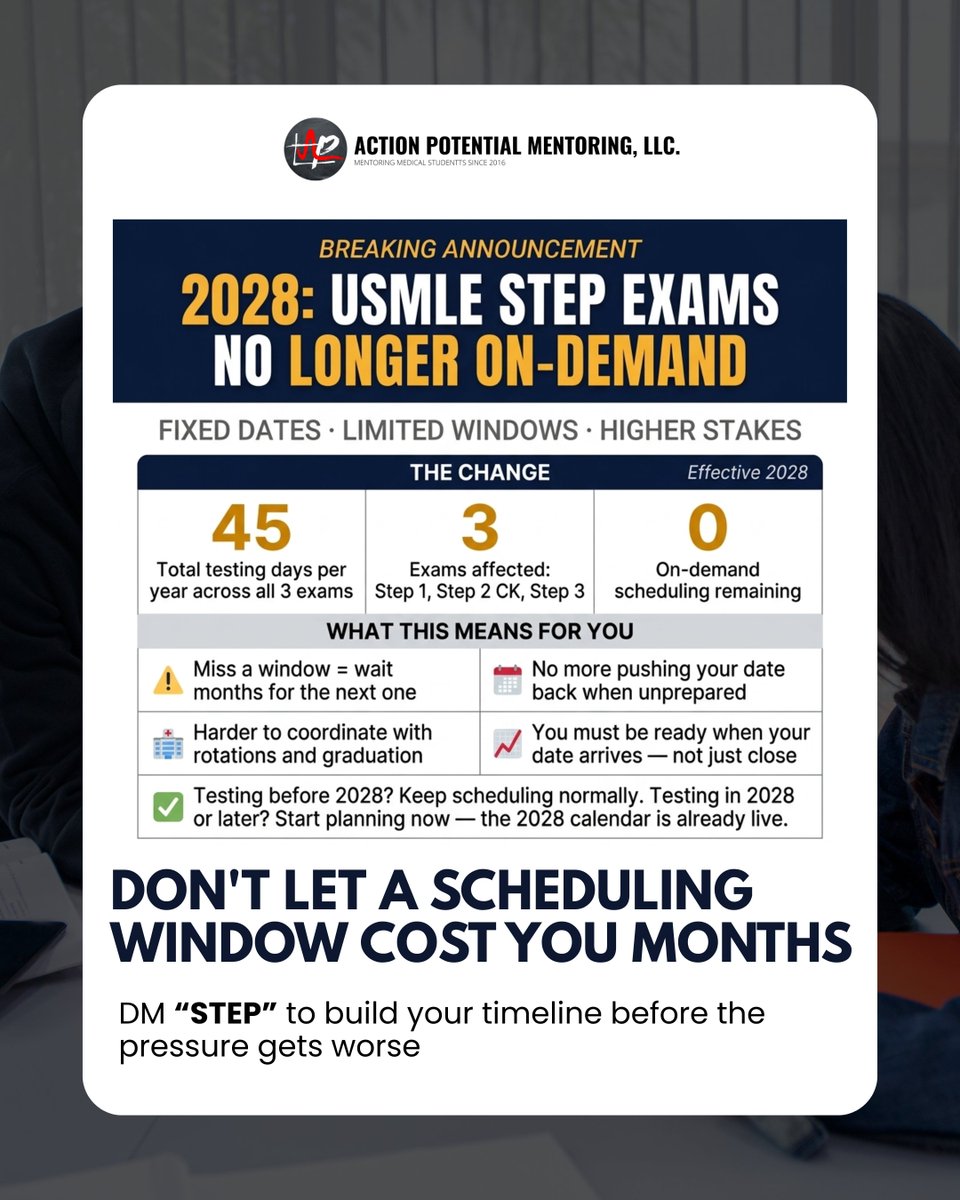
USMLE just announced that starting 2028, Step 1, Step 2 CK, and Step 3 will only be offered on designated testing dates — 45 days total across all three exams for the entire year.
No more scheduling whenever you feel ready. No more pushing your date back a few weeks when prep feels shaky.
Miss your window, and you could be waiting months for the next one. That changes everything about how you need to approach your timeline — especially if rotations, graduation, or residency apps are in the picture.
The 2028 calendar is already out. The students who plan now are the ones who won't be scrambling later.
DM me and let's map out your timeline before the pressure gets worse.
📌 Source: USMLE Designated Testing Dates Information Hub, June 23, 2026
Consider the problem we were handed. A student came to us six weeks out from the exam, stuck somewhere in the 230s despite appearing to do everything correctly. He was completing full UWorld passes, working through his entire Anki deck, and putting in long days, and yet the score refused to move at all.
Every piece of conventional advice had already been attempted, including more questions, more hours, and more flashcards, and none of it had touched the number in the slightest.
The change that finally worked was specific and had little to do with effort, and we will share the result this evening.
#MedTwitter #USMLE #Step2CK #MedStudent #Match2027
One message, one number, and months of disciplined work coming together.
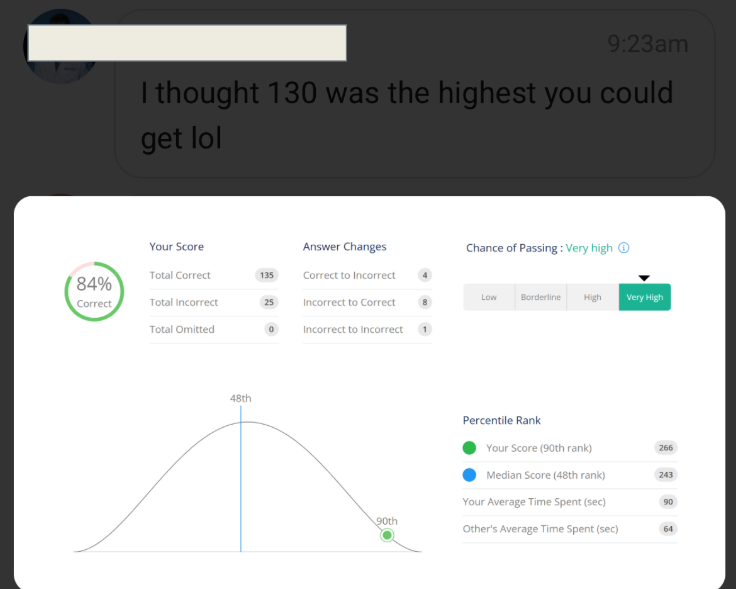
Ella set a goal of 245+ for Step 2 CK. Their UWorld Self-Assessment 2 came back at 248 just days before their exam.
Students often think confidence means feeling calm. It doesn't. Most still feel nervous. The difference is having objective evidence that your preparation is working.
We are opening 11 mentorship places for this weekend!
Send a message with the word "MATCH" and we'll see whether you're a good fit.
Here is a single concept, taught properly.
The system in focus today is the reproductive system.
Polycystic ovary syndrome is diagnosed by the Rotterdam criteria, needing two of three: oligo or anovulation, clinical or biochemical hyperandrogenism such as hirsutism and acne, and polycystic ovaries on ultrasound. Underneath it is insulin resistance, which drives ovarian androgen production, so many patients have obesity, acanthosis nigricans, and a high risk of type 2 diabetes. The unopposed estrogen from chronic anovulation raises endometrial cancer risk. First-line care is weight loss and metformin for metabolic risk, combined oral contraceptives for cycle control, and letrozole for fertility.
That is one pattern among dozens, and we have the complete Reproductive system mapped from end to end, arranged in the order that allows it to hold.
Knowing this fact is only the first step, and knowing where it belongs in your sequence so that it holds by exam day is the part we map out for every student inside mentorship.
#MedTwitter #USMLE #Step2CK #MedStudent #Match2027 #Reproductive
I went from med student to vascular surgeon, and I've coached over 2,100 medical students through the USMLE and COMLEX.
If I had to point to the one thing that changed everything, it wasn't more hours. It wasn't more resources. It was learning how to study in a way that actually compounds.
That shift is what helps my students lift their performance by 43 to 63% on the USMLE and COMLEX.
The process isn't easy. But it is clear once you know exactly what to do.
Want me to walk you through it on a live call, just me and you?
DM me the word "BOARDS" and we'll see if you're a good fit.
📩 DM "BOARDS" to start.
#USMLE #Step1 #Step2CK #MedStudent #MedSchool
A student asked us this earlier in the week:
“How many practice exams should I take before my real Step 2?”
Here’s the honest answer: enough full-lengths to calibrate timing and stamina, but not so many that you burn through fresh material or start memorizing answers. For most students, that means spaced NBME forms with real review days in between, not a stack of back-to-back exams at the end.
The spacing and review quality matter more than the raw number. And every miss should be reviewed by why you missed it, not just what topic it was.
There is a right cadence for every student. Our Scaled Repeatability approach is built for this.
#MedTwitter #USMLE #Step2CK #MedStudent #Match2027
Here is a pattern explained in full.
The system in focus today is the respiratory system.
When you suspect asthma but office spirometry is normal between attacks, the methacholine challenge is the next step. Methacholine is a muscarinic agonist that provokes bronchoconstriction, and a drop in FEV1 of 20 percent or more confirms airway hyperresponsiveness. Asthma is defined by reversible obstruction, so the other confirmatory pattern is a 12 percent or greater rise in FEV1 after a bronchodilator. Contrast that with COPD, where obstruction persists after bronchodilator. The teaching point: a normal office spirometry does not rule out asthma in an intermittent wheezer.
That is one pattern among dozens, and we have the complete Respiratory system mapped from end to end, arranged in the order that allows it to hold.
This is the sort of pattern our students rehearse until it surfaces automatically under examination pressure rather than only on a quiet evening of study.
#MedTwitter #USMLE #Step2CK #MedStudent #Match2027 #Respiratory
A myth worth retiring: You need 10 publications to match into a competitive specialty.
The reality is rather different. Program directors read for depth rather than for sheer quantity, and they pay close attention to whether you can speak intelligently about a project when they ask you about it in an interview. A candidate who has carried two or three substantive projects from question to conclusion, and who understands the methods well enough to defend them, consistently makes a stronger impression than one who lists ten posters they can barely recall. The genuine skill lies in choosing the projects that compound toward your intended specialty while recognising the ones that would quietly consume a year for little return. The Student Strata framework was built to guide exactly that selection, and it remains the part of our system that we keep inside mentorship.
This is the reason that 94% of our students pass on the first attempt and 87% match, an outcome we have refined across more than 2,100 students.
#MedTwitter #USMLE #Step2CK #MedStudent #Match2027
Here is what that work has looked like in numbers: Sarah went from 235 to 268 on NBME 9 in just 4 weeks. Across our students this year, 57 published research, 94% passed on the first attempt, and 96% matched.
We’re opening 20 mentorship spots this week for students who want to make a real score jump before application season.
Send a message with the word "MATCH" and we will look at whether you are a good fit.
#MedTwitter #USMLE #Step2CK #MedStudent #Match2027
Here is a high-yield teaching point worth keeping close.
The system in focus today is the cardiovascular system.
An S3 gallop is a low-pitched sound just after S2, best heard at the apex with the bell in the left lateral decubitus position. It happens when blood slams into an overfilled, poorly compliant ventricle during rapid passive filling. In an adult it is your classic sign of volume overload and systolic heart failure with a dilated ventricle, so pair it with crackles, JVD, and an ejection fraction under 40 percent. Contrast it with an S4, which comes just before S1 and signals a stiff, hypertrophied ventricle as in chronic hypertension. The trap: an S3 can be physiologic in young athletes and pregnancy, so context decides whether it is benign or ominous.
That is one pattern among dozens, and we have the complete Cardiovascular system mapped from end to end, arranged in the order that allows it to hold.
Knowing this fact is only the first step, and knowing where it belongs in your sequence so that it holds by exam day is the part we map out for every student inside mentorship.
#MedTwitter #USMLE #Step2CK #MedStudent #Match2027 #Cardiovascular
Marcus used this approach to move from a 219 baseline to a 266 practice score over 8 weeks, mainly by reorganizing how he reviewed mistakes rather than just doing more questions!
Application season is heating up, and there is a part of this process that very few people explain. Here is a thread on why scores tend to stall and what genuinely moves them.
The element that ties all of this together is the Reverse Pyramid Protocol, which is the piece we keep inside mentorship because it is the piece that does the real work!
Your weaker systems deserve early and repeated exposure across the schedule, so that they have time to settle into durable memory well before the exam arrives.
You should review your mistakes by type of error rather than by topic. Missing a renal question because you misread the stem is a different problem from missing it because you never learned the FENa cutoff, and the two require different remedies.
Working blindly through more questions stops helping past a certain point because the brain begins to recognize the item it saw last week rather than reason through it. The additional repetitions feel productive while accomplishing very little.
Most students who stall are limited by the order in which they learned the material rather than by any real gap in their knowledge. They understand more medicine than their score suggests, yet they learned it in a sequence that never allowed it to consolidate.
Microbiology has 400+ organisms. You don't need to memorize all of them; you just need to recognize
patterns.
Here's the pattern-recognition framework that makes boards micro finally click 👇
https://t.co/6T7sf03kD1