This year, my mentees matched: Cardiothoracic/Thoracic Surgery (Integrated path), Gen Surg, Triple board certification Peds + Neuro + Developmental, Interventional Radiology, Derm, FM, IM, OBGYN, Anesthesia, PM&R, Child Neuro, Ophtho, Neurology & Psych.
What a year #MedTwitter
Most people don't know this about Dr. Austin Price
He didn't start as the top one to two percent. He started at the bottom.
And that's exactly why 2,100+ students have trusted him with the thing they're most afraid to fail at.
Step 1. Step 2. Step 3. Shelf exams. Research. Match strategy.
It's all inside Action Potential Mentoring, built by someone who has been where you are and figured the way out.
Follow along!
Your breakthrough is closer than you think
Nobody handed me a resource list when I started USMLE prep. So I made one
Swipe through the full toolkit I swear by as a mentor 👇
https://t.co/vfjZLhH4zy
The score doesn't scare me. The mindset does👀
I've worked with students scoring 40% on practice questions who went on to crush their boards. Why? Because they had the one thing you can't teach: that fire in their chest when they see someone outworking them.
That feeling? That "oh shoot, I need to push harder"? That's everything.
When you surround yourself with people who are going all in, something shifts. Success stops being a maybe and starts being inevitable.
Here's the thing though. I'm not for everyone. If you're not the type who's constantly chasing better, we're probably not a good fit. And that's okay.
I only want to work with the ones who are hungry. 🔥
Are you that person? Drop a 👇 below or send me a message and let's talk.
What frustrates me most watching students prep for Step 2 CK is how late they realize the exam is not what they thought it was.
They find out mid dedicated, sometimes after a practice test tanks, and by then the pressure is compounding and the options are limited. It is not that they were lazy or unprepared, it is that nobody told them early enough that this exam rewards a completely different skill set than anything they have tested on before.
The information to prepare the right way exists but most students never seek it out until it already feels urgent and that is exactly when it is hardest to pivot. You do not have to be that student. DM me UNLEASH and let's get on a free quick call before you get to that point.
Hypersensitivity reactions: the framework boards test constantly
Type I (Immediate/IgE): anaphylaxis, asthma, allergic rhinitis
→ Mast cells + IgE + allergen → histamine release
Type II (Antibody-mediated): hemolytic transfusion rxn, Graves', myasthenia gravis, Goodpasture
→ IgG/IgM attack cell surface antigens
Type III (Immune complex): serum sickness, SLE, post-strep GN, polyarteritis nodosa
→ Ag-Ab complexes deposit in vessels → complement activation → inflammation
Type IV (Delayed/T-cell): TB skin test (PPD), contact dermatitis, MS, Type 1 DM
→ Sensitized T cells → cytokines → NO antibodies
Key: Type IV = only one with NO antibody involvement.
🔖 Save this
The identity shift most people don't talk about in medicine:
You enter training as 'the smart one.'
For most people, that identity has defined their entire life until this point.
Med school reliably strips that identity away.
The students who navigate it best aren't the ones who hold onto the identity.
They're the ones who build a new identity around learning, not knowing.
been hearing the same thing over and over lately:
“i’m studying all day but my scores still aren’t moving.”
want to hear directly from students and see where the disconnect actually is.
My opinion: the real 2026 “syllabus” is no longer just content
It’s pacing, rhythm, and mental reset speed.
The students who win will be the ones who practice short blocks, not long scrolls 🤛
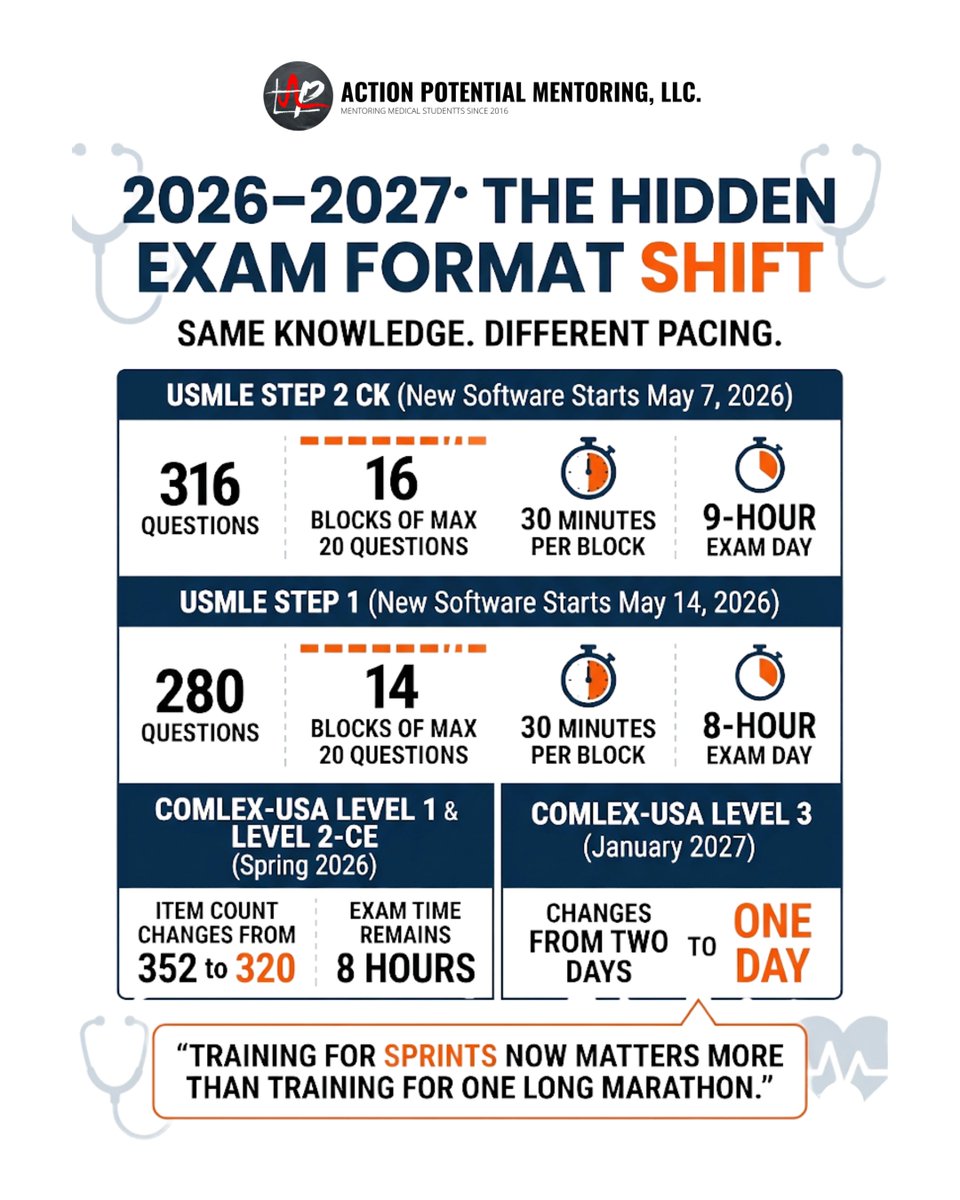
2026 USMLE/COMLEX update you’re not talking about: the exam is no longer one long marathon.
New block structure + shorter sprints = a fatigue curve that quietly changes how you lose points.
COMLEX is quietly doing the same thing structurally:
Level 1/2: cut from 352 to 320 questions in Spring 2026
Level 3: moving from two days to one day in January 2027
Fewer items + shorter exam = less room to recover from a bad block
Each block is a mini exam: you can’t go back once it’s closed, and the mental reset before each one suddenly matters way more than “overall stamina.”
This is where students who prep with long mock marathons get exposed.
The new USMLE software launches May 7 (Step 2 CK) and May 14 (Step 1), 2026.
Content, total questions, and total exam time stay the same, but you now get more 30‑minute blocks.
I've noticed something after years of mentoring:
The students who grow fastest aren't the ones who ask the most questions. They're the ones who come back after trying something with specific feedback on what happened.
"I tried what you suggested, here's what worked and here's what didn't"
That specificity is what makes a mentoring relationship compound!
You're going to sit down on exam day having prepared for months.
And you will still see questions that make you pause.
That's not a sign you're underprepared.
It means the exam is doing its job: testing whether you can reason through the unfamiliar.
Stay in the question
Reason out loud in your head
Trust the mechanism