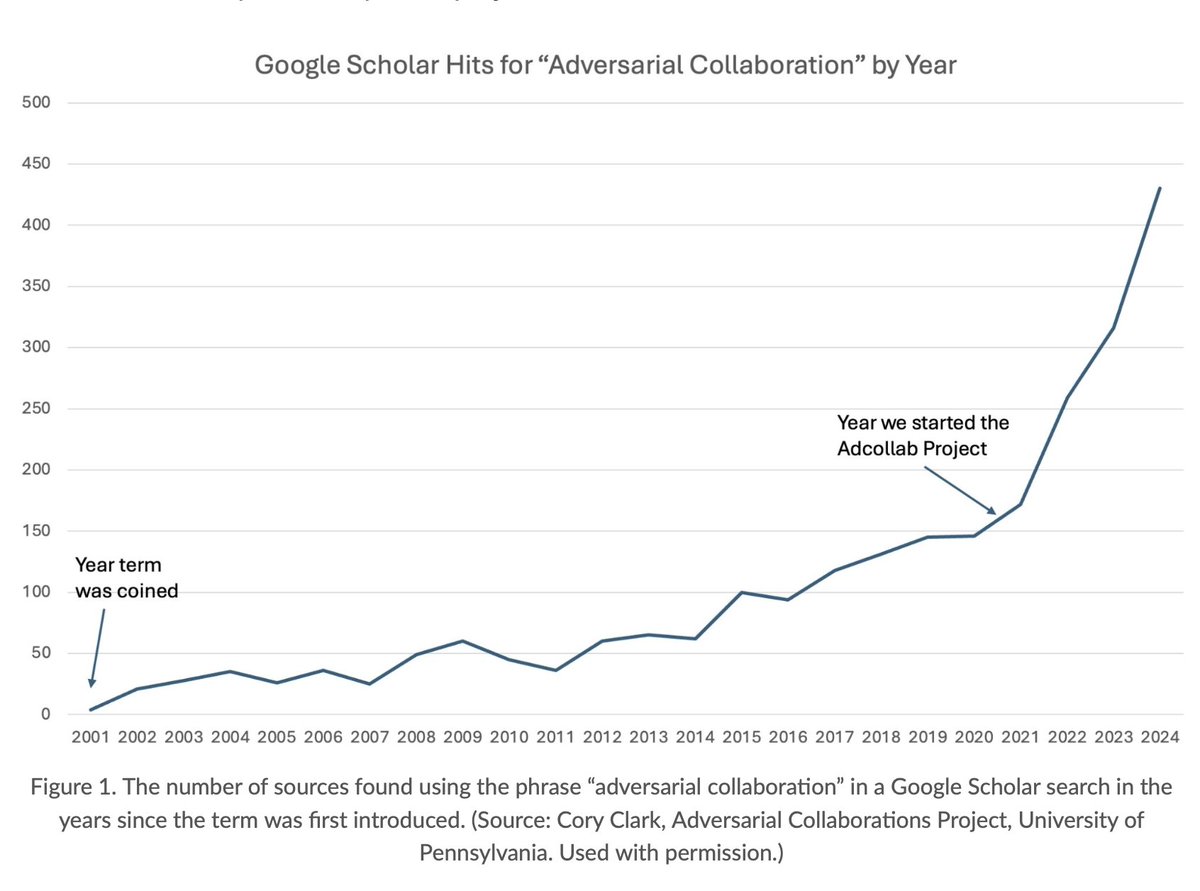
"The adversarial collaboration movement is still quite new, but there are some early indications that it is both valuable and growing in popularity."😎
https://t.co/hFTGUpNtm2
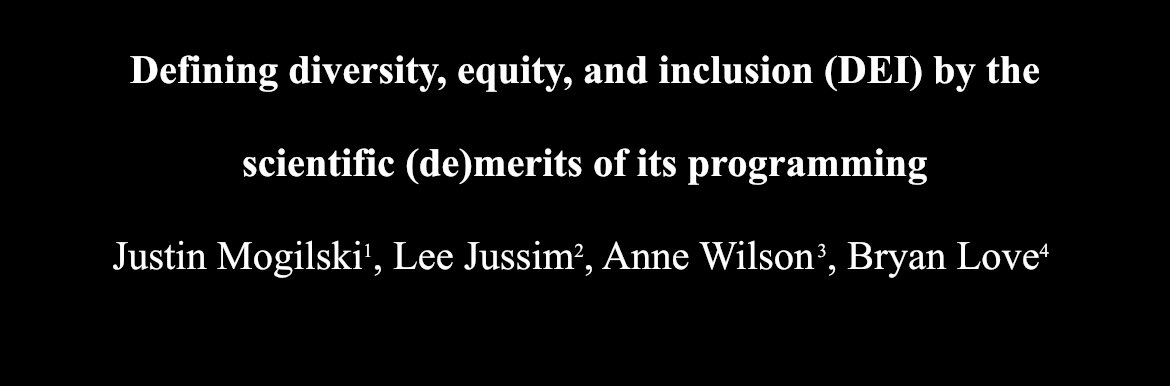
Months ago I began an adversarial collaboration with Drs. @PsychRabble, @awilson_WLU, and Bryan Love to make sense of DEI public discourse.
Today our paper was accepted at @Theory_Society.
We suggest a scientific standard for adjudicating the (de)merits of DEI 🧵👇
Insights from 29 scholars who have completed adversarial collaborations (ACs):
1. Humility is a must
2. ACs are hard but produce high quality science
3. Participating in ACs may shake your faith in non-AC science
By @calvinisch2@PTetlock@ImHardcory:
https://t.co/9WK1j4CeqB
Excited to explore whether there is "too much" intellectual humility in the context of conspiracy belief with one of my favorite colleagues (turned research adversary🙃)! Thanks to UPenn's Adversarial Collaboration Project for the opportunity.
An honest reflection on adversarial collaborations by @APA_Monitor:
They are hard. Current incentives in science are misaligned w/adcollabs. But they are less intimidating than they seem. Adversaries become friendlier, & teams mutually assimilate new data:
https://t.co/o9iH9mIRyY
1. In 2003, Kahneman published an article in American Psychologist describing the magic of collaborating with Tversky but also lamenting how current modes of scientific disagreement were unnecessarily hostile and unproductive. He hoped for a better way: Adversarial Collaborations
🚨Out in Psych Sci🚨
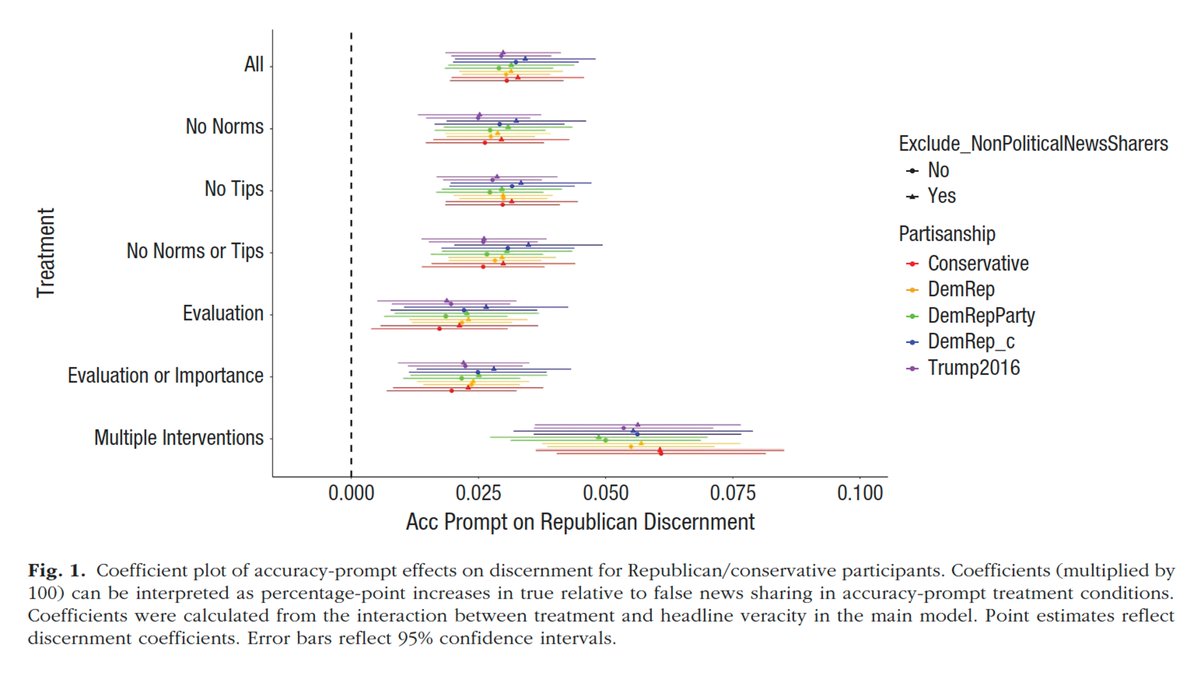
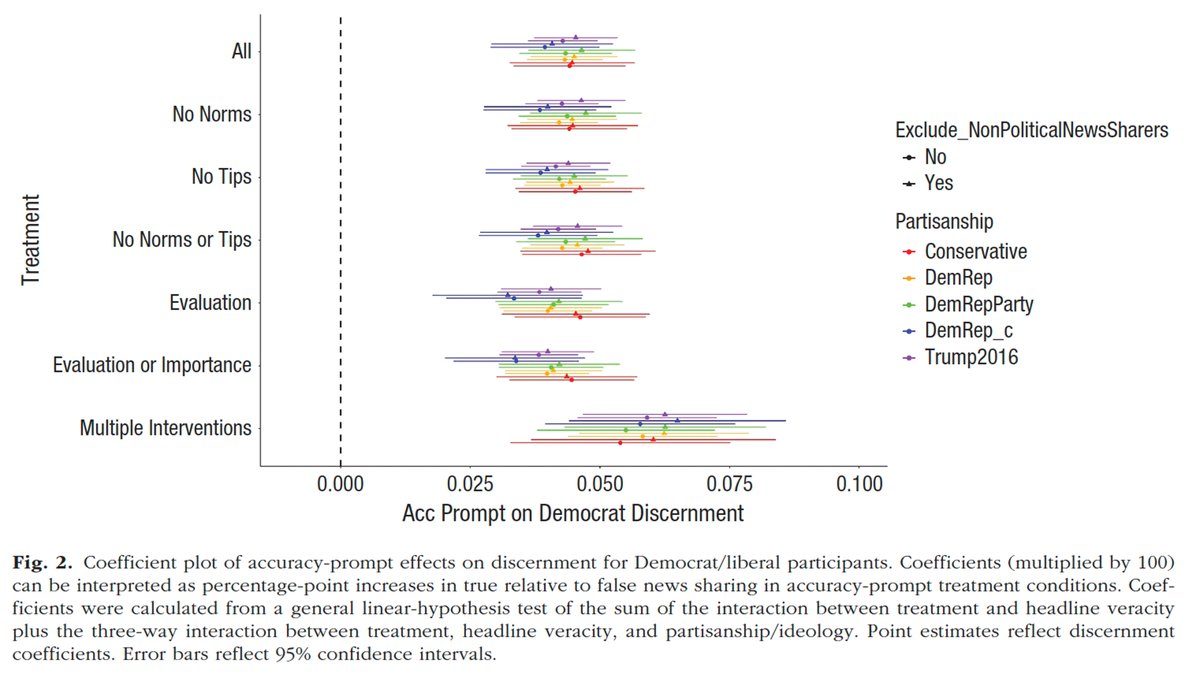
Prompting accuracy can increase news sharing quality -but is this true for those on the political right?
Our ADVERSARIAL COLLABORATION finds:
➡️Acc prompts increase sharing quality of Republicans
➡️Some evidence of greater efficacy for those on left v right
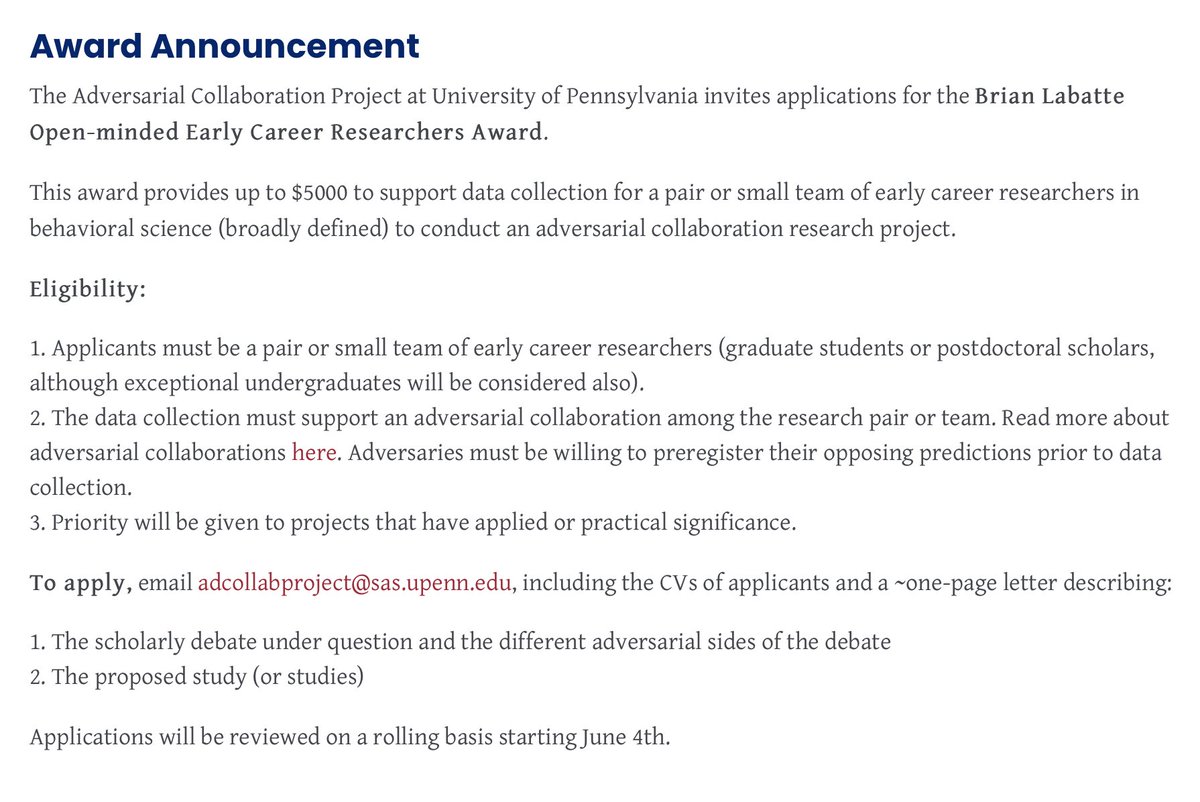
1. We are pleased to award the Brian Labatte Open-minded Early Career Researchers Award to @MaxPrimbs and @paulrconnor, who will be conducting an adversarial collaboration on the Bias of Crowds model of implicit bias. Congrats both! 🥳 We look forward to seeing your results!
Pairing of ideologically opposed academics should become sector norm when reseachers disagree, says @AdCollabProject leader @ImHardcory
https://t.co/ebNlx8n8ob
Our first adcollab project to make it to preprint!
We explored ideological differences in cognitive rigidity. As often will be the case with adcollabs, we found that context matters. Broad claims about who is more rigid are probably too broad.
This was my first time serving as a moderator for an adversarial collaboration, and the whole process was such a treat. We examined three major political psychology theories. See below for what we studied and found! https://t.co/0t4TRrWKTO
This was my first time serving as a moderator for an adversarial collaboration, and the whole process was such a treat. We examined three major political psychology theories. See below for what we studied and found! https://t.co/0t4TRrWKTO
1. Scientific institutions incentivize scholars to forward excessively broad and superficially novel claims that appear to contradict peers’ claims, creating unnecessary conflict, confusion, and inefficiency in the scientific discovery process: https://t.co/QV6a929Lkq
The role of social media on individuals and society has been a spicy debate.
If you have strong opinions on this issue, please sign up to join our project--we can turn this into a global adversarial collaboration!
Be ready to prove yourself wrong :)
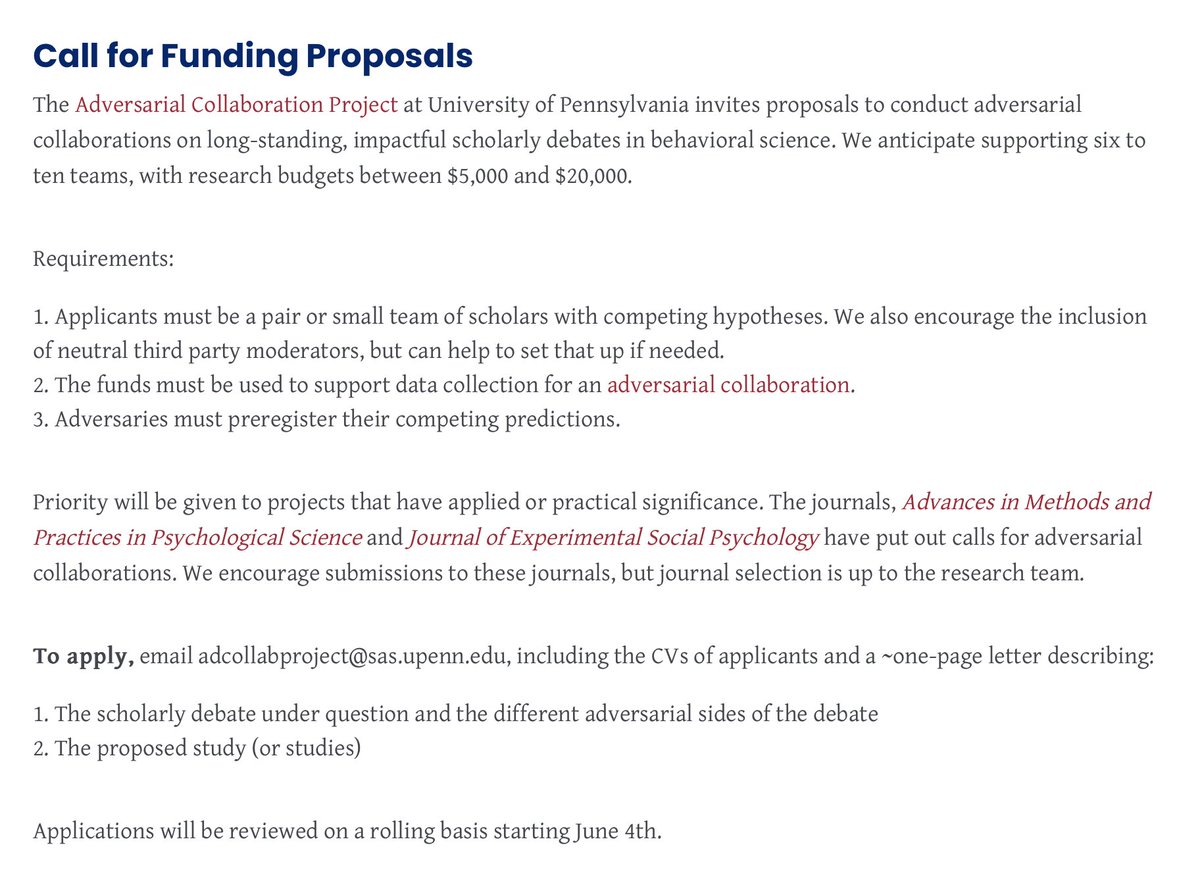
Nutrition researchers & adcollab enthusiasts, join @nutritionorg & @ImHardcory (director of the @AdCollabProject) on Nov 10 at 4pm ET to learn how adcollabs can advance nutrition research (and about an funding opportunity).
Free registration:
https://t.co/Aibg0e7DDX
Misinfo researchers, what do you see as the major controversies / points of disagreement within the field currently? Plz share widely to see what we come up with - thanks!