New on @BritBlueprint: Britain has become too lawyerly for an age that rewards builders.
Dan Wang’s Breakneck argues China builds while America argues. Britain has the same problem — not through litigation, but through process. The institutional accumulation of consultation, clearance, challenge, and review.
Britain doesn’t need fewer arguments because arguments are un-British. It needs fewer arguments because too many of them now function as substitutes for action.
https://t.co/23ecU1wk0e
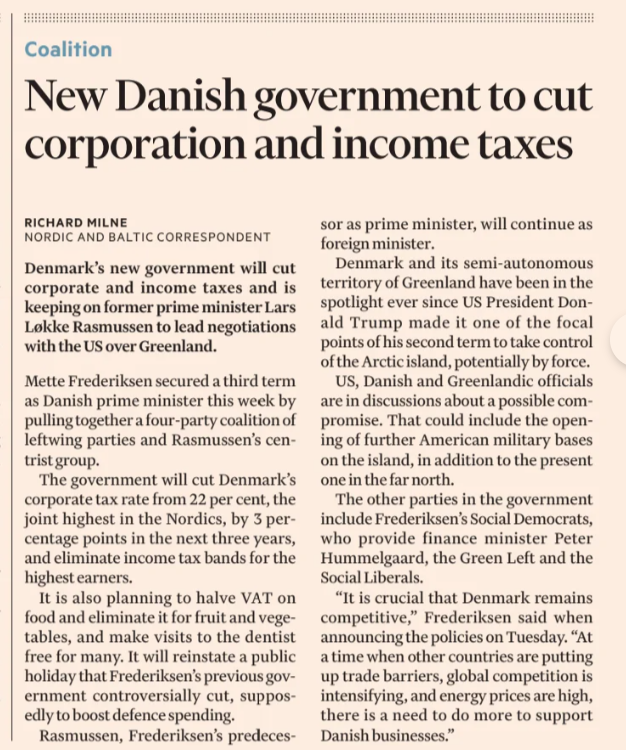
The new Danish government is cutting the corporation tax rate from 22% to 19% over three years, and eliminating income tax bands for the highest earners.
“It is crucial that Denmark remains competitive,” Prime Minister Frederiksen said.
It's sad that the British government does not have a similar attitude.
Most blockchain networks today still rely on a limited group of high-performance nodes to validate transactions and keep everything running.
That usually means expensive hardware, technical setups, and a barrier for everyday users who just want to participate.
@Minima_Global takes a very different direction.
The idea is simple but powerful: what if every device could be a full node?
Not just powerful servers but everyday devices like phones and IoT hardware becoming part of the network itself.
That changes the structure of participation completely.
➤ More users can contribute to network security
➤ Validation is distributed instead of concentrated
➤ The network becomes more resilient by design
➤ Participation is no longer limited to specialists
Instead of blockchain being something “out there” in data centers, it starts to live closer to where data is actually created at the edge.
That’s where @Minima_Global’s approach becomes interesting, because it shifts blockchain from centralized infrastructure into everyday digital environments.
As more devices connect globally, this model could redefine what true decentralization looks like in practice.
Not just theory.
But infrastructure anyone can run.
🔗 https://t.co/7BUolgXK2d
Yann LeCun proposes a brilliant idea.
And he wants the AI industry to stop building "AGI"
For years, every major tech company has been chasing Artificial General Intelligence, a single, massive AI that can do absolutely everything a human can do.
Turing Award winner Yann LeCun and his co-authors published a paper that completely destroys this approach.
He argues the entire concept of AGI is scientifically and philosophically flawed.
Why? Because humans aren't actually "general."
We suffer from a massive biological blind spot. We think we possess general-purpose intelligence only because we cannot comprehend the tasks we aren't evolved to do.
Our brains were not designed for complex mathematics, massive data processing, or scientific research. We are simply highly specialized biological machines.
So why are we forcing AI to mimic our limitations?
LeCun's paper introduces a radical pivot: Superhuman Adaptable Intelligence (SAI).
Instead of building one bloated model that can write poetry, drive a car, and predict protein structures—and doing all of them mediocrely, we must embrace specialization.
When multiple tasks compete for the exact same neural capacity, their gradients conflict. The performance drags.
Forcibly pursuing generality is an inefficient, unscientific trap.
The AI that cures cancer should not be the exact same AI that does your taxes.
Under the SAI framework, AI doesn't need to imitate humans. It needs to learn the underlying structure of the world and surpass us in the specific, critical areas where human cognition hits a wall.
What would it take to create the SpaceX of Nuclear, cutting costs by 10x?
For rockets, the answer was obvious: Make them re-usable.
What is the equivalent insight for reactors? 🧵
"You can't build nuclear quickly"
Built our first 10 MW-scale reactor and facility from bare dirt in 5 months.
"You can't build nuclear affordably"
Only spent $70M in our company history. Includes our real reactor & facility, fuel, prototypes, factory & equipment, payroll, regulatory costs, etc.
"You can't build small nuclear at scale"
🔜 About to build out our 1,000,000 sqft factory space.
More to come.
1/6
Financial Times: "A company-level OECD analysis of government subsidies across 15 key industrial sectors found that nearly 60 per cent of Chinese firms’ global market share gains since 2005 could be attributed to subsidies."
https://t.co/o2mcZeaagi
Britain had a moment of silence for George Floyd. Our politicians kneeled en masse to show their outrage at his killing. "I can't breathe" became a slogan.
George Floyd died on the other side of the world. He wasn't British.
Henry Nowak *was* British and his treatment by the police was shocking and negligent in the extreme. Yet there is no minute of silence. There is no coordinated public campaign. There is no kneeling at sporting events.
And we all know why.
During the summer of BLM, some people said "All Lives Matter". This was treated as the highest form of racism and anyone who said this was immediately cancelled. Why? Because the people in charge don't actually think all lives matter in the same way.
They have created a racial hierarchy of victimhood where a career criminal who died through mistreatment by police in a foreign country with 0 evidence of racism like George Floyd is automatically sanctified because of the colour of his skin.
And Henry Nowak, a British man, one of ours, is automatically dismissed and ignored because of the colour of his.
This is the ugly fruit of so-called "anti-racism", an obsession with race that has created a two-tier society which treats people differently because of the colour of their skin.
This needs to stop.
Conventional wisdom says that leaving the European Union has harmed the British economy.
Listen to almost any Brexit debate – over the airwaves or on the professional conference circuit – and it’s invariably taken for granted being outside the EU has done serious economic damage.
Now we're in June, and as the 23rd approaches – the ten-year anniversary of that hotly-contested, era-defining referendum – this message will be rammed home again and again.
But it simply isn’t true.
My latest "Economic Agenda" column in @Telegraph
🧵1/7
https://t.co/3x1C903R8n
Here are the top 20:
1. DEBT: Bring down debt with a new fiscal rule saying that, outside emergencies, public spending will not grow faster than the economy.
2. WELFARE #1: Remove mild/moderate anxiety, depression and musculoskeletal conditions as criteria for claiming benefit and replace it with a guarantee of rapid NHS treatment as happens in Denmark.
3. WELFARE #2: Cap the DWP benefits budget just as defence and NHS budgets are capped. Otherwise the DWP has little incentive to find savings or stop abuse.
4. WELFARE #3: Devolve administration of the welfare system to elected mayors allowing them to keep a proportion of any savings made.
5. WELFARE #4: Require face-to-face benefit assessments with no telephone applications except in exceptional circumstances.
6. WELFARE #5: Replace the triple lock with a guarantee the state pension will always match inflation.
The only thing that stops violent men from raping you and your society are other men who are equally willing to be violent in stopping the rapists. The West has decided that the highest virtue is to quietly comply with the destruction of your civilization because to do otherwise is bigoted toward the rapists. It really is that simple.
the only thing @AndyBurnhamGM will achieve if he gets elected is to increase the moron premium on the £3 trillion national debt - thus making us all poorer and accelerating the doom loop the UK is caught in due to our deeply incompetent politicians
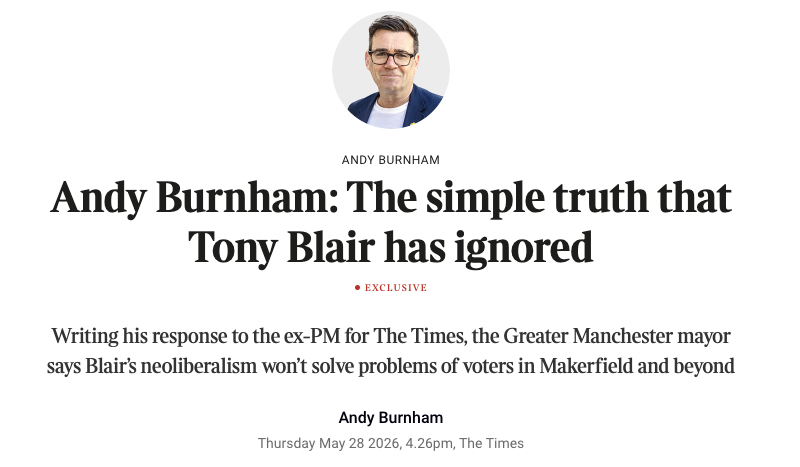
Andy Burnham's response to Tony Blair, just published in @thetimes, is a pretty frightening reflection on the man now at the front of the pack to be the next Prime Minister.
He understands the public's frustrations, but lacks a serious plan to fix Britain, instead leaning into boring old tropes.
⬇️
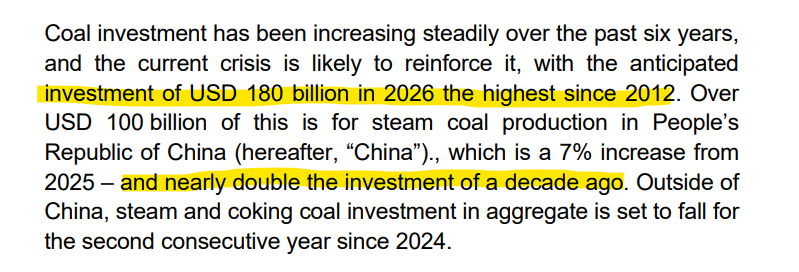
Coal is so consigned to history (COP26 in Glasgow dixit) that investment will rise in 2026 to a 14-year high, according to a @IEA new report.
The bulk of the investment will happen in China, which is putting money into coal at nearly **double** the rate of a decade ago.
Yes, I get it, you all hate Tony Blair etc you’ll find loads to disagree with here I’m sure - but the quality of analysis of our problems and what any potential leader ought to be thinking about if they want to solve them puts this essay light years ahead of what any current contender for national leadership has offered. Anyone who wants to be an effective prime minister (including the current one) should read it
Keir Starmer should rip up Ed Miliband’s “unnecessary” net zero agenda, Tony Blair tells #TimesRadio.
“It’s not that I'm a climate denier, but it's just coming to terms with this reality.”
@CalumAM
"On an admirably clear podcast from the IFS, asking 'why is UK electricity so expensive?', Dieter Helm pointed to the basic impact of doubling the capacity on the grid to 120GW to accommodate intermittent renewables plus backup gas generation."
https://t.co/KGeFdztjQ1
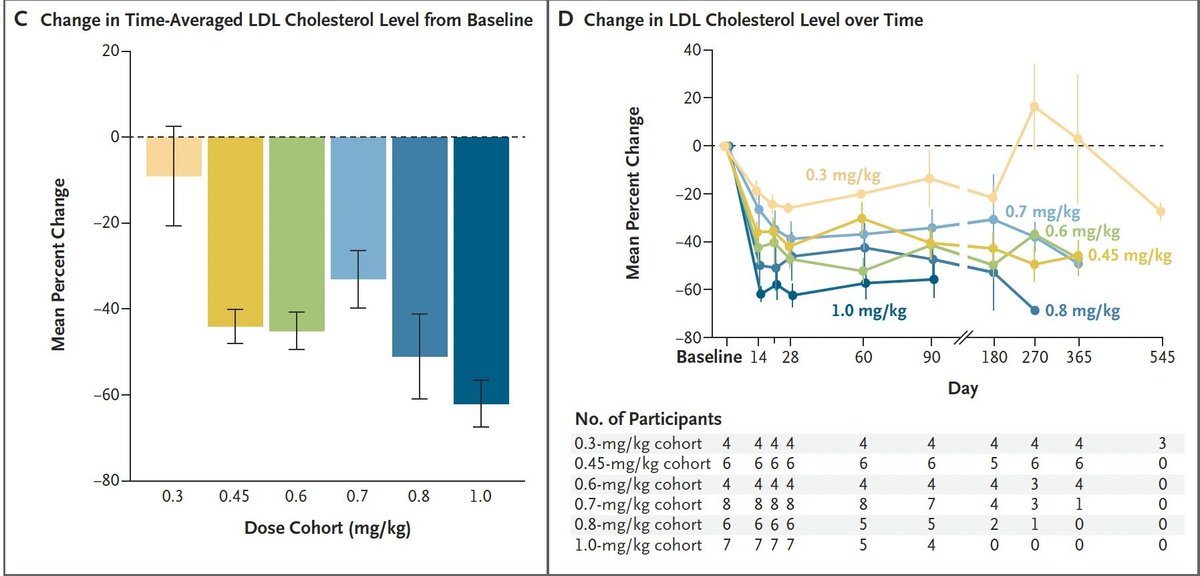
Eli Lilly has done it.
They've gone and made what seems to be a powerful, permanent gene therapy for LDL cholesterol.
That means they'll be able to effectively prevent most heart disease with a single infusion!
Reform UK wants to abolish income tax on overtime.
It sounds like a tax cut for hard work. Actually a tax cut for the word “overtime”.
So little GDP impact & huge cost - we reckon £14bn not Reform's £5bn
If you want to spent £5bn on tax cuts, we have ten better ways:
🧵
We haven’t built houses where we need them so have bad labour mobility and that kills productivity. and we’ve had higher power prices than our peers and that kills investment and growth. And we’ve had plenty of low cost labour due to mass immigration and that blunts the incentive to invest in labour saving productivity