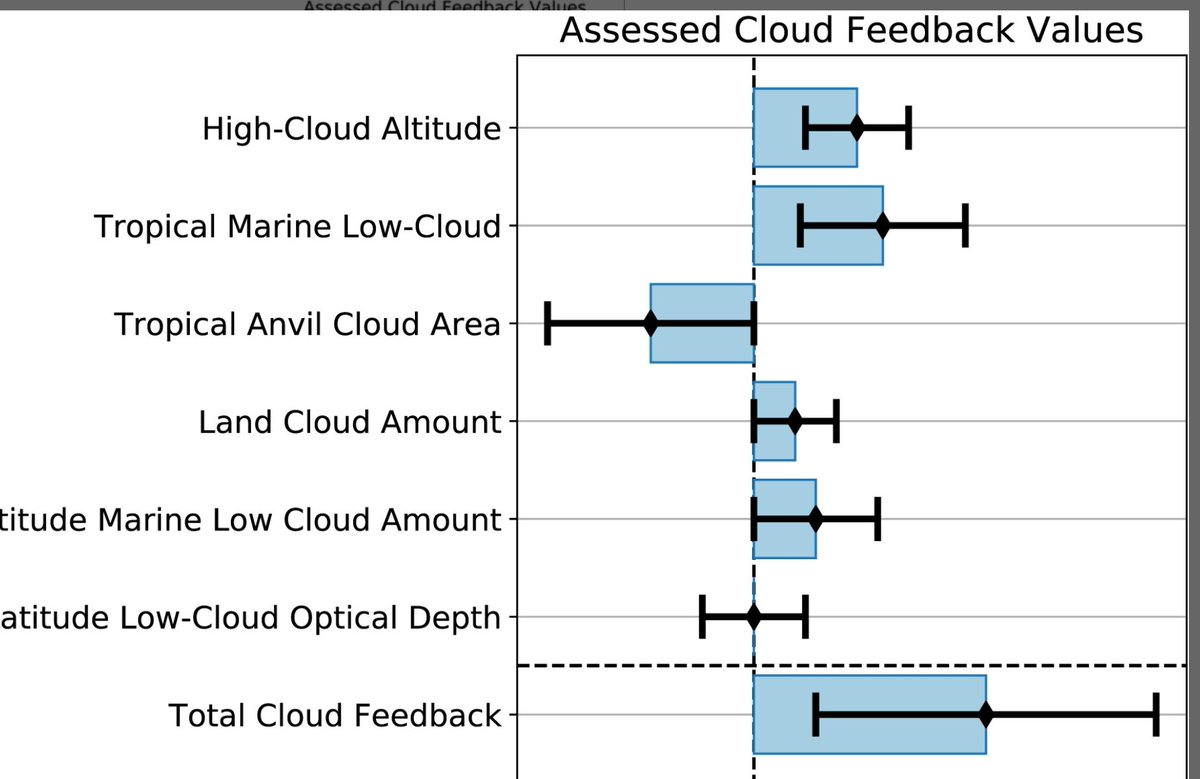
Science in action: in 2020 the Sherwood et al WCRP review estimated a -ve anvil cloud area feedback, but with large uncertainty. Now 3 papers out ~simultaneously have found a weak, +ve anvil cloud feedback using observations, high res models and simple theory
...completely different lines of evidence. As we write in the paper, this result makes physical sense based on our knowledge of high cloud evolution.
Altogether, the 3 papers suggest that, other than the FAT feedback, anvil clouds are more or less neutral for climate change.
Our new paper on tropical cloud feedbacks is out in @NatureGeosci. We show that changes in high cloud area do not provide a negative feedback on climate change like previously thought. Instead, high clouds become thinner with warming, which acts as a...
https://t.co/ecJhEejmpJ
...weakly positive feedback. This implies an increase (~0.3°C) in climate sensitivity relative to previous assessments that included a large, stabilizing feedback from anvil clouds.
Two other papers out this month, from @rshivpriyam & Brett Mckim, find a similar result from...
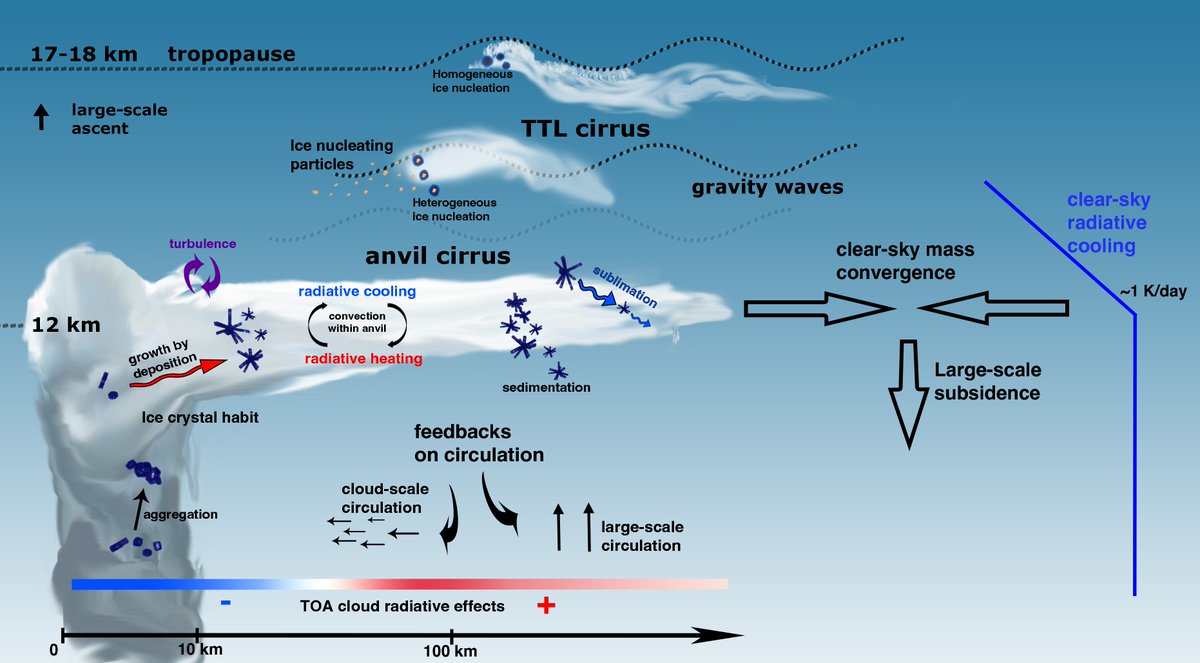
Another belated tweet; we've put together an opinion/opinionated review(?) on tropical cirrus, including their microscale and large-scale processes and feedbacks. Time is ripe to reduce those large uncertainty bars!
Under discussion for ACP:https://t.co/awWTKah339
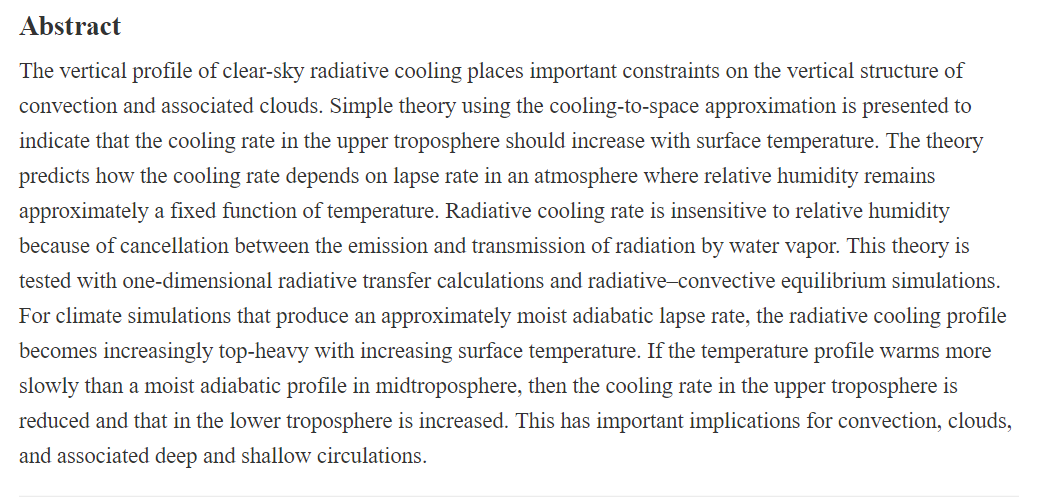
Hartmann, Dennis L., Brittany D. Dygert, Peter N. Blossey, Qiang Fu, and Adam B. Sokol (@AdamBSokol). "The Vertical Profile of Radiative Cooling and Lapse Rate in a Warming Climate", Journal of Climate 35, 19 (2022): 2653-2665, https://t.co/q6FM6lCoEW #JClimate
While this doesn't explicitly tell us about changes in high cloud amount, it could (w/ more work) offer an explanation for reduced anvil coverage that is distinct from the Stability Iris. Either way, it's one more piece in the puzzle of tropical convection.
New paper with Dennis Hartmann is out! We use theory and a cloud-resolving model to look at the response of tropical cloud ice amount to warming. https://t.co/qIPl4ZtZq2
This is an increase in “latent heating efficiency”—you get more latent heating for the same *climatological* ice amount. The increase is rooted in basic warming physics (complicated microphysics...no thanks) and agrees with trends in macrophysical Precip Eff found by others.
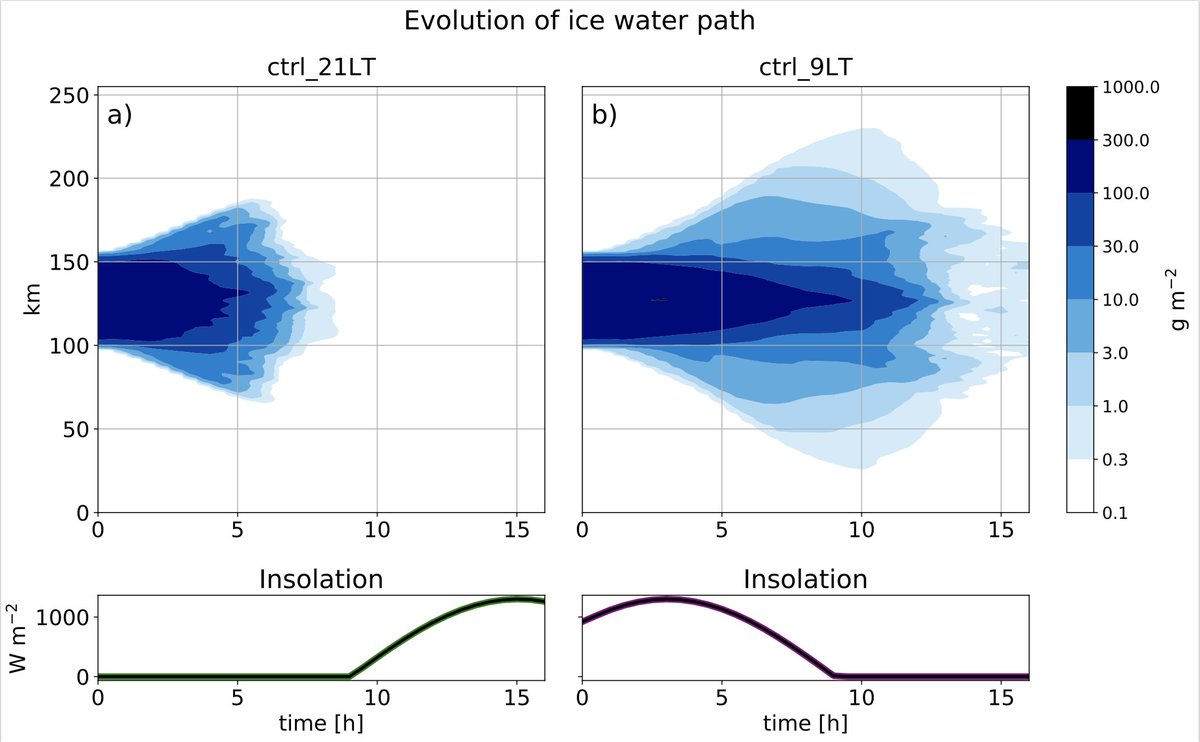
Daytime anvils in the tropics are longer-lived and more widespread than their nighttime counterparts. A cloud initiated at 9 pm will have a significantly different evolution from the one initiated at 9 am (as shown in SAM model simulations).
(sound on) Check put my PhD research! I am pioneering the study of interactions between tropical convection and top-20 hits from the 2006 UK singles chart
My first paper is out! We find that the anvil clouds produced by tropical convection evolve towards a preferred form. What could this mean for future changes in tropical high cloud amount?
https://t.co/Lhe0DTdCx4