$DBX
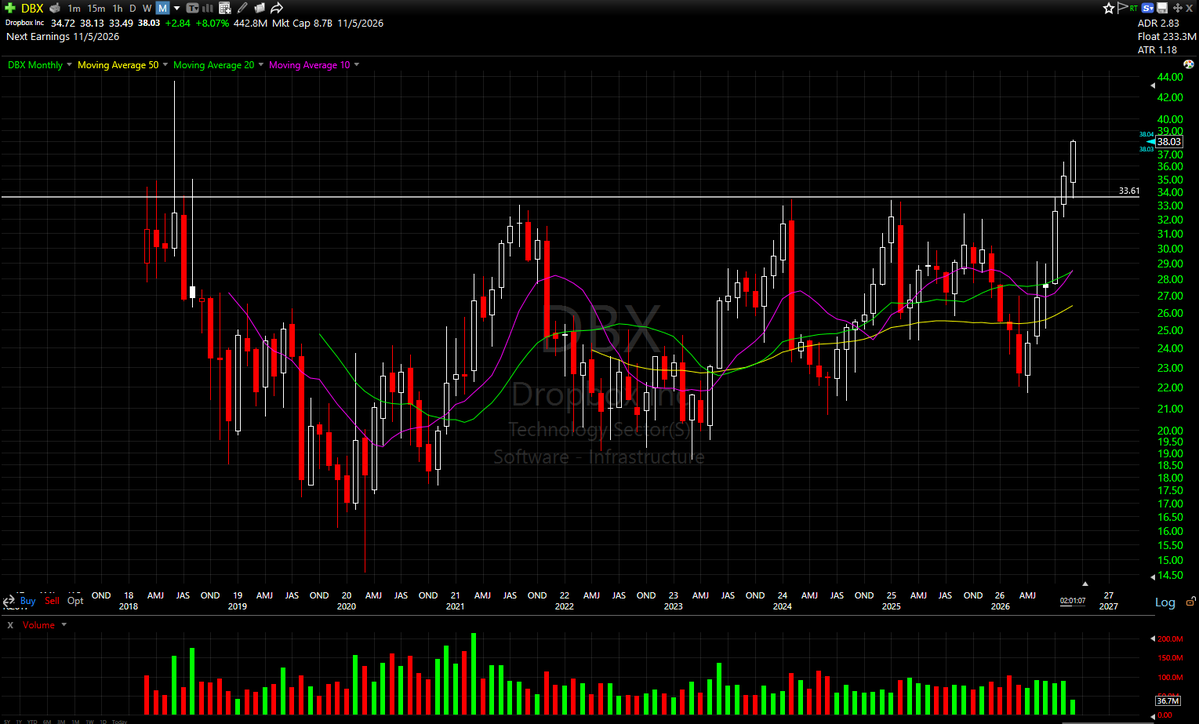
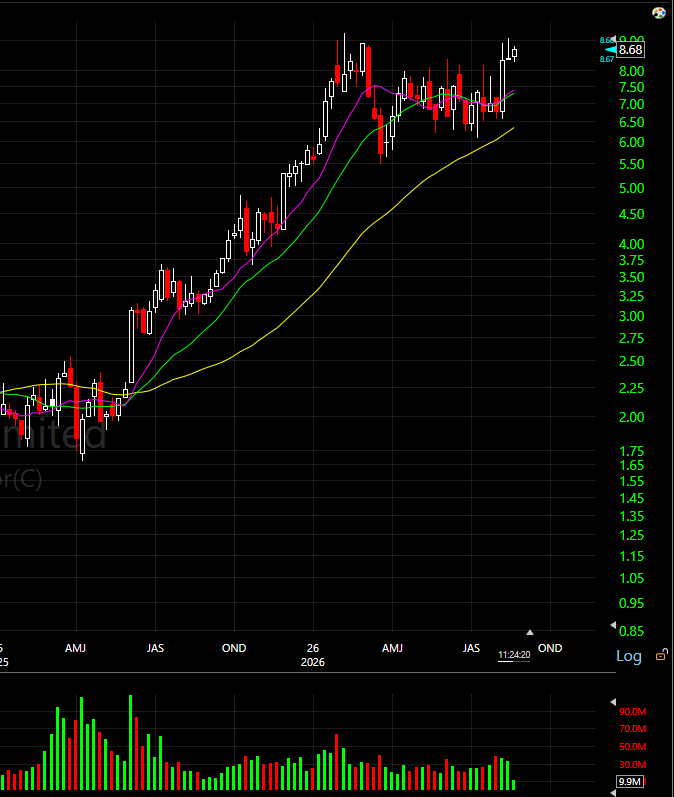
Dropbox isn't an unfollowed stock. It has full analyst coverage, and the consensus view is a Hold, with an average price target sitting below where the stock trades today. That's the actual setup worth paying attention to, not neglect, but a Street that's still modeling this as a decelerating storage company and pricing it accordingly, while the underlying numbers have moved somewhere else.
The chart already reflects part of that gap. For most of the years since its 2018 IPO, Dropbox chopped around in the high teens to low thirties, a range it never really escaped. It's now trading near $38, above that entire multi-year band and closing in on its 2018 peak, while sell-side targets still cluster below spot. Price is leading the estimates here, which is usually a sign the models haven't been updated for what's actually changed in the business.
What changed is not the top line. Revenue is flat, roughly $631.5 million last quarter, up less than one percent year over year, with full year guidance close to where 2025 landed. That's the number every growth screen and every Hold rating is built around, and it's a fair reason for caution if you stop there. What it leaves out is a business generating over a billion dollars a year in free cash flow at north of forty percent operating margins, on a market cap of roughly $7.6 billion. That prices the company at around seven times free cash flow, a multiple that assumes the cash flow itself is at risk. Nothing in the margin trend supports that assumption.
Dropbox is also not sitting on that cash waiting for a growth story to fund. It spent $1.7 billion retiring its own stock last year, cutting the diluted share count from 323 million to 273 million, and just added another $900 million to the authorization. A Hold rating built on flat revenue stops making sense once you account for a share count shrinking by double digits a year. Free cash flow per share is compounding even while the headline growth number stays at zero, and that's not reflected in a rating built primarily off the income statement.
Then there's Dash, Dropbox's AI powered search and knowledge product, which already has well over 150,000 users connecting through ChatGPT and Claude integrations, inside a search and knowledge discovery market management expects to more than triple by 2028. Management has said directly that none of this is included in current guidance. If it isn't in guidance, it isn't in the models that produced those price targets either, which means the option on it is sitting in the stock for free.
That's the actual asymmetry, not that the market missed the story, but that the market is still pricing the old version of it. Downside is a mature, high margin cash business trading at a discount multiple with a management team actively shrinking the float, already breaking out of the range it traded in for years. Upside is a re-rating once the models catch up to a shrinking share count and an AI product that's currently valued at nothing.
None of this is riskless, and it's worth being specific about why the Street is cautious. ARPU faces pressure from currency and a shift toward monthly billing, the competitive set includes Google, Microsoft, and Box, and insiders have been steady sellers on pre-set plans. Those are real reasons to model this conservatively. They're not, by themselves, reasons to justify a target below the current price when the buyback and the cash flow are moving the other direction.
$DBX is a case where the price has already started to move and the estimates haven't caught up yet.
With the new GPT-6 Astra model approaching, everyone is wondering how they can get exposure to frontier AI models like ChatGPT and Claude before OpenAI or Anthropic ever IPO.
I think $DXYZ is one of the more interesting ways to do it.
The market is anchoring to DXYZ’s stale reported NAV. But if you actually mark the portfolio to the latest private-market valuations, the picture changes materially.
DXYZ has exposure to both OpenAI and Anthropic, and recently put another $150M into OpenAI. It also raised ~$715M through its ATM at an average $34.25/share, effectively monetizing the huge premium investors previously paid for private-market access and turning it into capital to deploy into these assets.
Our math gets to a current NAV materially ABOVE where $DXYZ trades today once you update the major private holdings to their latest marks.
That creates a pretty unusual setup:
Investors are getting exposure to OpenAI as GPT-6 Astra approaches + Anthropic/Claude + the rest of DXYZ’s private-tech portfolio, while potentially paying a discount to the underlying marked value of those assets.
The market used to pay a massive premium for this exact access.
Now, by our math, it’s available below NAV.
Long $DXYZ.
Called out $GTLB weeks ago and now it’s up 15% after hours. This is proof that strong conviction played correctly can really move your account. This was my biggest position and still is, I think the theme stands true even with this huge EP
$GTLB may be one of the more misunderstood AI infrastructure plays.
The market still largely thinks about GitLab as seat-based DevOps software: AI writes more code → fewer developers needed → fewer seats → slower growth.
I think the more interesting relationship is the opposite.
We all know AI makes code dramatically cheaper to create. But that code still has to be tested, reviewed, secured, governed and deployed into production.
If AI agents cause the amount of code produced to explode, the workload flowing through GitLab can grow much faster than developer headcount.
That’s the key distinction the market is missing: seats vs. workload.
And, most importantly, the underlying business isn’t deteriorating:
• Q1 revenue +23%
• cRPO +24%
• $100K+ ARR customers +18%
• NRR 117%
GitLab also doesn’t need Duo to beat Cursor, Claude or Codex. Those tools can win code generation while GitLab remains the infrastructure/control layer connecting AI-generated code to production.
The bull case isn’t at all that “GitLab wins AI coding.”
It’s that AI creates far more code, while GitLab owns the pipes that code has to travel through.
Thus, $GTLB is a beneficiary to AI development. It wants more code, and AI enables that.
People who sell on every micro-pullback have no clue what they’re talking about. Wider timeframe saves time and stress, why worry when the $SPY is just flagging into the 8-weekly.
@ZaStocks and people who just flip-flop chasing sentiments and fear will always lose. to take advantage is to be well-timed but only with proper conviction to hold even when a narrative doesn't immediately play out.
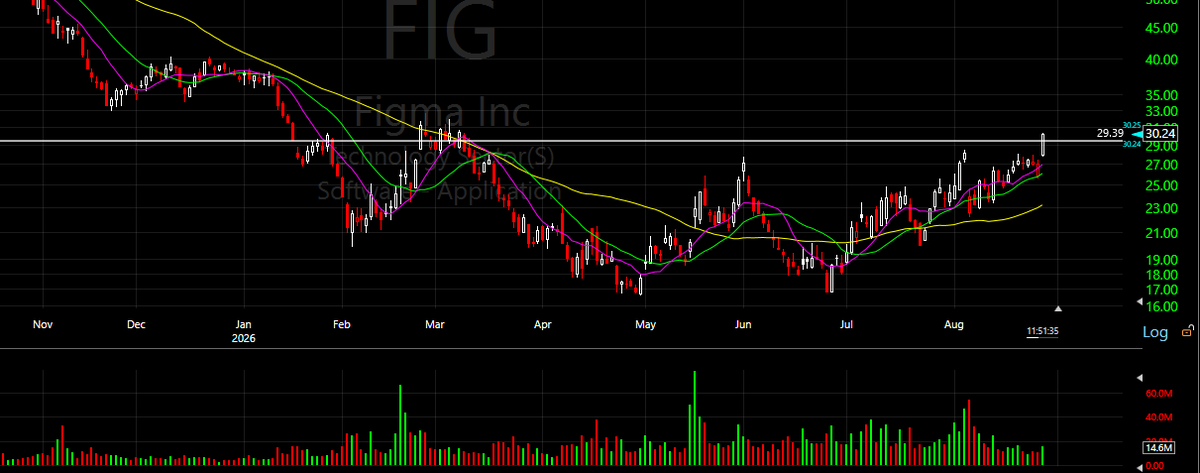
$FIG +11% today, and I think the move matters more than the headline.
The catalyst is the broader software re-rating after $CRM earnings. Salesforce just showed that AI is not necessarily destroying SaaS economics. Revenue grew 11%, guidance moved higher, retention remained strong, and its Anthropic partnership is effectively Claude sitting on top of Salesforce rather than replacing it. That attacks the exact narrative that compressed software multiples this year. $FIG is one of the highest-beta ways to express the other side of that trade.
The numbers make the setup more interesting. Figma grew Q2 revenue 48% YoY to $370M, its third consecutive quarter of accelerating growth. NDR is 136%. $100K+ ARR customers grew 46%. More than 80% of $10K+ ARR customers are already consuming AI credits weekly, and more than 50% were using Figma’s own agent weekly by the end of July. Gross margins remain 85% and the business produced a 14% FCF margin in Q2. This is not a software company watching AI eat its seat base. AI is creating another monetization layer on top of an already expanding seat base.
At ~$30/share, $FIG is roughly a $13.7B equity value. Back out ~$1.7B of cash and securities and EV is about $12B. Against FY26 revenue guidance of ~$1.465B, that is only ~8.2x EV/sales for a company growing ~39% for the year, exiting Q2 at 48%, with 136% NDR and positive FCF. That valuation starts looking very different if the market stops underwriting terminal AI disruption and starts underwriting AI-driven expansion.
The technical setup is now confirming the fundamental one. $28.48 was the key 13-week resistance level and the post-earnings high. $FIG just broke through it decisively and is trading above $30. You had accelerating fundamentals beneath a multi-month base, a heavily discounted multiple because of the AI fear trade, and now a catalyst forcing the market to reconsider the core bear thesis at the same moment price clears resistance.
That is the asymmetric setup. The market priced Figma like AI was going to compress its moat. The data increasingly suggest AI may be expanding it.
Only 3 days since I posted this, $FIG is now up 11% haha. Insane base breakout. I entered long, chasing (sort of) because my initial position was too small. I expect this stock to run, it's a pretty high-conviction name with great fundamentals so I'm excited to see where this goes.
$FIG is starting to look like one of the cleaner asymmetric setups in software.
What I think the market is missing is that Figma is still largely being valued as a premium design SaaS company facing potential AI disruption. The actual numbers are pointing in the opposite direction. Q2 revenue grew 48% YoY, accelerating for the third straight quarter, NDR held at 136%, and customers spending over $100K annually grew 46%. Management raised FY revenue guidance again. This is happening as Figma begins monetizing AI credits and expands from design into code, agents, and a broader product creation workflow.
The AI concern may actually be the opportunity. If code becomes easier and cheaper to produce, the bottleneck shifts toward deciding what gets built, designing it, iterating on it, and coordinating teams around it. Figma already owns that collaborative layer. Figma Make, Code Layers, agents, and AI credits give it a path to monetize more of the workflow without needing to replace its core seat-based business. That creates the possibility of both seat expansion and a new usage-based revenue stream layered on top.
The technical setup is starting to line up with the fundamental one. After the post-earnings flush into the low $20s, $FIG built a base, reclaimed the $25 to $26 area and has started breaking out of that shorter-term range. The next real test is roughly $28 to $28.50, which has repeatedly acted as supply. A clean break and hold above that zone on volume would confirm the larger base breakout and leave relatively little recent price structure overhead.
The market is focused on AI compute costs and the premium multiple. I’m more interested in accelerating growth, 136% NDR, expanding enterprise penetration, positive FCF, and a company potentially moving from design software toward the operating layer for turning ideas into products.
$FIG
$ALAB looks expensive at ~$49B. I think the denominator is wrong.
Q2:
• Revenue $392M, +104% YoY, +27% QoQ
• 73.3% GAAP GM
• 39.1% non-GAAP operating margin
Q3 guide:
• Revenue $540-560M
• +40% QoQ at midpoint
• ~43% non-GAAP operating margin
• $1.16-1.21 EPS
That’s a ~$2.2B revenue and ~$4.74 EPS annualized run-rate, before most of the next product cycle contributes.
The real thesis is content/XPU.
Scorpio X is expected to become $ALAB’s largest product family in Q3. Management sees >$1,000 of potential Scorpio X content per XPU and a ~$20B merchant scale-up switching TAM.
Then 2027 adds:
• Optical connectivity
• Custom silicon
• NVLink Fusion designs
• CXL controllers at 2 US hyperscalers
• UALink Scorpio products
At ~$47.5B EV, $ALAB trades ~22x its Q3 revenue run-rate. Expensive, until you model the operating leverage.
At $4B revenue and 42% operating margins, you get ~$1.7B operating income and potentially ~$1.5B after-tax earnings power.
That puts today’s valuation at ~32x that earnings scenario for a business that could still be growing 50%+.
The market sees an expensive PCIe retimer company.
I see 104% growth, 70%+ gross margins, 40%+ operating margins, rapidly increasing content/XPU, and a move from retimers → switching → CXL → Ethernet → optical → custom silicon.
The question isn’t whether $ALAB is cheap on today’s earnings.
It’s whether today’s earnings are remotely representative of the business 12 months from now.
I don’t think they are.
Another $DXYZ post!
So $DXYZ is being valued off a stale NAV. Reported NAV is $24.56/share vs a ~$32 stock price, which makes it look like you’re paying a ~30% premium for a closed-end fund of illiquid private tech. But marking the underlying portfolio to recent transactions/secondary pricing gets me closer to $39.70/share.
Here’s the math:
DXYZ reported $748.4M of net assets across ~30.47M shares as of 3/31. The biggest discrepancy is Anthropic. DXYZ carries its Anthropic exposure at $134.1M, based roughly on a ~$380B valuation. Anthropic subsequently raised at a $965B post-money valuation. Simply marking the stake to that transaction gives $134.1M × (965/380) = $340.5M, or +$6.78/share of incremental NAV. Secondary transactions have reportedly implied valuations closer to $1.5T. At that mark, DXYZ’s stake is worth ~$529.3M, adding $395.2M or $12.97/share versus the reported value.
SpaceX adds another meaningful adjustment. DXYZ’s SpaceX vehicles were carried at a combined $107.3M around a ~$1.25T valuation. At a ~$1.86T implied equity value, those positions are worth roughly $159.7M, adding $52.4M or $1.72/share. Databricks was marked at $18.2M around a $134B valuation and has since raised at $190B, taking the stake to ~$25.8M and adding another $0.25/share. Revolut’s latest secondary pricing takes DXYZ’s position from ~$11.8M to ~$16.5M, another +$0.16/share. Public marks and smaller adjustments add ~$0.04/share. I leave OpenAI, Shield AI, Stripe, Skild, OpenEvidence and the rest essentially unchanged without sufficiently strong new price discovery.
The NAV bridge is therefore roughly: $24.56 reported NAV + $12.97 Anthropic + $1.72 SpaceX + $0.25 Databricks + $0.16 Revolut + $0.04 others = ~$39.70/share.
At ~$32, that’s a ~19% discount to mark-to-market NAV, not a 30% premium to NAV.
The obvious criticism is that marking Anthropic to an illiquid secondary market is aggressive, so use the actual $965B primary financing instead. That still gets DXYZ to roughly $33.50/share. The sensitivity is roughly: Anthropic @ $380B → $24.56 NAV; @ $965B → ~$33.50; @ $1.5T → ~$39.70; @ $2T → ~$45.50.
That’s what I think the market is missing. Investors see $32 / $24.56 = 1.30x NAV and conclude DXYZ is expensive. But $24.56 is an accounting snapshot of private assets that have repriced significantly. Using hard transaction marks gets you around today’s stock price; using observable secondary pricing gets you to ~$40.
$DXYZ may not be a private-tech fund trading at a 30% premium. It may be an Anthropic-heavy portfolio trading at ~0.81x current economic NAV. Anthropic drives the majority of the discrepancy, which is simultaneously the thesis and the risk.
The market still prices $IREN like a Bitcoin miner that happened to pivot into AI, but that framing misses what the company actually owns. Bitcoin mining was simply the first way IREN monetized its most valuable asset: scarce, grid-connected power. Now that same power is being converted into AI infrastructure at much better economics.
IREN is targeting >$4B of AI Cloud ARR from 480MW by year-end, which works out to roughly $8.3M of annualized revenue per MW. The more important number is what comes next: ~1.2GW of AI capacity targeted for 2027 and a long-term development pipeline of ~5GW. You don’t need to assume today’s revenue density holds forever for the math to get interesting. At just 60% of the current implied economics, 1.2GW could support roughly $6B of ARR against a company worth only the mid-teens billions today.
This also isn’t speculative capacity anymore. Microsoft signed a $9.7B five-year contract and has already accepted the first 50MW deployment, while NVIDIA signed another $3.4B five-year contract. Roughly 85% of IREN’s >$4B 2026 ARR target is already contracted.
The real debate around $IREN isn’t whether a Bitcoin miner can become an AI company. It’s how much a scarce portfolio of power, land, substations and data-center capacity is worth when that infrastructure can be monetized through AI instead of Bitcoin. IREN already owns the hardest part of the stack, and it is increasingly controlling the rest as well: power, data centers, GPUs, cloud software and the customer relationship.
Bitcoin monetized the megawatt. AI changes what that megawatt is worth.
I don't think it's worth panic selling everything today.
I'm still holding positions like $HPE , which is still in the positive. It's a very volatile stock, to be shaken out by a 10% move downwards over the last couple of days probably means your position sizing, entry, and risk were messed up to begin with.
My stop is at break-even, although I'm hopeful this stock, which has been a RS winner, will show some strength into this market weakness.
Even more, the theme is there. This is a clear AI winner and it doesn't hurt to hold a stock like this for a while even if it doesn't look like a clean breakout anymore. I wouldn't mind if this thing goes sideways or meanders for a bit, as long as I don't hit my stop-loss.
In order to find winners, you need to have the patience and shrewdness to give it some room. Every winner pulls back every now and then, especially in the beginning of their moves.
$DXYZ and what the market is missing:
Stop valuing DXYZ like a normal closed-end fund.
Yes, DXYZ trades well above reported NAV. That’s obvious.
But NAV isn’t necessarily the right endpoint for valuing a vehicle holding SpaceX, OpenAI, xAI, Databricks, etc.
Say reported NAV is ~$25.
Re-marking the private portfolio might get you to ~$30. Still below the stock.
But now ask: what is public-market access to that $30 actually worth?
At a 1.5x multiple → $45/share
At 2.0x → $60/share
At 2.5x → $75/share
Normally I’d hate paying a premium to NAV.
But DXYZ owns assets public investors largely cannot buy directly, several of which could be among the most important IPOs of the next decade.
And while the stock trades above NAV, DXYZ can issue shares at that premium and use the proceeds to acquire more private assets, potentially increasing NAV/share.
The bear case is: “$40+ stock vs ~$25 NAV.”
The bull case is: the NAV is stale, the assets are scarce, and the premium itself has economic value.
You’re not just buying today’s NAV.
You’re buying the access, which justifies its premium and then some.
It isn’t. Do research next time, I’m open to debate but a blanket statement that’s outright false is not worth anyone’s time. Last reported NAV is currently below share price. My entire argument is that the true NAV is far above what is stated and that the opportunity itself to private markets justifies trading even more above NAV.
$RDDT has such a resilient looking monthly chart.
It’s been building higher lows, forming a tight flag setup for years now.
Not only that, but the theme and fundamentals can’t be beaten.
It’s definitely worth a long-term hold: