@Eduardo18062771 Depends. AFL teams never had the average talent of the NFL teams, even at the time of the merger—but they were maybe 90% of the way there. They were pretty feisty by 1964 or 1965, though, IMO—and obviously able to compete with the NFL by the end of the decade.
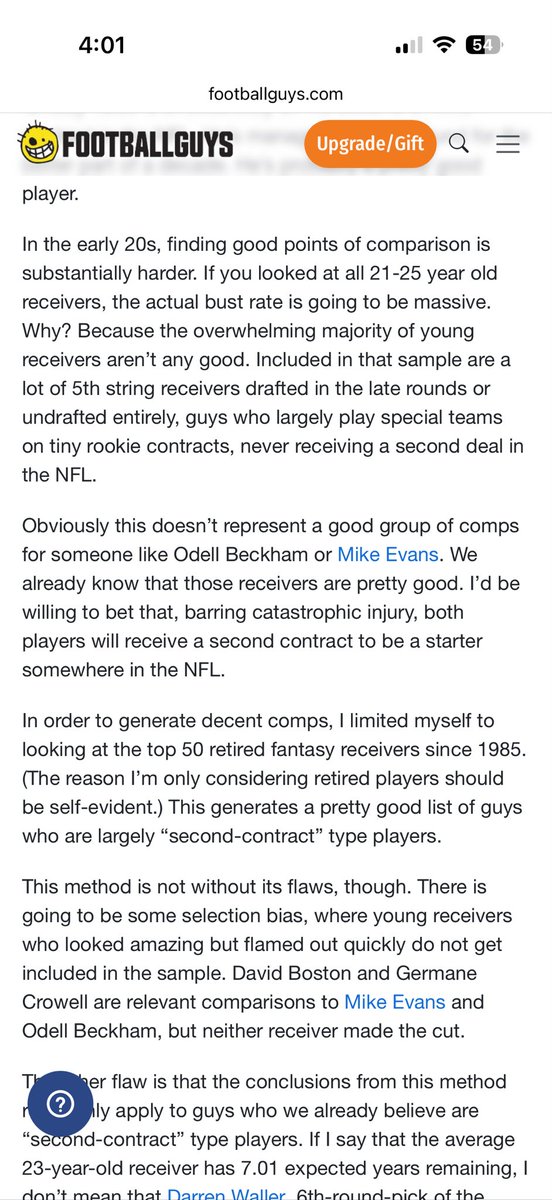
Xavier Legette astutely wields Harstad’s Razor, here—“everything interesting is probably selection bias”.
Delved into the topic in the follow-ups. Net result is bust risk winds up understated for very young players, even (especially) very good ones. https://t.co/Hoa0h26EgP
. @AdamHarstad - Do you think limiting to top 50 career finishers might unduly impact the results here? You found that year to year until their last relevant season, these guys were likely to “bounce back” -but can that be influenced by survivorship bias?
https://t.co/GN2rXySFQl
@Eduardo18062771 Both the “long-time in the league” 30yos and the “imported from NFL” 30yos were likely equally capable of beating the CFL castoffs and half-decade retirees they were suddenly facing, so I’d expect both groups to age similarly… until the talent pipeline finally met the demand.
@Eduardo18062771 Eventually the pipeline responds to increased demand and increases supply. But right at first, the quality of player is necessarily much lower.
30yos were lasting longer not because there were two classes and one was better… but because the competition was much worse.
@Eduardo18062771 George Blanda was retired in 1959 before joining Houston at age 33 in 1960. Went on to play until 48!
Butch Songin was 36 and hadn’t played professional football since a run in the CFL back in 1953-1954.
Basically just check the 1960 AFL leaderboards for anyone over 30.
@Eduardo18062771 Frank Tripuka washed out of the NFL after 1952, spent seven years in the CFL, retired, then joined the AFL as Denver’s first starting QB and led the league in passing at age 33 and 35.
Check out the latest @Footballguys Dynasty Show where I get a chance to sit down with @AdamHarstad and pick is brain on all things dynasty fantasy football!
Building a Dynasty Fantasy Football Juggernaut https://t.co/yqkSAG4Lxs via @YouTube
Getting the chance to talk with one of the sharpest minds in fantasy, @AdamHarstad
Let me know what questions you would love to hear us talk about on the @Footballguys Dynasty Show!
@cplant_@DynastyAreaMan (If the draft actually *was* iterated a thousand times, it’d be trivial to demonstrate that ADP value in the one that counted correlated with success.)
@cplant_@DynastyAreaMan The reason ADP fallers works for fantasy and not NFL is… there’s no such thing as NFL ADP; the draft is only ever run once, so the “average” is just the actual results and every team perfectly conforms to ADP value.
Consensus board is more like fantasy rankings than ADP.
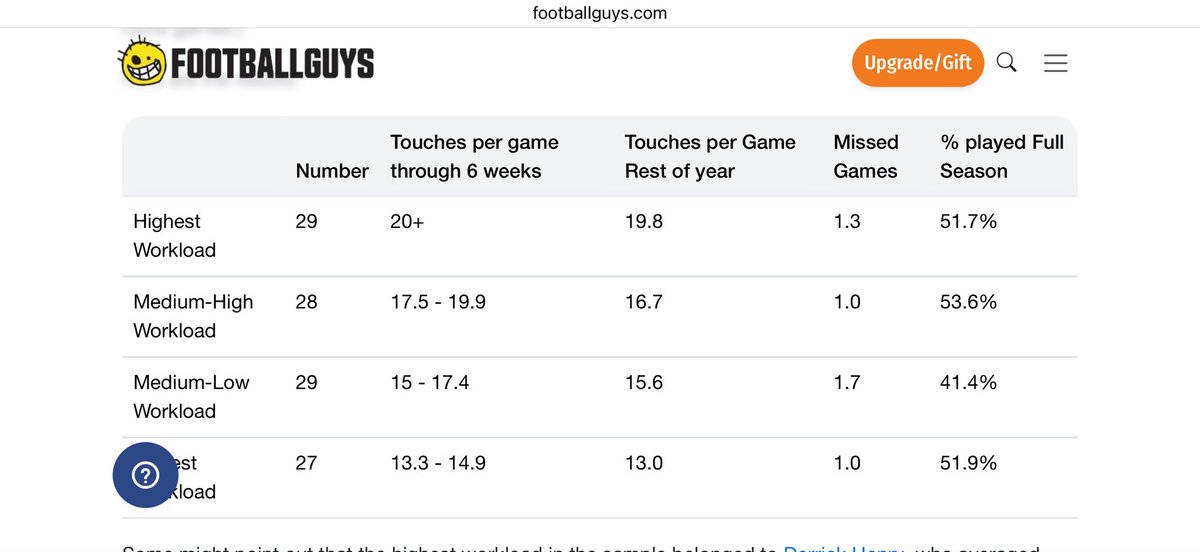
@JusttheFoosball@a_michel42@SmolaDS And the data shows that RBs who get more touches wind up getting hurt at the same rate (or even less frequently) than RBs who get fewer touches.
@a_michel42@JusttheFoosball@SmolaDS I don’t think it’s repetition so much as selection. Backs who can’t handle lots of touches don’t get lots of touches. Backs who can, do.
I’m heavily influenced in this view by Bruce Arians, who was quite candid about this w/r/t Willie Parker and Andre Ellington.
@a_michel42@JusttheFoosball@SmolaDS Also very important to remember that a lot of the work on workload looked at a *very, very different* offensive environment than today’s. Even if “high-workload” RBs were at greater risk in the aughts, the “high workload” backs today would be “medium workload” by 2000s standards.
@a_michel42@JusttheFoosball@SmolaDS Here’s all the data on workload and longevity / injury rates: https://t.co/zbx9Hw6Fp4
And I’ve attached my favorite chart. High-workload RBs are less likely to miss time over the second half than low-workload RBs!
@DSP4150 Late and short would be Gary Barnidge. 600 total yards through age 29, 1000 yards at age 30, 600 total yards at age 31+.
Late and long would be Drew (not Dru) Hill. 1350 yards in 73 games through age 28, then 1k+ in five of the next seven.