lol did nobody at Anthropic stop for a second and wonder why the numbers looked this absurd before posting the “victory”-tweet?
https://t.co/DPdPc04YZT
A TEAM JUST DEPLOYED 15 AUTONOMOUS LOOP AGENTS FROM A SINGLE PROMPT USING APPLIED GRAPH ENGINEERING
Most developers still manually hardcode multi agent systems, writing separate logic for every individual task.
Graph engineering changes this by using a central topological map to spin up all 15 nodes simultaneously.
A single 200 word input generates the architecture, routing 120 unique pathways between agents instantly.
Instead of failing under conflicting instructions, these loop agents self correct via continuous state sharing.
Managing a 15 node mesh requires high token throughput, making this dependent on strict low-] latency API tiers.
See exactly how this automated multi agent graph architecture actually operates in real time ↓
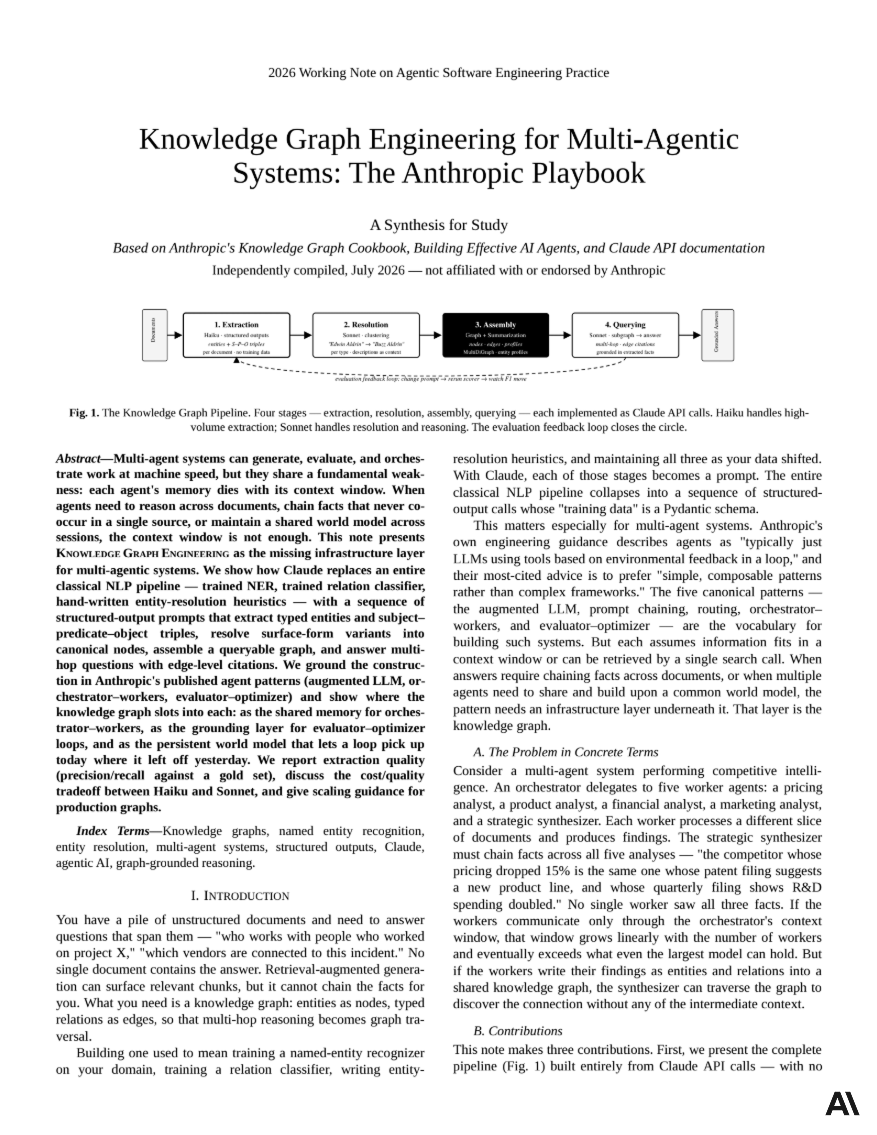
A senior Anthropic engineer just dropped 12-page PDF on "Graph Engineering" for multi-agentic systems.
The shift: your agents memory dies with their context window. A knowledge graph makes it permanent.
Extract → Resolve → Assemble → Query → Repeat
Every agentic graph has 5 stages:
• Extract: Haiku pulls entities and S-P-O triples. One call per doc. The Pydantic schema is the only training data.
• Resolve: Sonnet clusters "Edwin Aldrin" → "Buzz Aldrin" - zero string overlap - using descriptions as context.
• Assemble: canonical nodes, typed edges, provenance on every triple. One connected graph.
• Query: serialize a subgraph → Sonnet reasons over triples → every answer cites a specific edge.
Plug this into multi-agent systems as shared memory.
Workers write to it, evaluators fact-check against it, loops persist overnight with it.
This 12-page PDF changed how I'm building multi-agent systems today.
Read it now, then explore the article below.
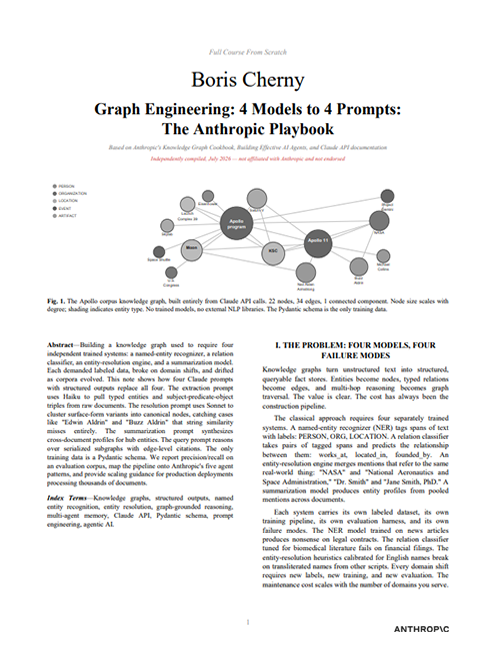
Boris Cherny just dropped 7-page PDF on Graph Engineering - how 4 Claude prompts replace 4 trained ML models
The twist: your agent's memory dies with the context window. A knowledge graph makes it permanent - and now you build one with prompts, not ML engineers.
here's 4 prompts, step by step:
prompt 1 → extraction - Haiku pulls entities + relations - one call per doc - no NER, no labeled data
prompt 2 → resolution - Sonnet merges duplicates string matching will never catch - two different names, same person
prompt 3 → summarization - Sonnet builds profiles from multiple sources - facts that never appeared in the same document
prompt 4 → querying - feed the graph to Sonnet - every answer cites a specific edge - no hallucination
how to wire this into agents today:
step 1 → shared memory for multi-agent teams - workers read/write one graph - orchestrator's context stays clean
step 2 → grounding layer for eval loops - evaluator checks facts against graph edges, not vibes
the result: one Pydantic schema replaces weeks of ML training per domain - precision 1.00 - 10k docs cost under $10
this 7-page PDF is what comes after loop engineering
bookmark this, then read the article below ↓
You can still get exposure at a great discount that is backed 1:1 and trade whenever you want + the tessera tokens convert into stablecoin value down the road.
No brainer to take that opportunity.