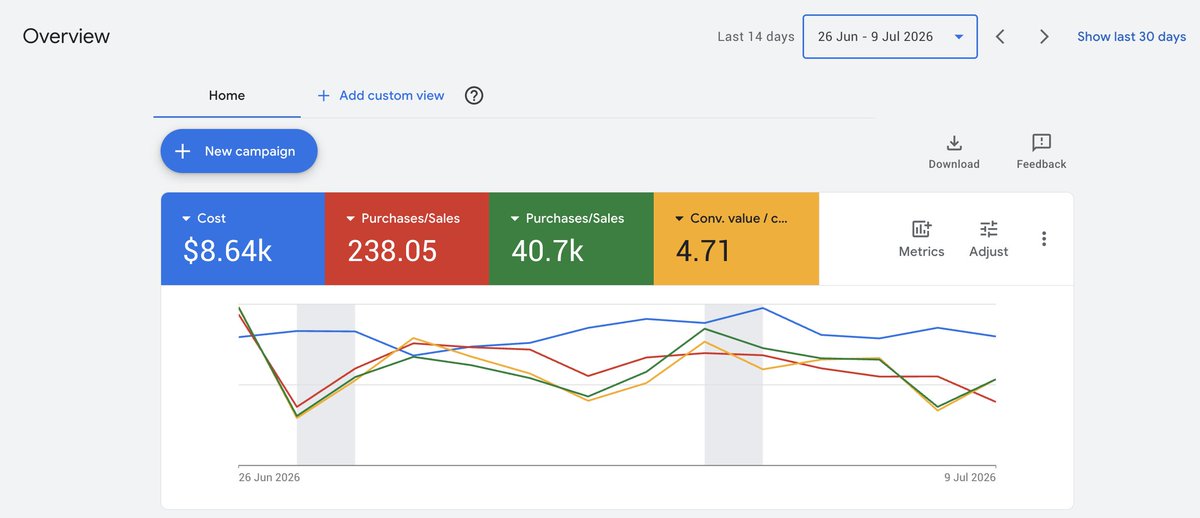
We’ve been testing new growth strategies at Kairo Agency to drive incremental revenue from new customers.
I’m pleased to say the results speak for themselves.
Running Google Ads? A few things I'd strongly recommend:
Don't let Performance Max dictate your entire strategy
Optimise for conversions that actually drive business value
Regularly cut wasted spend from low-intent searches
Look beyond ROAS when measuring performance
Understand the difference between branded and non-branded demand
Get your conversion tracking right before scaling budgets
Get these fundamentals right and you're already ahead of most advertisers.
Black Friday is 3 weeks out.
One Smart Bidding setting most e-com stores skip:
Seasonality adjustments.
Your conversion rate spikes on sale days.
Bidding takes a few days to catch up.
By then the sale is over.
Tell Google in advance.
Sale days only. 1 to 7 days max.
Give your highest-AOV category its own Search campaign.
Don't let it fight for budget inside a catch-all.
This one (highlighted) is a single product category:
US$2.8k spend
US$20.9k conv. value
7.52x ROAS
The account average is 5.28x.
Separate campaign = its own budget, its own tROAS, its own search terms.
The high-AOV stuff stops getting starved by cheap clicks.
Your Google Ads ROAS might be mostly returning customers.
Quick check:
Segment conversions by new vs returning.
PMax and brand search are great at finding people who were already going to buy.
If ROAS climbs but new customers stay flat, you’re paying for repeat orders.
BFCM tip for e-com stores:
You change prices on your site.
Merchant Center doesn't catch up in time.
Price mismatch = disapproved products.
Disapproved products = no Shopping traffic on your biggest days.
Add sale_price and sale_price_effective_date to your feed this week.
Black Friday is 4 weeks out.
Smart Bidding will not see the conversion rate spike coming.
Add a seasonality adjustment for the sale days only.
Keep it to 1 to 7 days.
Set the expected lift from last year's data, not a guess.
And end it on the last sale day, not after.
Stop letting PMax run your whole feed.
Same account, last 30 days:
Standard Shopping: 6.94x ROAS
Performance Max: 4.88x ROAS
The hack:
Pull your best categories into standard Shopping campaigns.
Let PMax handle discovery on the rest.
You get search term data, bid control, and a benchmark PMax has to beat.
Which categories to test first?
→ Your top 3 by revenue
→ Anything with a tight, obvious search intent
One date to diary:
From Feb 2027, Search campaigns with Display turned on get migrated and spend may shift.
Want to keep things as they are? Set Display to Low priority with a 50% allocation before then.
Follow for more Google Ads updates for e-com.
Google just gave e-com brands a control I've wanted for years: channel prioritisation.
You can now tell Google which channels get your budget first, and cap how much the rest can take.
Here's how I'll use it to scale more profitably:
How I'd roll it out:
1. Check channel and placement reports first
2. Set weak channels to Low with a cap. Don't zero them
3. One campaign at a time, 2 weeks before vs after
4. Scale budget once Search is fully funded
Control first, then scale.
Most stores get nervous about Q4 CPCs and pull back.
One e-com account I run, Q3 vs Q4 last year:
Spend: +19%
Revenue: +25%
ROAS: 6.7x to 7.1x
Q4 buyers are worth more. Your budget should follow them.
Most e-com stores set Target ROAS once and forget it.
• Hitting target but spend dropping? Target's too high.
• Spending fully but missing target? Fix the feed or offer first.
• Beating target AND limited by budget? That's your scale signal.
tROAS is a dial, not a setting.
The plan:
1. Report brand and non-brand separately
2. Fix PMax policy limits before scaling
3. Rebuild or pause the competitor campaign
4. Move budget to non-brand campaigns already at 3x+
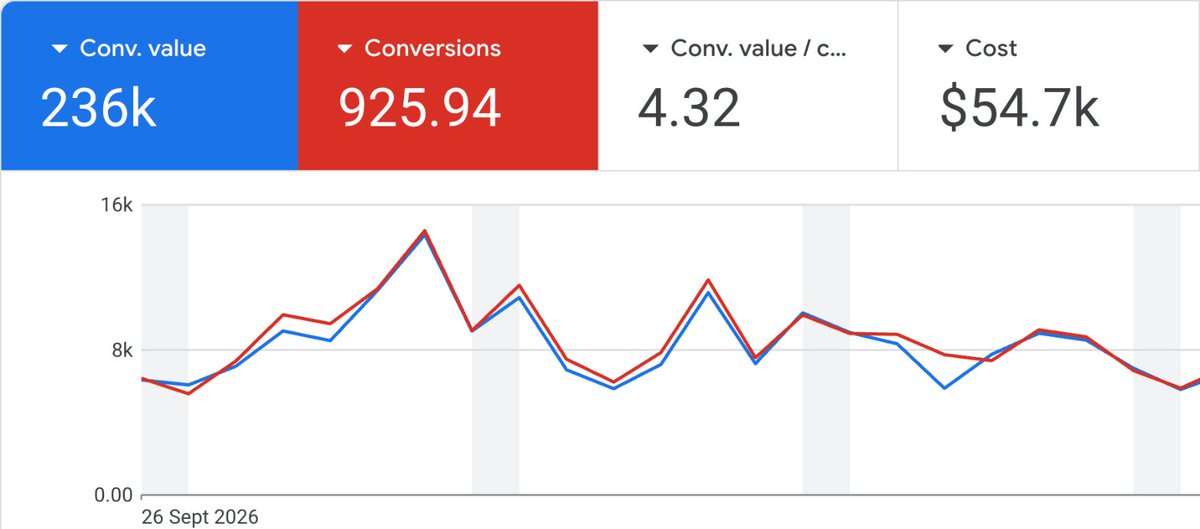
I just audited a $55k/month e-commerce Google Ads account.
On the surface it looks great:
$236k revenue
4.32x ROAS
926 conversions
But a blended ROAS can hide a lot. Here's what I found:
Finding 4: conversion value isn't all revenue.
New customer acquisition is on, adding $133 of value for every new customer.
Great for bidding. But that value shows up in reported conversion value, so the ROAS you see isn't pure revenue. Know what's in your number.