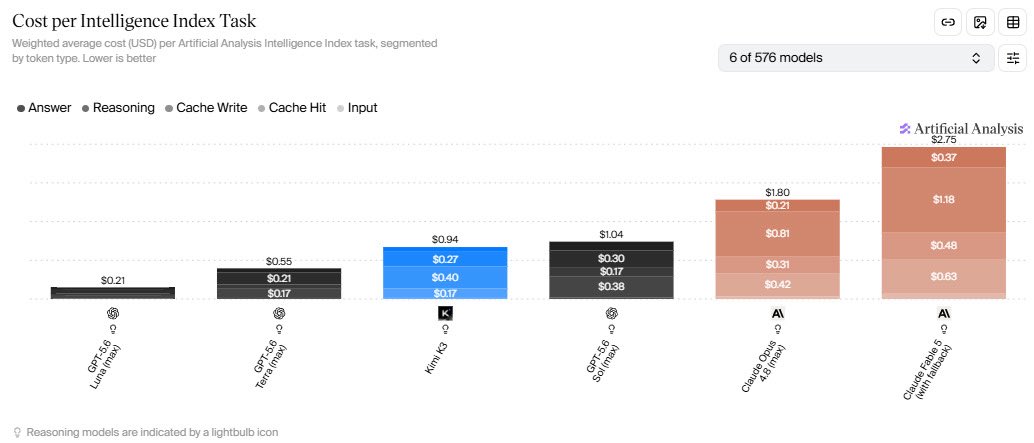
Kimi K3 may be an important inflection point for AI. Potentially negative for Anthropic and OpenAI while being net positive for essentially every other company in the world. I mean that very literally. Although the real “Sputnik moment” would be an open-source frontier model that was also token efficient unlike Kimi K3 which is 50-70% more expensive to run than GPT 5.6 per Artificial Analysis.
Rationale:
A world where there are only 2-3 dominant frontier labs with 90% inference margins is net negative for every other layer while being awesome for those 2-3 labs. Those labs would become monopsonies for power, data centers, semiconductors and hyperscalers and would obviously vertically integrate over time into all those layers while also completely subsuming the application/software layers.
Anything that lowers margins and increases competition at the model layer is good for every other AI layer: power, semiconductors, hyperscalers, neoclouds and yes even software.
This is why Jensen is so supportive of open-source. An open-source model requires the *exact* same amount of compute to run as a closed frontier model of similar size and architecture. Kimi K3 is roughly the same price as GPT 5.6 Terra on a per token basis, which actually suggests that it is less computationally efficient as I am sure that GPT 5.6 is priced to a higher margin than K3. And given that K3 is a token wastrel, i.e. token inefficient, it is significantly more expensive per task than GPT 5.6 and Grok 4.5, which are much more token efficient. Cost per token and token efficiency (i.e. intelligence density per token) are the drivers of intelligence per unit of cost. The winning AI companies will be those that offer the most intelligence per $ over time.
Lower margin % at the model layer = more margin $ at every part of the infrastructure layer and is a godsend for software. This can happen either through open-source models like K3 at the frontier *or* having a vertically integrated model company like Meta, SpaceX or Google at the frontier. Both outcomes result in a lower margin % at the model layer as vertically integrated model companies don’t really care where the margin $ come from. This is why it was so painful for OpenAI and Anthropic when Google was right there with them from a model competitiveness perspective and why Grok 4.5 and Muse 1.1 were just as important as Kimi K3.
The reason Kimi K3 is only *potentially* negative for Anthropic and OpenAI is 1) the @ericvishria point that the Claude and ChatGPT products and harnesses may be more important than their models today and 2) the hypothesis that they have much more advanced model checkpoints internally that are already being used for RSI. In the latter scenario, reaching RSI even a few months ahead of other labs might be enough to cement a permanent lead.
Time will tell on both points. And likely fairly quickly.
Caveat would be that since Kimi K3 is not token efficient and thereby actually more expensive than ChatGPT 5.6, we may need to see a more token efficient open-source model at the frontier or see Grok 5/Composer 4/Muse 2 at multiple points on the Pareto frontier for this potential risk to Anthropic and OpenAI to play out. And I am sure they will both vertically integrate as quickly as possible while continuing the product/harness strength they have shown over the last 8 months.
I think programming will be around for a long time. But it was never about coding, but about communicating to a machine what you want to create. Coding was just friction between what you had in mind and how you had to explain it to the machine.
But to effectively program using AI, you still need to have deep conceptual knowledge of computer science, mathematics, hardware, design, ....
The good news is that you can use AI to accelerate your learning. So instead of increasing your knowledge in baby steps the traditional way, you can make giant leaps if you leverage AI.
And, no, I don't believe that mastery requires pain. Also, I don't believe thinking requires writing by hand.
Anyway, basically a long and rambling way to paraphrase Steve Jobs: What a AI is to me is it's the most remarkable tool that we've ever come up with, and it's the equivalent of a rocket ship for our minds.
The GenAI economy has generated $110 billion in sales over the past 12 months. It is growing fast. On an annualized basis, the revenue run rate exceeds $175 billion.
These numbers took us several months to construct, and as far as we know, it’s the first bottom-up, deduplicated measure of consumer and enterprise AI spending across the full stack.
We are releasing this research today in our first The State of the AI Economy report.
https://t.co/cJwZb0T99C
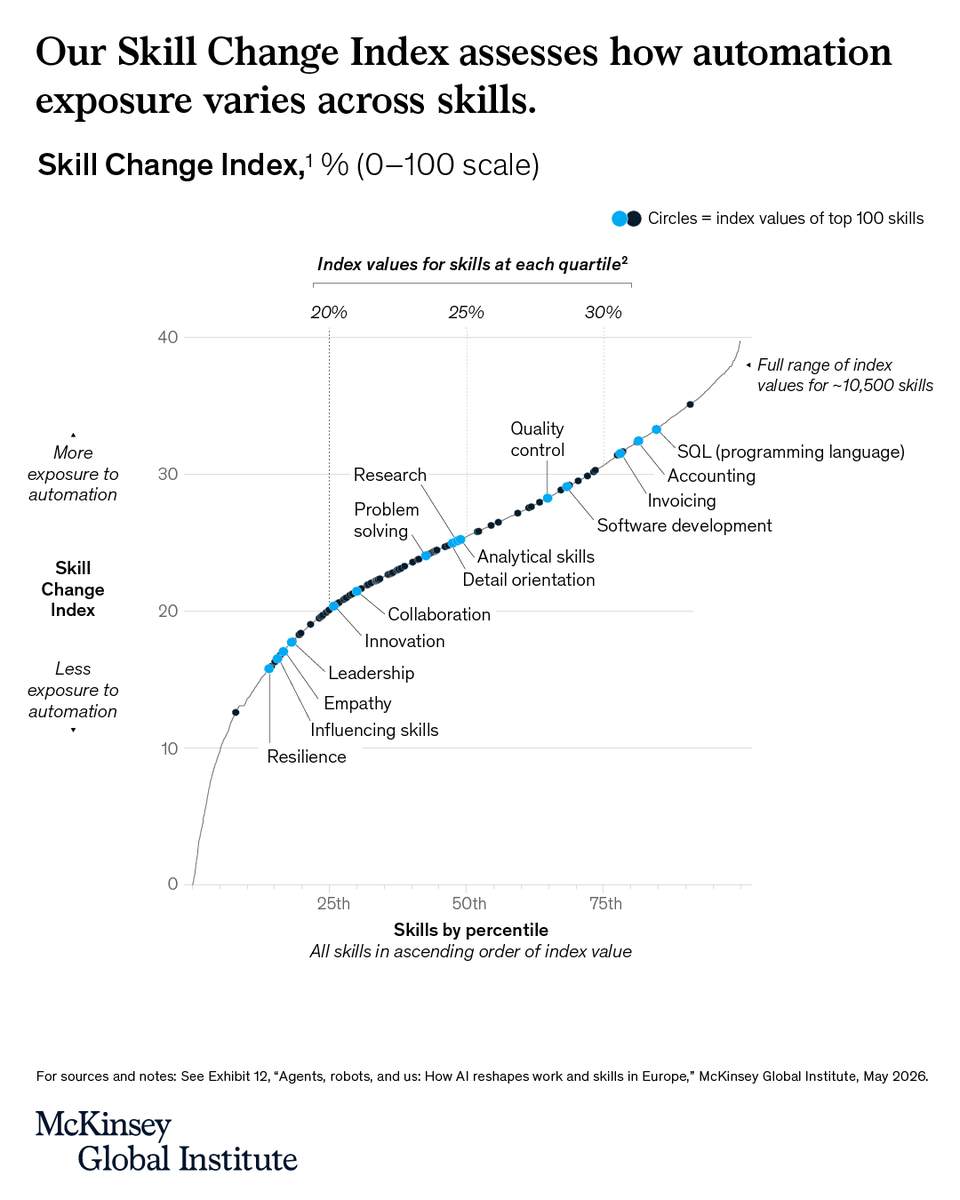
AI won’t make most human skills obsolete, but it will change how they’re used.
MGI’s Skill Change Index shows which skills will be most, and least, exposed to automation: https://t.co/BIUzxV3CtQ
Highly recommended!
"Messy Jobs: The Work That AI Cannot Reach" by Luis Garicano, Jin Li, and Yanhui Wu.
"Economists Luis Garicano, Jin Li, and Yanhui Wu offer a new framework for thinking about AI and work. They show why some roles will disappear, why others will be reshaped, and why many of the most valuable forms of human work will endure. Along the way, they explain how AI changes careers, firms, and the wider economy. AI will automate many tasks, the authors say, but jobs are more than tasks. Jobs are bundles of judgment, coordination, accountability, tacit knowledge, and human relationships. When tasks are tightly bundled within a job, AI will be less able to eliminate it."
https://t.co/2z3V00M8bW
𝗔𝗜 𝗶𝘀 𝗿𝗲𝗺𝗼𝘃𝗶𝗻𝗴 𝘁𝗵𝗲 𝗷𝗼𝗯𝘀 𝘄𝗵𝗲𝗿𝗲 𝘀𝗲𝗻𝗶𝗼𝗿 𝗲𝗻𝗴𝗶𝗻𝗲𝗲𝗿𝘀 𝗰𝗼𝗺𝗲 𝗳𝗿𝗼𝗺
Companies cutting junior roles to save money are running an experiment that economics already answered in 1962. That year, Kenneth Arrow turned an observation into formal theory: people get better at their work by doing it.
He called it 𝗹𝗲𝗮𝗿𝗻𝗶𝗻𝗴 𝗯𝘆 𝗱𝗼𝗶𝗻𝗴 and went on to win a Nobel Prize.
Last month, researchers from the Atlanta Fed, Columbia, UT Austin, and Chicago Booth applied his theory to AI automation. The result is bad news for the companies doing the cutting.
Here is the argument:
𝟭. 𝗟𝗲𝗮𝗿𝗻𝗶𝗻𝗴 𝗼𝗻𝗹𝘆 𝗵𝗮𝗽𝗽𝗲𝗻𝘀 𝗱𝘂𝗿𝗶𝗻𝗴 𝘄𝗼𝗿𝗸
Arrow's core claim: "Learning is the product of experience." We don't get it from study alone, we get it from solving real problems. He pointed to the Horndal iron works in Sweden, where productivity grew close to 𝟮% 𝗽𝗲𝗿 𝘆𝗲𝗮𝗿 for 15 years with no new investment. Nothing changed except the workers, who kept learning.
𝟮. 𝗘𝗻𝘁𝗿𝘆-𝗹𝗲𝘃𝗲𝗹 𝘁𝗮𝘀𝗸𝘀 𝗮𝗿𝗲 𝘁𝗵𝗲 𝗰𝘂𝗿𝗿𝗶𝗰𝘂𝗹𝘂𝗺, 𝗻𝗼𝘁 𝘁𝗵𝗲 𝗰𝗼𝘀𝘁 𝗰𝗲𝗻𝘁𝗲𝗿
The researchers argue junior work is where engineers build the skill senior roles depend on: debugging production incidents, writing tests, reviewing code. None of this transfers from a degree. When we automate these tasks, we automate the training pipeline along with them.
𝟯. 𝗧𝗵𝗲 𝘀𝗾𝘂𝗲𝗲𝘇𝗲 𝗶𝘀 𝗮𝗹𝗿𝗲𝗮𝗱𝘆 𝘃𝗶𝘀𝗶𝗯𝗹𝗲
Unemployment for young degree-holders now runs consistently above the overall rate, a reversal of the historical pattern. AI isn't the only cause. Post-pandemic overhiring and a slower job market play a part too. But the graduates locked out today are the missing senior engineers of 2032.
𝟰. 𝗧𝗵𝗲 𝗺𝗼𝗱𝗲𝗹 𝗽𝗿𝗲𝗱𝗶𝗰𝘁𝘀 𝗮 𝗵𝘂𝗺𝗮𝗻-𝗰𝗮𝗽𝗶𝘁𝗮𝗹 𝘁𝗿𝗮𝗽
The economy has two stable states, one with high learning and one with low. Cheaper AI improves the first and tips the second into a trap. An industry that settles into low learning ends up with a smaller pool of "low-quality managers", as the paper calls it.
𝟱. 𝗧𝗵𝗲 𝗰𝗼𝘀𝘁𝘀 𝗮𝗻𝗱 𝘁𝗵𝗲 𝘀𝗮𝘃𝗶𝗻𝗴𝘀 𝗹𝗮𝗻𝗱 𝗼𝗻 𝗱𝗶𝗳𝗳𝗲𝗿𝗲𝗻𝘁 𝗽𝗲𝗼𝗽𝗹𝗲
Automation savings show up in this quarter's profits, but the bill for lost learning lands almost entirely on workers. And because learning spills over between firms, one company's decision to cut its juniors eventually weakens the talent pool for everyone, including itself.
How to solve this? The researchers propose taxing automation profits and subsidizing firms that keep people on frontier tasks. Whatever policy does, the question for us is simpler: if AI writes the code juniors used to write, who reviews the AI's code in 2032?
A fundamental problem with extending Codex/Cowork/Code to all knowledge work is that they remain very "software-brained" where the end result (the software) is what is important & that code serves as a source of truth.
For a lot of other knowledge work, the process is at least as important as the outcome. This includes researching what is known, an exploration of alternatives, failed efforts, prototype branches, experiments, etc. All of those things are valuable, so you cannot use the PowerPoint at the end the way you can use a codebase, nor is progress on a to-do list sufficient context post compaction. You work in learning loops, refining your perspectives as you go.
In some ways, this makes long-running models like Fable hard to use for deep knowledge work, since they are designed to deliver product to you in the end. You can prompt your way around this problem, but everything about the Codex and Code harnesses want you to be a software developer and you have to fight them. There is a real disconnect between how a manager or analyst thinks about problems and how the agentic software tools approach solving them. Addressing this is critical to breaking out of the coding niche for these tools.
A.I. companies are engaging in “doom trolling,” Cal Newport writes. “They like to solemnly describe the harms that their models will cause, while acting helpless to do anything about it.” https://t.co/BaQagAQnaT
"Researchers at the A.I. company Anthropic claim to have found clues about the inner workings of large language models, possibly helping to prevent their misuse and to curb their potential threats." via @NYTimes https://t.co/oiMAnVNnTC
🇪🇺 - EU will publish list of critical technologies today - a key step to kickstart Europe's de-risking efforts vis à vis China
• A short thread with graphs on why this list matters, what we can expect, and what's next for EU de-risking plans 👇🧵 [1/8]
Zmarł Profesor Paweł Śpiewak. Uczył nas myśleć i pisać. Był wybitnym intelektualistą, a dla wielu z nas mentorem. Odegrał olbrzymią rolę w kształtowaniu środowiska Kultury Liberalnej.
Żegnaj, Profesorze
It's general election day in Italy. I have again seen lots of strange stories and statements on Italy in the international press.
So here's a data-based summary thread that may help in debunking claims about a "profligate, reform-lazy Italy", pulling all of Europe down. 🧵#CAIN









![AgatheDemarais's tweet photo. 🇪🇺 - EU will publish list of critical technologies today - a key step to kickstart Europe's de-risking efforts vis à vis China
• A short thread with graphs on why this list matters, what we can expect, and what's next for EU de-risking plans 👇🧵 [1/8] https://t.co/eLxHBLeggw](https://pbs.twimg.com/media/F7gWEjKWYAAO7Rl.png)