This is a great post and is well worth reading from my friend, Eric
Compared with 3 years ago; the ETA space is becoming hot and relative to 2 years ago when being a searcher differentiated you from private equity, you now have to stand out from very well qualified searchers - these are your peers and folks with top MBAs, military backgrounds, Amazon jobs, McKinsey etc
The best piece of advice that I have is to try to build relationships with brokers and anyone with access to deal flow. Be relationship focused and not transactional (even though your goal is to get a deal done). Try to speak to sellers if you’re able to directly but don’t be a douche and try to bypass brokers (who you need to be your friends to close on a deal if it’s a brokered deal)
Net Working Capital Guide in M&A
This should be... fun?
What is net working capital (NWC)?
By its simplest definition, NWC is Current assets (excluding cash) less current liabilities (excluding debt). NWC is used to determine how much cash needs to be left behind to keep the business operating.
Purpose of a NWC analysis in a transaction
1. Ensure the business is left with adequate working capital at close by protecting both parties from seasonal or timing-based swings in working capital at close.
2. Reduces risk of manipulation of cash by seller. For example, protecting the buyer from the seller accelerating collections, selling inventory for cash (without replenishing the inventory), or delaying payments to vendors.
Let's dive deeper into both of these.
1. Ensure business is left with adequate working capital at close.
The buyer expects to be able to operate the business normally immediately after close and this requires the seller to deliver enough cash to do so. If working capital is significantly reduced prior to close (without recourse to the seller), the buyer would have to fund an additional cash investment to ensure operations aren't interrupted.
2. Reduces risk of manipulation of cash by Seller.
In a cash-free/debt-free transaction, the seller will keep the cash balances at close. As such, any increase to cash near the close day will increase the proceeds paid to the seller. So how can a seller manipulate working capital balances before close?
1. Aggressively collecting outstanding receivables, offering larger than normal discounts to collect, or even factoring out receivables.
2. Heavily promoting or discounting inventory to turn more quickly or stopping the replenishment of inventory leading up to close.
3. Extending payables by withholding or slowing payments (I've seen this one done to the tune of $2m on the day of close).
Setting a working capital peg and true-ups
To mitigate the risks, we end up setting a working capital peg to "normalize" a working capital amount to be left in the business. A NWC peg is a negotiated number between the buyer and seller. Once the peg is determined there will be a true-up to ensure a fair balance of trade.
Two general types of NWC pegs are used: Fixed Dollar Value or a Fixed Dollar Value with a Collar
Fixed dollar value example: The peg is set at $50m. Working capital true-up is calculated as the difference between the closing working capital balance and $50m.
Collared range example: The peg is set a $50m with a collar between $45m and $55m. If the closing NWC falls within this range, there is no true-up. If the closing NWC fall out of this range, then the true-up is calculated based on the $50m target.
What does a buyer or a seller want?
Simply...
A buyer wants the NWC peg to be HIGHER
A seller wants the NWC peg to be LOWER
Why? Some illustrative examples:
Scenario A: Closing NWC is $525k and the NWC peg was $500k, the BUYER will end up owing the SELLER $25k because there was more NWC left in the business than originally expected.
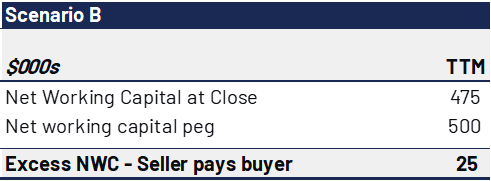
Scenario B: Closing NWC is $475k and the NWC peg was $500k, the SELLER will end up owing the BUYER $25k because there was less NWC left in the business than originally expected.
Finding a normalized NWC peg
The basic formula here is:
Current assets
- Current liabilities
+/- definitional adjustments
+/- diligence/accounting adjustments
= Adjusted NWC
Current assets and liabilities
Current is generally defined as less than one year in duration and represents short-term investments on the balance sheet needed to carry on and promote normal day-to-day activities.
Definitional adjustment examples (this is not the exhaustive list and there are exceptions to this list)
Cash
Debt
Capital Leases
Accrued interest
Income taxes payable
Related party balances
Employee advances/loans
Intercompany payables/receivables
Accounting/diligence adjustments examples (same caveat above)
Cash to accrual adjustments (payroll, bonuses, prepaids, rebates, etc.)
Inventory variance calcs
Bad debt and E&O reserves
DSO/DIO/DPO normalization
Debt-like items (like vacation accruals potentially)
Accrued bonuses
One-time, non-recurring accruals
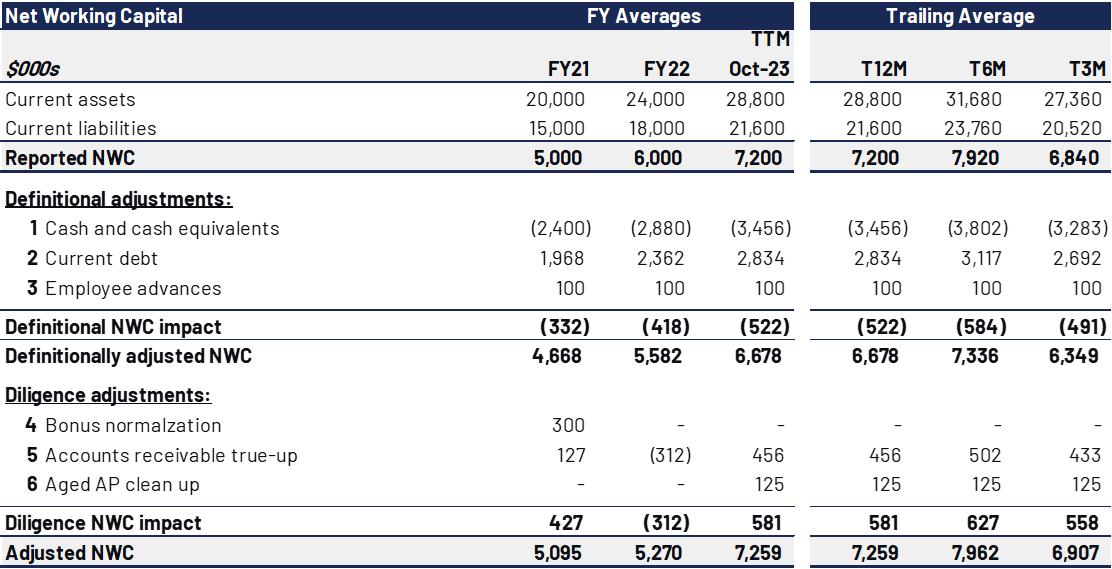
A net working capital table will show the walk from reported NWC, definitional adjustments, diligence adjustments, and other potential considerations. It will often include averages by year including an L3M, and L6M and a TTM average to account for any potential seasonality considerations.
This table will be used to determine what the appropriate "peg" should be. There is no "one-way" to calculate NWC and each business is unique (such as high-seasonality, negative net working capital, high growth, etc.). Work with your advisors to determine what is best for you.
If you've read this far down and have found this content helpful, give me a follow, a bookmark, a retweet or a comment.
I recently started a healthcare focused financial due diligence firm and post about financial due diligence, healthcare, M&A activity, and the occasional sarcastic comment.
https://t.co/8mViLFJCoJ
I look at private companies for sale all the time.
I’ve learned every good investor has “stock” questions they ask.
To really understand a business well.
Here are 14 of my favorites.
* What happens if you raise prices? What happened the last time you raised prices?
* Why do customers love the product? How do you know that?
* What’s the number one thing you can do to increase retention?
* Why do customers leave you? How do you know?
* What is the biggest impediment(s) to growth?
* Why am I the lucky buyer/investor? ← asking myself this sometimes!
* When you win deals, why? How do you know?
* When you lose deals, why? How do you know?
* What’s your biggest problem(s) right now?
* Why are you selling the business?
* Pretend you have to fire everyone but three people. Who do you keep?
* Pretend you must reduce staff by three tomorrow. Who do you let go?
* What keeps you up at night?
* What would happen if you didn’t come into work for 6 months? (for SMBs for sale)
—
What’s your favorite question? Disagree with any of these?
(If you liked this or found it helpful, give this tweet a like, retweet, or comment. Show the algorithm you like helpful, nontoxic content.)
"Before you throw more time at the problem, throw more focused action at the problem. You don’t need more time, you need fewer distractions."
– @JamesClear
"The Process:
1) Decide what you want to achieve.
2) Try different ways of achieving it until you find one that works for you.
3) Do more of what works. Do less of what doesn’t.
4) Don’t stop doing it until it stops working.
5) Repeat."
–@JamesClear
Developers: Register for this Dec 16 forum and learn how to modernize your DevOps with Microsoft and GitHub. Spaces are limited and will fill quickly. Make sure to reserve yours now! https://t.co/f8mA4BztBo
HPC: Our AI Supercomputing VMs are in public preview! Each ND A100 v4 cluster enjoys 1.6 Tb/s of total dedicated InfiniBand bandwidth per VM, plus AMD Rome-powered compute cores behind every NVIDIA A100 GPU. #HPC#bigdata#AI#Azure#ML#MSFTAdvocate https://t.co/YMXS4TIdeS
#MicrosoftTeams for personal use is now in preview!
The team and I are so, so excited to get the preview out today and see your feedback. Much more to come.
Go Teams!
https://t.co/dusViumgm0
HIMSS 2020 cybersecurity survey: breaches, ransomware and other security incidents are getting bigger and more disruptive at healthcare organizations. https://t.co/xy8MjD9tF2
USF Morsani College of Medicine uses tech to keep up with the rapid pace of innovation to better prepare their students as they enter the medical field. https://t.co/AqsFwBRbsa