I am so thankful for the renewed vision of @churchandfam. Helping Christians walk in quiet faithfulness, leaning on the all-sufficient Scripture. Quiet Faithfulness. The phrase sounds soft, but it isn't.
When Paul tells the Thessalonians to "aspire to live quietly, and to mind your own affairs, and to work with your hands" (1 Thessalonians 4:11), he's not describing a personality type so much as he's giving an ambition. The Greek word he uses for "aspire" gets translated elsewhere as "strive earnestly," which is the language of pursuit, the kind of word a man uses when he's chasing something down. Paul's telling Christians that a quiet life is something to chase and protect the way a man protects a calling, and once you read it that way the verse stops sounding like advice for introverts and starts sounding like marching orders.
Scripture treats faithfulness as the long obedience, and the examples it gives us are almost uniformly slow ones. Abraham wandered for decades on a promise he never saw finally fulfilled, Moses spent forty years on the back side of the mountain before God called him to anything anyone would remember, David tended sheep, and Anna prayed in the temple for over sixty years and got two verses in Luke for her trouble. Hebrews 11 reads like a roll call of people who died still believing, having seen the promises and greeted them from afar, which is the contour of biblical faithfulness across the whole canon: mostly hidden, mostly slow, mostly unsung.
Jesus himself frames the kingdom this way when he compares it to a mustard seed and to yeast worked silently through dough (Matthew 13:31-33), and his parables consistently turn on masters returning to ask not "what did you build" but "were you faithful with what I gave you" (Matthew 25:14-30). The reward language in the Gospels is counter-cultural on this point, because the commendation isn't "well done, famous servant" or "well done, influential servant" but "well done, good and faithful servant," and that single word does most of the theological work.
This cuts against almost everything our moment celebrates. But if quiet faithfulness is merely a useful corrective to our noisy age, it can be discarded the moment the cultural mood shifts, but if it's the actual shape of Christian discipleship as Scripture describes it, then it stands whether the culture happens to be loud or silent, hostile or friendly.
The doctrine rests first on God's sight. "Your Father who sees in secret will reward you," Jesus says, and he repeats that phrase three times in one passage about prayer, fasting and almsgiving (Matthew 6:4, 6, 18), with the whole sermon assuming a God who watches in private. If you don't believe that, then faithfulness in obscurity makes no sense, and if you do, it makes all the sense in the world.
It also rests on vocation. Paul writes that everyone should "lead the life that the Lord has assigned to him, and to which God has called him" (1 Corinthians 7:17), and the Reformers recovered this doctrine against a medieval church that had divided the world into sacred work and secular work. They argued, rightly, that the milkmaid milking and the preacher preaching were doing equally holy labor when done unto Christ, which means that a father teaching his son a catechism over breakfast is doing kingdom work, a mother nursing a sick child at 3 a.m. is doing kingdom work, and the plumber praying for the man whose house he's fixing is doing kingdom work. The ordinary stations of life are the primary theater of Christian obedience, not the exception to it.
And it rests on perseverance, which is the doctrine Jesus pressed on his disciples when he said "the one who endures to the end will be saved" (Matthew 24:13) and Paul pressed on the Galatians when he wrote "let us not grow weary of doing good, for in due season we will reap, if we do not give up" (Galatians 6:9). Peter tells us to make every effort to supplement faith with virtue (2 Peter 1:5) and then lays out a chain of qualities that takes a lifetime to build. Why? Because faithfulness isn't a sprint or even a marathon but something closer to a man clearing land one tree at a time, year after year, until the field is finally ready for planting.
The Puritans understood this in their bones, which is part of why we keep going back to them. Thomas Watson called the Christian life "a daily dying," and he wasn't reaching for a metaphor so much as describing what discipleship had felt like to him for forty years. That's the posture our generation lost somewhere, and it's the one we're trying to recover.
Family worship belongs in that picture, and so does showing up at church when you don't feel like it, and so does the brother who's called the same nursing home for fourteen years to read the Bible to his uncle who hasn't recognized him in nine, and so does the pastor who's preached the same gospel to forty people for decades. These aren't the lesser callings or the consolation prizes for Christians who couldn't make it onto a bigger stage; they're the actual substance of biblical faithfulness, and the sooner we stop apologizing for them the sooner we'll start practicing them with joy.
Two things need clearing away before we go further, the first being that quiet faithfulness isn't passivity or retreat and isn't a baptized excuse for laziness, cowardice or disengagement, because the same Paul who told the Thessalonians to live quietly was beaten with rods, stoned, shipwrecked and finally beheaded for the gospel. Quietness is the texture of the work rather than the absence of it, which is a distinction worth holding onto when the temptation comes to mistake withdrawal for obedience.
The second clarification is that quiet faithfulness isn't only for the unimpressive but is for everyone, including the visible, because a man with a platform is called to it as urgently as a woman with a kitchen sink full of dishes. Public ministry that isn't sustained by hidden faithfulness eventually exposes itself, because every fallen pastor was a man who let his secret obedience erode while his visible reputation grew, and that should sober anyone who's tempted to think quiet faithfulness is the work other Christians do while the rest of us get on with more important things.
This is the biblical pattern, and it's the ground everything else stands on. Fight on, pray on.
Most of what lasts is built quietly.
Long before culture changes publicly, faithfulness is formed privately — around dinner tables, morning prayers, ordinary work, and everyday obedience.
No spotlight. No applause. Just steady faithfulness, again and again.
“Build what lasts through ordinary faithfulness.”
Begin building today: https://t.co/E6jQzJt9N5
It can be startling, but it should not be surprising, how hard it is for some pastors to simply preach through a book of the Bible. Slow, plodding, Sunday after Sunday gets tiresome and boring for men who are not captured by the Word of God. So, instead, they'll do topical or thematic series based on what they "think" the church needs.
I've been there, I know the temptation, I've fallen into it, but now, a decade on into pastoral ministry, I can say with full confidence: helping God's people understand His Word by plumbing the depths of verse after verse is one of the greatest gifts a pastor can give!
Outside your home, the most important place you’ll ever take your family…
… is the local church.
To get practical help in preparing your children for this joyful opportunity, get our free Family at Church Kit — featuring a Sunday preparation checklist, after-church discussion guide, and more.
👉 https://t.co/9jJbHekgrJ
Be sure to check out my interview with @SBrownOnline for @churchandfam all about his new book The Family that Sings!
Watch or listen here (or wherever you listen to podcasts): https://t.co/xqpA54letv
You can buy the book here: https://t.co/pl6rcf3ceg
“Eternal Life Within Present Grasp” is this week’s #featuredsermon from 1 Timothy 6:12 and 19. From time to time #Spurgeon preaches a sermon from multiple texts. Some of these are by way of development, some by way of contrast, some by way of confirmation and reiteration. This sermon belongs to that last category. The same phrase occurs in each text: “Lay hold on eternal life.” Emphasising first the vital important of knowing and obtaining this life, and therefore the need for every man to lay hold upon it, the preacher then begins to plead and enforce the exhortation. We are to believe in it as it is presented in the Scriptures and impressed upon us by the Holy Spirit—it must be more than an idea to us. We must possess it, laying hold of it by putting our faith in Jesus Christ and working it out in all our actions. We must watch over it, for it is too easily shrivelled and undermined. We need to fulfil it, living here as those who have this life everlasting in our souls, with its realities conditioning our use of our time and strength. Then, we need to expect it—we must eagerly anticipate it as something that we enter fully before very long. How much do we consider eternal life? Perhaps even as Christians it tends to fade into the background. Spurgeon rescues it from neglect, and sets it before our eyes, front and centre, and very much within present grasp.
#s1946 #readingSpurgeon
"For a church to tolerate sin in anyone is to promote sin to everyone." - Tom Ascol
Join Tom Ascol, Joel Beeke, Kevin Swanson, and many others at the "Manhood & Womanhood" Church & Family Life Conference this May.
👉 Register now at https://t.co/o0zgIwTqmS
Be prompt, for life is brief. If your children are to be trained up in God’s fear, begin with them to-day; if you are to win souls, continue at the holy labour without pause. You will soon be gone from all opportunity of doing good; therefore, whatsoever your hand finds to do, do it with your might.
#Spurgeon #s1922
Today I preach the funeral of a dear friend who followed Christ for many years. Fitting that it falls on the Saturday between Good Friday and Resurrection Sunday. This longing is where we live. Seeing the death of Christ, we long for His return to raise the living and the dead.
A mouse was caught in a trap, the other day, by its tail, and the poor creature went on eating the cheese. Many men are doing the same; they know that they are guilty, and they dread their punishment, but they go on nibbling at their beloved sins.
#Spurgeon#s1917
@BonifaceOption Well, you could put down your vestiges of popery and embrace the fullness of the Reformation by becoming a Baptist.
But if not, then of course differences of ecclesiology and fundamental features of polity are good reasons to bypass some churches.
"He will swallow up death forever;
and the Lord GOD will wipe away tears from all faces,
and the reproach of his people he will take away from all the earth,
for the LORD has spoken.
It will be said on that day,
“Behold, this is our God; we have waited for him, that he might save us.
This is the LORD; we have waited for him;
let us be glad and rejoice in his salvation.”
~Isaiah 25:8-9
Baptists believe that the visible church should only be made up of people who have actually received saving grace. That’s it. All the rest of our beliefs are downstream of this one.
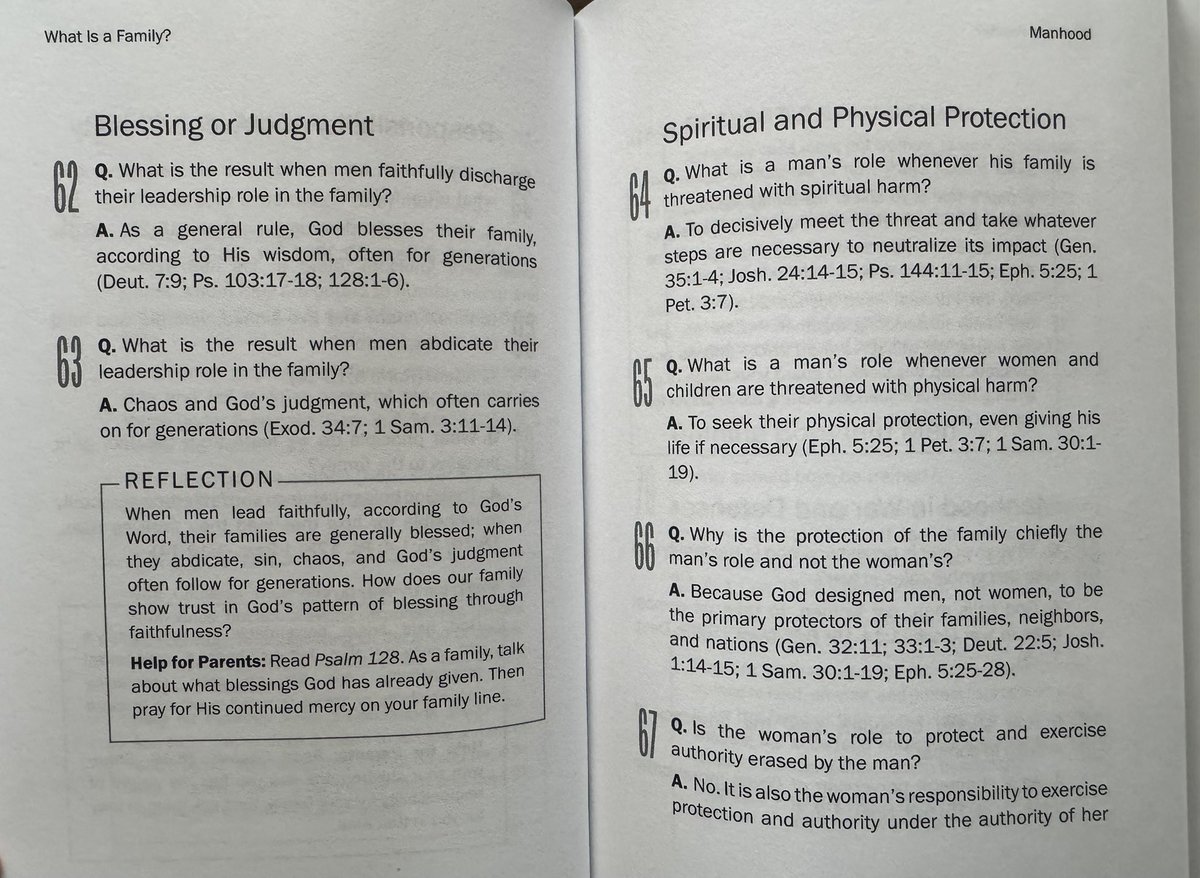
You’re going to want to pick up this new book by Scott Brown (@SBrownOnline), president of Church & Family Life (@churchandfam).
It’s a catechism on the family. Much needed.
The great Scottish preacher Ebenezer Erskine (1680-1754) once visited a woman on her death bed and lovingly tested her readiness for heaven. When she assured him that she was ready to depart and be with Christ because she was in that hand from which no one could pluck her, Erskine asked, "But are you not afraid that you will slip through His fingers in the end?"
"That is impossible because of what you have always told us," she said.
"And what is that?" he asked.
"That we are united to Him, and so we are part of His body. I cannot slip through His fingers because I am one of His fingers. Besides, Christ has paid too high a price for my redemption to leave me in Satan’s hand. If I were to be lost, He would lose more than I; I would lose my salvation, but He would lose His glory, because one of His sheep would be lost."
In matters of church ordinances, Christians must have a clear command or example from Christ or the apostles. We cannot invent practices based on analogy or similarity with Old Testament practices.