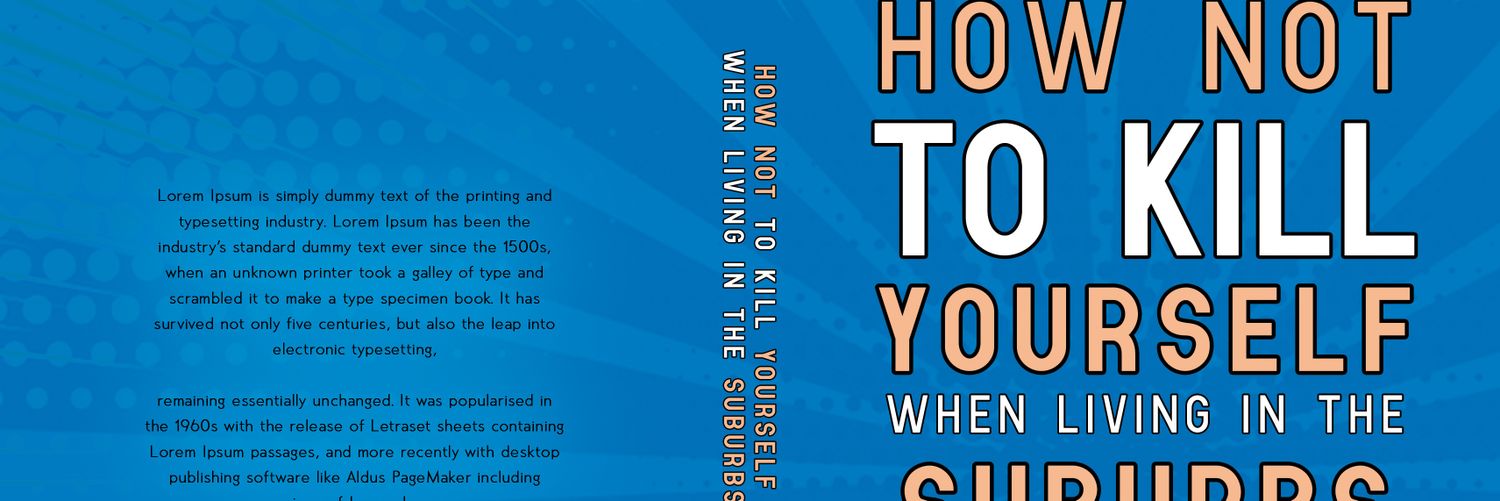
Only 5 books left of second print run. My favourite quote thus far is "laugh-out-loud-while-alone-on-plane-funny." If you're scratching your head for a Xmas present, this is a good laugh for under a tenner.
https://t.co/MkPMDupMcD
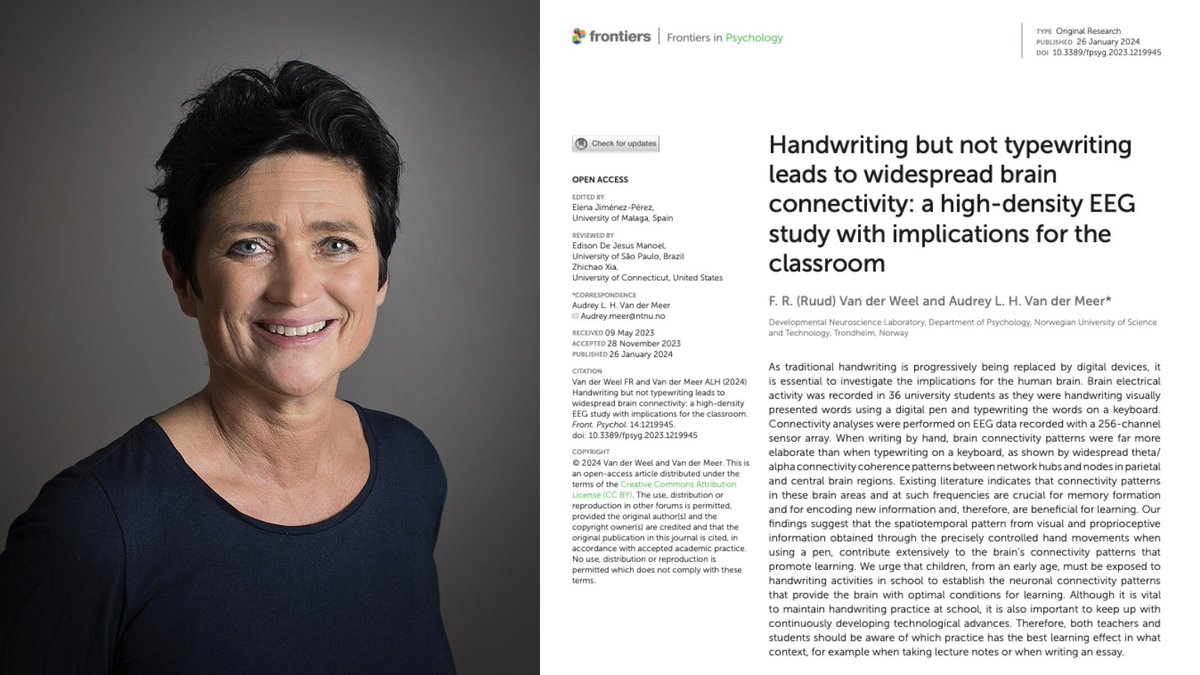
A Norwegian neuroscientist spent 20 years proving that the act of writing by hand changes the human brain in ways typing physically cannot, and almost nobody outside her field has read the paper.
Her name is Audrey van der Meer.
She runs a brain research lab in Trondheim, and the paper that closed the argument was published in 2024 in a journal called Frontiers in Psychology. The finding is brutal enough that it should have changed every classroom on Earth.
The experiment was simple. She recruited 36 university students and put each one in a cap with 256 sensors pressed against their scalp to record brain activity. Words flashed on a screen one at a time.
Sometimes the students wrote the word by hand on a touchscreen using a digital pen, and sometimes they typed the same word on a keyboard. Every neural response was recorded for the full five seconds the word stayed on screen.
Then her team looked at the part of the data most researchers had ignored for years, which is how different parts of the brain were communicating with each other during the task.
When the students wrote by hand, the brain lit up everywhere at once.
The regions responsible for memory, sensory integration, and the encoding of new information were all firing together in a coordinated pattern that spread across the entire cortex. The whole network was awake and connected.
When the same students typed the same word, that pattern collapsed almost completely.
Most of the brain went quiet, and the connections between regions that had been alive seconds earlier were nowhere to be found on the EEG.
Same word, same brain, same person, and two completely different neurological events.
The reason turned out to be something nobody had really paid attention to before her work. Writing by hand is not one motion but a sequence of thousands of tiny micro-movements coordinated with your eyes in real time, where each letter is a different shape that requires the brain to solve a slightly different spatial problem.
Your fingers, wrist, vision, and the parts of your brain that track position in space are all working together to produce one letter, then the next, then the next.
Typing throws all of that away. Every key on a keyboard requires the exact same finger motion regardless of which letter you are pressing, which means the brain has almost nothing to integrate and almost no problem to solve.
Van der Meer said it plainly in her interviews.
Pressing the same key with the same finger over and over does not stimulate the brain in any meaningful way, and she pointed out something that should scare every parent who handed their kid an iPad.
Children who learn to read and write on tablets often cannot tell letters like b and d apart, because they have never physically felt with their bodies what it takes to actually produce those letters on a page.
A decade before her, two researchers at Princeton ran the same fight using a completely different method and ended up at the same answer. Pam Mueller and Daniel Oppenheimer tested 327 students across three experiments, where half took notes on laptops with the internet disabled and half took notes by hand, before testing everyone on what they actually understood from the lectures they had watched.
The handwriting group won by a wide margin on every question that required real understanding rather than surface recall.
The reason was hiding in the transcripts of what the two groups had actually written down.
The laptop students typed almost word for word, capturing more total content but processing almost none of it as they went, while the handwriting students physically could not write fast enough to transcribe a lecture in real time, which forced them to listen carefully, decide what actually mattered, and put it in their own words on the page.
That single act of choosing what to keep was the learning itself, and the keyboard had quietly skipped the choosing and skipped the learning along with it.
Two studies. Two countries. Same answer.
Handwriting makes the brain work. Typing lets it coast.
Every note you have ever typed instead of written went into your brain through a thinner pipe. Every meeting, every book highlight, every idea you captured on your phone instead of on paper was processed at half depth.
You did not forget those things because your memory is bad. You forgot them because typing never woke the part of the brain that would have made them stick.
The fix is the thing your grandmother already knew.
Pick up a pen. Write the thing down. The slower road is the faster one.
👁️Hammersmith and Fulham Council is going full Orwell
It's wiring up AI surveillance capabilities into 500+ CCTV cameras
Buried in documents we've uncovered are proposals to monitor a wide range of behaviour
Here's what you should know⤵️
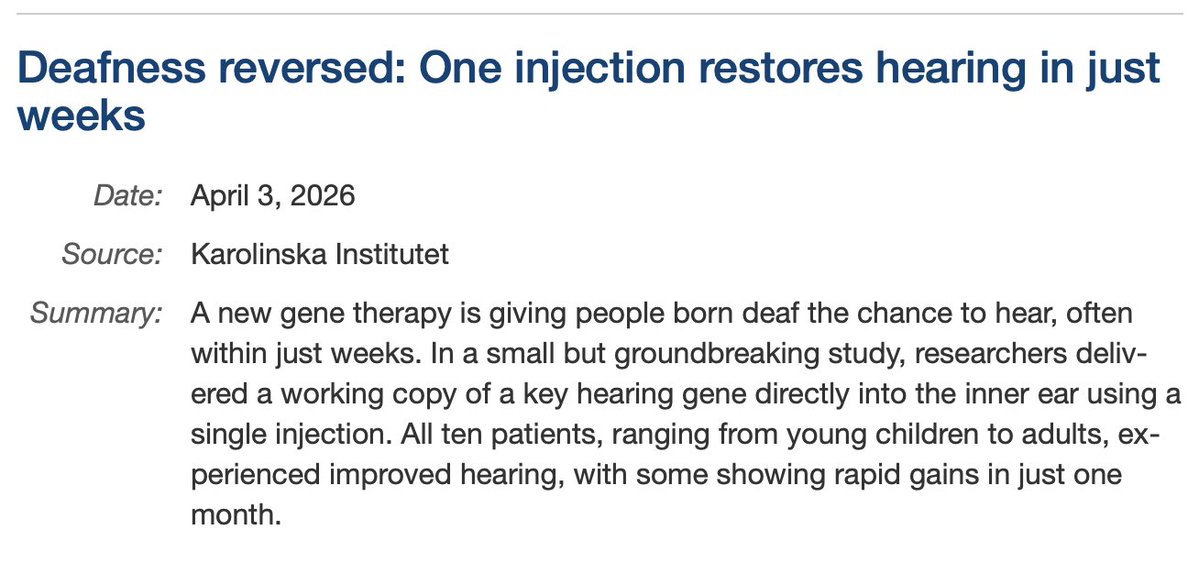
1/ Insane: A single injection into the inner ear reversed deafness in all ten patients. Some started hearing again within weeks. Gene therapy just crossed a threshold we thought was still years away.
Lets dig into this breakthrough and how it works 🧵
This is wild.
143 million people thought they were catching Pokémon. They were actually building one of the largest real-world visual datasets in AI history.
Niantic just disclosed that photos and AR scans collected through Pokémon Go have produced a dataset of over 30 billion real-world images. The company is now using that data to power visual navigation AI for delivery robots.
Players didn't just walk around with their phones. They scanned landmarks, storefronts, parks, and sidewalks from every angle, at every time of day, in lighting and weather conditions that staged photography would never capture. They documented the physical world at a scale no mapping company with a fleet of vehicles could have replicated on the same timeline or budget.
Niantic collected this systematically, data point by data point, across eight years, while users thought the only thing at stake was catching a rare Charizard.
The most valuable AI training datasets in the world aren't being assembled in data centers. They're being built by people who have no idea they're building them.
90% of people will miss this tonight because they’re looking at their phones. DON’T BE ONE OF THEM. ☄️
The planets are literally aligning for us on this February 28th. A rare 6-planet alignment is happening right now, and it’s the perfect time to set an intention, make a wish, or just sit back and marvel at how tiny we really are.
The universe is putting on a free show—don’t forget to look up. 🔭
I find this terrifying but also can't help but laugh at humanity's stupidly.
The Webs We Weave has gone literal.
'War is a Racket' is now
'War is this inside of a Tennis Racket.'
Don't pull on that thread there's a killer drone at the end of it.
Etc etc
Fiber optic lines should be banned in drone warfare. This stuff makes a giant mess that's going to last hundreds of years!
Most cables are made of durable plastics like Polymethyl Methacrylate (PMMA) and fluoropolymer coatings, which can persist in the soil and waterways for over 600 years.
As these cables degrade or are burned, they release microplastics and "forever chemicals" (PFAS), which contaminate agricultural land and can enter the food chain.
The nearly invisible lines create dangerous entanglement traps for birds, bats, and mammals. Some birds have already begun using these non-biodegradable shards as nesting material.
The cables tangle in vehicle axles, agricultural machinery, and forest-firefighting equipment. They also complicate post-conflict de-mining by snagging on heavy clearance machinery.
Soldiers must move with extreme caution to avoid entangling themselves or triggering booby traps hidden within the "web".
Digital ID for every adult is not progress. It is the end of a free society dressed up as convenience.
I am a cyber security specialist. This is my take.
They are selling it as a fix for illegal migration. That is bollocks.
We spend hundreds of billions a year on cyber security and yet the volume of breaches is breaking records. The threat is growing faster than the spend.
Digital ID will not stop boats. It will not stop trafficking gangs. It will not fix a broken border.
Criminals will work around it.
Honest citizens will pay the price.
It builds giant data banks that track where you go, what you buy, what you read and who you speak to.
It links your identity to every checkpoint in daily life.
One breach and your life is exposed.
Look at Jaguar Land Rover and the airports in recent weeks. Now imagine that at national scale on an ID system tied to everything you need to live your daily life.
Here is the risk that ministers will not admit.
Ransomware seeded through a supplier or an insider:
It lies quiet for months. It rolls through the backups. On trigger day the register and the recovery sets are both encrypted.
Payments fail. Health and benefits stall. Borders slow. Citizens are frozen out until a ransom is paid or the state rebuilds from scratch.
Centralise identity and you centralise failure.
Do not fall for the pitch.
Function creep is certain. It starts as login.
It becomes access to money, travel, speech and public services.
It turns rights into permissions controlled by the state and its contractors.
It creates a single point of failure for criminals, insiders and hostile states to target.
It will punish the elderly, the poor and anyone who is not always online.
It will centralise risk and outsource blame.
It will not stop fraud.
It will not stop illegal migration.
It will build the machinery for a social credit system by stealth.
If ministers cared about the border, they would enforce current laws, resource patrols and processing, close loopholes and remove those with no right to stay.
You do not need a national ID to do any of that.
We scrapped ID cards in 2010 for a reason.
Britain does not need a central register to prove age or status.
Yes to privacy first proofs. No to a database state.
Someone is trying to radicalize us. And yes they’re trying to radicalize both sides against each other. And it’s working. And there doesn’t seem to be any way to stop it other than turning off your phone and your tv (if you still have one), and going outside to hang out with real flesh and blood people.
They keep feeding us the most horrible versions of each other. The algorithms are. But who makes the algos? Who REALLY benefits from us being at each other’s throats?
If you let the algos convince you the other side is evil then you have been psyopped.
Yes, there are evil people, but most people are not. We’re letting ourselves be defined by the absolute worst examples at the extremes. That’s what they keep showing us on every news channel and every social media feed. The worst of the worst. It’s all designed to foment us into anger and self destruction. I don’t know why exactly—could be as simple as divide and conquer. It probably is.
Don’t swallow the psyop.