Update on the way 🛠️
@Adam__SIRE and Jordan are hosting an X Spaces this Friday to give you a full rundown on where SIRE is at.
They'll cover:
- What we've built so far
- aVault and aLink status updates
- What's in the pipeline
- Your questions, answered live
📅 Friday, May 15th · 2PM UTC
Set reminder: https://t.co/gahaKqDVLG
Half of white-collar jobs gone by 2030. Great headline. Bad game theory.
I keep seeing high‑profile voices predicting that AI agents will cause a massive net loss of jobs, and plenty of smart people in tech are starting to believe it. Dario Amodei (Anthropic) has warned that AI could eliminate up to 50% of entry‑level white‑collar roles and push unemployment into double digits, and investors like Vinod Khosla talk about AI doing 80% of jobs by 2030.
That makes cheap headlines, but it misunderstands how competition usually plays out. In most firms, AI agents don’t simply remove 30% of your workforce, they increase the output each person can deliver.
Recent empirical work finds that AI‑adopting firms tend to grow faster and often increase employment, because automating low‑value tasks frees people to drive more sales, better service, and faster iteration.
This turns AI adoption into a game‑theory problem. Imagine Company A and Company B compete in the same market with similar AI:
Company A uses AI to cut 30% of staff and banks the savings.
Company B keeps headcount flat and uses the same tools to 3x output per person, more experiments, better product, more coverage.
If both have the same technology, the firm that reinvests the productivity gain into growth will usually take market share from the firm that shrinks.
History points the same way. From the industrial revolution to computing, technology has consistently destroyed specific tasks but, over time, created new industries, new roles, and higher total employment. More than half of today’s specialized jobs didn’t exist in 1940.
So the real strategic question for leaders is not:
“How many people can I let go now that I have AI agents?”
It’s:
“Do I want to be the firm that shrinks, or the firm that compounds market share?”
AI will absolutely erase some roles. But for most companies, the competitive equilibrium is unlikely to be 30% fewer people doing the same work, it’s the same (or more) people producing much more.
The winners won't be the companies that used AI to get smaller, they'll be the ones that used it to outmaneuver the competition.
Introducing SIRE Core Contributor: Jordan Moore
Jordan is a quant researcher with a PhD in Mathematics whose career has been built on one principle: edge comes from better data, better market understanding, and better execution, not from any single model. His background spans modelling, data science, and building the production pipelines that connect the two, with experience across gaming, analytics, and web3.
Before SIRE, Jordan worked on forecasting systems, simulation models, and end-to-end data pipelines, consistently in roles where the job was to turn messy data into usable signals. That combination of statistical rigour and engineering pragmatism is what makes his contribution distinctive: he doesn't just build models, he builds the systems that let models run reliably.
Focus on Systematic Research
As a Core Contributor, Jordan's focus is on building a more systematic and scalable quant foundation for SIRE, stronger research workflows, cleaner data infrastructure, and a clear path from idea to testing to live deployment. In a protocol where intelligence drives capital, the quality of that research layer directly determines performance.
A word from Jordan:
"What excites me most about SIRE is that this is still a young space, which means there is real room to build an edge rather than just chase one. Prediction markets bring together sport, data, market behaviour, and execution in a way that is genuinely interesting. That makes it a great environment for rigorous research, but also for building things that can have an immediate real-world impact."
Jordan brings the qualities SIRE needs at this stage: mathematical depth, production discipline, and a bias toward systems that compound. His work is helping ensure that as SIRE scales, its intelligence layer scales with it.
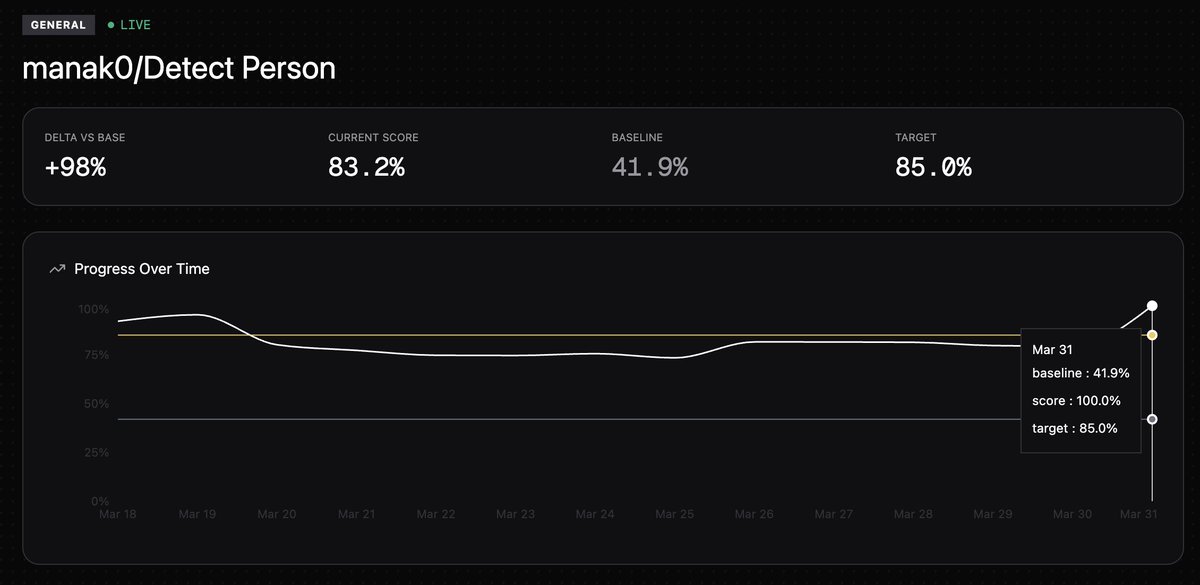
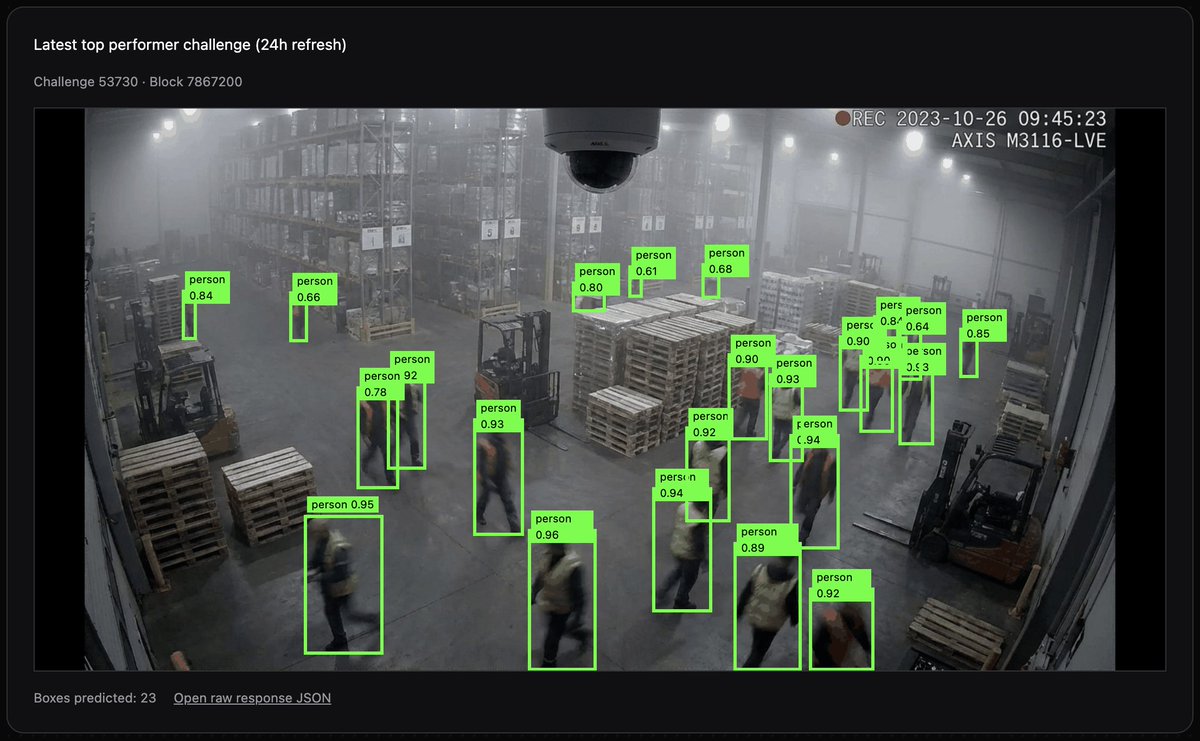
85% target accuracy on person detection on @webuildscore sn44.
today, someone just hit 100%.
this is what a decentralised vision ai network looks like when it's working.
and it's open source.
Soon we'll be bringing on new experienced contributors to SIRE to improve the strategy and agent workflow.
Now as aVault performance keeps improving after recent changes, (and dVault and aLink move further into development) we need more hands to keep up with what we're building. The goal is to keep sharpening execution across the board.
Since the latest updates to the agent:
Days: 7
Staked: $338k
Profit: $25.8k
ROIC: 7.49%
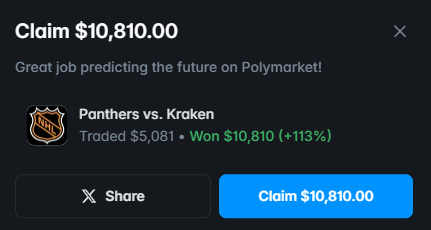
And that’s despite Barcelona’s 96th min goal that cost us $10k…..
Very excited about what February will bring for SIRE
-Launch of the new golf model
-Expanding the team
-Multiple big improvements to the agent
-Working with Polymarket to increase their offering
-Fully expecting a new record for monthly volume
We have big ambitions for 2026 but it all starts with building great tech, one day at a time.
The professional sports betting arena is changing quickly, and those that prosper will be those that build, build well, and build quickly.
Introducing @manakoai
Over the last several months, we announced partnerships across multiple industries, each validating our tech while building toward something bigger.
Today, we introduce Manako, our flagship product for a global audience.
We're thrilled to announce our partnership with @Polymarket.
Polymarket has been our go-to platform for trading, and with the upcoming launch of ΔVault, it will also be where our market making will take place.
Excited to grow with the leading prediction market. 🔵
Massive night for αVault in the Champions League.
The model identified deep market inefficiencies and executed on high-value underdog positions in Europe's top flight.
$10,040 Deployed | $25,829 Returned | +157% ROI.
6 Games. 9 Positions. 6 Wins.
Highest Value Captures:
🔹 Ajax to beat Villareal & Villarreal not to win -> +$9,322.16 Profit
🔹 Bodø to beat Man City & City Not to win -> +$8,678.42 Profit
Nights like this aren't accidents; they are the result of systematically targeting overvalued favourites.
When the market drifts too far from true probability, we are there to take the other side.
Data over narrative.