If you haven't checked it out yet, we built an RL Glossary.
Reinforcement learning is how modern AI actually gets trained. But the resources out there are scattered, fragmented, and frankly, confusing.
So we organized it. One place. Concepts laid out by where they fit in the pipeline. Read it in order or jump around.
Take a look.
https://t.co/skWjcB8Jsn
ICYMI: a 3B open-source model, fine-tuned on Adaptive Engine, matched proprietary accuracy on function calling for @CCSMedical patient support.
With over 90% lower latency.
Worth a read if you missed it the first time.
https://t.co/zVGh2jNFN7
How do you train one model to be poetic, another to be terse, and a third to be completely unhinged?
Reinforcement learning. Same base model, same loop, different rewards.
We put together a short video that walks through it, naming paint colors as the example. Rollouts, rewards, GRPO, and what happens when a model starts gaming the judge.
Want to learn more, check out our RL Glossary - https://t.co/FkHDBXVydf
900,000 call transcripts. Every day.
That's the volume @ATT processes through its call center AI pipeline. Each one needs accurate summarization, PII removal, regulatory flagging, and bilingual support.
They were running it on a general-purpose LLM with a long system prompt. It worked, but it was expensive, inflexible, and slow to iterate on.
We worked with AT&T to fine-tune a specialized model purpose-built for the job. 30% faster. More accurate.
Read the full story on our website.
https://t.co/HiABBG8oF9
We built a visual walkthrough of how reinforcement learning actually works.
Not theory. Just one example: training a model to name paint colors. From a single rollout, to a group, to a reward, to GRPO, to what happens when the model starts gaming the judge.
If you've ever wanted RL explained without the math wall, start with this post below.
https://t.co/mdhe0rKFmi
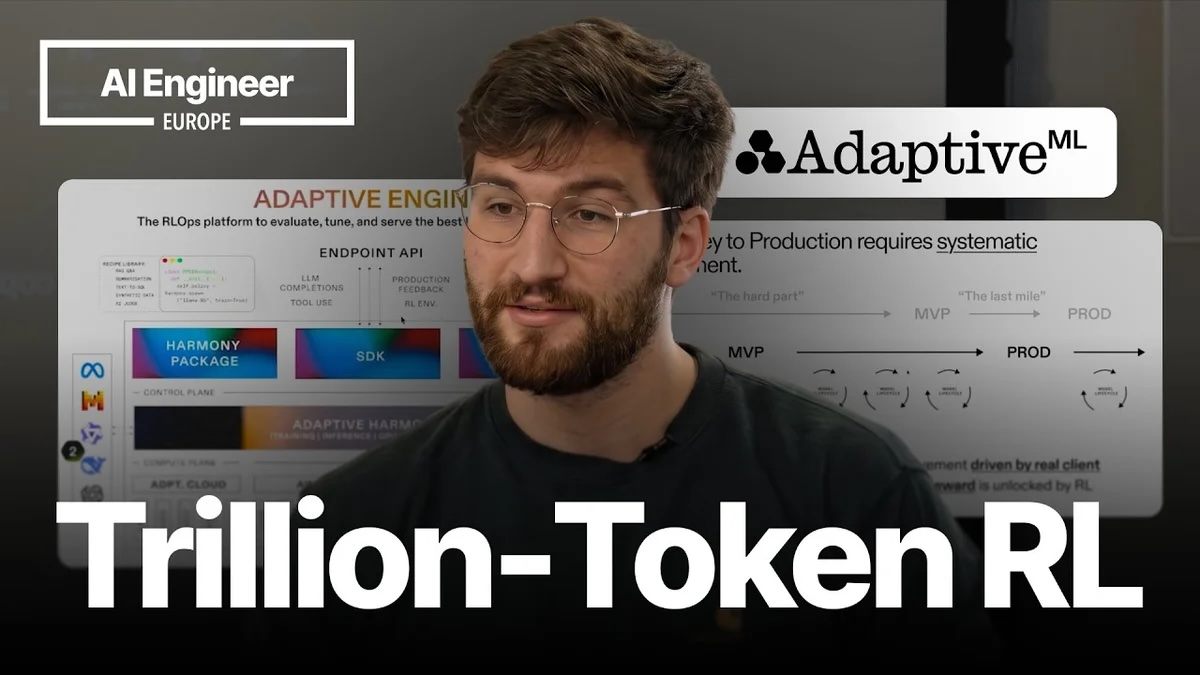
Want to know what we learnt from processing trillions of tokens at Fortune 500 companies?
Our Co-Founder & Chief Customer Officer Alessandro Cappelli’s talk at @aiDotEngineer covers just that.
An insight into what it really takes to deploy large-scale AI agents in production.
Watch the full talk on the Startup Hub website 👇
https://t.co/is0Aux1wi2
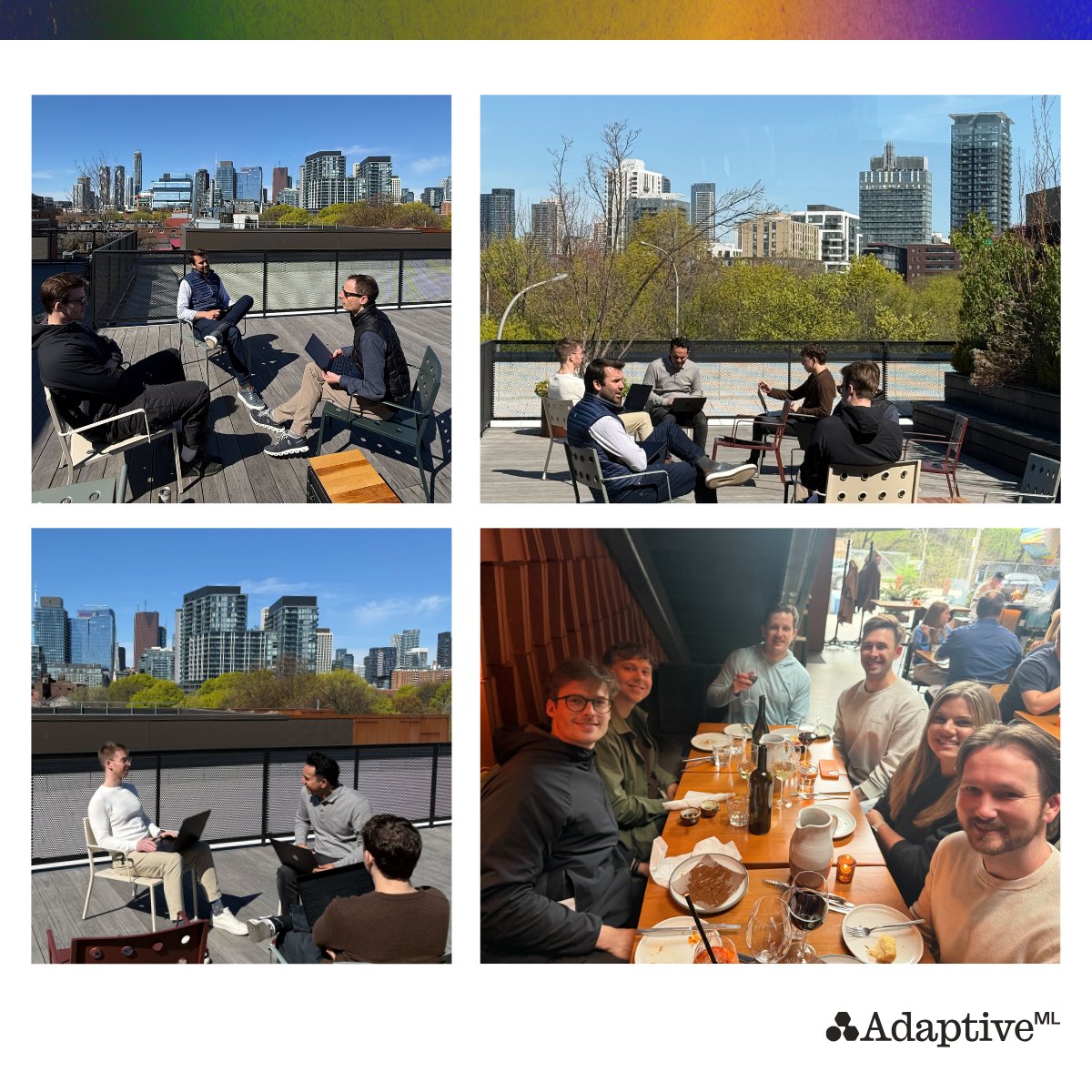
Not all meetings are the same, especially when on a sunny rooftop.
Last week the commercial team came together at the Toronto office for an offsite.
As a remote first company, bringing teams together regularly is fundamental to building a great culture.
Want to learn more about Adaptive ML - check out our website here - https://t.co/kbvN4Lqnt5
In patient support, every second matters.
With @CCSMedical, we fine-tuned a 3B @metaai Llama model (on @AWSstartups) on Adaptive Engine to match proprietary model accuracy on function calling, with over 90% lower latency.
Smaller, faster, and tuned for the task.
Read the case study:
https://t.co/KLA9JNw0fr
You don't choose RL. Your workload does.
A Fortune 500 customer-operations team we worked with started where most teams do: prompting. It got them to 90% accuracy on a frontier model and a $1.6M annual bill.
Then they specialized. An 8B model trained with SFT cut roughly 80% of the cost. RL extended it further, learning from outcomes the demonstrations couldn't anticipate.
Prompting defined early behavior. SFT stabilized it. RL pushed past the demonstration ceiling.
This progression isn't a stylistic preference. It's where high-volume production LLM systems converge.
Our latest piece breaks down when to use each technique, where each one hits a structural limit, and a simple decision rule for figuring out what your system actually needs.
Read the full article on our website: https://t.co/Dd0DaYyogQ
Latest product update is out.
Highlights include:
- Function graders for deterministic evaluation logic in RL and eval workflows
- Constrained decoding to enforce structured outputs at generation time
- Checkpoint promotion to evaluate and ship intermediate training states
As post-training workflows mature, evaluation quality, output reliability, and model promotion become core parts of the stack.
Read the full update here -
https://t.co/qvGgQ6F3MD
New case study with @awscloud and @AIatMeta.
We fine-tuned a Llama 3.2 3B model on Adaptive Engine to power a patient support agent for @CCSMedical.
Result: 90%+ latency reduction. ~230ms end-to-end responses.
Specialized small models beat generalists where it counts.
90% reduction in response latency. That's what enterprise AI should look like.
@AdaptiveML deployed a Llama-powered AI agent on AWS to transform patient service operations for CCS, making chronic care support faster and more reliable than ever.
Introducing Recipes.
The latest post from our DevRel, Dylan Ebert, explains how a single Python file can define a full AI workflow on Harmony, Adaptive Engine's compute backend.
https://t.co/YrxIQTWaw1
As a post-training platform for specialized agents, we’re often asked how teams should choose between prompting, SFT, and RL.
These techniques are not mutually exclusive and are often used together, but they apply to different constraints in the system.
We break down a practical framework for how these approaches fit together and how to evaluate their tradeoffs. If you’re building with LLMs, this helps clarify what moves performance and cost.
https://t.co/Dd0DaYyogQ
Same paint color. Same base model. Four different names: Sandy Beige, Sunset Dust, Burnt Sienna, Cinnamon Toast.
The difference is what each model was rewarded for.
Our latest piece visualizes reinforcement learning using a simple task: naming paint colors from hex codes. One base model, three judges, three trained 'painters'.
The Poet rewards evocative names. The Architect rewards terse, material-led ones. The Unhinged rewards the vivid and off-register. Nobody wrote a 'be more poetic' rule. The reward did the work.
That's the shape of RL. A reward, a loop, and outputs nudged toward what the reward says is good. Anything you can score becomes a training signal: math, code, conversation. Same loop, different reward.
The piece also covers where this breaks down. Reward hacking, Goodhart's law, and how to avoid both.
Find the full interactive post on our website here - https://t.co/mdhe0rK7wK
1/9 A 12B Gemma 3 model now summarizes 600,000 customer care calls a day at a major telecom. It replaced a generalist model. Judge-evaluated accuracy: 97.69%. ~5 points higher on the same benchmark. Here's the infrastructure that made it possible. 🧵👇
8/9 The end result at 600k calls a day: Higher accuracy. Lower cost. Compliance-grade outputs the previous system couldn't produce. And a model that keeps improving from production feedback. Infrastructure that appreciates over time.