Sharing the latest developments in the world of Tech,Web3 & AI | Content Creator | I help people master AI,web3, Coding, Digital marketing. | Dm for Collab
Another Tesla Roadster discussion taking over my feed. Another video idea in my head.
I like the idea of starting with a simple description instead of planning every editing detail upfront.
The CapCut plugin is coming soon to ChatGPT, bringing a conversational way to explore video creation with CapCut Web.
Early Access is currently available through ChatGPT desktop (PC only).
Mobile and web support is expected in mid-November.
#CapCutDidThat #CapCutWeb #ChatGPT #CapCutWorld
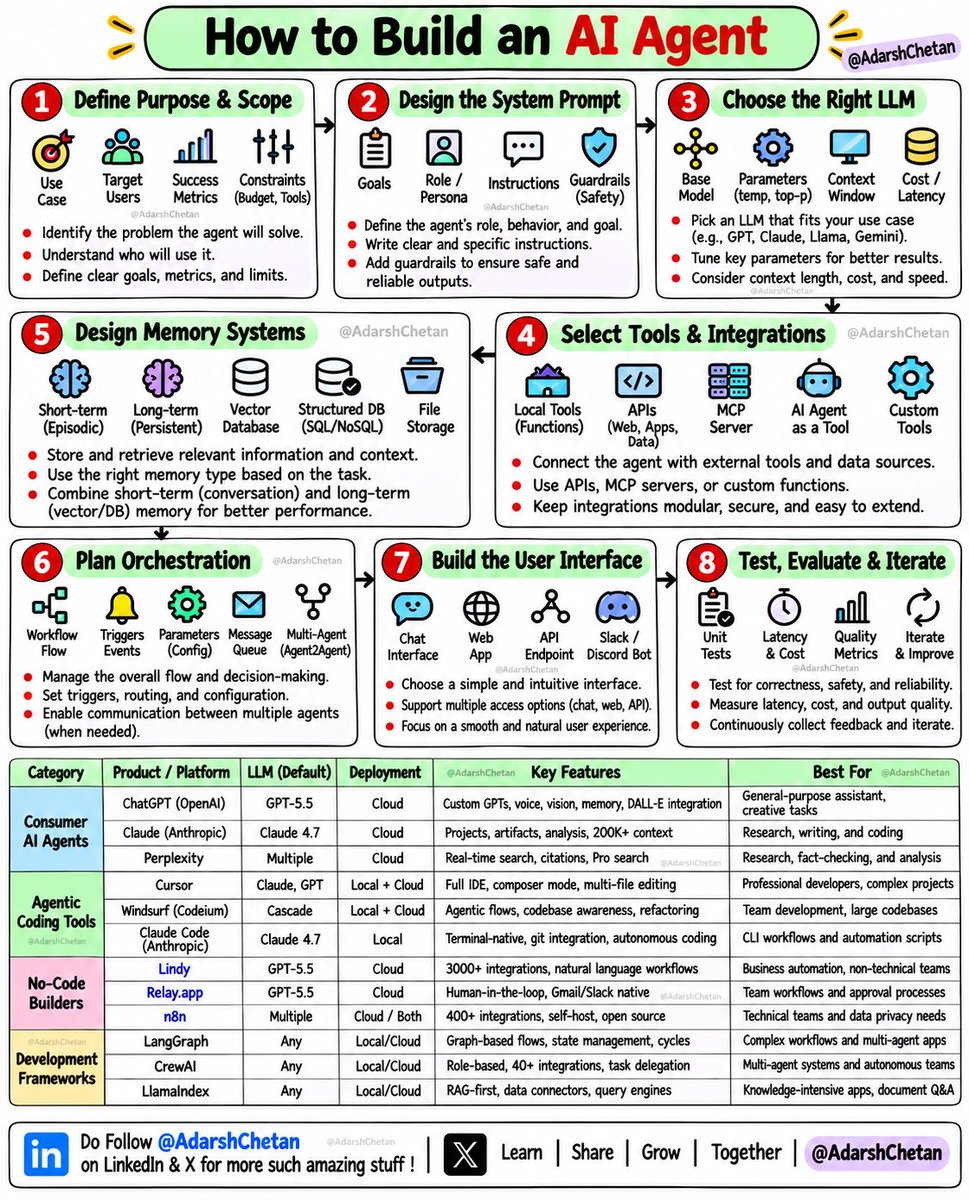
How to Build an AI Agent: A Step-by-Step Guide
AI Agents are transforming how we automate tasks, make decisions, and build intelligent applications.
But building an AI agent requires more than just connecting an LLM to a prompt.
Here are 8 essential steps to build an AI Agent:
1️⃣ Define the Purpose & Scope 2️⃣ Design the System Prompt 3️⃣ Choose the Right LLM 4️⃣ Integrate Tools & APIs 5️⃣ Build Memory Systems 6️⃣ Plan Agent Orchestration 7️⃣ Develop the User Interface 8️⃣ Test, Evaluate & Improve
🛠️ Popular AI Agent Tools & Frameworks:
•LangGraph
•CrewAI
•n8n
•LlamaIndex
•Claude Code
•Cursor
•Windsurf
•Lindy
💡 Remember: A reliable AI agent needs clear instructions, the right tools, effective memory, proper orchestration, and continuous evaluation.
Don't just experiment with AI agents.
Start building real-world applications!
📌 Save this roadmap for your next AI project.
Do Follow for more such amazing stuff ❤️
What can you build with Base44? Almost anything you can imagine. 🚀
Imagine turning a simple idea into a fully functional application without spending weeks writing code or managing complex infrastructure.
That's exactly what @Base44 makes possible.
Base44 is an AI-powered no-code platform that helps you build apps, websites, dashboards, and AI-powered tools simply by describing what you want in plain English.
Here are 4 features that make it worth exploring:
1. Build Apps Using Natural Language 💡
Have an idea? Just describe it.
Base44 turns your prompts into working applications with interfaces, features, and functionality.
Example: Build a personal expense tracker by simply describing how you want to track your income, expenses, and monthly savings.
2. Built-in Database & Authentication 🔐
No need to manually configure your backend.
Base44 handles database management, user sign-ups, login systems, and user permissions.
Example: Create a customer portal where users can securely log in, manage their profiles, and track their orders.
3. AI-Powered Features & Integrations 🤖
Make your applications smarter by adding AI capabilities and connecting external tools.
You can integrate services, automate workflows, and build intelligent experiences.
Example: Create an AI chatbot that answers customer questions and helps users find relevant information.
4. Publish & Launch with Ease 🌐
Your application doesn't have to remain an idea or prototype.
Base44 includes hosting, so you can publish your project and share it with users.
Example: Build a business website, connect a custom domain, and make it accessible online.
The best part? You don't need to be an expert developer to get started.
From a simple idea to a working product, Base44 helps reduce the gap between imagination and execution.
Think about all the tools you could build:
→ Personal productivity apps\
→ Business dashboards\
→ Customer management systems\
→ AI-powered assistants\
→ Websites and SaaS products
Karpo Decision 27B Act handled about 78% of page actions for just 13% of model cost in the team's Browserbase tests.
It selects browser actions in one forward pass without generating text, while a general-purpose LLM handles planning. The full system averaged 89% task success at $0.096 model cost per task.
That makes specialization worth exploring for agent builders. Check out Karpo-Browser and give it a star:
https://t.co/lU0x6OktJS
karpo-browser hit 89% on all 102 Browserbase v2 tasks. It averaged 201s and 9.6¢ in estimated model cost per task, ~1/13 of Fable + Claude Code’s listed cost. Only Claude Fable 5.2 (92%) and Gemini 4 Carbon (90%) scored higher in the chart. Open source. https://t.co/SOBULGowrJ
Build Your Own AI Agent with Claude in Just 10 Minutes!
No coding. No complex setup. Just follow these 10 steps:
1Open Claude
2Write a clear prompt
3Add useful skills
4Connect external tools
5Define your agent's goal
6Configure settings
7Test your agent
8Launch it
9Improve continuously
10Start automating tasks!
💡 The real power of AI isn't just generating answers.
It's building agents that can perform useful tasks with the right tools and instructions.
Do Follow for more such amazing stuff ❤️
How to Build an AI Agent: A Step-by-Step Guide
AI Agents are transforming how we automate tasks, make decisions, and build intelligent applications.
But building an AI agent requires more than just connecting an LLM to a prompt.
Here are 8 essential steps to build an AI Agent:
1️⃣ Define the Purpose & Scope 2️⃣ Design the System Prompt 3️⃣ Choose the Right LLM 4️⃣ Integrate Tools & APIs 5️⃣ Build Memory Systems 6️⃣ Plan Agent Orchestration 7️⃣ Develop the User Interface 8️⃣ Test, Evaluate & Improve
🛠️ Popular AI Agent Tools & Frameworks:
•LangGraph
•CrewAI
•n8n
•LlamaIndex
•Claude Code
•Cursor
•Windsurf
•Lindy
💡 Remember: A reliable AI agent needs clear instructions, the right tools, effective memory, proper orchestration, and continuous evaluation.
Don't just experiment with AI agents.
Start building real-world applications!
📌 Save this roadmap for your next AI project.
Do Follow for more such amazing stuff ❤️
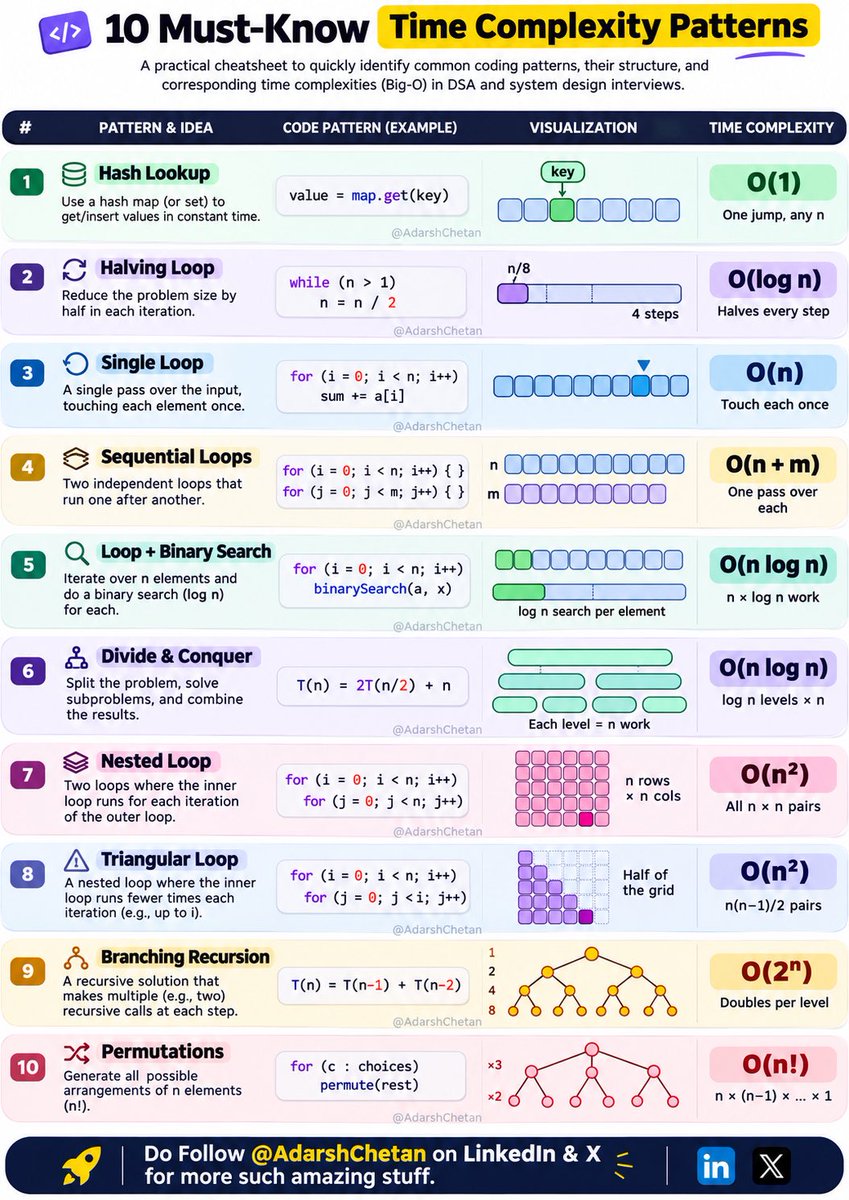
10 Must-Know Time Complexity Patterns Every Developer Should Understand!
Ever wondered how to quickly identify the time complexity of an algorithm?
Understanding Big-O notation is one of the most important skills in Data Structures & Algorithms (DSA).
Instead of memorizing complexity formulas, learn to recognize common coding patterns.
Here are 10 essential patterns every developer should know:
1️⃣ Hash Lookup — O(1) Accessing elements through a hash map or hash set typically takes constant time.
2️⃣ Halving Loop — O(log n) When the input size is divided by 2 in every iteration, the complexity is logarithmic.
3️⃣ Single Loop — O(n) A loop that visits every element once takes linear time.
4️⃣ Sequential Loops — O(n + m) Two independent loops contribute their individual complexities.
5️⃣ Loop + Binary Search — O(n log n) Running binary search inside a loop results in O(n log n).
6️⃣ Divide & Conquer — O(n log n) Splitting a problem into smaller parts and processing each level efficiently often produces this complexity.
7️⃣ Nested Loop — O(n²) When an inner loop runs for every iteration of an outer loop, the complexity becomes quadratic.
8️⃣ Triangular Loop — O(n²) A nested loop with a gradually increasing inner range performs approximately n(n−1)/2 operations.
9️⃣ Branching Recursion — O(2ⁿ) When each recursive call generates multiple additional calls, the execution tree can grow exponentially.
🔟 Permutations — O(n!) Generating every possible arrangement of n elements results in factorial growth.
💡 Why should you learn these patterns?
Understanding time complexity helps you:
✅ Write efficient and scalable code. ✅ Identify performance bottlenecks. ✅ Choose better algorithms and data structures. ✅ Prepare for DSA and technical interviews. ✅ Understand how algorithms behave as input grows.
Remember: Don't just memorize Big-O formulas. Understand the pattern behind the code.
Do Follow for more such amazing stuff ❤️
DSA Patterns Every Developer Should Master in 2026!
Struggling to solve Data Structures & Algorithms problems?
The secret isn't solving thousands of random problems. It's learning to recognize the right pattern.
Most coding interview questions can be approached using a set of reusable problem-solving techniques.
Here are 15 essential DSA patterns worth mastering:
1️⃣ Sliding Window – Solve subarray and substring problems efficiently.
2️⃣ Two Pointers – Find pairs, remove duplicates, and optimize array traversal.
3️⃣ Binary Search – Search efficiently in sorted arrays and search spaces.
4️⃣ Prefix Sum – Handle range sum queries and cumulative calculations.
5️⃣ Hashing – Perform fast lookups, frequency counting, and grouping.
6️⃣ Recursion & Backtracking – Explore combinations, subsets, and permutations.
7️⃣ Greedy Algorithm – Make locally optimal choices to reach a global solution.
8️⃣ Stack & Queue – Solve ordering, balancing, and next-greater-element problems.
9️⃣ Linked List Techniques – Use fast and slow pointers for cycle detection and middle-node problems.
🔟 Heap / Priority Queue – Find top K elements and manage priority-based operations.
1️⃣1️⃣ Trees & Traversals – Master DFS, BFS, BST, and tree-based problems.
1️⃣2️⃣ Dynamic Programming – Break complex problems into overlapping subproblems.
1️⃣3️⃣ Graph Algorithms - Understand BFS, DFS, shortest paths, and topological sorting.
1️⃣4️⃣ Kadane's Algorithm – Find the maximum sum contiguous subarray efficiently.
1️⃣5️⃣ Bit Manipulation - Use XOR, AND, OR, and shifts for optimized solutions.
💡How should you prepare?
✅ Understand the concept behind each pattern.
✅ Solve 5–10 problems for every pattern.
✅ Start with easy problems and gradually move to medium and hard.
Do Follow for more such amazing stuff ❤️
@yunhaojiao Independent testing is the missing layer in AI-driven development. Great to see TestSprite making reliable, verifiable software testing a priority! 🚀