Just tried Google’s new NotebookLM Audio Overview and I’m genuinely impressed! I uploaded the NIH’s “Your Guide to Healthy Sleep” and in seconds, it turned the whole PDF into a podcast-style conversation.
https://t.co/tkuduBe5qC
#AI#Podcast#GoogleAI
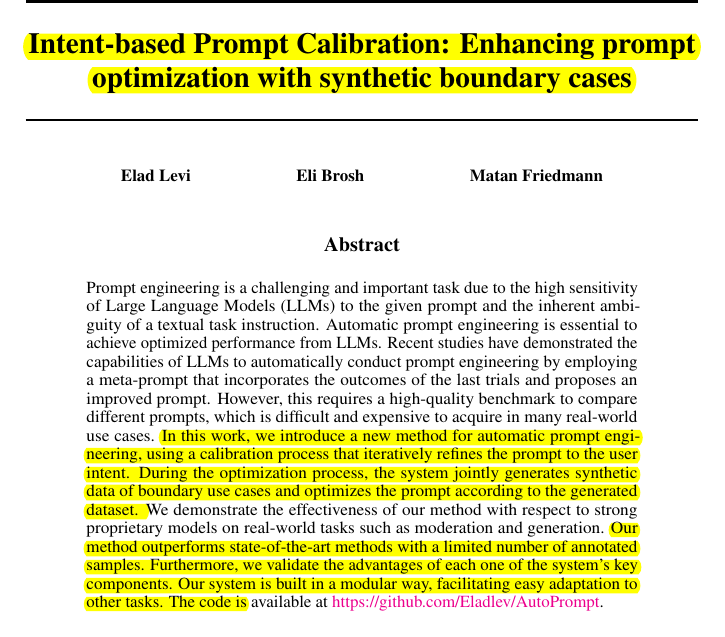
LLMs are highly sensitive to prompt variations, leading to inconsistent performance across different prompts for the same task. 👨🔧
Intent-based Prompt Calibration (IPC) iteratively refines prompts to match user intent using synthetic boundary cases, addressing prompt sensitivity and optimizing with limited data.
📌 IPC generates challenging synthetic samples at each iteration, focusing on boundary cases that expose prompt ambiguities.
📌 The system employs three meta-prompts: Sample Generator, Analyzer, and Prompt Generator. The Sample Generator creates diverse, adversarial samples with balanced class distribution. The Analyzer evaluates prompt performance and identifies failure cases. The Prompt Generator suggests improved prompts based on historical performance and analysis.
📌 For generative tasks, IPC first calibrates a ranking prompt, then uses it to optimize the generative prompt. This approach allows optimization with minimal annotation effort.
📌 The system architecture consists of four components: Dataset (manages data operations), Estimator (handles predictions and annotations), Evaluator (assesses records and performs error analysis), and Optimizer (manages the optimization process flow).
📌 IPC outperforms existing methods like OPRO and PE on classification tasks (spoiler detection, sentiment analysis, PG detection) and generative tasks (enthusiastic/reliable and sarcastic/positive movie reviews).
📌 The method demonstrates superior performance with limited data, achieving higher accuracy and lower variance compared to baseline approaches.
📌 Ablation studies reveal the importance of synthetic data generation, iterative refinement, and error analysis in improving model performance.
📌 IPC effectively handles imbalanced data distributions by generating balanced synthetic samples, particularly beneficial for real-world moderation tasks.
Swap and Pop in Solidity:
As an auditor, you will encounter many different techniques which will be repetitively used over and over again.
One such technique that has gained popularity for its efficiency in array manipulation is the "Swap and Pop" method.
This method is an elegant solution for removing elements from an array, especially when the order of elements is not a critical concern. Let's dive into what makes this method stand out, its implementation, and the trade-offs involved.
Understanding Swap and Pop:
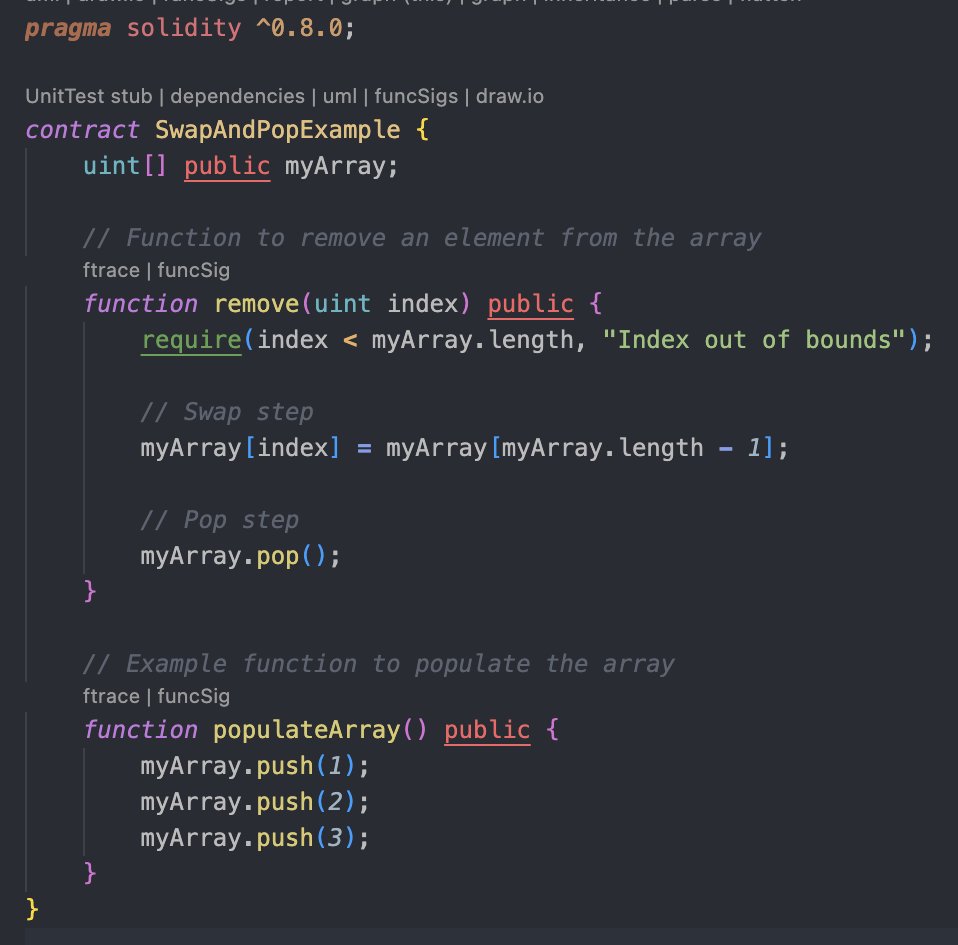
At its core, the Swap and Pop mechanism is a two-step process used to remove an element from an array.
The process goes as follows:
Swap: The element to be removed is swapped with the last element in the array.
Pop: The last element of the array (now the unwanted element) is removed or "popped" off the array.
This approach is efficient because it avoids the need to shift all elements after the removed element, a process that would consume more gas as it requires more computational work.
Here's a basic example of how the Swap and Pop mechanism can be implemented in Solidity:
It is critical to understand that this methodology will alter the sequence of the array, which can sometimes be a critical bug.
Please RT if this helped 👀
@SolidityScan unbounded for loops and array of investors and investments are become too large after some time as for every investments array length will increase so after some time contract will stop functioning
🪐 Introducing Cantina Competitions 🪐
With @MorphoLabs! 🦋
• $200,000
• 2500 SLOC
• Cantina Code assisted (much bigger than you think)
• Invite Code ONLY
A new era for web3 security begins today.
👇No invite code? Huge opportunity below👇
@calyptus_web3 _earning will remain zero due to rounding. For earning >0 time difference should be much higher ( around 1 million year) which is very unlikely