@NewmanJ_R@BobMurphyEcon - Listened to your Podcast the other day and thought I'd blog about AI and The Economic Calculation Problem; any excuse to write about Mises, Hayek, and AI
https://t.co/VsZc8f5hzU
Democracy is alive and well in the Commonwealth, by @AddyGills
As Mencken put it: “Democracy is the theory that the common people know what they want, and deserve to get it good and hard.”
And get it hard we have.
https://t.co/M9KyDh5QsZ
This agreement, in part, does come down to my own priors. My instincts are, quite explicitly, Hayekian: I tend to think in terms of nomos rather than thesis—law as a framework of general rules for spontaneous coordination, rather than law as an instrument for directing society toward a substantive end. That is very much where my disagreement with Professor Vermeule begins.
I want to say that up front, both to be fair to his position and to avoid talking past each other, because I think our disagreement lies less in the internal logic of his theory than in its underlying premises.
Let me take this point by point, because I would be remiss not to give you the response such a timely critique deserves:
1. I did not accuse Professor Vermeule of defending mere appetite or private whim. My criticism is that this does not remove the practical problem of who specifies the idea of the “good” in concrete cases, by what standard, and through which institutions. The discretion remains; it is simply moralized.
2. The knowledge problem does not “prove too much.” It applies with greater force against a regime that asks rulers to specify and administer a substantive common good than against one that confines law more narrowly to general rules, adjudication, and coordination. All regimes govern under uncertainty, but it is another thing entirely to claim the authority to direct moral and social life.
3. On Liberty: Agreed, my position is not morally neutral. My argument is not that liberal constitutionalism escapes moral reasoning, but that its moral commitments are better expressed through a framework of restraint, pluralism, and general rules than through rulers empowered to administer a substantive vision of the good from above.
4. On Originalism: Correct, text does not apply itself, and history does not interpret itself—these are not methods meant to eliminate judgment. My claim is comparative, not absolute. A judge constrained by text, history, and original meaning is less free than a judge invited to reason from a substantive theory of the common good. The fact that discretion cannot be abolished does not mean it cannot be narrowed.
So no, I do not think the disagreement is whether law contains morality or prudence. Of course it does. I see the disagreement as whether those realities justify a constitutional order in which liberty is treated as derivative and rulers are empowered to administer the good from above.
(My apologies if this does not format correctly on X—I am not a regular user)
I look forward to your response and appreciate y'all taking the time!
@on_the_kaw@realwilldonahue@Vermeullarmine I will actually take that to heart on my proofreading and editing—I have been trying to optimize my Substack for SEO and readability, but I really appreciate that feedback. If the structure is taking away from the substance, then to hell with SEO!
@Vermeullarmine@realwilldonahue I am just a redneck masquerading as a law student who was doing the same just as an economist back when you wrote, "Beyond Originalism"—I would be more concerned if you HAD heard of me😅
Ah, this is awesome. I appreciate y’all taking the time to engage my post, even if we disagree!
That said, I was responding to an article inviting engagement on its own terms. I do not think it is unreasonable to critique arguments made in an article without first reading the subsequent companion volume.
If that standard applies to me, I assume it would apply equally to Judge Pryor and others who responded to the same piece.
To be fair, I also realize the article has now aged a good bit, and Professor Vermeule has had time to further clarify and develop the argument.
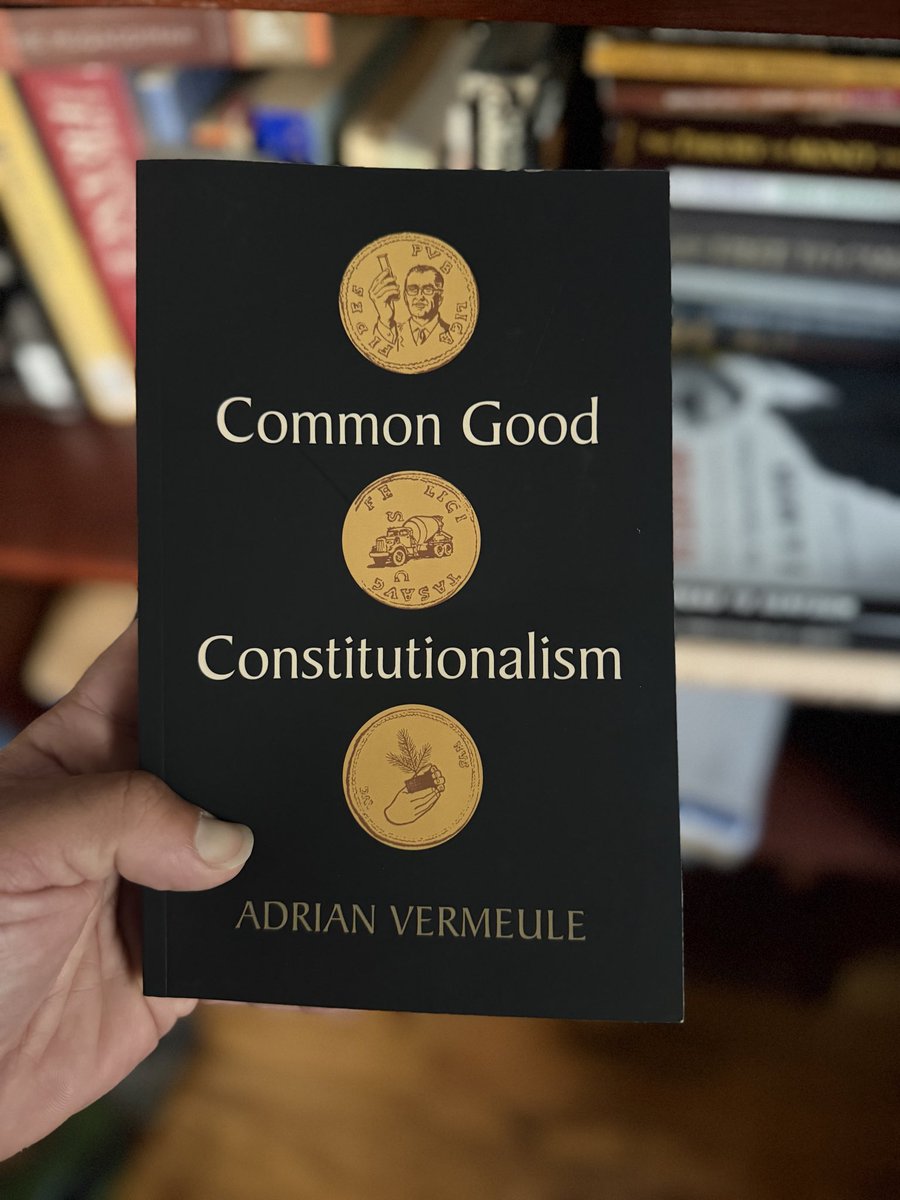
I’ve ordered the book and look forward to reading it (well...after finals). I hope y'all will engage whatever follow-up I write then as well—thanks again!
Here is part three of my six-part series: Monopoly and the State: A Rebuttal, How the Government Creates Monopoly
@AddyGills https://t.co/xLgsas35kS
@BobMurphyEcon@michaelmalice
@premium I have been trying to cancel my premium account since March, and you have stopped replying to my DMs. Please have a support team member reach out.