I am deeply grateful to God almighty and elated to be starting the new year as an Associate Professor of Nursing and Dean, College of Nursing at the esteemed Wesley University, Ondo State @Wesleyuni_ondo
School of Nursing (RN)
School of Midwifery (RM)
Postgraduate Diploma in Education (PGCert)
BSc in Nursing
MSc Healthcare Management and Leadership
PhD in Nursing
Lecturer, Nursing Education and Administration
Associate Professor of Nursing
Dean, College of Nursing Science
Hi women, can you post pictures or talk about your academic achievements? I need some motivation this month.
If you see this tweet, share it so women can see it.
My mum defiled the odds and went back to school when she was well over 50years as the state government won’t promote Nurses without a BSc degree beyond grade/level 14.
As a result she went back to rewrite her WAEC exams and I could remember how much I laughed her on the first day of her exams when I saw her in school uniform. I was so little and didn’t know that my action was humiliating but she ignored me and went for her exams.
When she started her BSc in Nursing at NOUN, many people were calling her Iya (old woman) and wondered what she was looking for. She remained focused and graduated with a second class upper division.
In 2014, she surprised everyone when she won the Commonwealth Shared Scholarship to study MSc Healthcare Management and Leadership in the UK. She didn’t only stopped there, but she’s now completing her PhD in Nursing in South Africa, while she’s now a lecturer in Nursing even though she’s a retired Nurse.
She’s my greatest role model and because of her I’m always on my toes and encouraged never to give up. Because of her, I went to a private university as she couldn’t bear to see me spend 3 years at home seeking for admission and doing nothing. Because of her, I also won the Commonwealth Shared Scholarship in 2020 for my 2nd master’s degree. Because of her, I’m motivated to compete my PhD as I know if she can do it, I’m also capable of completing my PhD.
Are you excited for tomorrow’s X-space on “Preparing and Applying for the UK Global Talent Visa”?
Meet some of our speakers👇
1️⃣ Jumoke Muritala @Jvmoke: a UK Global Talent Visa recipient in Visual Arts, multidisciplinary visual artist, multi creative, and Business Development Manager whose work explores cultural storytelling, identity, and human connection through face art. She is a member of the British Art Network and a Global Arts and Medicine Fellow, with her work exhibited across the UK, Brazil, and Nigeria.
2️⃣ Dr Abraham Bajona @beewaskaba: a UK Global Talent Visa recipient and material scientist specializing in solid-state characterization of pharmaceutical, food and agrochemical materials. Research areas span from extraction, optimization and structure-function interplay in biomaterials.
3️⃣ Dr Dareen Assaf @assafdareen: a UK Global Visa recipient and Researcher with a focus on equity and inclusion in higher education, migration, and gender. Also working at SAVTE, a Sheffield charity supporting refugees and asylum seekers. She is also a UK Young Academy Fellow.
4️⃣ Dr Chuks Oko-Otu @oko_chukwuemeka: a UK Global Talent Visa recipient and Visiting Research Fellow at Oxford University. Holds a PhD in Modern War Studies, an MSc in International Conflict Analysis with Distinction and BA in History (first Class).
Don’t miss out👌
Today is the International Day of the Boy Child and it’s alarming to see the silence around it.
Do you know that👇
☑️ Most single men in the dating pool have significantly lower levels of education and income than what most women are looking for.
☑️ Around 60% of college degrees are now earned by women, leaving a 60/40 gap in higher education.
☑️ Young women now earn more on average in early career phases than their male counterparts.
☑️ Young men face higher day-to-day employment instability.
☑️ Young men suffer higher lifetime wage scarring from inactivity.
☑️ Young women build early financial foundations faster than men.
This is largely because👇
— According to the Fatherhood Institute, only 60.6% of boys achieve a good level of development by age 5, compared to 74.2% of girls.
— According to the Education Policy Institute (EPI), 5-year-old girls are 3.3 months ahead of boys in communication and literacy.
— By age 11, 63% of girls meet the expected standard in English reading and writing, compared to just 56% of boys.
— UK parliamentary data highlights that 23% of boys are identified with Special Educational Needs (SEN), compared to just 13% of girls.
— The House of Commons Library notes that only 40% of young men progress to higher education by age 19, compared to 54% of young women.
— 15% of young men drop out of the University in comparison with 11% young women.
If we want more responsible and economically productive young men, we need to pay more attention to the #BoyChild and support them with necessary mentorship and capacity building skills.
🚨GLOBAL TALENT VISA (Research Route) X SPACE 🚨
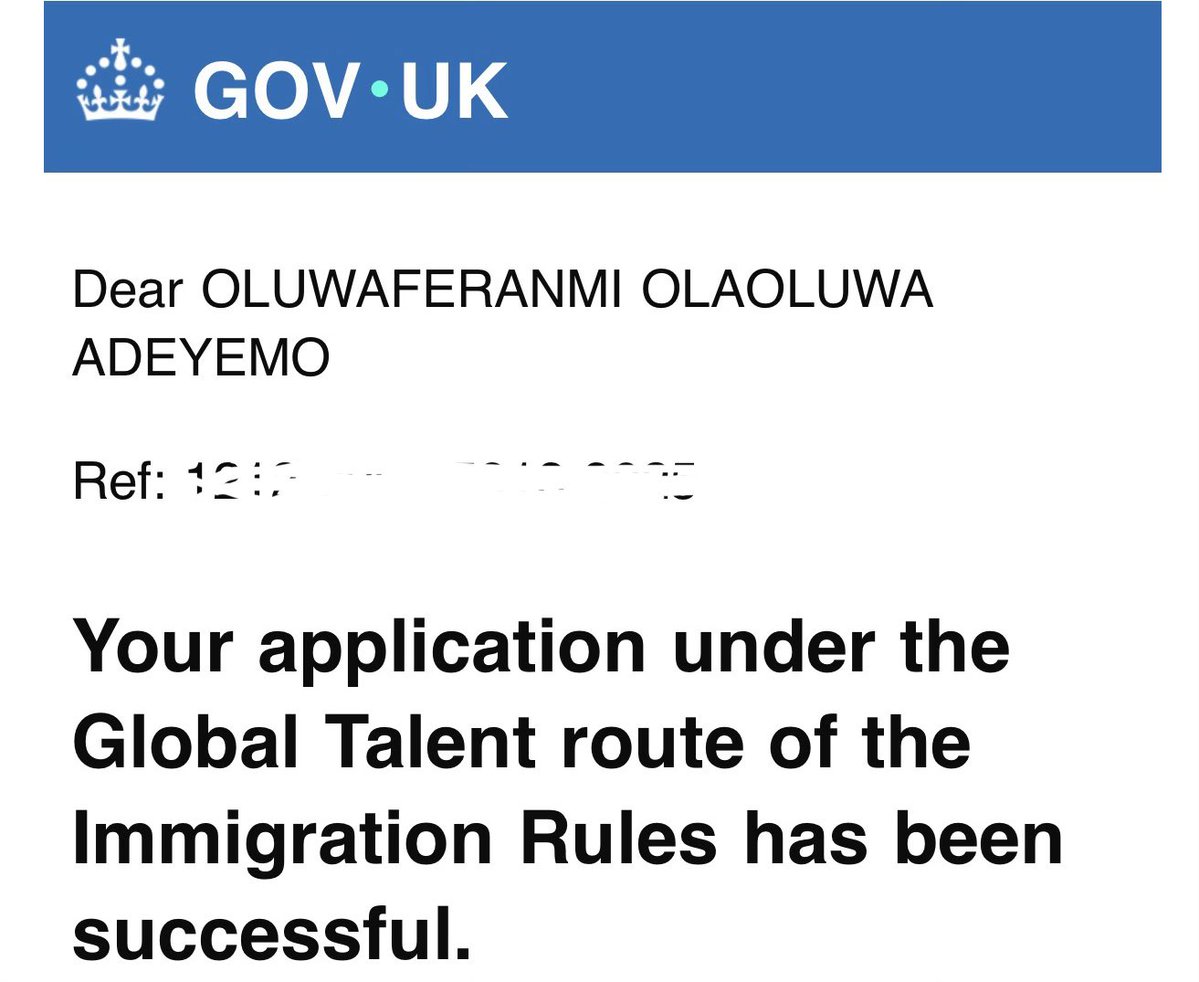
Following the numerous messages and questions from prospective applicants on how to successfully apply for the UK Global Talent Visa (Research Category), I’ll be hosting an insightful X Space this Sunday featuring current GTV recipients 🎓🇬🇧
They’ll be sharing:
✨ Their application journey
✨ Key strategies and lessons learned
✨ Common mistakes to avoid
✨ Tips for building a strong portfolio/evidence
If you’re a researcher, academic, PhD student, or aspiring applicant considering the Global Talent Visa research route, this conversation will be highly valuable.
You’ll also have the opportunity to connect with recipients in your field and ask them questions about recent changes and how to better prepare your application.
🗓 Date: May 17
⏰ Time: 5PM (GMT+1)
📍Venue: X Space
https://t.co/KMaGibSS7o
🚨GLOBAL TALENT VISA (Research Route) X SPACE 🚨
Following the numerous messages and questions from prospective applicants on how to successfully apply for the UK Global Talent Visa (Research Category), I’ll be hosting an insightful X Space this Sunday featuring current GTV recipients 🎓🇬🇧
They’ll be sharing:
✨ Their application journey
✨ Key strategies and lessons learned
✨ Common mistakes to avoid
✨ Tips for building a strong portfolio/evidence
If you’re a researcher, academic, PhD student, or aspiring applicant considering the Global Talent Visa research route, this conversation will be highly valuable.
You’ll also have the opportunity to connect with recipients in your field and ask them questions about recent changes and how to better prepare your application.
🗓 Date: May 17
⏰ Time: 5PM (GMT+1)
📍Venue: X Space
https://t.co/g3Bz0bPpms
Please help retweet: @taadelodun@ireteeh@iamkayfactor@TosinOlugbenga@the_Lawrenz@oko_chukwuemeka@AskMichaelTaiwo@Yemisiolufemi
Read more about how to prepare and apply for the Global Talent Visa, science and research category (peer-reviewed route) here if you’re a PhD student near completion or an early career researcher👇
https://t.co/yTRaHBe1GD
One of the benefits of being a UK Global Talent (research and academia) is the flexibility to work for multiple employers (in your endorsed field) with no new sponsorship required and with no restriction on hours.
Personally, in recent months, I have found myself working across 3 universities carrying out interdisciplinary research👇
1. Research Associate at Manchester Metropolitan University, contributing to a portfolio of projects exploring collective governance, systems transformation, equitable partnering and sustainable change.
2. Research Assistant at the University of Hull under the Yorkshire Policy Innovation Partnership (YPIP) project. The YPIP is a multi-university, cross-sectoral collaborative project funded by UK research councils (UKRI & ESRC) under the Local Policy Innovation Partnership (LPIP) Hub.
3. Co-Investigator at Sheffield Hallam University on the Sheffield & Rotherham Wildlife Trust/Wildscapes research project to develop a climate change risk assessment methodology and prototype tool for integration into Biodiversity Net Gain (BNG) evaluations.
If you are a PhD candidate, nearing completion, or an early career researcher with equivalent doctoral-level experience, explore the article below for a concise guide on preparing for and submitting a strong application for the UK Global Talent Visa via the Route 4 (peer-reviewed) route👇
6 years ago, in March 2020, I received the Commonwealth Scholarship nomination email that transformed the course of my life.
Long story👇
After being rejected following 6 attempts, I summoned the last confidence left to try again for the 7th time. I remember submitting the application just a few minutes before the 4pm deadline in December 2019.
In early 2020, I found myself encouraging others and reminding them that “remember not the former things… for God will do a new thing” (Isaiah 43:18). Yet, in the privacy of my room, I wrestled with a deep sense of stagnation and uncertainty.
Then came the early hours of March 27, 2020. In a moment marked more by global panic due to the COVID-19 pandemic, in addition to my personal regrets of resigning from my former job where I returned back to as a volunteer, the email arrived. I couldn’t hold back the tears and excitement.
However, one would think that that’s it right? But the struggle didn’t end there.
A few days later, I received an email from the university to provide an English Language proficiency test before my scholarship award could be confirmed. Failure to do this before the given deadline means that I would have to forfeit the scholarship.
Because of the COVID-19 lockdown measures, I had to register for the TOEFL iBT Home Edition which allows you to take the official exam online from home, but monitored by a human proctor.
When I completed the test, I was one mark short of the University’s requirement in one of the sections. I emailed the school and I was advised to either sit for another test or the scholarship will be transferred to someone on the waiting list. Immediately I registered for another test with less than 3weeks left.
On the day of the second test, I experienced what I’ve never witnessed before in my entire life. A test that should last for 2-3 hours, I spent 16 hours on it (from morning until midnight the next day). Yes, you read that correctly.
The internet kept crashing and the test site kept hanging. My mum even went to our neighbours to borrow their laptops thinking that the laptop was the problem.
Thankfully, my parents understood that this was not ordinary situation and they went downstairs and began praying. As they were praying, my stomach was bloating and I began to have great discomfort but I could not stand up — the test will be cancelled if you do.
God eventually came through for me and gave me divine favour from the human proctors that were assigned to me who kept setting up the test again for me. They could have told me to reschedule the test for another day.
I eventually submitted the test and I met the required scores in all the sections, even had better scores than my first attempt.
Looking back now, if there is anything the experience has taught me, it is that persistency and prayer are two powerful tools that makes life eventually aligns.
Try again this year because it might just be your year of turning points.
Finishing your PhD or navigating life as an early career researcher in the UK? The Global Talent Visa could be a strategic route to overcoming key immigration barriers in the UK.
I’ve put together a practical guide outlining how to prepare your evidence and approach the application process effectively.
Take a look in the quote below👇
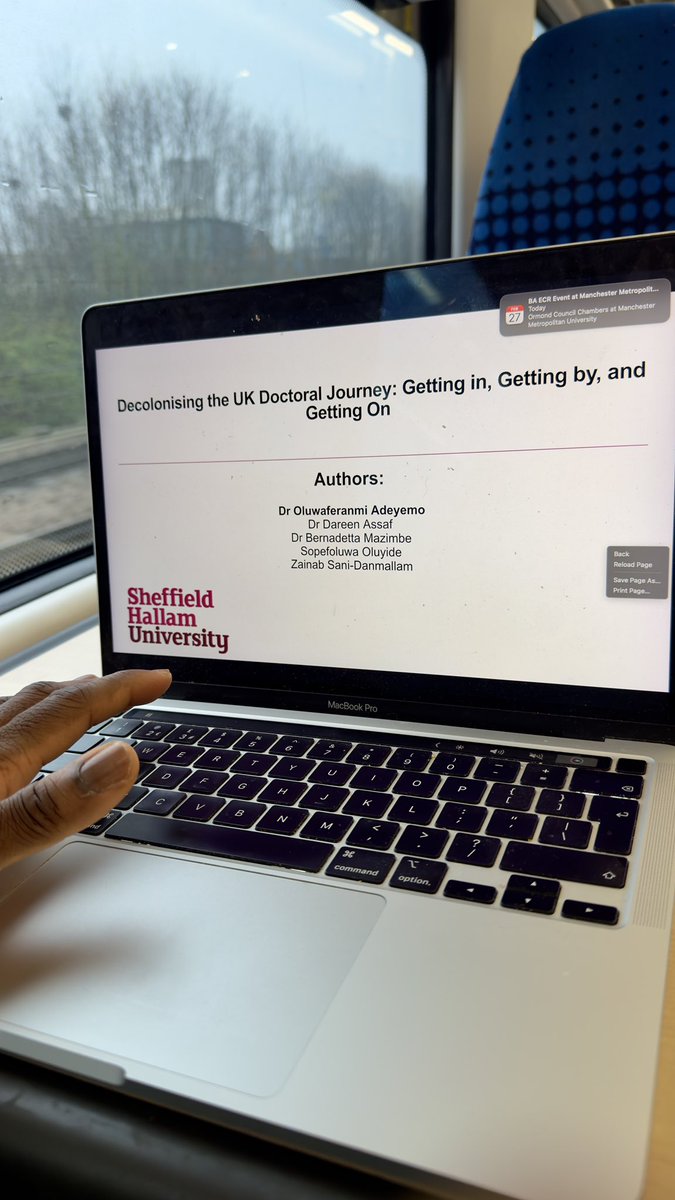
Off to The Manchester Metropolitan University @ManMetUni for The British Academy @BritishAcademy_ Early Career Researcher Network (BA ECRN) and the Black Researcher Consortium (BRC) in-person event.
I’d also be making my first presentation for the year at the event, drawing insights from our recently published book-chapter on “Decolonising the UK Doctoral Journey” on behalf of my co-authors.
I look forward to learning more about the BRC and its mission to transform research inclusivity as well as connecting with peers as we share our lived experiences as black academics in the UK academia.
P.S: access the book chapter (and the whole book)👇
https://t.co/AfdChnunPF
Delighted that my first co-authored book chapter in the book "Decolonising the Organisation: Emerging Frontiers and New Perspectives" published by Palgrave Macmillan is now available for reading.
This research piece began for me as a personal reflection on how we can meaningfully improve the representation and experiences of Black and minoritised groups within the UK higher education.
Special thanks to the Co-Editors Dr. Olatunji Adekoya, Professor Seun Kolade and others for providing us the opportunity to be part of this important and timely piece.
To my amazing erudite colleagues (docolo-decolonisers as we fondly call ourselves) Dr. Dareen Ahmad Assaf, Sopefoluwa Oluyide, Bernadetta Mazimbe, and Zainab Sani-Danmallam – it has been a great privilege and honour of my life to learn and work alongside you.
This book is a must-read for senior academic leaders and students/researchers across UK higher education and beyond.
Our chapter (see link below) offers one of the few accounts centred on the lived realities of what it means to decolonise higher education, told from the perspectives of those who are most directly affected by these systems.
Follow the link below to access out chapter👇
https://t.co/AfdChnunPF