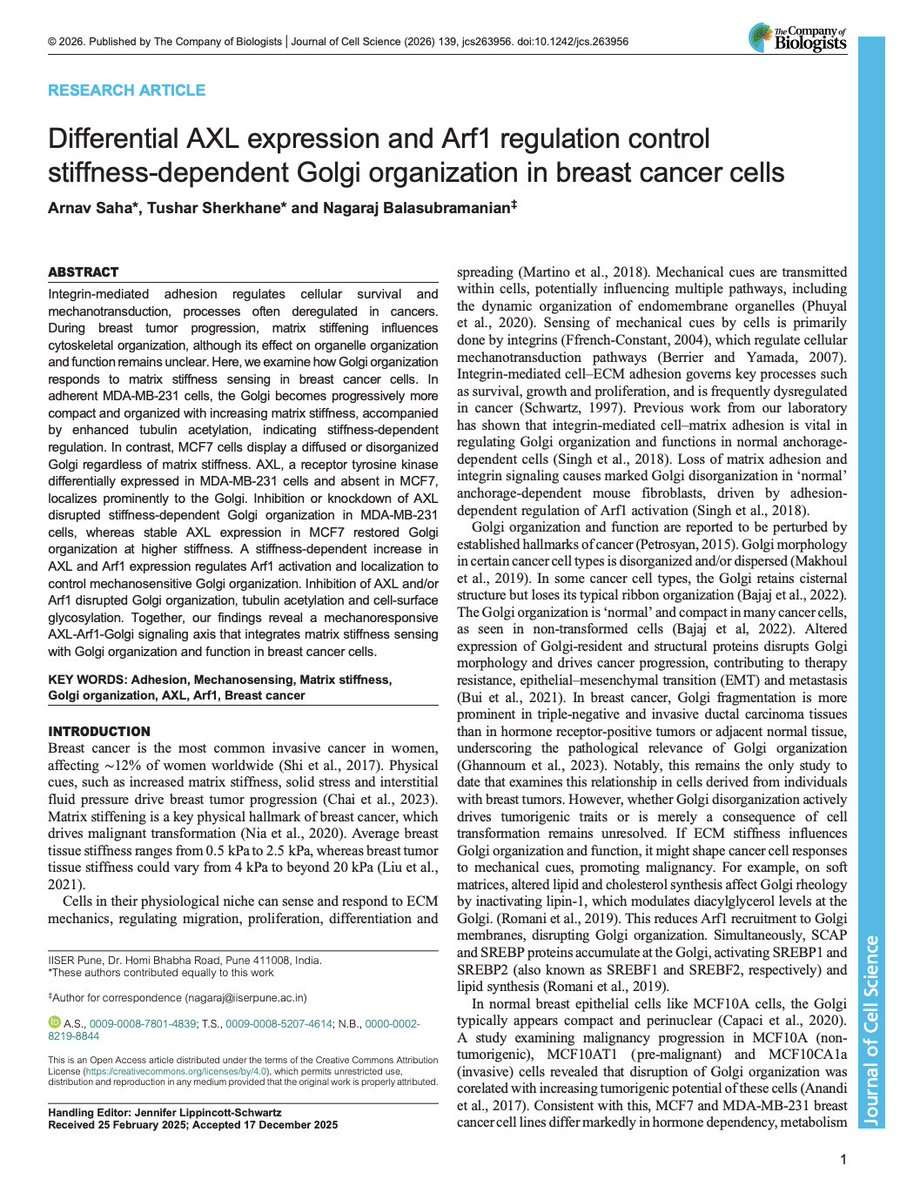
The AXL-Golgi story...
has two parts, both of which are now published.
1) AXL receptor tyrosine kinase regulates Golgi organization and function via an adhesion-Arf1 signaling axis in breast and lung cancer cell lines
https://t.co/EN0RNV1BJY @BiologyOpen
2) Differential AXL expression and Arf1 regulation control stiffness-dependent Golgi organization in breast cancer cells
https://t.co/DrlvS4293x @J_Cell_Sci
Together, they make for a comprehensive story identifying the role of AXL in controlling Golgi organization and its regulation by mechanosensory cues (matrix stiffness).
Work started as a simple screen by Prachi to pick AXL as a gene of interest, taken forward by @ArnavSaha19 and @Tush96rkhane. Supported ably by many others. It's also nice to be able to use data from Vibhas's @SVibha1 studies in this paper, as she identified the adhesion-Golgi connection many years ago.
Congratulations to all involved in this study, which was challenging and exciting in equal measure.
Prof. Sunil Bhagwat (Director, @IISERPune) kicks of this special, first ever multi-IISER Industry Conclave. Representatives of all 7 IISERs are present here today in Pune.
IISER Pune is celebrating 20 years this year.
Looking forward forward to a good industry - academia connect over the course of the day.
🥈Second place in this year's #NikonSmallWorld photo competition goes to John-Oliver Dum for his image of a jumping spider (Salticus scenicus) with pollen. Cute but spooky, and just in time for Halloween next weekend! 🕷️🎃
https://t.co/G2kNlHxzyv
Systematic membrane thickness variation across cellular #organelles revealed by #cryoET. New computational workflow developed by Desislava Glushkova, Stefanie Böhm, and Martin Beck: https://t.co/gVLwUSqQv1
📕 Part of our #Tools collection: https://t.co/xomdAA4BcF
My graduate student Rhea writes a magnum opus review on the role of gene regulatory mutations in #AMR. She posits that antibiotics increase demand for gene expression and regulatory mutations mitigate it to facilitate adaptation. Out now @GeneticsGSA
https://t.co/nsNnFdInPv
Delighted to announce the appointment of Dr CS Pramesh as President-elect @UICC for 2026-2028. He takes office as President UICC in Oct 2028. Recognized globally for advancing access, quality, and equity in cancer care particularly in LMIC's, his leadership will strengthen systems worldwide. @cspramesh@TataMemorial
#WATCH | Berlin, Germany | Union Minister Piyush Goyal says, "Who's responsible for this mess in the first place? Where did the ozone layer get damaged? Who sent all that carbon into the atmosphere?... I represent 17% of the world's population, but my contribution to global carbon emissions is less than 3%. You (Europe) represent probably 3% or 4% of the world's population, yet your contribution to those carbon emissions—or this mess—is humongous...The problem was caused by you...Even today, as we sit here, my per capita contribution to carbon emissions is probably less than 10% or 15% of yours. Even today, Europe's per capita contribution to carbon emissions—and its per capita environmental impact—is probably seven or eight times that of India...I'm representing 17% of the world's population, and I am more conscious of waste and the circular economy. I also have to meet the needs of 1.4 billion people. I have to meet their energy needs, their food needs, and ensure that my nation remains secure. Despite all of that, we have one of the world's fastest-growing clean energy programmes..."
(Source: Piyush Goyal Social Media Page)
I think there's a lot of misunderstanding about AI causing dangerous runaway biorisk. Here's what I said to a worried colleague:
I think there are three aspects of this that are important. Firstly, there's lots of things in biology that are just unknown and for which we don't have the data, and the attrition rate is so high that neither humans nor AI can do very well. Drug discovery is a spectacular example - most things just don't work, and we are always swimming in a sea of ignorance.
Secondly, lab work is extremely messy and prone to false positives and negatives and things just not working. AI can help accelerate some of this work - I have been part of such projects myself - but we are very far from AI being able to autonomously orchestrate any kind of risky work in a way that poses unknown dangers, except those that would arise from accidents (glassware and robotic arms breaking, chemicals being mixed unintentionally).
Thirdly, all the autonomous biological discovery that I am seeing is almost exclusively computational and falls into two categories: discovery with a human strongly in the loop, and discoveries where AI has sped up an already well-understood process.
That being said, I agree that it's a good idea to sandbox or gate AI for biology or chemistry experiments with a strong human-in-the-loop component, but more so in my mind because it could spend valuable capital chasing minor goals or cause dumb accidents rather than design a supervirus autonomously or anything like that.
I am also in favor of pausing new model development for, say, a year while we discuss future potential biorisk and agree on international safeguards, the way it was done at Asilomar with recombinant DNA technology in the 70s.
I think the bigger issue in some sense for me from an optics standpoint is that if tomorrow a bad actor designs a gain-of-function mutation "using AI", even if it just means speeding up an existing process or doing literature searches faster or better - basically stuff they could have done without AI - the alarmists are going to yell, "We told you so!"
Congratulations to @cspramesh on his successful election to the Presidentship of the International Union for Cancer Control. He takes office in 2028 and serves on the Board as President-elect. Pramesh is Director of Tata Memorial Hospital, Mumbai, and Professor and Head of Thoracic Surgery at Tata Memorial Centre. He is also Convener of the National Cancer Grid, a network of over 400 cancer centres, research institutions and patient advocacy groups. He already sits on the boards of UICC and ASCO. Pramesh is accessible and proactively helpful in his official role as well ass outside. A well-deserved recognition, which comes with many tough demands: Which he will surely meet
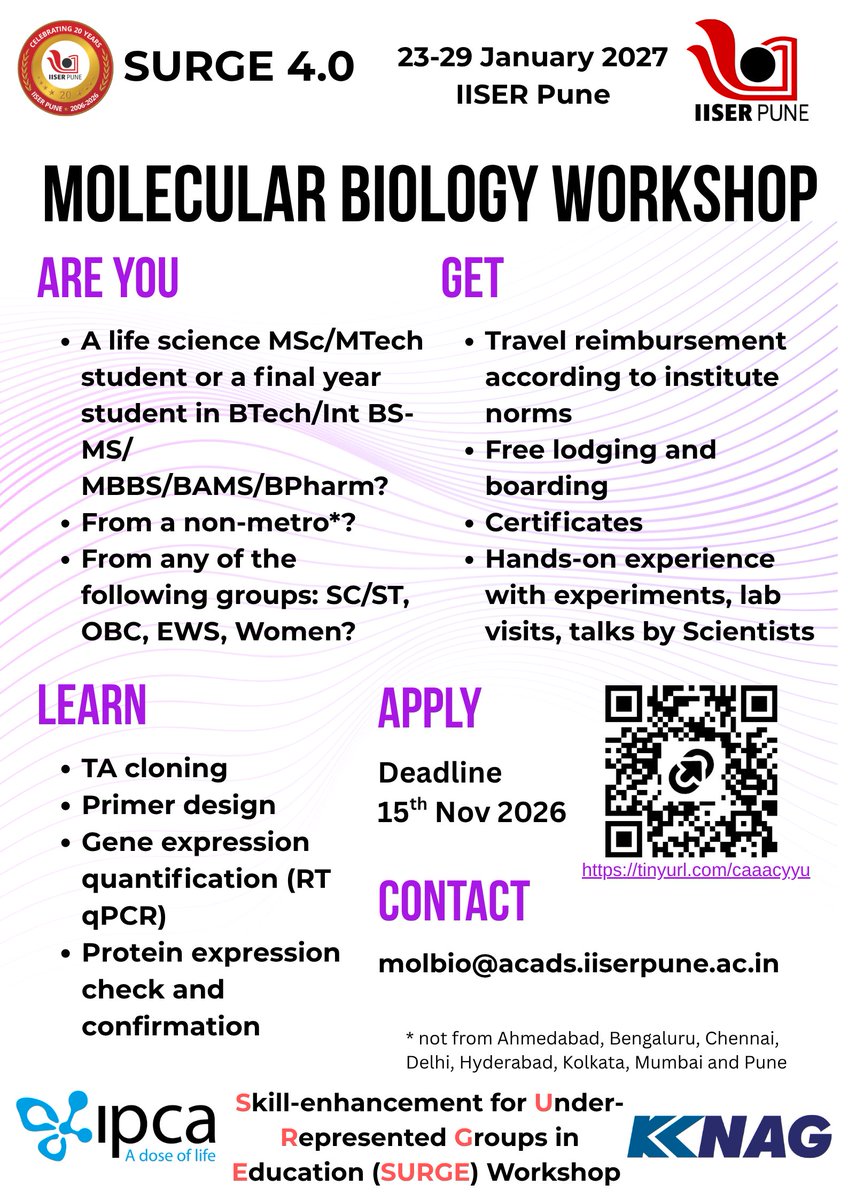
Announcing the fourth edition of the SURGE workshop. This all expenses paid 7-day long workshop is for SC/ST/OBC/EWS/Women students studying in a Master's course in institutes located in non-metro cities.
https://t.co/XhQbcz70DX
Kindly help in spreading the word.
My dear friends, please, I hope to demand your absolute attention to this matter:
In 2018, my junior from St. John’s Medical College, Bengaluru, Dr. Randall Sequeira (middle in the pic), trekked up a steep, bauxite-rich plateau in Odisha to hold a monsoon health camp in the indigenous Kutiya Kondh village of Kutrumali.
In a piece he wrote then titled "Kutrumali’s Demons," Randall described sleeping under a dripping school roof in freezing fog, borrowing utensils from a local health worker to cook khichdi, and waking up at 6 AM to a line of tribal mothers. He wrote with heartbreak about treating malnourished toddlers with protruding bellies and visible ribs, listening to stories of stillbirths and chronic fevers, while noticing the shiny new solar lights installed by a mining conglomerate eyeing the aluminium ore beneath the villagers' feet.
Comparing his small medical team to hobbits sheltering in the night, Randall worried about the outside forces coming for that fragile village.
Randall stayed with the tribal/ adivasi community to serve them. After St. John’s and an MD in Internal Medicine from SMS Jaipur, he gave up every comfort of urban medicine to live in Kalahandi, recognizing that clinical prescriptions are meaningless when indigenous communities are stripped of their forests, water, and dignity.
On the night of October 16, Odisha police picked up Dr. Randall Sequeira and Dalit activist Laxman Naik at 11 PM from his home in Bhawanipatna. A gentle physician who has spent years trekking up hills to save tribal children is now locked in Rayagada sub-jail under frivolous but draconian charges (attempt to murder, dacoity), simply for standing with Adivasis peaceful protesting the mining of their sacred hills in Sijimali and Kutrumali.
https://t.co/PsxZZCngyV
Odisha Govt. said it will cut down forests to connect tribal villages. But it was a way to bypass green laws and fast track London based Vedanta’s, and Adani's mining plans. Local organisations estimate that around 45 villages depend on these hills and would be affected.
https://t.co/0pATUIYADm
The state has answered with repression rather than dialogue. In the last three years, at least 43 police cases have been filed and over a hundred Adivasis and Dalits, both women and men, have been incarcerated in Odisha jails. For example, from In March and april 2026, 8, 2026, to April 8, 2026, within one month, 24 people were sent to jail, 217 were made accused, and the number of “others” total 1,140. An activist who was not named in the original FIRs, but has since been implicated in about 12 cases, so that bail in one case is followed by arrest in another. This pattern of capture and releases have been used to crush rational dissent.
Dr. Randall understood that being a good doctor means understanding that prescriptions cannot compensate for the denial of land rights, that surgery cannot undo displacement and that no medical can substitute for the basic infrastructure a government has failed to provide.
https://t.co/fOC9AU3jaR
To my fellow medical fraternity, and every citizen with a conscience: a kind physician who embodies the highest ethics of our profession is being criminalized to clear the way for bauxite mining. Please do not let his voice be buried in a sub-jail.
Amplify this, demand due process, and demand the immediate release. Please sign in this form to show solidarity: https://t.co/cgLIoEXExG
If anyone can help out in this situation please reach out to Medico Friend Circle - https://t.co/OT2D2E3DuW
50 years ago The Selfish Gene became an instant bestseller, bringing evolutionary biology back into cultural conversation and catapulting its author, Richard Dawkins, to global fame. Yet today scientists are still debating its core message.
https://t.co/EBRdVqYESS
Walker Vickers and Maitreyi Das discover that memory of growth promotes early Ras #GTPase activation to establish dominance of inherited cell ends in S. #pombe.
https://t.co/AyPVYrQV6a
What does it take to reinvent bone healing for millions of patients? Hear it from the team behind SERIOSS®, the world’s first silk protein-based bone void filler, now CDSCO-approved for manufacturing & sale in India.
Order here: [email protected]
(1/2)