You know the enormity of risk that the artiste community is facing under this regime when even while voicing the most popular opinion at the moment, the actor has to say “ab jo hona hai, hoga. No problem. Per main chup nahi baith sakti.”
An Open Letter to the Jantar Mantar protestors:
My dear young friends,
I address you today not as a politician or an MP, but as someone deeply troubled by what is happening to your generation of young Indians.
This is personal for me. I was born to a middle-class family: my father was a salaried newspaper employee, my mother a homemaker, with three children to educate on one income. For a family like ours, merit was not a slogan. Scholarships, fair examinations, honest results — these were the only way one salary could carry three children's dreams.
I went to school in Mumbai and Kolkata, to college here in Delhi, topped the University and earned admission into IIM — and chose instead to follow my passion for international affairs, in America, on a scholarship. Nothing was inherited; everything was earned by hard work and yes, Exams.
So I know that a fair, merit-based system is the only ladder for young people from lower and middle-income families to climb up. When that ladder is broken — papers leaked, examinations cancelled, trust destroyed — the children of the rich and powerful do not suffer. They have other ladders. It is your dreams, and your families' sacrifices (and tragically, in some homes, young lives themselves) that are betrayed.
To the young people gathered at Jantar Mantar, and those raising your voices peacefully across India: this country hears you. Your anger is not indiscipline — it is the anguish of a generation that did everything right and was still betrayed . You are not alone.
And to the millions of young Indians watching quietly: your generation is not a problem to be managed. You are the answer to India's future. Do not lose hope. This ladder will be rebuilt — by you, and by every Indian who stands with you.
To Shri Sonam Wangchuk-ji, my heartfelt appeal: please end your fast. You have awakened the conscience of the nation; that is what a fast is meant to do. India needs your voice for the long road ahead.
With Parliament in session again from Monday, we will have an opportunity to raise the students’ issues in the highest forum of our democracy. That’s where the problem should be addressed, not by fasting unto death. Please heed my plea.
And finally, to the Government: I respectfully urge you to reach out and engage in the dialogue our democracy owes its young citizens. That is not weakness; that is statesmanship.
3 Idiots me sabse 'loser' character real life mein sabse courageous nikle... aur baaki teen 'heroes' sabse bade losers. Who would've thought? More power to you, bhai. ❤️
#SOS: To every Indian,
Things are looking grimmer by the day.
I don’t know how much longer Sonam sir can hold on. He keeps telling us he can. But those of us sitting beside him are terribly worried.
This is a man who could have chosen a life of comfort and recognition. Instead, the recipient of a Ramon Magsaysay Award, an honour equivalent to the Nobel Prize, is putting his own life at risk for the future of our children, the young, and this country. He sits for those dead students murdered by a broken, corrupt education system. He is sacrificing his body and maybe his life for a greater cause.
It makes me think what does it say about US that a son of India, who brought us such great honour before the world, has to STARVE himself to death simply to be heard by his OWN government?
This is not my idea of India. This is not India!
Somewhere along the way, we stopped feeling. We began to accept silence when there should have been outrage, indifference where there should have been compassion. We have become spectators to suffering. We have convinced ourselves that someone ELSE will speak, someone ELSE will act.
I have no words left.
I am sorry sir.
We are failing you. We are failing you by allowing a nation to reach a point where a man of your integrity and stature must gamble with his own life just to make those in power LISTEN. We are failing you because we normalised arrogance over empathy. We normalised power over compassion. And we normalised indifference over conscience.
July 20 is our last attempt to save you.
If we cannot stand up now, history will not ask what Sonam Wangchuk did for India. It will ask what India did when Sonam Wangchuk needed her.
Concerning🧵 #DST#InspireSHE#IISER
After stopping KVPY, @IndiaDST has silently discontinued INSPIRE-SHE scholarship for BS and MS students. This is a nightmare for fundamental science in India. Students were uncertain about this until a certain student from IISc filed RTI. 1/n
Sad to see INSPIRE-SHE, the only running scholarship for undergraduate basic science students in India, being stopped .
After the discontinuation of KVPY in 2022 by @IndiaDST, this is deeply disappointing. Nightmare!
In 1939, Jawaharlal Nehru visited Rabindranath Tagore to ask if Jana Gana Mana could become India's national anthem. A statistician was in the room.
That statistician, P.C. Mahalanobis, would go on to build the system that let a newly independent nation of 350 million people see itself clearly for the first time.
In 1950, nobody knew what the average Indian ate. Or earned. Or whether they had work. Policy ran on guesswork.
Mahalanobis changed that.
He built the National Sample Survey, which knocked on thousands of doors and asked, item by item: what did you eat last month? Rice, dal, cooking oil, fuel, clothing.
Harold Hotelling, then among the foremost statisticians in the world, wrote that no sampling technique developed anywhere could "compare in accuracy" with what Mahalanobis had built.
This is the story of how India built, then lost, and is slowly rebuilding the infrastructure of national self-knowledge.
Issue 4: The Making of Indian Statistics, written by @jainhiya_ , designed & built by @AltCarbonIndia
https://t.co/MdIvN1hXhC
Jane Goodall had no college degree and no science background. She was a secretary. A scientist hired her to study wild chimps specifically because she knew nothing about science, and she ended up proving that the one thing we thought made us different from animals was wrong.
Louis Leakey was studying human origins in Kenya and needed somebody to go live near wild chimpanzees in Tanzania and just watch them for months. He picked Goodall because he figured a trained scientist would show up with a head full of textbook ideas about how animals are supposed to behave. Goodall had none of that. She’d just observe what was actually happening.
She showed up at Gombe in July 1960 with a notebook, binoculars, and her mom (local officials wouldn’t let her go into the jungle alone). For four straight months, every chimp she approached bolted, and her funding only covered six.
Then she spotted a chimp she’d named David Greybeard. Naming them was considered completely unscientific, and her future professors at Cambridge would lose it over this, but she did it anyway. David poked a grass stalk into a termite mound, pulled it out covered in termites, and ate them right off the stalk. He was using a tool to get food. Then she watched him strip leaves off a twig to make it work better, turning a found object into a custom tool. Scientists had one rule for what made humans different: only we make tools. When she sent the news back to Leakey, he wrote: “Now we must redefine man, redefine tool, or accept chimpanzees as human.”
Cambridge let her get a PhD without ever finishing a bachelor’s degree. Only the eighth person in the school’s history to pull that off. She discovered chimps eat meat (everyone assumed they were vegetarian), form alliances, and grieve when their family members die. A chimp named Flint stopped eating after his mother Flo died in 1972. Three weeks later, he was dead too.
Between 1974 and 1978, a group of chimps she’d been watching for years split in two. The bigger group hunted down and killed every male from the smaller group, one by one, over four years. Ambushes on chimps caught alone. Goodall said she’d lie awake at night with the images stuck in her head. She’d always believed chimps were “rather nicer” than us. That belief didn’t survive.
She got the Presidential Medal of Freedom in January 2025. Nine months later she died in her sleep at 91, on a speaking tour in California, still giving talks 300 days a year.
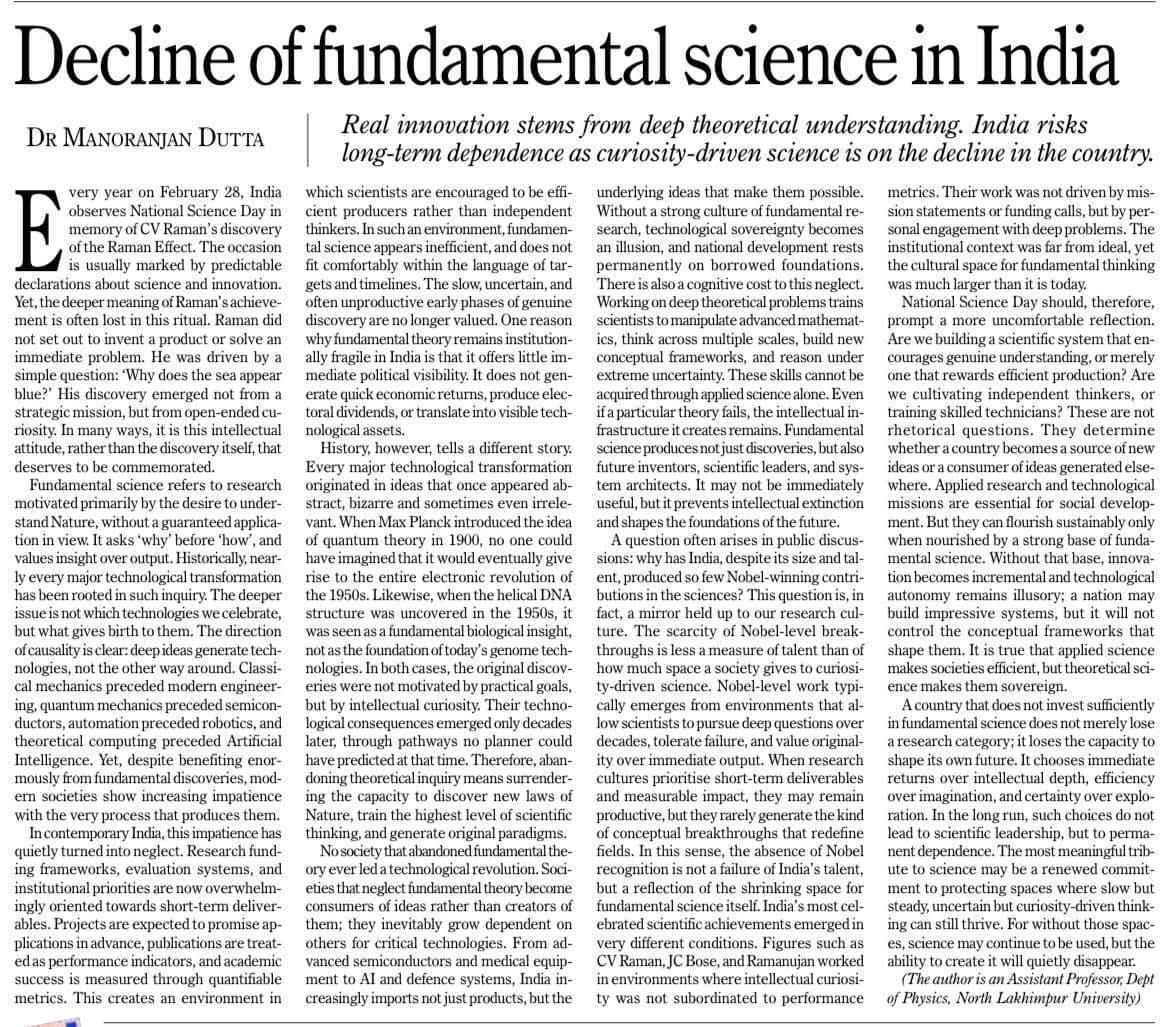
India risks long-term dependence as curiosity-driven science is on the decline. Real innovation stems from deep theoretical understanding, not just short-term deliverables.
Dr.Dutta writes...
India truly the hub of moral, ideological, and systemic failure where every new startup hinges on faster production of cheap service labour and fortifying its middle class as cushy, exploitative middleman while the wealthy bleed the country dry.
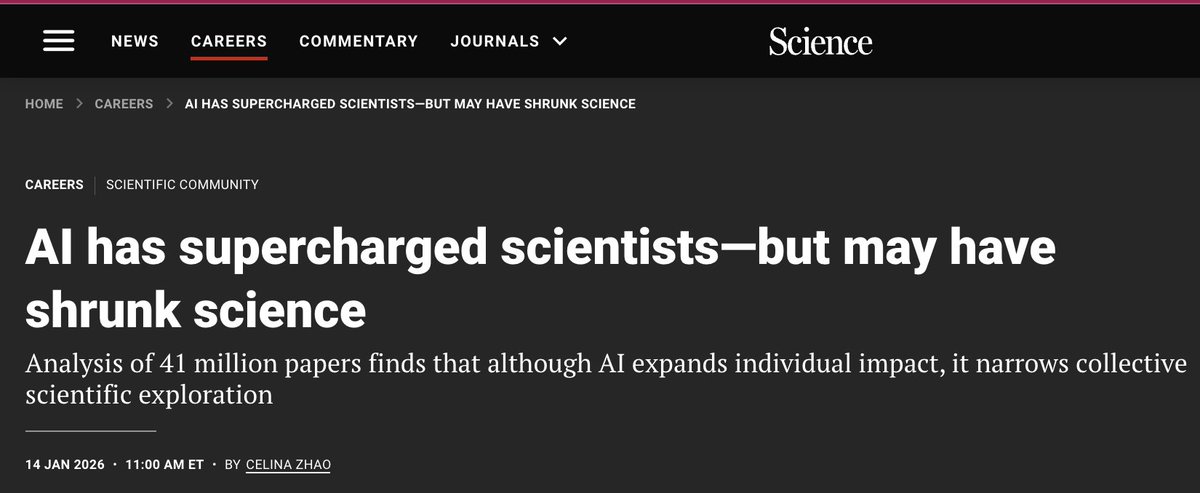
Scientists who use AI have published three times more papers, received five times more citations, and reach leadership roles faster than their AI-free peers.
But science as a whole is paying the price, the study suggests. Not only is AI-driven work prone to circling the same crowded problems, but it also leads to a less interconnected scientific literature, with fewer studies engaging with and building on one another.
It's a classic social dilemma: what's good for individuals is bad for the collective.
https://t.co/MUPrSIZypz
Here it is! Our article in NAR! We redefine the core of BREX, uncover hidden functional domains, and identify 3 new BREX-related(BR) RM-like defense systems, expanding the BREX landscape. Fabulous effort-@yoraj21@IISER_BERHAMPUR#BREX#PhageDefense
https://t.co/DkkVmZx4rP
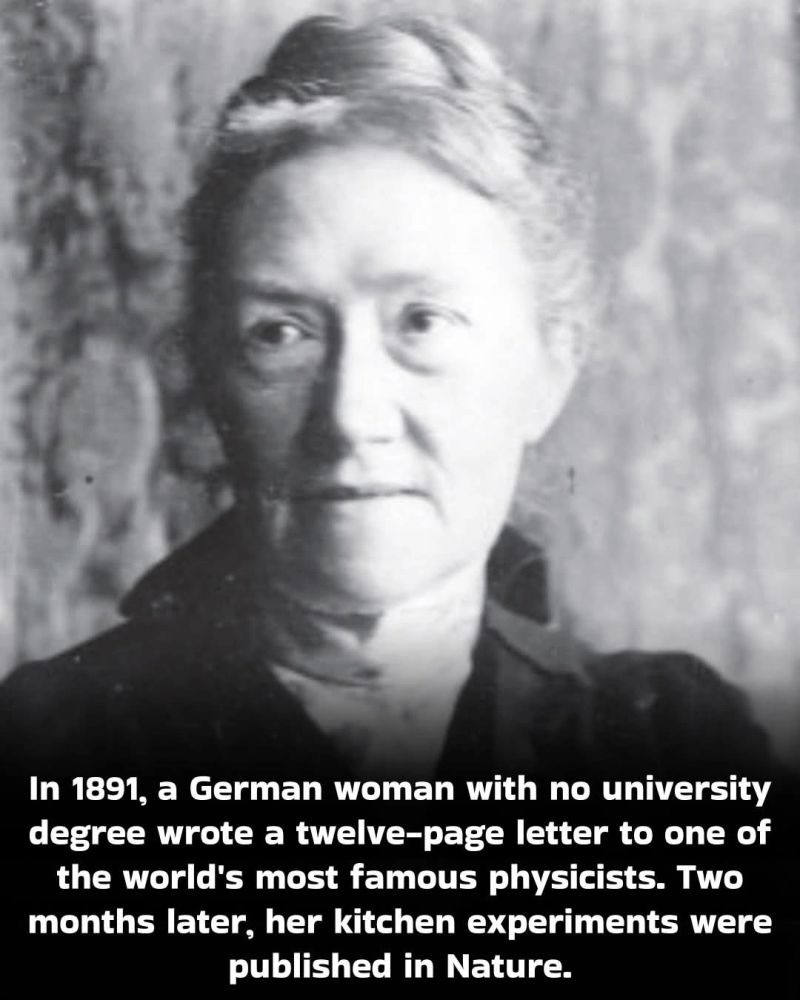
Agnes Pockels was nineteen years old when she noticed something strange in the dishwater.
It was 1881. She was standing at the sink in her family's home in Brunswick, Germany, watching the way grease moved across the surface of the water. The way soap changed everything. The way the surface itself seemed to have properties she couldn't explain.
Most people would have finished the dishes forgetting it.
Agnes Pockels wrote it down.
She would have liked to study physics at university. But in Germany in 1881, women were not permitted to attend university.
She devoured the physics books of her brother, teaching herself the mathematics and theory that formal education had denied her.
She needed a way to measure what she was observing. So she built one.
In 1882, she developed what she called a Schieberinne—a sliding trough.
With this homemade apparatus, Agnes Pockels began a decade of solitary research.
She had found the moment when a single layer of molecules, one molecule thick, formed across the surface.
She calculated that a single molecule occupied about twenty square angstroms of surface area. This threshold would later be named the "Pockels Point" in her honor.
Ten years. No laboratory. No colleagues. No mentors. No funding. Just a woman at kitchen sink, making measurements of stunning precision. And no way to publish any of it. She was isolated.
Then, in 1890, she read an article in a German science journal. The English physicist Lord Rayleigh—one of the most celebrated scientists in the world—had been studying the properties of water surfaces. He was asking questions remarkably similar to her own.
She wrote to him.
On January 10, 1891, she sent Lord Rayleigh a twelve-page letter in German, outlining a decade of research. She described her apparatus, her methods, her findings. She was modest almost to a fault:
"My Lord, will you kindly excuse my venturing to trouble you with a German letter on a scientific subject? ... For various reasons I am not in a position to publish them in scientific periodicals, and I therefore adopt this means of communicating to you the most important of them."
Rayleigh read the letter. He recognized immediately what he was holding.
On March 2, 1891, he forwarded it to the editor of Nature, the most prestigious scientific journal in the English-speaking world, with a covering letter:
"I shall be obliged if you can find space for the accompanying translation of an interesting letter which I have received from a German lady, who with very homely appliances has arrived at valuable results respecting the behaviour of contaminated water surfaces.."
Ten days later, Agnes Pockels's research was published in Nature under the title "Surface Tension."
She was twenty-nine years old. She had never set foot in a university. And her kitchen experiments had just entered the scientific record.
Agnes stunning story, a soul-stirring story can be found here