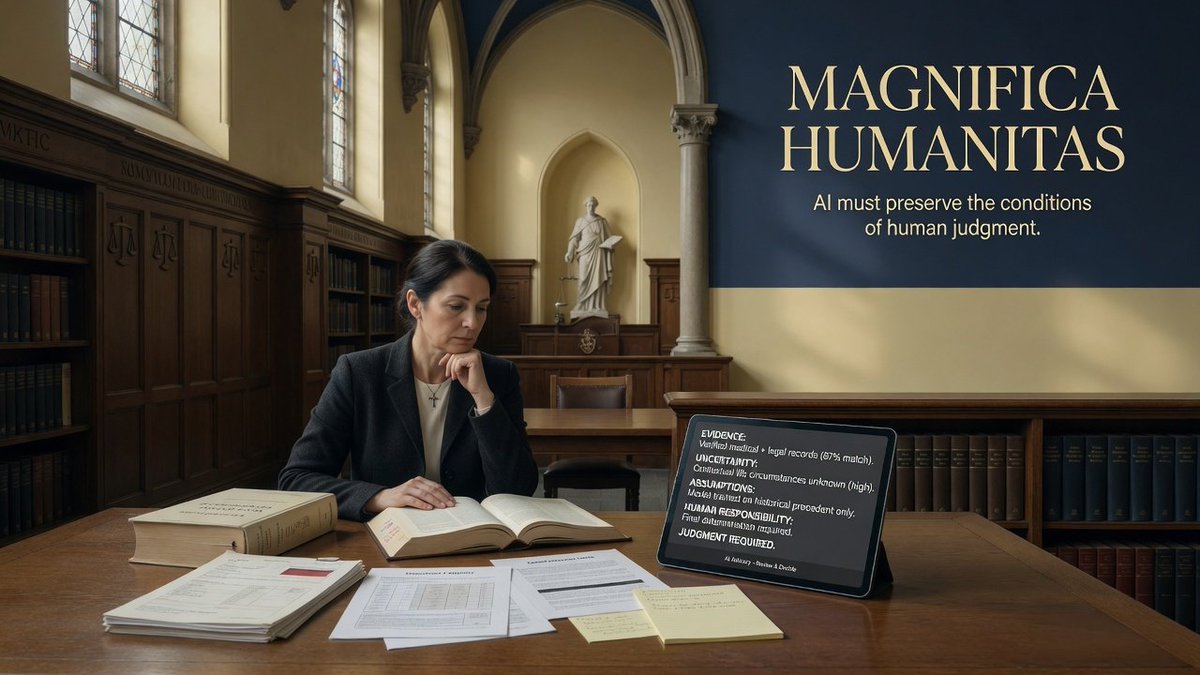
Full reflection here:
https://t.co/I0xFWUTXC2
What’s your biggest concern about AI shaping human judgment? Reply below 👇 Follow for more on responsible AI governance.
Pope Leo XIV just dropped an encyclical on human dignity in the AI age.
I didn’t see it as brand new — I saw it as clarifying something I’ve been circling for years at FIA Labs. The real question isn’t “Can AI be aligned?
AI will become more powerful. That’s certain. The open question: Will our institutions remain ordered toward the human person as that power spreads into the places where we judge, remember, speak, and govern?That’s not just technical.
It’s human.
The next hallucination problem may not look like hallucination at all.
It may look like coherence.
A system can remain fluent, persuasive, aligned, and internally consistent while becoming less externally grounded.
That is harder to detect because the failure does not announce itself as failure. It feels useful. It keeps the conversation moving. It mirrors the user’s assumptions. It removes friction.
But coherence is not evidence.
Fluency is not grounding.
Agreement is not judgment.
The real governance question may become:
what has authority to interrupt the drift?
Coherence without grounding, challenge, and admissibility can become a very sophisticated form of error.https://t.co/DhwVz8FnYD via @LinkedIn
AI should not give confident tax answers from unsettled law.
It should help structure better questions.
A live Australian CGT proposal shows the point:
not “should I sell before 1 July 2027?”
but:
what assets?
which structure?
which concessions?
what valuation evidence?
what assumptions?
what commercial objective?
In high-consequence domains, the value of AI is not replacing professional judgment.
It is making the reasoning before judgment more visible.
5/ In high-consequence domains, a fast answer can be dangerous.
The better AI system is often the one that slows the reasoning down before the human acts.
4/ This is where applied reasoning systems can help.
Not by replacing tax lawyers, accountants, or advisers.
But by structuring the problem, exposing assumptions, preserving uncertainty, and clarifying what professional judgment still has to resolve.
2/ The obvious question is:
“Should I sell before 1 July 2027?”
But that is too blunt.
A better question is:
what would a serious adviser need to know before any responsible answer could be given?
1/ A live Australian tax proposal is a useful test case for what AI should — and should not — do in high-consequence domains.
It should not turn unsettled law into confident advice.
It should help humans ask better questions.