Crude Oil Becomes Value Only After Refining🛢️➡️⛽
Crude oil is just the starting point.
First it is extracted.
Then transported by pipeline or tanker.
Then heated and refined.
Then separated into the products the economy actually uses.
🔹LPG
🔹Petrol
🔹Naphtha
🔹Jet fuel
🔹Diesel
🔹Fuel oil
🔹Lubricants
🔹Asphalt
That is the real oil system.
Not one commodity.
A full industrial chain that powers cars, planes, ships, roads, chemicals, and global trade.
Oil is not just burned.
It is transformed.
Victor Wembanyama tiene 22 años y se COMIÓ las Finales de Conferencia Oeste. Reaccionó ante cada error que tuvo.
Dylan Harper es un ROOKIE y está jugando estos Playoffs como si la madre lo hubiese hecho competir en torneos de bebés desde que llegó al mundo.
Stephon Castle es un SOPHOMORE y tiene más carácter que cualquier veterano de la NBA.
San Antonio Spurs es el ejemplo perfecto de que adurez no es lo mismo que experiencia.
Si la IA sigue la tendencia de la telefonía y te cobra por minuto...
Tesla y todos los demás pilotos automáticos te van a eventualmente cobrar por minuto o milla/kilómetro de viaje en piloto automático.
Si lo compraste y pagaste por completo, es el equivalente a los que teníamos paquetes de DATOS ILIMITADOS antes de que los quitaran.
Brutal! $$$$$ Y así parece que va a ser en todo.
Los dueños de la IA ahora serán los que cobren por hora y no los mismos empleados (que perderán su trabajo).
Sería interesante ver si ahí aumentan los salarios ya hahaha regalarse el dinero directito sería una movida brutal de el equipo de los culeros.
Genios.
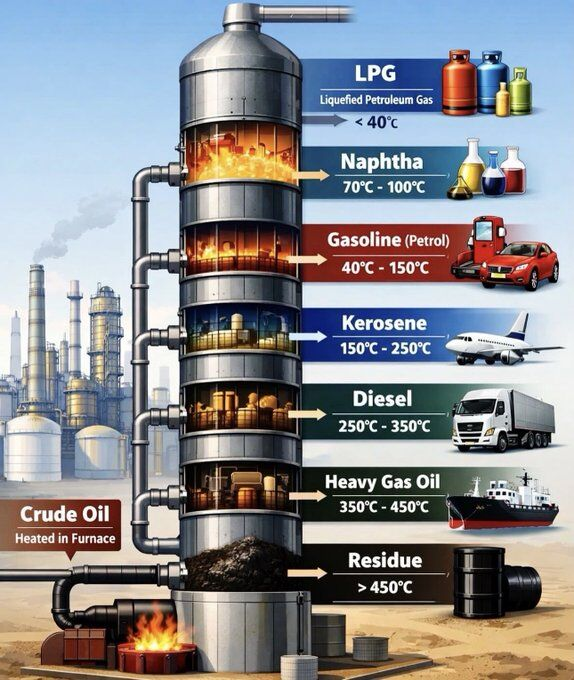
🛢️One barrel of crude becomes 7 different products in a refinery
💥When the refinery burns, all 7 disappear
When you hear "Ras Tanura refinery shut down," most people think: "Gasoil prices go up."
But look at what actually comes out of one barrel:
→ LPG (<40°C): Cooking gas, heating
→ Naphtha (70-100°C): Petrochemicals, plastics, pharmaceuticals
→ Gasoline (40-150°C): Cars, transportation
→ Kerosene (150-250°C): Jet fuel, aviation
→ Diesel (250-350°C): Trucks, shipping, logistics
→ Heavy Gas Oil (350-450°C): Marine fuel, industrial heating
→ Residue (>450°C): Asphalt, industrial processes
1 barrel, 7 products.
When a refinery burns, you lose all 7 at once.
Why refinery destruction is worse than crude shortage?
Crude shortage:
→ Less oil to process
→ Refineries still convert what's available
→ System runs at lower capacity
Refinery destruction:
→ Crude available but no capacity to convert it
→ Crude sits in storage or gets shut in
→ All downstream products disappear simultaneously
What's offline now?
→ Ras Tanura (Saudi's largest): Shut down
→ Tehran refineries: Destroyed (20M+ liters/day gasoline offline)
→ South Pars gas: 60% offline
When refineries go offline, what stops?
→ Jet fuel: Airlines can't refuel, routes cut
→ Diesel: Trucks stop, logistics break
→ Naphtha: Petrochemicals, plastics, pharma production stops
→ LPG: Cooking gas, heating shortages
→ Gasoline: Transportation fuel
You can have all the crude in the world.
Without refineries, you can't convert it into usable products.
The global shift toward Small Modular Reactors (SMRs) has reached a fever pitch in 2026. As nations scramble for 24/7 carbon-free power, the focus has moved from massive, multi-billion dollar projects to these flexible, factory-built units.
What makes the SMR market the one to watch?
1. Faster Financing: It is significantly easier to secure funding for a 300MW project than a 1,200MW mega-plant. Smaller price tags lower the barrier for private investors and smaller nations.
2. Grid Compatibility: SMRs are a perfect match for countries with decentralized grids. They provide stable baseload power without requiring a complete overhaul of existing transmission lines.
3. Industrial Decarbonization: Major players in mining and data centers are no longer waiting for the national grid. They are looking at SMRs to provide dedicated, on-site power that renewables alone cannot guarantee.
4. Scalability: The modular nature allows countries to start with one unit and add more as demand grows, creating a "pay-as-you-grow" model for nuclear energy.
The Debate: Speed vs. Scale
Are SMRs the definitive solution for the energy transition, or do we still need "Gigawatt" giants to meet global demand?
Cast your vote:
A) SMRs – The future is modular and fast.
B) Large-Scale – We need maximum power at any cost.
Share your take in the comments!
👉 https://t.co/ge8OTo4ouG
#SMR #NuclearEnergy #EnergyTransition #NetZero2026 #CleanTech
The US organic industry is now doing $75+ billion.
Growing at 6.8%, double the pace of conventional.
Three tailwinds hitting simultaneously.
1. MAHA. Didn't create the organic category. But poured fuel on it. Consumers already moving toward clean labels and skepticism of synthetic pesticides found organic's 23-year-old USDA seal waiting for them.
2. GLP-1. 12%+ of Americans have tried GLP-1 medications. They eat less. When you eat less, you pay more attention to what you eat. You hunt for nutrient density. Total food spend declines, which means more budget for premium items.
3. Generational shift. Millennials and Gen Z are the fastest-growing organic buyer segment. They grew up with the USDA seal. For them, organic isn't a premium. It's the baseline expectation.
The numbers:
Organic berries up 12% to $2.4B, priced 24.7% above conventional. Volume still surged 24%.
Organic citrus up 17.8% despite being priced 50%+ above conventional.
Then there's Aldi. The most price-sensitive grocery chain in America saw organic produce sales up 20%+ in a single year. Fruit up 30%. 43 million pounds of organic bananas.
Fruitist, jumbo blueberry brand backed by Ray Dalio and J.P. Morgan, confirmed the GLP-1 connection directly. Their own data shows GLP-1 users increase berry purchases after starting medication. $400M+ in sales. $443M raised. 12,500+ retail locations.
Aldi growing organics 20% and Fruitist raising $150M at $1B+ are the same tailwind creating two completely different businesses at opposite ends of the market.
One proving mainstream adoption. One proving premiumisation.
Both telling you the same thing: Organic isn't a category anymore, it's the new default.
Countries with the Largest Aircraft Manufacturers ✈️
🇺🇸 United States — Boeing, Lockheed Martin, Northrop Grumman
🇪🇺 Europe — Airbus (France & Germany)
🇨🇳 China — COMAC
🇷🇺 Russia — UAC, Sukhoi
🇨🇦 Canada — Bombardier
🇧🇷 Brazil — Embraer
🇯🇵 Japan — Mitsubishi Heavy Industries
Top Energy Producers
(Annual share of global production / generation)
1) ⛏️ Coal
🇨🇳 China → 51.7%
🇮🇳 India → 11.7%
🇮🇩 Indonesia → 9.1%
2) 🛢️ Crude Oil
🇺🇸 United States → 20.8%
🇸🇦 Saudi Arabia → 11.2%
🇷🇺 Russia → 11.1%
3) 🔥 Natural Gas
🇺🇸 United States → 25.1%
🇷🇺 Russia → 15.3%
🇮🇷 Iran → 6.4%
4) ☢️ Nuclear
🇺🇸 United States → 29.7%
🇨🇳 China → 16.3%
🇫🇷 France → 13.7%
5) 🌽 Biofuels
🇺🇸 United States → 37.4%
🇧🇷 Brazil → 22.3%
🇮🇩 Indonesia → 9.0%
6) 💧 Hydro
🇨🇳 China → 30.4%
🇧🇷 Brazil → 9.3%
🇨🇦 Canada → 7.7%
7) ☀️ Solar
🇨🇳 China → 39.1%
🇺🇸 United States → 14.2%
🇮🇳 India → 6.3%
8) 🌬️ Wind
🇨🇳 China → 39.8%
🇺🇸 United States → 18.2%
🇩🇪 Germany → 5.3%
Source: Energy Institute & Ember (2025, 2024 data
🌍 The 20 companies present in the MOST countries & territories:
1. DHL Group – 220 countries
2. FedEx – 220 countries
3. UPS – 200 countries
4. Siemens – 190 countries
5. IBM – 175 countries
6. Huawei – 170 countries
7. CMA CGM – 160 countries
8. Hertz – 160 countries
9. MSC – 155 countries
10. PwC – 151 countries
11. Deloitte – 150 countries
12. EY – 150 countries
13. Marriott – 144 countries
14. KPMG – 143 countries
15. Bureau Veritas – 140 countries
16. SGS – 140 countries
17. Maersk – 130 countries
18. Hilton – 126 countries
19. Regus / IWG – 120 countries
20. McDonald’s – 119 countries
Source: Veridion + company reports
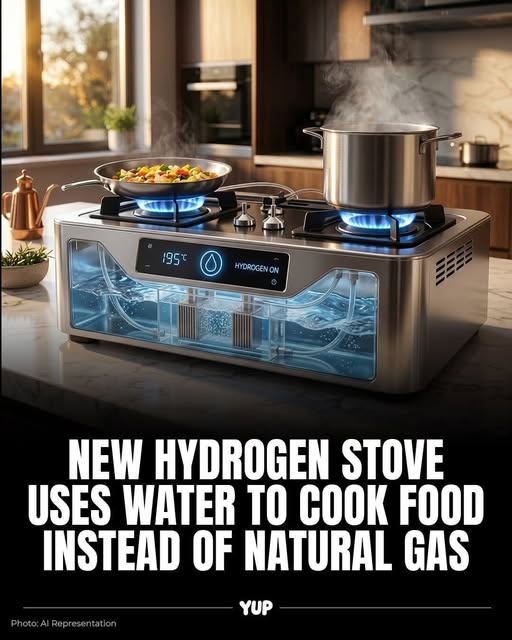
A company called Greenvize has developed a hydrogen-powered stove that literally creates its own fuel on demand. Using a process called electrolysis, the system splits water into hydrogen and oxygen using electricity. That hydrogen is then instantly used as a clean-burning fuel for cooking.
The wild part? Just 100 ml of water and about 1 kWh of electricity can power up to 6 hours of cooking. No gas tanks. No refills. No waiting.
Inside, a PEM electrolyzer produces hydrogen in real time, meaning there’s no need to store or transport fuel at all. It’s generated and used instantly.
If scaled, this could completely change how we cook, especially in places where gas access is limited. A stove powered by water and electricity isn’t just clever… it might be the beginning of a fully decentralized kitchen.
Cómo va a ser atractivo para el capital extranjero un país que pasa 8 horas diarias sin luz y que hay que hacer de tripas corazón para lograr algo de conectividad