@grahamruthven I had Cat 1 in Russia 2018 and it was a similar seat in Moscow… ie upper levels in the corners, since then I only buy the cheapest category for Olympics/World Cup because you just don’t where you are going to end up.
Notre mission : livrer une ambulance 4x4 au front ukrainien 🇺🇦
Du 29 avril au 6 mai, suivez notre périple à travers l'Europe pour sauver des vies et rencontrer ceux qui vivent la guerre au quotidien. 🚑
#UneAmbulancePourLeFront#StandWithUkraine#SupportUkraine
BEAST GAME EPISODE 3 IS OUT NOW!
To celebrate, I'm giving away $100,000 total to 10 random people who like and retweet this post!
Go watch it here: https://t.co/Yntf9E7FTN
@levelsio The cheapest way to do it is via a local Portuguese bank by far, if you don’t want to apply to each individual bank use idealista or another broker
I can put you in touch with the major Portuguese bank I use, if you negotiate well they can get you down to euribor+0.6 spread
🇪🇺 eu/acc
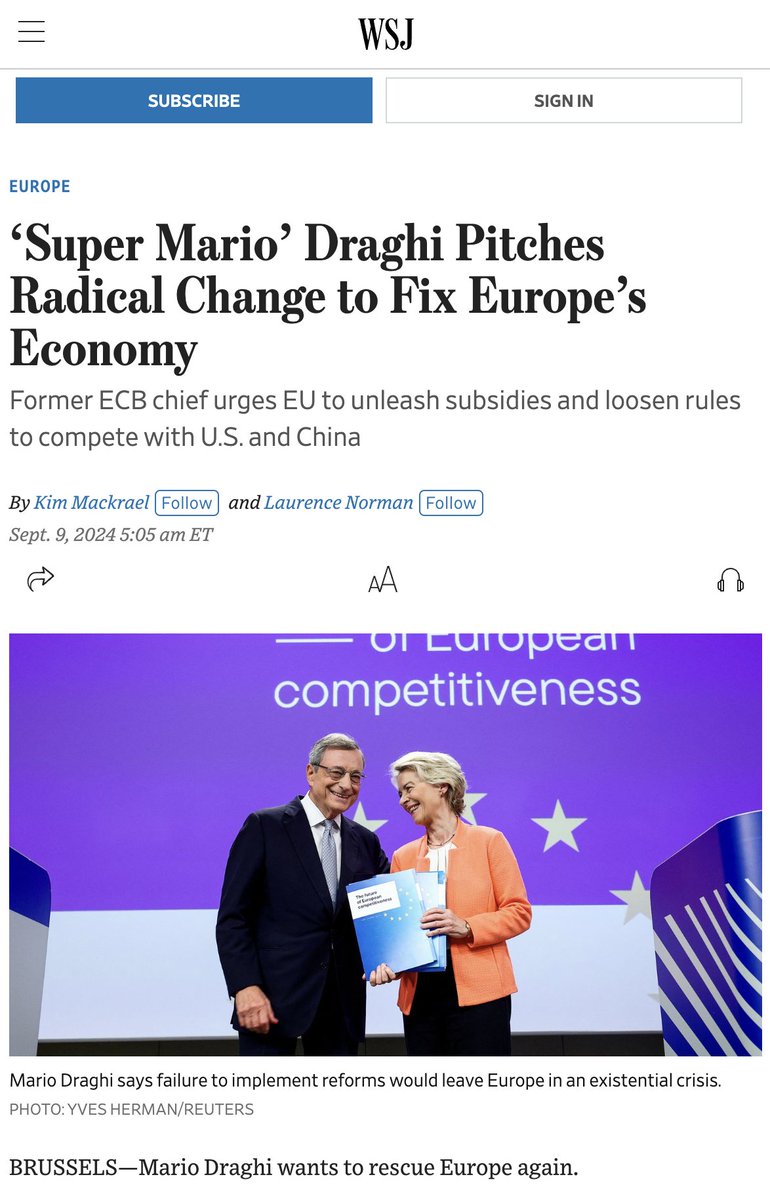
A few weeks ago Mario Draghi asked my recommendations for his report that came out today about European competitiveness
I had a call with him and summarized my problems with doing business in the EU
I wrote this which is included in the report presented to the European Union today:
1. Minimum revenue cut offs for current and new regulation
Exempt small businesses with annual revenues below €10 million from complex regulations like VATMOSS, GDPR, the EU AI Act, and certain labor laws. This approach encourages innovation and growth by allowing startups to focus on product development and market validation without the heavy burden of regulatory compliance. Once these businesses surpass €10 million, they will have the resources to comply with regulations, ensuring that growth is not stifled.
2. Simplify starting a pan-EU business with an EU-wide Incorporation (Inc.) business form
Currently, starting and operating a business across the EU is complex due to 27 member states, each with its own company registration requirements. To streamline this process and make it easier for entrepreneurs to operate across Europe, there should be a single, standardized business entity that applies uniformly across all EU countries. I call this the European Inc.
3. Start an EU business fully online, no physical offices, notaries, lawyers etc
To continue, right now starting a business in most EU member states it’s complicated, very time and resource intensive, and often involves lawyers and notaries. Instead, it should be as simple as going online to a centralized EU website, where entrepreneurs can register their business and details in just a few clicks. The entire process should be streamlined and efficient, allowing businesses to start operating immediately.
The EU government taxes and bookkeeping of this business should also be fully online in an EU portal/dashboard.
4. 0% corporate tax for first 3 years of any new business
Countries like Singapore have successfully attracted new businesses from around the world by giving them a massive tax discount during the first 3 years of business. Because they know that’s the most difficult time of a business: figuring out what product it makes and if there’s a market for it. That takes pressure off startups and business founders that they can focus on creating a great product and innovating.
5. Change tax on stock options: don't tax when a stock option is exercised, but tax it when the stock is sold
The current tax policy in the EU taxes stock options at the time they are exercised, creating a significant financial burden on employees who have not yet realized any tangible financial gain. This approach stifles innovation, discourages entrepreneurship, and places the EU at a competitive disadvantage compared to other regions like the United States.
I propose a simple change: Tax stock options when the stock is sold, not when the option is exercised.
6. Don’t see tech or AI as an enemy, but as a burgeoning and essential industry
The most popular companies in tech are focused on AI right now for a reason. It’s the next frontier of computing. The European Union seems to consider AI the enemy. Any technology can be used for good or bad. By regulating it even before Europe has made much contributions (Europe has almost no tech companies leading in AI), it has stifled any potential innovation in AI from the start.
Apart from the regulation itself, the optics of it make the EU look bad on a global scale. Why would tech founders move to Europe to start a business if the EU is actively positioning itself as Anti-AI?
AI has gigantic potential to be used for good: think of the medical field for diagnosis of diseases, generally in programming (it helps programmers to create software faster/better), etc.
This goes further than AI. The same applies to tech in general. It seems the EU is on a crusade against technology while not being able to compete in it itself. It feels a case of sour grapes: if we can’t build great technology in EU, nobody is allowed to do so!
7. Teach tech/coding/AI topics in all schools and unis
It would help a lot if the EU has a focus on teaching AI and tech in schools and universities. Making the new generation competitive in this field instead. To secure the future prosperity of the European Union, we must prioritize education in technology, coding, and AI across all levels of schooling, from primary education to universities. This strategic focus is not just an educational reform—it’s a critical investment in the future competitiveness, innovation, and economic resilience of the EU.
I miss San Francisco.
I miss Crissy Field. The Marina Green.
I miss that walk along the water at sunset, with all that green to your left, the water to your right, and the sight of that huge surreal orange bridge up ahead.
The Italian sandwich spots in north beach. The insane views from Russian Hill.
Getting lost in the Presidio, or Golden Gate Park for hours at a time.
The parrots flying above Alta Plaza Park.
I miss the sand dunes at Ocean Beach.
All those little stores in the mission that sell the most random things that you can’t help but check out over and over again, even though you’re not really sure what they are.
I miss running into some of the best coffee spots in the world everywhere you turn.
The feeling that you’ve gone back in time as you wander through the Haight-Ashbury and walk by stores that somehow survive selling nothing but tie-dye clothes.
I miss hiking around Lands End, in disbelief that place exists on earth.
I miss the time-worn but perfect hole-in-the-wall Chinese food restaurant you can’t get enough of.
I miss walking into the Ferry Building on a Saturday morning and wanting to sample from every single one of those little shops, and then existing out to a picture perfect farmers market along the water.
I miss that stunning downtown view that rises you out of nowhere as you head up highway 280.
I miss the electric energy of a crowded Dolores Park on a sunny day, and guessing just what crazy thing that next vendor is going to walk by with.
I miss the occasional movie at the Castro Theater, and that hilarious vibe as you’re heading inside.
I miss walking up to one of the most beautiful ballparks ever built, and that smell of garlic that sharply greets you as you enter.
I miss the throwback steakhouse vibe of The House of Prime Rib.
Or occasionally putting on my tourist hat and heading down to Fisherman’s Wharf or over to Alcatraz; two places where you’re guaranteed to never run into anybody you know.
I miss zipping down Franklin St and timing it so the lights all turn green just as your car approaches the intersection.
I miss the authenticity of Chinatown.
I miss how the wind sounds as you ride the ferry across the bay to Sausalito. Talk about a bucket list experience.
I even miss hearing those loud kids that crowd The Tipsy Pig all day, screaming at the top of their lungs as that fifth drink starts to hit them.
I miss that it never gets too hot, and that picturesque layer of fog that settles just above the water, even when it hangs around for just a few weeks too long.
I miss the eclectic mix that makes up the people of San Francisco, and the passion they have for their city.
And most of all, I miss the enthusiasm and the optimism, even within a city that has always had its challenges.
The people who live there are there because they know there are better days ahead.
They know they live in a special place.
It’s been down before, but there are just too many great things about it to ever count it out.
San Francisco will be back.
And it will be better than ever.
It’s an American national treasure.
It’s a place we should all be rooting for.