In this thread, I barely scratched the surface of the interesting features this paper put forward. If you want to see how accuracy and specificity were calculated, learn more about their use of blockchain or the reasoning behind their decisions, add this to your reading list!
Using CV to narrow the variance of the decision and using the full picture to compute is ideal. If the model classifying calculates its performance enhancement in a vacuum, not taking into account previous information or thoroughly validating, I’d think twice of its performance.
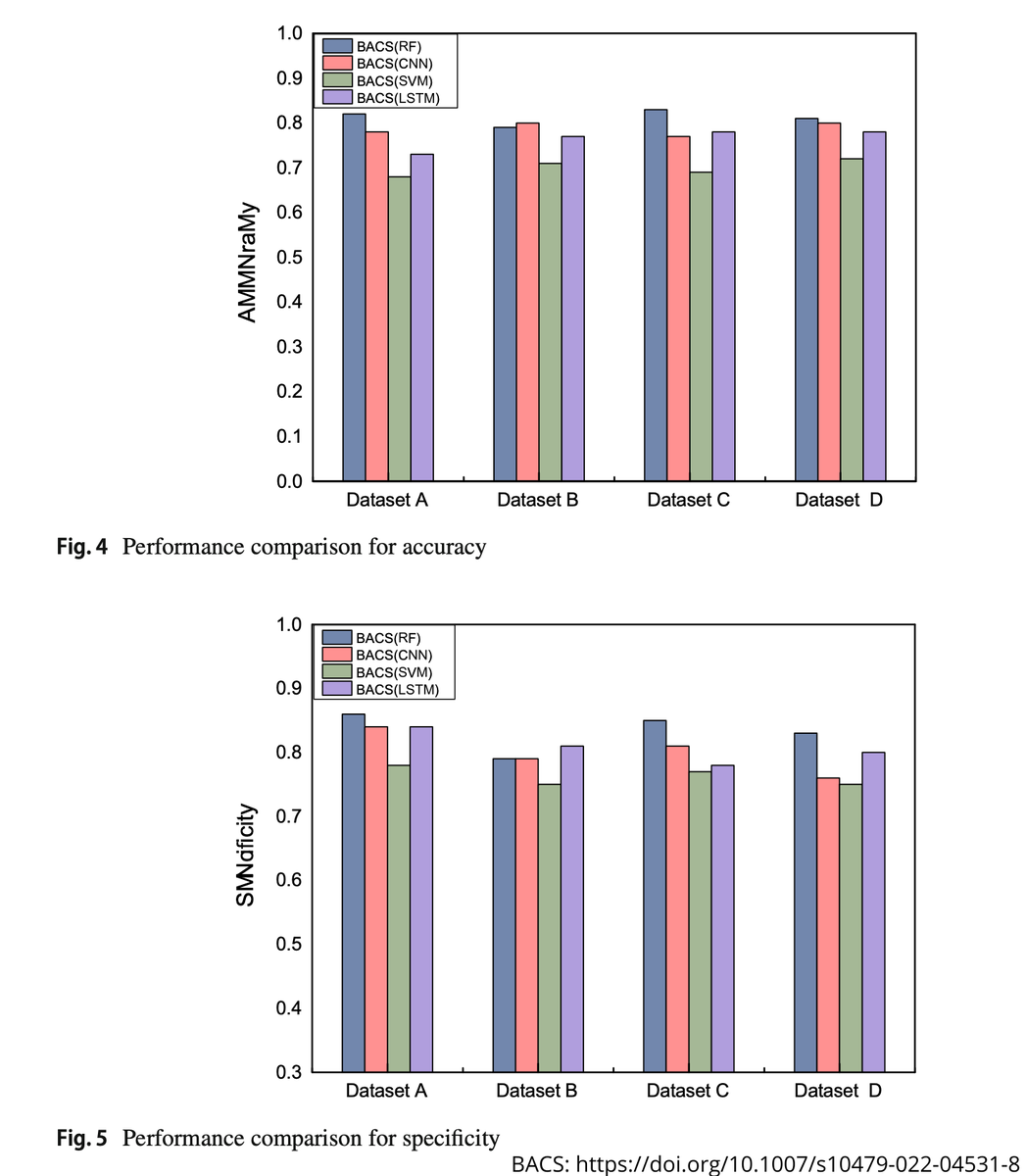
BACS time consumption while storing data safely, applying predictor selection, and using Hyperparameter opt. is still faster than other methods tested. Its use of RF compared to other methods in accuracy and specificity, given different datasets, also shows fantastic results.
Hyperparameter optimization is critical to enhance the performance of models. BACS enhances model performance in a 10-fold CV configuration and uses the Bayesian Optimization algorithm due to its efficiency and its process that takes into account previous parameter information.
Ensuring that our model does not get swayed by one category mistake is important. One predictor, should not have an unproportionate impact on the score which has real repercussions on people’s life. RF’s smaller predictor subset size decorrelates and reduces the variance.
I read a paper about an automated ML pipeline that creates efficient credit scoring classification and uses blockchain to store its data. For my final project, I’ve been tasked to inspire people to delve into this paper and position it in the context of my ML course! A thread:
For modeling, BACS utilizes Random Forests due to its randomness and its way to utilize a portion of all credit data but only using a subset of predictors making it less prone to overfitting, decorrelates the trees, and reduces the disproportionate impact of a strong predictor.
Boruta creates x shadow features of its features by duplicating/shuffling the columns of the dataset, runs RFC & arrives at a Z score. It then calculates the original feature’s Z score and compares it to the max score of its shadows. The feature is significant if it’s higher.
To reduce the dimensionality of the dataset and improve performance, BACS uses the Boruta algorithm, which leverages randomness in the system to provide a clearer picture for feature selection for Random Forest Classifiers(RFC) reducing the impact of random fluctuations.
It uses supervised methods, like Boruta Feature Selection and Random Forests for classification. It reduces variance modeling with RF, and uses CV for hyperparameter opt. Lastly, it gets a full picture using Boruta, RF & Bayesian Opt. All while storing data safely and automating.
BACS is an auto pipeline that stores data on a blockchain, performs credit data distribution balancing, and implements a classification method that integrates feature extraction, selection, and hyperparameter optimization where the inputted data reduces human interference.
With data that has massive implications for everyone in society, ensuring that the data is tamper-proof & transparent while the process reduces the unproportionate impact of predictors, minimizes human input & does not reduce the efficiency of the method is fundamental.
Currently, ML credit scoring focuses on the selection and combinations of classifiers for performance while forgetting about the storage and flow of the data in the process, making it harder to track and depend on the data.
2008 is not regarded as a prosperous year and credit problems stagnate social development worldwide. I am not exaggerating when I say our society/economy rests on the shoulders of credit scoring and the management of credit risk. It’s a useful tool for recipients and creditors.
🔒 If you have enabled iCloud backup for app data, this will include your password-encrypted MetaMask vault. If your password isn’t strong enough, and someone phishes your iCloud credentials, this can mean stolen funds. (Read on 👇) 1/3
Thank you @emilymbender for answering my questions regarding data ethics and the startup world + all the resources you shared with us! Been thinking about it all weekend
Biggest thank you to @emilymbender for generously sharing your knowledge, advice, and stories with the @SmithCollegeSDS club. Truly such an honor to learn from someone leading the efforts in the data science ethics space!
After a successful 10 min sellout for our 1st NFT drop, we will be hosting our 1st “#NFT holder only” event this Thursday at 7 pm ET.
This kickoff will be the 1st of a series of conversations with entrepreneurs sharing insights on the greatest leading edge biz opportunities🚀
That’s Chichi for you!!! Always thought provoking me as well in most conversations we have and at our blockchain club too. It’s so important to have these in mind while creating technology for the future
1. Most Curious Lemur- @Chich_Wu
Chichi is a Data Science/Art History student at @smithcollege in MA. She impressed the team by asking the group thought-provoking questions about the ethical uses of data and went the extra mile to connect with #EthicalAI expert Deniz Johnson.