Reporters are asking me today, "so what's next for election integrity?" Here's the response, to everyone:
The integrity of America's elections is vital to our country's future and those of us who live and breathe it are NOT going away!
America, roll up your sleeves. The work of securing our elections is FAR from completed!
We know – and the American people know – that there are myriad problems in our election systems and that election results for one candidate or political party are not the goal of the @EIwatchdogs
The goal is to have honest, transparent, and accurate elections EVERY time, so the people can trust the outcome, regardless of who wins or who loses.
Democrats don’t get that. The media doesn’t get that.
The focus of the leftist crazies for the last several months was whether President Trump would ‘accept’ the outcome of the elections. What is that even about?
When election results are not close….no one looks under the hood.
It is only when you have a very close election that people start examining the process and whether there were dead people voting, whether there are votes cast illegally from po boxes or vacant lots….whether the tabulators jammed so that ballots were scanned more than once….whether the printers at the vote centers were working…whether voters had to be sent to a different location….how many people showed up to vote and were told they had ‘already voted…’. And on and on.
The work of the Election Integrity Network https://t.co/CA0c2XdlTI is needed NOW more than ever.
Election integrity cannot wait until the next campaign, the next controversy or the next close race. The rules that govern tomorrow’s elections are being shaped today.
Democrats who gained power will pursue election law changes that will put ‘voter convenience’ ahead of secure, accountable and trustworthy elections.
Their goal is to model every state’s election laws after California’s. Americans concerned about election integrity need to be ready for that fight in every statehouse, every legislative committee and every county election office.
What do you need to do? Watch the proposals in your state legislature.
Challenge efforts to weaken voter identification – which was passed overwhelmingly in several ballot questions on Nov. 3, by the way.
Demand that voter registration systems verify eligibility and keep accurate rolls.
Push back against expanded mail voting and legalized ballot harvesting.
Insist on meaningful audits, public transparency and laws that guarantee a fair process.
Demand accountability.
“Access” should never become an excuse to waive measures to verify eligibility.
Who is eligible? How is identity verified? Who handled the ballot? Can the count be checked?
Those questions deserve answers, not accusations that asking them is somehow an attack on democracy.
Watch efforts to reverse bans on ranked-choice voting.
Pay attention to the “democrat” in Democrat Socialists of America. The socialist path does not have to begin with a revolution. It can advance through the ballot box, one majority vote at a time. That is why Americans who oppose socialism must take the fight over election rules seriously.
The National Popular Vote Interstate Compact is more than an election reform proposal. It is a way to make the nationwide popular vote decisive in choosing the president. This change will put America on a socialist path by way of “democracy”. The Democrat Socialists of America will use fifty-one percent to erase the constitutional rights of the other forty-nine.
But outrage alone will secure nothing.
Get involved in an Election Integrity Network coalition in your state. Study your state laws. Measure state laws against the principles of the U.S. Citizens Elections Bill of Rights. Identify the gaps. Use the Model Election Laws Handbook to strengthen your state’s election laws. Read the election bills proposed in your state. Show up at hearings. Become a trained poll worker or observer. Demand safeguards that protect eligible citizens’ votes and make the results independently verifiable.
Bring evidence. Know the rules well enough to challenge weak answers. Stay involved after the headlines fade.
Be right and be polite...but be persistent.
Hopelessness is surrender in advance. Every citizen who decides there is no point leaves these decisions to someone else.
We need all hands on deck.
There is work to do. And the time to do it is now! Today!
If not you, then who?
The consent of the governed means something only when we the people can trust and verify the process that records our consent.
We welcome you to join the ranks of the Election Integrity Network. Let’s start today! @EIwatchdogs@BasedMikeLee@seanmdav@RealAmVoice@Bannons_WarRoom@seanspicer
You may care most about parental rights or medical freedom. Your neighbor may prioritize strong borders and immigration enforcement. Someone else may be determined to stop financial fraud and protect taxpayer dollars.
Free speech. Property rights. Religious freedom. The sanctity of life.
Whatever your issue, you have a stake in honest elections.
When an election is compromised, the consequences extend to every decision made by those who gain power through it.
Election integrity deserves attention before a close race, before a dispute and before confidence breaks down.
Demand transparent procedures, accurate voter rolls, secure ballots and meaningful audits to verify results.
Get involved with an election integrity coalition in your state:
https://t.co/IX6Wd6zOro
Everything starts at the ballot box.
“To say I’m outraged is a massive understatement.”
Michelle Byram discovered her mother, Kathy Lennon, had voted absentee at a Bangor, Maine, care facility in 2016—after seeing an “I voted” sticker.
Her mother had Alzheimer’s. Michelle questioned whether she understood the choices: “I’m pretty confident that she couldn’t even name a candidate.”
Officials said municipal staff administered voting and that Alzheimer’s alone did not disqualify her.
Michelle’s experience carries a clear lesson:
Families cannot assume how voting will be handled. Ask questions before ballots arrive.
Who offers assistance? How is consent confirmed? Are the voter’s own instructions followed? Can they freely decline?
Download the Protecting Vulnerable Voters Toolkit linked in the comments and help strengthen safeguards in your community.
Protect the person. Protect their choice.
Source: Bangor Daily News https://t.co/0u1chqSXSr
When a noncitizen votes, the consent of the governed is stolen.
America’s future belongs to its citizens to decide. Every illegal ballot undermines that right.
Verify citizenship. Protect the ballot. Protect the consent of the governed.
We appreciate the efforts of the Trump Administration's Department of Justice and Department of Homeland Security for their efforts to secure American elections.
@CivilRights@DHSgov
Poll-watching plans should not overlook voting activity involving residents of nursing homes and other care facilities.
Vulnerable residents have the right to vote—and the equal right to decline. Assistance must protect their choices, not replace them.
Work with your county election office to understand:
• How voting assistance is provided
• Who may enter facilities for election activity
• Who may handle voting materials
• Whether authorized observation is permitted
• How concerns should be reported
Every potential ballot represents a person.
https://t.co/9Qw9KLBXI7
This certainly doesn’t look like proper assistance with the voter’s preferences in mind!
The victimization of vulnerable voters isn’t new and this isn’t an isolated incident. We must protect these voters and ensure it is their votes being cast, not those of paid harvesters.
A resident’s ballot belongs to the resident.
Lawmakers and candidates should know the process in local nursing facilities: Who helps a resident register? Who assists with a ballot? How is the resident’s choice protected?
🚨 Tag a lawmaker or candidate to make them aware.
Tell the Census Bureau what you want for the 2030 Census.
Election Integrity Network is asking Americans to comment on three issues:
1. Support the restoration of the citizenship question on the 2030 census form.
2. Ask for a real count of people. No algorithms or estimates.
3. Ask that only U.S. citizens count toward House seats. Do not include permanent residents.
Comment by October 13:
Open the Federal Register proposal https://t.co/2pJB8t8MSw
Click “Submit a public comment,” write your views on these three points, and submit.
Add a sentence about why an accurate count matters where you live.
Did you know the Census Bureau included people living in the United States illegally in the 2020 count used to assign House seats?
The 2030 Census is being planned now.
You have until October 13 to tell the Census Bureau what you want changed.
Election Integrity Network is asking for three things:
1. Put a citizenship question on the census form.
2. Count people directly and explain how the Bureau will avoid the local data problems seen in 2020.
3. Use U.S. citizens only when deciding how many House seats each state gets. The current proposal would also count lawful permanent residents, so this change needs to be requested.
It takes three steps:Open the proposed rule](https://t.co/2pJB8t8MSw), click “Submit a public comment,” then write and submit your views by October 13.
House seats and local planning depend on census data. Make your voice heard.
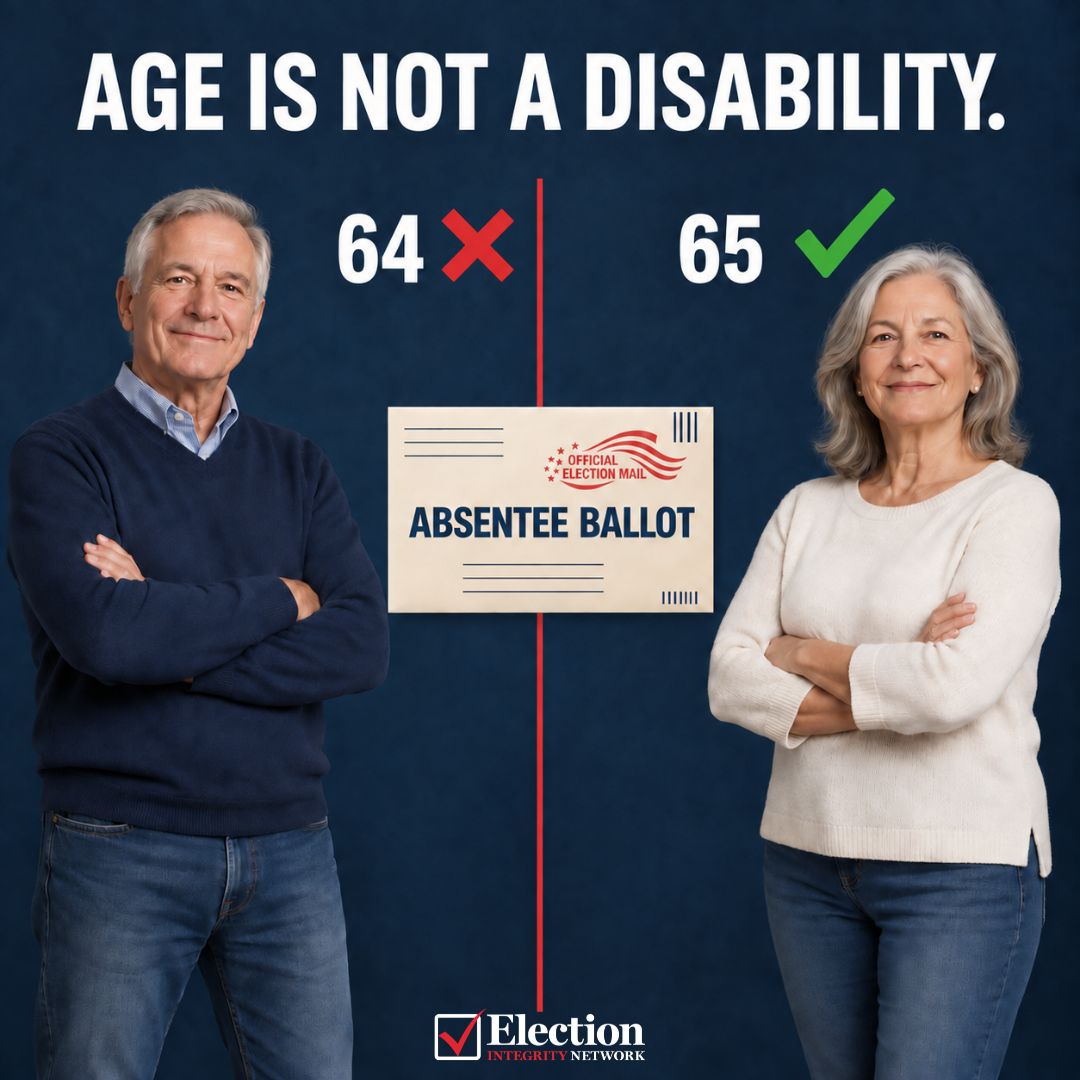
Everyone should vote in person unless they physically cannot enter the polling location. Turning 65 doesn’t automatically confine you to your home. Vote safely, securely, and secretly. Vote in person.
Several states give no-excuse absentee access based on age—even when the voter is not disabled.
Among the 13 excuse-required states, age is itself an absentee qualification in:
Indiana — age 65 or older
Kentucky — inability to appear on account of age, disability or illness
Louisiana — age 65 or older
Mississippi — age 65 or older
South Carolina — age 65 or older
Tennessee — age 60 or older
Texas — age 65 or older
West Virginia — “advanced age,” without a numeric threshold in the NCSL summary
Age and disability are not interchangeable.
That distinction is now at the center of a constitutional fight. In August 2026, a federal appeals court ruled South Carolina’s age-based absentee rule unconstitutional.
Every eligible citizen should be able to vote—and every lawful vote should be protected from dilution by an ineligible ballot.
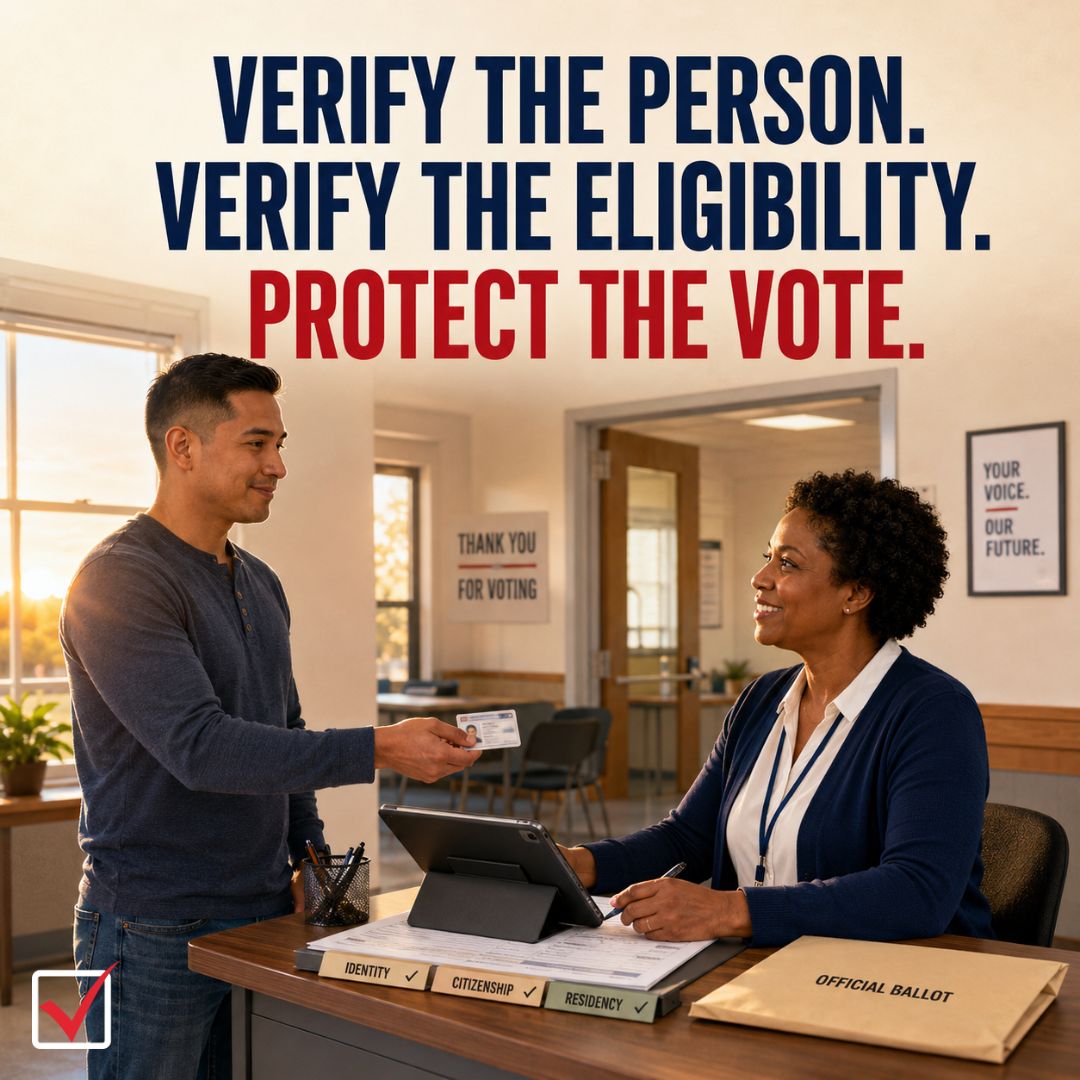
That requires more than recognizing the person in a photograph. It requires an election system that confirms:
Identity. Citizenship. Residency.
Principle II of the Model Election Laws Handbook calls for voter ID for every voter and every ballot, with acceptable identification confirming citizenship and residency.
Security and access are not opposing goals. A well-designed law can provide free identification, accessible enrollment, provisional voting and a fair cure process while still requiring meaningful eligibility verification.
Read Principle II and judge every voter ID proposal by what it actually proves.
https://t.co/HLNmLlGlYt
When evaluating a voter ID bill, ask:
Does it verify identity, citizenship and current residency?
Does it apply to in-person, early, absentee and mail voting?
Are accepted IDs tied to an eligibility-verified voter record?
Can lawful noncitizens obtain any accepted form of ID?
Can a document with an outdated address establish the correct voting jurisdiction?
Is qualifying ID available free of charge?
“Voter ID” is a label. The statutory details determine whether the bill merely recognizes a face or verifies an eligible voter.
The @TXsecofstate and some Texas counties are charging thousands of dollars for the voter rolls. They should be free of charge and available monthly at the least.
Voter rolls are not the private property of government officials, political parties or outside vendors.
Radical Transparency means citizens receive lawful access to registration lists, voter-history records, maintenance reports, duplicate findings and the records behind additions, removals and status changes.
Protect sensitive personal information—but expose the government’s process.
Elections belong to citizens. Citizens must be able to examine the foundation on which those elections are conducted.
In Chapter 4 of Fraud: How the Left Plans to Steal the Next Election, Eric Eggers turns to the question of noncitizen voting and voter-registration systems that allow ineligible people to enter the process.
Eggers discusses concerns surrounding voter registration, citizenship verification, government databases, and policies that make registration easier while making eligibility more difficult to verify. He also examines disputes over evidence of noncitizen registration and voting, arguing that even relatively small numbers matter in close elections.
Eggers emphasizes the distinction between access and eligibility: He argues that making registration convenient should not eliminate safeguards designed to establish that an applicant is legally qualified to vote.
The chapter ultimately raises a basic election administration question: How should states verify voter eligibility while ensuring eligible citizens can register and vote?
CALIFORNIA DESTROYED ITS ELECTIONS.
It systematically dismantled transparency, accuracy, and integrity under the cloak of "voter access".
Now its failed policies are spreading to other states.
At the ALEC Annual Meeting in Orlando, EIN exposed how California’s decade-long experiment in so-called “voter access” dismantled transparency, accuracy, and public trust—and showed legislators how to stop the same collapse in their states. 🎥
The solution is ready.
EIN distributed 100 copies of the Model Election Laws Handbook, giving lawmakers practical model legislation to restore elections that are secure, transparent, verifiable, and worthy of public confidence.
The threats are real.
The California playbook is spreading.
But states do not have to follow it.
EIN is leading the way—with the policies, legal framework, and tools legislators need to act now.
Protect your state before California-style elections reach it.
https://t.co/jjnUMry1pM





, click “Submit a public comment,” then write and submit your views by October 13.
House seats and local planning depend on census data. Make your voice heard.](https://pbs.twimg.com/media/HTdbIRGW8AAEG71.jpg)