Implementing hash-sig in Golang
Yesterday I came across Ethereum Foundation's leanConensus (fka beam call) #7, and loved the section on LeanMultiSig spec. Dove into a bit more, came across the paper - Hash-Based Multi-Signatures by @drakefjustin et al. and decided to implement it, but I only had the weekend free so wasn't sure how far I'd get along. 🧵
Cysic is partnering with @FluxePay!
We’re excited to announce that we’ll be accelerating the future of cross-chain privacy for stablecoins by powering Fluxe’s aggregation ZK circuit infrastructure.
"Compliant privacy is like giving up, it's not really privacy at all."
The quote reflects a real tension: traditional "compliant privacy" often means backdoors, key escrow, or selective disclosure to authorities - which isn't really private.
We hear you. But here's why we think differently about compliance in Fluxe 🧵 1/5
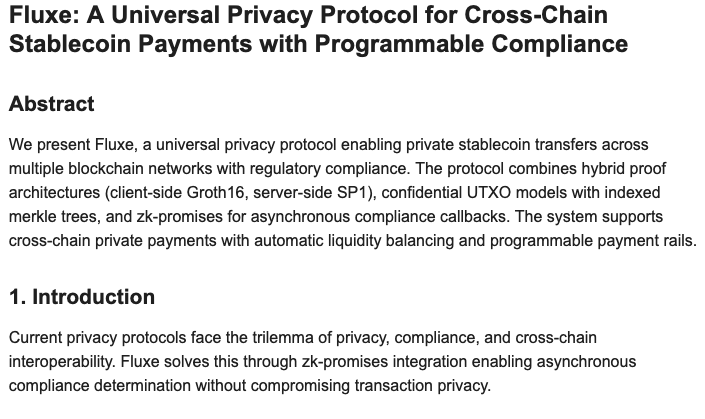
If you want to read more on how Fluxe enforces arbitrary compliance while retaining privacy using zk proofs and zk-promises
https://t.co/hLhx8A5Xj3
https://t.co/XJk3WO4kmv
This is deeply unfortunate, yet the undisputed truth about the state of privacy protocols today.
This might sound a bit like ambulance chasing, but compliance is what's needed here. Privacy should be the default but how do you stop malicious actors from using it?
Fluxe was built for this precise reason, asset freezing for malicious usage of the protocol, but also asset recoverability. Privacy sounds great until you're the one losing your savings, your next paycheck, or potentially your entire networth
DEXs are plagued with many inefficiencies and UX problems
1. Slow fills
2. MEV attacks
3. Slippage Roulette
4. Failed txn fees
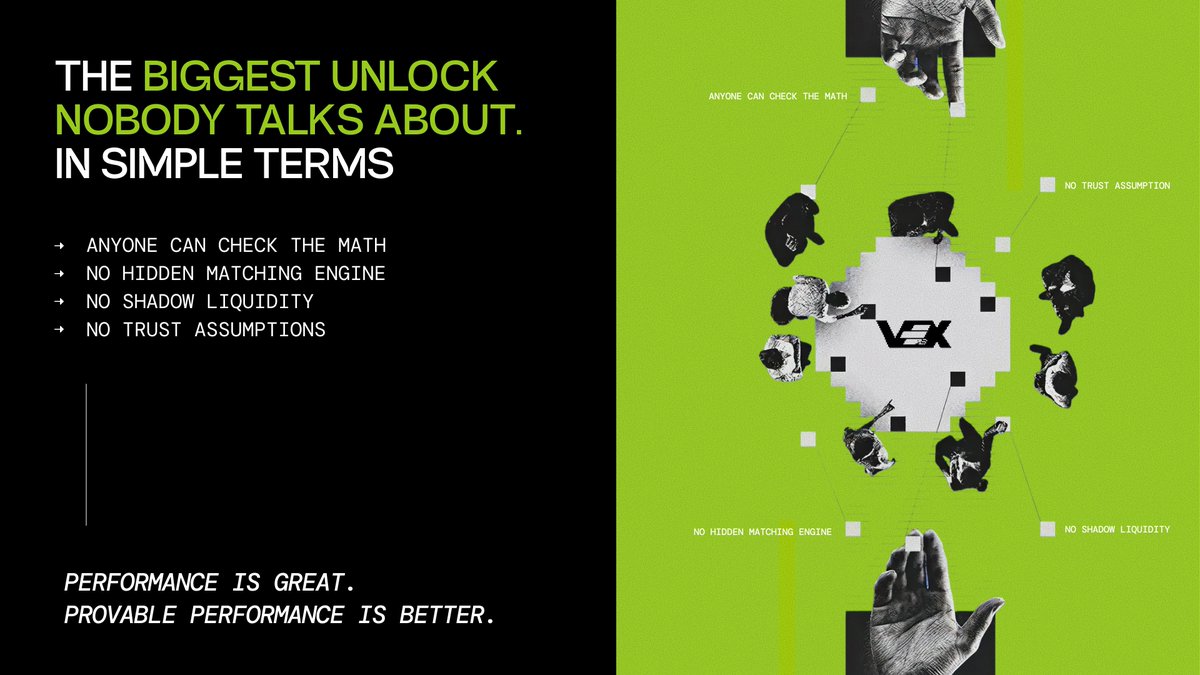
VEX solves for this
Verifiable fairness + Real Execution Speed
LFG! S-Two is now accelerated and is performant on Apple Metal.
Metal benchmarks are already beating highly optimized simd implementation for trace sizes as low as `log_n=17`, while still remaining competitive with smaller trace sizes.
Major metal kernels implemented:
– M31/QM31 field ops
– Circle FFT / IFFT
– FRI fold + decompose
– Merkle (BLAKE2s) hashing
– Quotient accumulation
– Fiat–Shamir channel mix/draw
– Constraint VM row eval
– MLE folds + circle eval
VEX had open sourced a Metal accelerated backend for S-Two by @StarkWareLtd - fully optimized for Apple devices, from MacBooks to iPhones. 🚀
Early benchmarks already show big gains, and this is only the beginning. Repo below 👇
Our goal is simple: make the world’s fastest prover even faster.
Over the next few weeks we’ll be rolling out OpenCL and CUDA backends targeting AMD and NVIDIA GPUs, bringing high-performance proving to every major hardware class.
Team dropped big alpha today in slack
- 1 ms execution
- Double the zk prover speed
- Metal GPU integration for apple devices
Real time verifiable exchange is becoming a reality very soon. GVEX