Welcome to Aether AI! ✨ We're building the next generation of intelligence: Causal World Models.
Forget correlations. We're focused on AI that truly understands underlying mechanisms, reasons about interventions, and operates reliably in the real world. This isn't just about bigger models; it's about fundamentally smarter, safer #PhysicalAI and #EmbodiedAI.
Our work is led by our founder, Prof. Biwei Huang @huang_biwei, whose vision drives us to redefine what's possible in AI.
Follow us for technical insights, team milestones, behind-the-scenes glimpses, and our vision for a smarter, more reliable future.
Join our journey as we redefine intelligence itself!
Learn more: https://t.co/aRfQlZlpiJ
#AetherAI #CausalAI #AIResearch #FutureOfAI
That’s a wrap on #IROS2026!
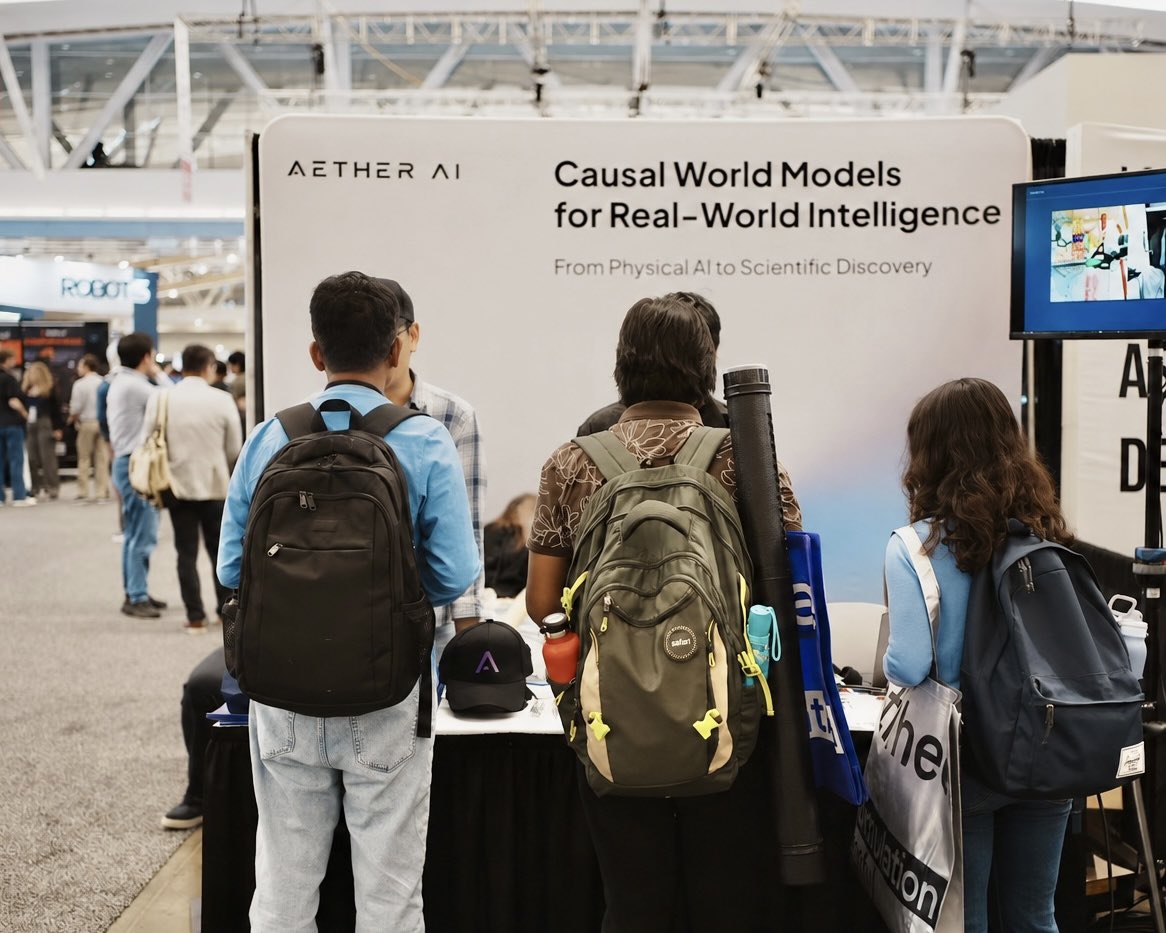
Huge thanks to everyone who stopped by our booth for the sharp questions, thoughtful challenges, and deep conversations about Causal Intelligence. Plenty for us to unpack, and so many conversations we can't wait to continue.
What a ride. Let’s keep the momentum going!
@ieeeiros #IROS #CausalAI
Early errors can snowball in long-horizon robotic tasks. If a small deviation goes undetected, the robot may continue acting on an incorrect state estimate, causing later decisions to drift further from reality.
We address this with our "causal brain", which predicts how actions should change task-relevant state variables over time.
After each action, it compares the predicted transition with what actually happened. These discrepancies provide a continuous calibration signal, helping the system discover new causal factors and relationships, update outdated knowledge, and adapt as the physical world evolves.
#CausalIntelligence
We’ll be at #IROS2026 in Pittsburgh, Sept 28 to 30!
At Booth #116, we’ll be sharing our work on causal intelligence and the question of how AI can reason about actions and their consequences in the physical world.
Come meet the team and tell us what you’re building. See you there! @ieeeiros
#IROS2026 conversations, continued after hours!
On Sept 29, Aether AI and @abaka_ai are hosting Jazz Night in Pittsburgh.
Join us for live music and a toast, while we talk about what’s next in AI.
RSVP: https://t.co/4hCLbKWlfX
A robot sees a coffee cup, shadows, and clutter. But what actually matters for its next move?
We’re building causal intelligence to represent what matters for action and reason about how actions change the world.
It’s a tricky problem, but we’re just getting into the good stuff. Stay tuned!
#CausalIntelligence #PhysicalAI
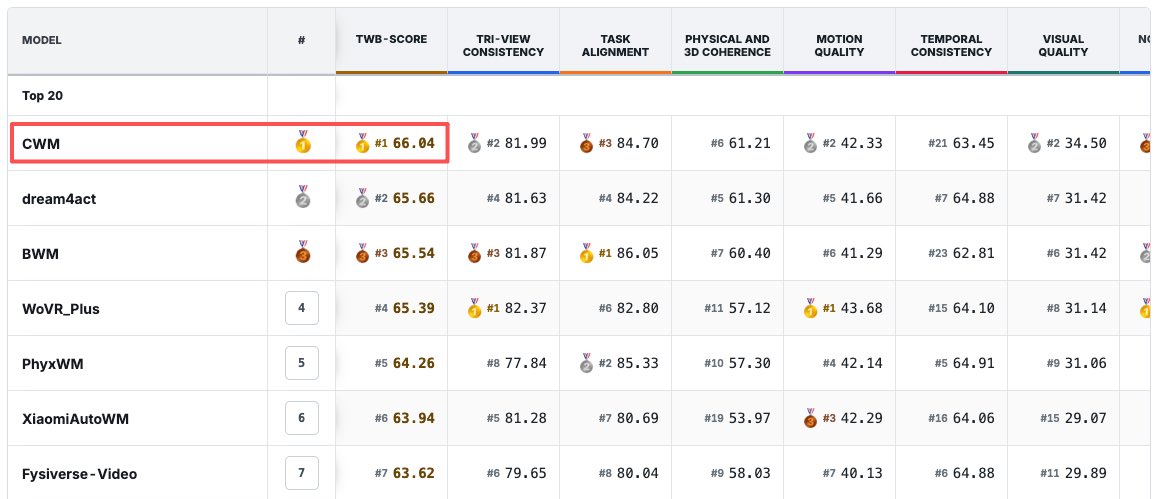
CausalWM takes the No. 1 spot on TriWorldBench!
By bringing Causal Chain-of-Thought into future video prediction, it makes intermediate physical variables part of the generation process.
The same interface can also accept visually rendered control signals. With limited fine-tuning, simulator-rendered robot trajectories can guide the generation of future videos consistent with those trajectories.
Explore more details👇
Thrilled to share CausalWM, our causal world model v1 built based on Causal Chain-of-Thought (CoT). It currently ranks No. 1 on TriWorldBench and the robot domain of PAI-Bench.
Many world models predict the future frames directly from current observations with language or action conditions. This can produce visually convincing videos at first glance, while still getting many subtle but important physical details wrong.
Because the underlying physical variables remain entangled in implicit representations, it is difficult to tell whether the model has truly captured the relevant physical mechanisms or is merely relying on shortcuts that produce plausible-looking results.
With CausalWM, we bring Causal CoT into future video prediction. The model follows an explicit sequence:
Optical Flow → Geometry / Pointmap → Future RGB
Each step in the causal CoT captures a meaningful intermediate transition, allowing the model to progressively capture causal dependencies underlying physical evolution.
One result I find especially interesting is the in-context control interface created by Causal CoT. Because our CausalWM has learned to use new visual signals in causal CoT. With limited fine-tuning, any useful features (e.g., simulator-rendered robot trajectories) can be added as in-context control, to guide it to generate consistent future videos.
This in-context learning ability gives us a practical way for physical reasoning and causal intervention.
Links in the thread below.
@FReza1984@huang_biwei The current study evaluates recursive self-improvement within each environment, with memory frozen after exploration. Cross-environment generalization remains future work, including which procedures transfer and how memory should adapt when tools, workflows, or conditions change.
@SiddhantD06@huang_biwei Weight-updating continual learning changes model parameters; RSIAgent keeps the weights fixed while updating external memory and practice selection. Its learned procedures can be inspected and revised without retraining the backbone.
The weights stay fixed; the agent’s available knowledge changes. RSIAgent turns verified practice into persistent memory of procedures, conditions, and failure lessons. This memory guides later execution and what the curriculum agent explores next, improving performance without retraining the model.
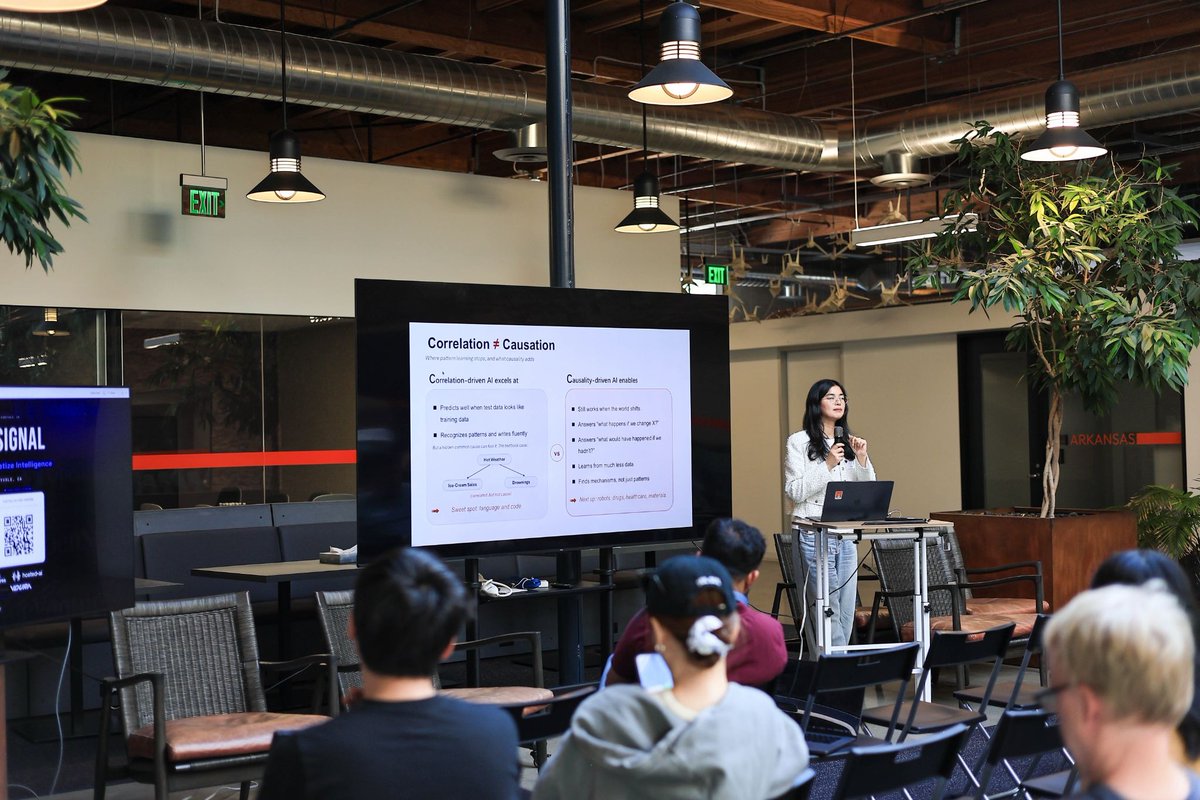
Our founder @huang_biwei spoke at AI Infra Signal in Sunnyvale last weekend and shared some of our work on causal intelligence💡
For us, causality is about understanding how actions change the world and reasoning about their consequences before acting. This matters as AI systems begin to act in changing environments.
Thanks to the organizing team, speakers, and everyone who attended. The wide range of perspectives made the broader AI infrastructure picture much more concrete!
Introducing RSIAgent: a framework for recursive self-improvement in digital agents through autonomous exploration.
RSIAgent enables agents to autonomously acquire, verify, and reuse experience. With Kimi-K3 and GLM-5.3 as base models, it outperforms GPT-6 Astra on both OSWorld 2.0 (0808 offline) and Agents’ Last Exam (Near-term)👇
Can an agent explore a new environment, learn its causal structure, and keep improving without updating its model weights?
We introduce RSIAgent, a framework for recursive self-improvement through autonomous exploration. Using Kimi-K3 and GLM-5.3 as base models, RSIAgent outperforms GPT-6 Astra on both OSWorld 2.0 and Agents’ Last Exam.
RSIAgent decides what to explore, executes tasks, verifies outcomes, and consolidates stable action-condition-outcome relationships into memory for future use.
With the underlying model weights fixed, RSIAgent achieves:
- 78.98% Partial Score on OSWorld 2.0 (0808 offline), compared with 72.60% for GPT-6 Astra
- 84.82% on Agents’ Last Exam (Near-term), compared with 82.26% for GPT-6 Astra
We call this Scaling Experience. Agents can continue improving by acquiring, verifying, and reusing their own experience while the underlying model weights remain fixed.
Links in the reply below.
Ice cream sales and drowning accidents rise at the same time. Does eating ice cream cause people to drown?
Of course not. Warmer weather drives both: people buy more ice cream, and more people go swimming. Temperature is the confounder.
The same trap appears in model evaluation.
“A new prompt improved performance by 15%.” But did the prompt actually improve, or did the test set just get easier?
Real-world evaluations involve countless, often unobserved variables, making perfectly controlled experiments difficult or impossible. A change in query difficulty, distribution, or context can easily look like a model improvement.
This is why causal evaluation matters.
Instead of asking what changed together, it asks what the intervention actually caused. By accounting for confounders, we can distinguish genuine improvements from changes in the evaluation environment and make better downstream decisions.
How does your team account for confounders across evaluation runs?
#CausalAI #CausalWorldModels
Catch our founder @huang_biwei at AI Infra Signal hosted by OpenStages on Sep 12!
She'll talk on “Causal World Models for the Next AI Paradigm” and explore how causality can help AI reason about how actions change what happens next.
See you there!
Had a great time chatting with @CharlieFink and @VirtualTedS.
Reasoning before acting is a fundamental part of Physical AI. Counterfactual reasoning gives a robot a way to consider possible consequences before committing to an action.
Making that reasoning transparent is equally important if we want to understand why a particular action was chosen.
“What if I do this action? What will happen?”
That’s the core of counterfactual reasoning in Physical AI.
Our founder @huang_biwei joined @CharlieFink and @VirtualTedS on @AIXRPodcast to talk 10+ years of causal AI research, how it’s shaping our causal world models, and why Physical AI is our first proving ground.
Check out the full episode in the comments.
“Causality is the ability to understand the rules that govern how actions change the world, and to reason about their consequences before acting.”
For physical AI, this becomes a practical question: what will an action change, and what happens next? This is what we study through our causal world model.
Great to see our founder @huang_biwei bring this perspective to the Frontier Physical AI Summit!
Great evening at the Frontier Physical AI Summit in Stanford. The discussions covered research, foundation models, and the realities of deploying autonomous systems in the physical world.
I shared our perspective on why physical AI needs more than correlation. Causality means understanding how actions change the world and reasoning about their consequences before acting, especially when trial and error can be costly or unsafe.
This distinction drives our work on causal world models at @AetherLab_AI. Thanks to the organizing team for bringing everyone together!
The hard part often comes one step earlier: how do we recover the relevant causal variables in the first place? In robotics, these variables are often not given directly. They have to be learned from inputs such as pixels, trajectories, and raw sensor streams before we can model how actions change the system.
In robot learning, the data distribution changes with the policy.
Early on, a robot may stay within familiar positions and rely on simple actions. As the policy changes, it may try different angles and enter less familiar states.
This forms a feedback loop: policy → data → learning → updated policy → new data.
A model trained on earlier experience may perform well on historical data, while the updated policy takes the robot into states that were rare in its training data.
The policy learns from data and shapes what comes next. A causal world model needs to evolve with this loop, adapting as new interactions reveal the consequences of new actions.
#CausalWorldModels
What makes a world model causal?
As a robotic gripper closes around an object, the contact conditions change. Friction, grasp point, speed and angle can all affect the outcome.
Our framework treats causality as an explicit system of causal variables, causal structure and causal dynamics in latent space.
Which condition would you vary first?
#CausalWorldModels