Common Sense Approaches to Federal Bureau of Prisons Reform
The Federal Bureau of Prisons (BOP) requires several practical reforms to enhance safety and efficiency within the federal prison system. Here are key measures that warrant implementation:
Adequate Funding Allocation
The BOP needs proper funding to maintain facilities, hire qualified staff, and implement essential programs. Without sufficient resources, the bureau cannot effectively manage its facilities or provide rehabilitation services.
Strategic Budget Management
A comprehensive budget must be passed and maintained to ensure proper allocation of resources across all federal correctional facilities. This includes funding for staff training, facility maintenance, and prisoner rehabilitation programs.
Enhanced Mail Screening Protocols
To prevent drug smuggling, all incoming mail should undergo thorough screening using advanced detection methods. Modern scanning technology can detect substances hidden in letters, packages, and other materials, significantly reducing contraband entering facilities.
Cell Phone Signal Interference
Installing signal jamming technology throughout federal prisons would effectively prevent unauthorized communication via cellular devices. This measure would enhance security by stopping inmates from coordinating illegal activities or maintaining outside criminal connections.
These reforms represent practical solutions to current challenges facing the federal prison system. By implementing these measures, the BOP can better fulfill its mission of maintaining secure facilities while providing opportunities for inmate rehabilitation.
@GLFOP @ILFOP263
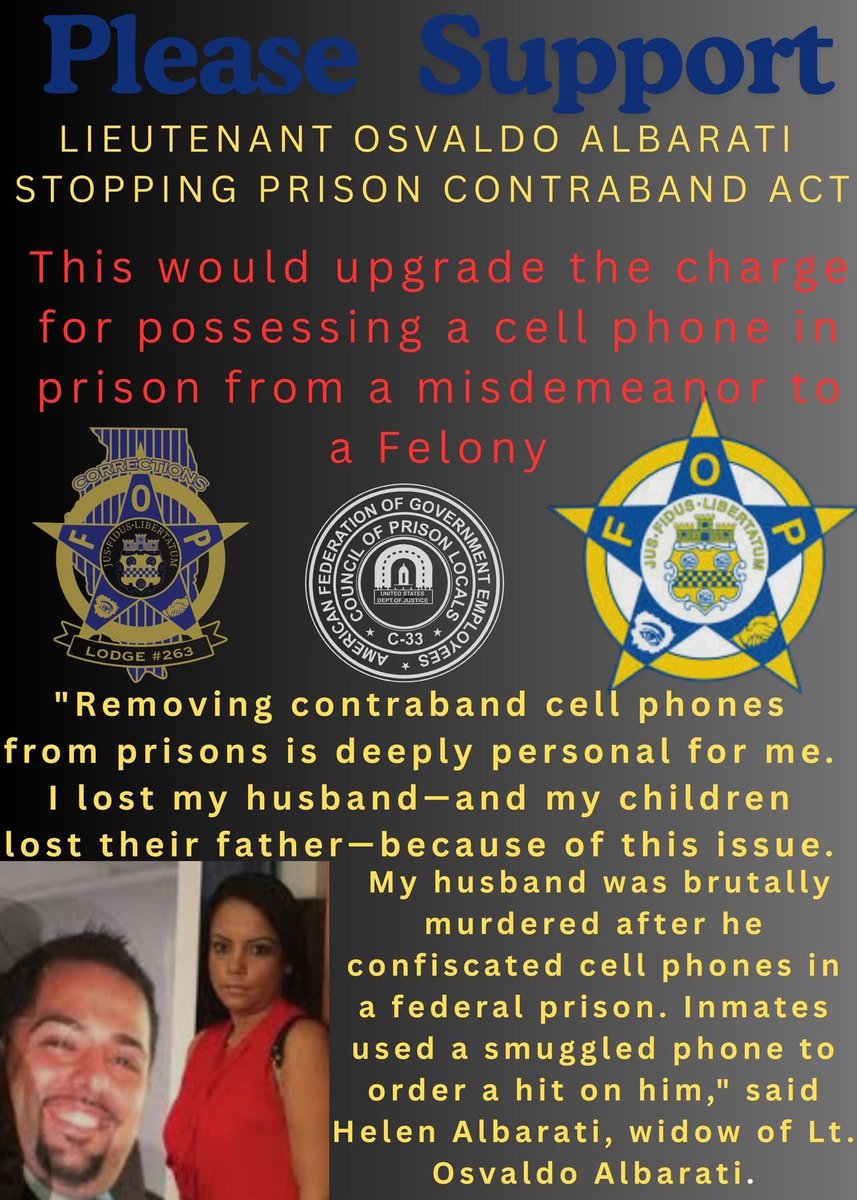
The Senate has passed S.736, the Lieutenant Osvaldo Albarati Stopping Prison Contraband Act. introduced by Senator Grassley, with key support from Senators Durbin and Booker, the bill aims to crack down on the smuggling of cell phones into federal prisons. Other notable co-sponsors include Senator Cruz, Senator Cory Booker, and Senator Ashley Moody. It would make it a felony for either inmates or staff to bring in or possess a contraband cell phone inside a federal prison —a move designed to curb illicit communications and improve prison safety.
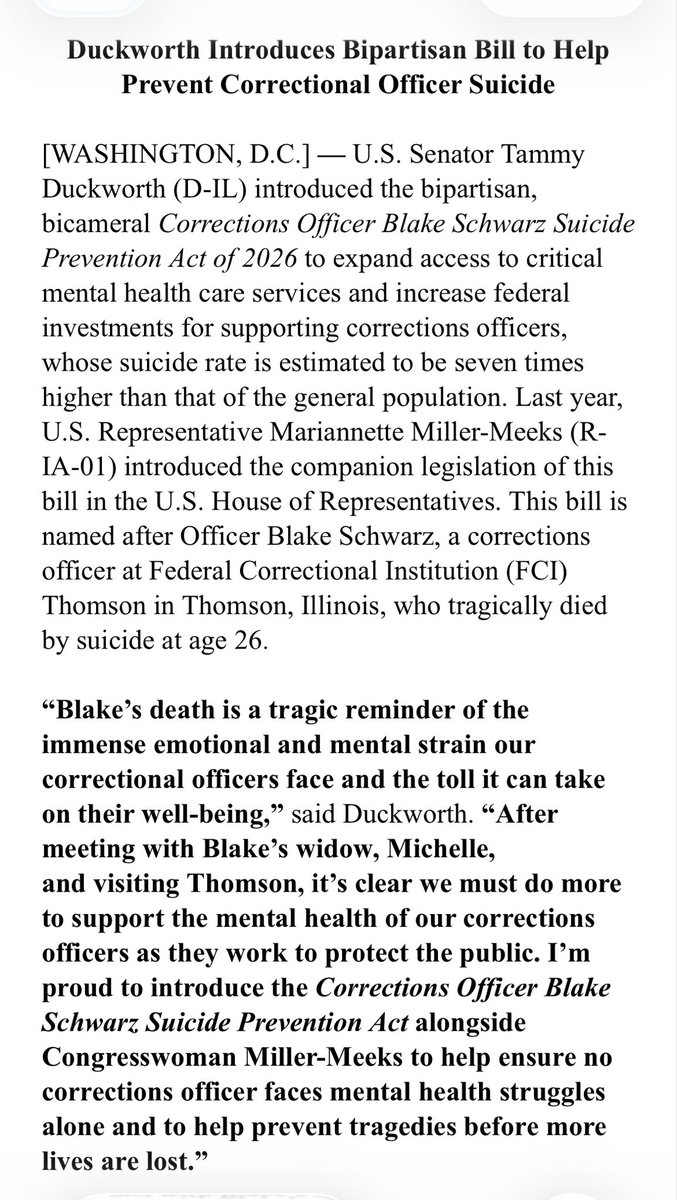
.@SenDuckworth has introduced the Corrections Officer Blake Schwarz Suicide Prevention Act
This was previously introduced in the House. I wrote about it last year in covering the often overlooked epidemic of correctional officers dying by suicide (no paywall, link below)
A Widow’s Plea: Michelle Schwarz on Suicide Prevention in Corrections
Suicide among correctional officers is rarely discussed, yet it’s a crisis that can’t be ignored any longer. Correctional officers die by suicide seven times more often than the general public—more than police officers, too. Michelle Schwarz knows this pain firsthand. Her husband, Blake Schwarz, was an honor graduate of the Federal Law Enforcement Training Center and was on the Disturbance Control Team at USP Thomson in Thomson, Illinois. After years on the front lines, Blake lost his life to suicide.
In this powerful video, Michelle shares her story and calls for urgent action to protect the mental health of those who protect us. Watch now to hear directly from Michelle and learn why the time for change is now.
#suicideprevention
#FederalBureauPrisons
#Enoughisenough
https://t.co/JlsFBRbhnZ
The Positive Dog Program at FCI Thomson is changing lives, one paw at a time. What started as a small idea has blossomed into a partnership with the VIP Service Dog Foundation, and now, 15 dogs are part of a unique journey—training to become service animals while living alongside inmates in the facility.
Here’s how it works: the program pairs incarcerated individuals with dogs, giving both a chance to grow, learn, and give back. The dogs, who will one day serve veterans and people with disabilities in the local community, get intensive training and socialization for up to 18 months. Inmates, meanwhile, learn valuable skills—everything from dog grooming and training techniques to patience, responsibility, and empathy.
Blair Peters from the VIP Service Dog Foundation put it plainly: “It’s really going to be a good environment because the dogs are going to get a lot of training time and a lot of focus. So it’s great for the dogs from that standpoint. Then it’s also going to give the prisoners a chance to learn skills. They’re going to work on grooming, they’re going to work on dog training and being able to work with animals with different skillsets and different challenges.”
But here’s the challenge: the entire Thomson Dog Program is 100% funded through donations. Donations can’t be accepted at the prison, and the only way to support the program is through the Positive Paws link. Every bag of food, every chew toy, every training treat comes from the generosity of people who believe in second chances—for dogs and humans alike.
If you want to help, consider making a donation through Positive Paws. Your support keeps this program growing, gives hope to those inside, and puts future service dogs into the hands of veterans and others in need. Together, we can keep this incredible program thriving—for every dog, and every life it touches.
https://t.co/9jR3VOMLrD
We’re excited to share some good news: Local 4070 has raised $4,000 and donated an additional $1,000, totaling $5,000 for the Gray Matter Collective.
Over the past two years, we’ve teamed up with the Gray Matter Collective and Haley DeGreve to shine a light on mental health for law enforcement officers right here at Thomson. Haley has visited our staff at Thomson multiple times, on different shifts, to share her personal story and let everyone know about mental health resources available in our area.
Because of this partnership, 24 staff members from Thomson have gone through ASSIST training — that means more advocates and more awareness about mental health where we work. The Gray Matter Collective also runs small groups in the community, including a law enforcement support group led by a licensed counselor, which many of our staff have attended.
We’re grateful for everything the Gray Matter Collective does for Thomson Federal Prison and for supporting mental health in our local community. Thank you for standing with us and making a real difference.
January 30 marks the next shutdown deadline—less then four weeks away.Congress only has 12 working days on the calendar this month.And they still haven’t finished 9 out of 12 government funding bills
I am proud to cosponsor the Prison Staff Safety Enhancement Act because no correctional officer or prison employee should ever be subjected to harassment, assault, or sexual misconduct in the workplace. At Thomson Federal Prison alone, staff reported more than 1,600 incidents of inmate sexual misconduct between 2019 and 2023. That is unacceptable, and it demands immediate action.
Thank you to the senators for putting people over politics and paving the way for the Senate to pass the funding needed to reopen the government. This crucial step means that law enforcement officers at Thomson Federal Prison—many of whom have been working without pay and forced to get a second job during the government shutdown—are finally one step closer to receiving their hard-earned paychecks. We are hopeful that the Senate will pass the funding bills and that the House of Representatives will follow suit, so the dedicated officers at Thomson can get the pay they’ve earned.
#ThomsonFederalPrison #shutdown
I’ve been made aware of the incident at Thomson Prison involving exposure to an unknown substance in the mailroom, and I’m keeping all those affected in my prayers.
Unfortunately, incidents like this happen far too often and must be addressed with urgency. That’s why I signed onto H.R. 1046, the Marc Fischer Memorial Act, which would require the Bureau of Prisons to develop and implement a strategy to stop fentanyl and other synthetic drugs from entering facilities through the mail.
Our correctional officers and prison staff risk their lives every day. It’s time to give them the protection they deserve and get this bill passed.
Amidst the government shutdown, I want to thank Warden Brian Lammer for his years leading the dedicated correctional staff at FCI Thomson, many of whom are continuing to keep our communities safe by working without pay.
Your commitment to collaboration, innovation, and the well-being of both staff and those in your care will be felt at FCI Thomson long after you move on to your next chapter.
House Republicans stopped revising their legislative calendar back in July. So I updated it for them. Since July 4, the House has conducted 20 days of business in 16 weeks. Oct. 27-30 remains TBD.
Today, the law enforcement officers at Thomson showed up and did their jobs.
They walked into Thomson Federal Prison, put on their uniforms, and faced the risks that come with working behind these walls—knowing their paychecks weren’t coming.
Last Friday should have been a payday. Instead, it marked the first time in this shutdown that we missed a full paycheck. This isn’t just a number on a bank statement. It’s rent. It’s groceries. It’s gas to get to work. The longer this shutdown goes on, the harder it gets for the men and women who keep this place running.
We already have one of the toughest jobs out there. Every day, we deal with dangers the public rarely sees or hears about. We do it because we believe in our work. But there’s only so much anyone can take. Banks and landlords aren’t giving us a break just because Congress can’t come to an agreement. Bills are still due. Families still need to eat.
We’re calling on lawmakers to remember the people on the front lines. End this shutdown. Let us do our jobs without having to worry if our families will be okay.
We’re not asking for special treatment. We’re asking to be paid for the work we do, and for respect for the risks we take every single day.
Statement from the Union Representing Officers at Thomson Federal Prison
@AndrewDesiderio@igorbobic The government is shut down the house refuses to pass a budget and you focus on somebody pain for their own transportation how they get to DC