A Heartfelt Thank You!
African Institute for Development Policy (AFIDEP) sincerely appreciates everyone who participated in the High-Level Dialogue on Public Institutions and Oversight in Africa and the launch of the Integrity Narratives 2026 Report in Nairobi.
Your contributions, insights, and engagement enriched the discussions on strengthening public institutions, enhancing accountability, and advancing democratic governance across Africa.
As we reflect on the dialogue, we invite you to continue the conversation and explore the evidence, insights, and stories shaping Africa’s governance landscape.
Explore the Integrity Narratives 2026 Report here: https://t.co/QfMTTzMZoB
Discover the revamped Africa Integrity Indicators website: https://t.co/wjqC212H6Q
The journey toward accountable, transparent, and resilient public institutions requires sustained collaboration, evidence, and collective action.
Thank you for being part of the conversation and the change!
"Mozambique is rich in minerals, but its greatest resource is its people.”
At the Conference on Population and Development in Maputo, opened by His Excellency Daniel Francisco Chapo, President of the #Mozambique, African Institute for Development Policy (AFIDEP)’s Dr. Rose N. Oronje delivered the inaugural keynote.
Every year about 500,000 young Mozambicans enter the labour market, while the formal economy creates about 25,000 jobs.
📍 Her message: accelerating fertility decline through voluntary family planning, and investing in education, skills and productive jobs, will decide the size of #Mozambique’s demographic dividend.
Read more: https://t.co/iw01gNhH3y
#DemographicDividend #Mozambique #PopulationAndDevelopment #YouthEmployment #HumanCapitalDevelopment #FamilyPlanning #SustainableDevelopment #AFIDEP
Did you know? Approximately 80% of Malawi's population is below the age of 35.
This presents Malawi with a significant opportunity to harness its youthful population as a driver of productivity, innovation and economic growth. However, this potential will not be realised automatically.
It requires deliberate investments in:
📚 quality education,
🏥 healthcare,
🧑🧑🧒🧒 family planning
🍳 development and
👨🏾💻 decent job opportunities.
By equipping young people with the health, knowledge and skills they need to participate productively in the economy, Malawi can turn its youthful population into a powerful engine for economic transformation. Without these investments, this potential risks remaining untapped.
Read the study: https://t.co/jyjLnAVHPE
#DidYouKnow #DemographicDividend #PopulationAndDevelopment #AFIDEP
Mozambique’s changing population presents an important opportunity for economic transformation. But turning this opportunity into a demographic dividend will require deliberate policy choices and sustained investment in people.
AFIDEP is participating at the Conference on Population and Development.
Date: November 4-5, 2026
Venue: Mozambique-China Cultural Centre in Maputo
Theme: Population, Economic Transformation and Well-being: Policies to Harness the Demographic Dividend in Mozambique.
Organised by Mozambique’s Ministry of Planning and Development, the conference brings together stakeholders to explore how population policies and investments can drive economic transformation and improve people’s well-being.
AFIDEP’s Deputy Executive Director and Head of Programmes, Dr Rose N. Oronje, will deliver a keynote presentation titled “How can Mozambique harness its demographic transition for accelerated development for its people?” Her presentation will explore the policy choices and investments needed to harness the demographic dividend, with a focus on fertility decline, human capital development and productive employment.
Read more: https://t.co/Oue80rFit0
#PopulationAndDevelopment #DemographicDividend #EvidenceInformedPolicy #AFIDEP
Population dynamics shape nearly every development challenge Africa faces, making them a cross-cutting factor in achieving most of the Sustainable Development Goals, and nowhere is this clearer than in the task of creating decent jobs for the continent’s fast-growing, youthful workforce.
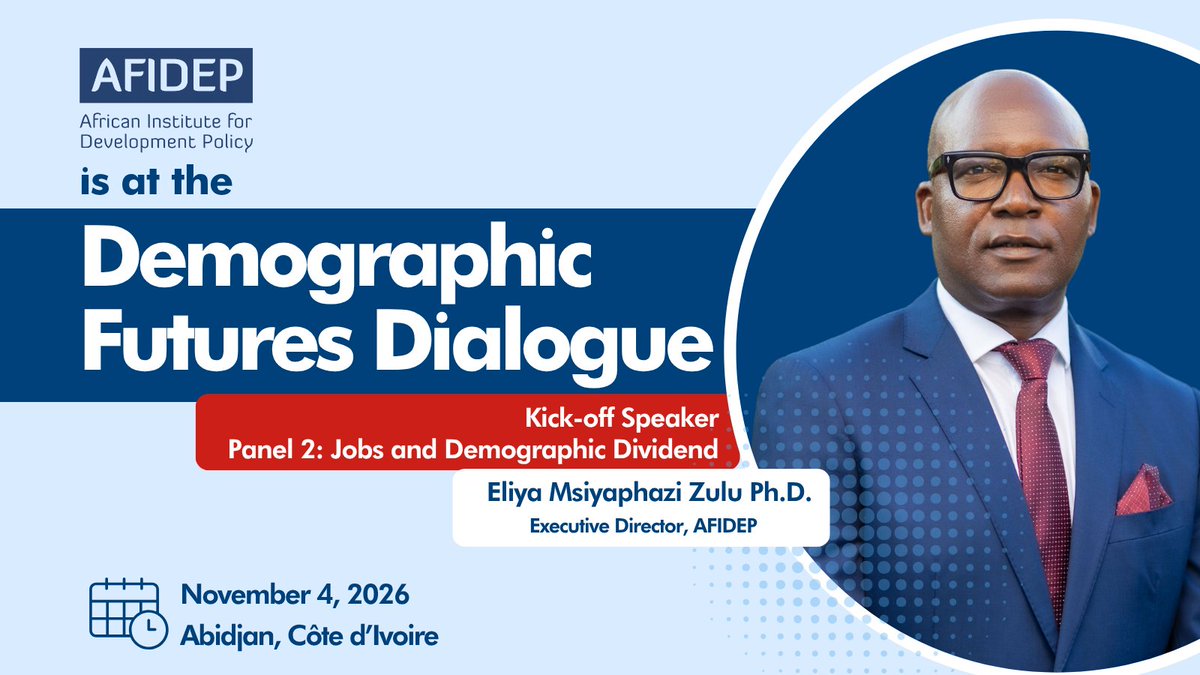
AFIDEP’s Executive Director, Dr Eliya Msiyaphazi Zulu, will deliver a kick-off presentation for the panel on Jobs and the Demographic Dividend at the Demographic Futures Dialogue in Abidjan, Côte d’Ivoire, on 4 November 2026.
The session will explore how African countries can harness demographic change to drive productive employment, with a focus on human capital development, job creation and the conditions needed to realise the demographic dividend.
Co-hosted by UNFPA, the African Union Commission and the Government of Côte d’Ivoire, the Dialogue brings together policymakers, researchers, development partners and other stakeholders to explore how demographic change can be turned into opportunities for prosperity, resilience and inclusion through informed policies, planning and investment.
Dr Zulu’s presentation draws on AFIDEP’s long-standing work in this field. By strengthening the use of evidence in policymaking and planning, AFIDEP supports African countries to harness the demographic dividend through strategic investments in human capital, job creation and inclusive economic development, work that has helped spark unprecedented interest in tackling population and development issues across the continent.
Learn more on our #DemographicDividend work: https://t.co/ojO19CVA8Z
#PopulationDynamics #DemographicDividend #SDGs
Prioritising reforms for Malawi’s economic recovery and transformation requires more than policies. It requires a change in mindset, action and accountability.
Speaking at the Economics Association of Malawi (ECAMA) Annual Economic Conference 2026 in Mangochi, AFIDEP Executive Director, Dr Eliya Msiyaphazi Zulu, highlighted the importance of addressing behaviours and practices that continue to undermine the country’s progress.
“It’s the mindset shift. Continuing to engage in behaviours that we know are undermining the country’s progress, because we feel we cannot be held to account.”
Dr Zulu emphasised that Malawi’s challenge is not a lack of policies or ideas, but the need to prioritise reforms, strengthen implementation and sustain progress. He highlighted the importance of stabilising the economy, improving economic management and investing in agriculture, mining, businesses and human capital to support long-term transformation.
“These efforts must align with Malawi 2063, create opportunities for young people, deliver practical results, remain fiscally affordable and strengthen the country’s ability to earn and save foreign exchange.”
With approximately 270,000 young people entering the labour market annually, while the economy creates around 40,000 formal jobs, effective reforms are essential to expanding employment opportunities, improving livelihoods and building a more productive economy.
Achieving this requires sustained commitment, effective coordination, public accountability and consistent monitoring to ensure that reform priorities translate into tangible results for Malawians.
Malawi’s economic transformation depends on turning policy commitments into action, strengthening institutions and sustaining reforms that deliver lasting improvements in people’s lives.
#ECAMA2026 #EconomicTransformation #Malawi #AFIDEP #EconomicReforms #Accountability #Malawi2063
As the high-level dialogue on public institutions and oversight in Africa kicked off today, the question on the table was, are Africa’s institutions and oversight mechanisms catalysts for democratic consolidation, or instruments of regression?
Opening the high-level policy dialogue, #AFIDEP’s Dr. Rose N. Oronje cited African Union’s #Agenda2063 Aspiration #3: An Africa of good governance, democracy, respect for human rights, justice and the rule of law, highlighting that good governance is “not one of the components of development”; it is the precondition for sustainable development; it is that which enables a continent to develop.”
Delivering his keynote remarks, John Githongo, Chairman of the board, Inuka Kenya NI Sisi, and founding Director of Transparency International, Kenya, noted that the Country has exhausted the technical and legal frameworks for the governance challenge. The problem is not what we lack, but what we refuse to do.
While presenting the Scorecard findings, AFIDEP’s Governance and Accountability Theme Lead, Alex Nester Jiya, PhD, noted that the continent's choice is not between having institutions and having none, but between institutions that exist and institutions that work. He said sustained political commitment can narrow this divide.
The Africa Integrity Indicators provide evidence on how governance works in practice, not just on paper.
📍Explore the recently disseminated Round 13 data here ⤵️ https://t.co/jqeKwoGyjj
#AII13 #AfricaIntegrityIndicators #GoodGovernance #AFIDEP #MoIbrahimFoundation
Evidence must be at the centre of efforts to advance meaningful and sustainable government reforms.
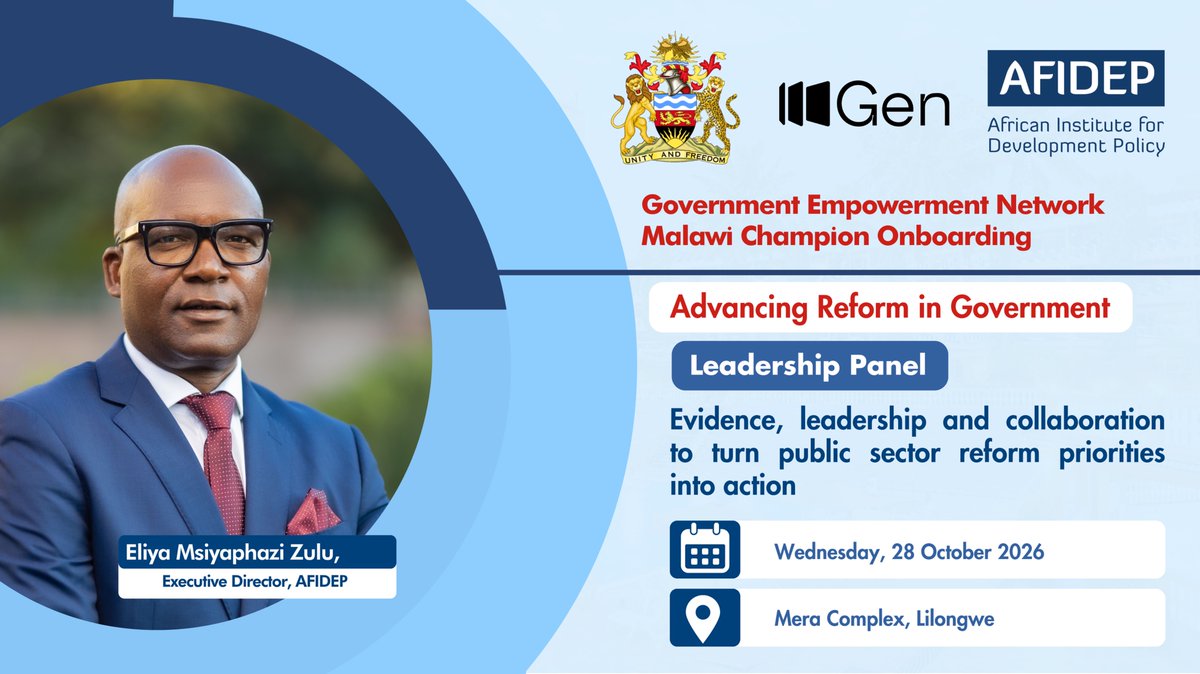
Speaking during a leadership panel on Advancing Reform in Government at the Government Empowerment Network (GEN) Malawi Champion Onboarding in Lilongwe, AFIDEP’s Executive Director, Dr Eliya Zulu, emphasised the importance of grounding reform proposals in credible evidence to inform decision-making and build support for institutional change.
Drawing on AFIDEP’s experience supporting parliamentary autonomy reforms in Malawi, Dr Zulu highlighted how research, lessons from other countries and strategic engagement with decision-makers contributed to advancing reforms aimed at strengthening Parliament’s autonomy and effectiveness.
He encouraged reform champions to master the evidence behind their proposals, demonstrate the benefits of proposed changes and engage relevant stakeholders to translate evidence into action.
@johngithongo said two-thirds of Africans still prefer democracy, even as support had declined by seven percentage points over a decade and openness to military intervention had increased.
He linked this tension to corruption, insecurity and unmet expectations, particularly among younger Africans. He said Africans, it would seem, support democracy in principle while increasingly open to authoritarian alternatives in practice.
#AII13 #AfricaIntegrityIndicators #IntegrityNarratives #GovernanceInAfrica #Accountability #EvidenceToAction
Today, AFIDEP launches the Africa Integrity Indicators Round 13 data and Integrity Narratives 2026.
Today, we bring new evidence to the conversation. Explore the findings. Interrogate the evidence. Ask the difficult questions. Start the conversation.
Register through https://t.co/Hyrf6MDQ1F to join us!
#AII13 #AfricaIntegrityIndicators #IntegrityNarratives #GovernanceInAfrica #Accountability #EvidenceToAction
AFIDEP's Executive Director, Dr @EliyaZulu , will join a leadership panel on Advancing Reform in Government at the Government Empowerment Network (GEN) Malawi Champion Onboarding in Lilongwe.
GEN Malawi is a government-led initiative aimed at empowering public servants to drive reforms by strengthening their capacity to identify institutional challenges, develop evidence-informed solutions and translate reform priorities into action.
AFIDEP brings extensive experience in supporting institutional reforms in Malawi. Through the Malawi Parliament Enhancement Project (MPEP), AFIDEP provided technical support to the Parliament of Malawi in advancing reforms aimed at strengthening its autonomy, operational efficiency and capacity to fulfil its legislative, oversight and representation functions.
Dr Zulu will share insights from this experience, highlighting the role of evidence, leadership and institutional collaboration in translating reform priorities into meaningful change.
What has shaped the Africa Integrity Indicators Scorecard's journey, and what does its future hold under AFIDEP?
In this video, Dr Rose Oronje, AFIDEP’s Deputy Executive Director and Head of Programmes, reflects on the Scorecard’s journey, from its launch in 2012 by Global Integrity in collaboration with the Mo Ibrahim Foundation to its transition to the African Institute for Development Policy (AFIDEP) in 2021.
Dr Oronje discusses why the Scorecard moved to AFIDEP, the changes introduced since the transition, and AFIDEP’s vision for strengthening this important governance initiative.
🎥 Watch Dr Oronje share insights into the Scorecard’s evolution and its future.
#AII13 #AfricaIntegrityIndicators #IntegrityNarratives #GovernanceInAfrica #Accountability
SPEAKER SPOTLIGHT | Dr Alex Nester Jiya
Dr Alex Nester Jiya, is AFIDEP’s Research and Policy Analyst and Acting Lead of the Governance and Accountability Theme, whose work focuses on democratic governance, public policy, institutional development, and evidence-informed decision-making.
Alex brings diverse experience in policy and governance research, data analysis, financial compliance, and institutional accountability. He also served as a United Nations Volunteer on the UN E-Government Surveys in 2022, 2024, and 2026.
He holds a PhD and an MSc in Governance and Regional Integration from the Pan-African University Institute of Governance, Humanities and Social Sciences, alongside a Bachelor of Social Science in Economics from the University of Malawi.
With a strong passion for data and strengthening transparency and oversight systems, Alex brings valuable expertise to conversations on building resilient institutions and advancing democratic governance in Africa.
Register through https://t.co/Hyrf6MDQ1F to join the conversation on strengthening accountability and democratic governance in Africa.
#AII13 #AfricaIntegrityIndicators #IntegrityNarratives #GovernanceInAfrica #Accountability
How can Malawi turn policy commitments into tangible economic progress?
As the country pursues economic recovery and transformation, the focus must shift beyond policy formulation to effective implementation, institutional accountability and reforms that deliver meaningful results.
At the high-level 2026 Economics Association of Malawi (ECAMA) Annual Economic Conference, taking place on 29–30 October at Sunbird Nkopola in Mangochi, AFIDEP Executive Director Dr Eliya Msiyaphazi Zulu will contribute to discussions on prioritising reforms for Malawi’s economic recovery and transformation.
Held under the theme “From Policy to Practice: Making Reforms Work,” the conference will bring together policymakers, economists, private sector leaders, civil society and development partners to explore practical solutions for advancing inclusive and sustainable economic growth.
Read more: https://t.co/KUeuZHLkOo
#ECAMA2026 #AFIDEP #EvidenceInformedPolicy #EconomicTransformation #Malawi2063
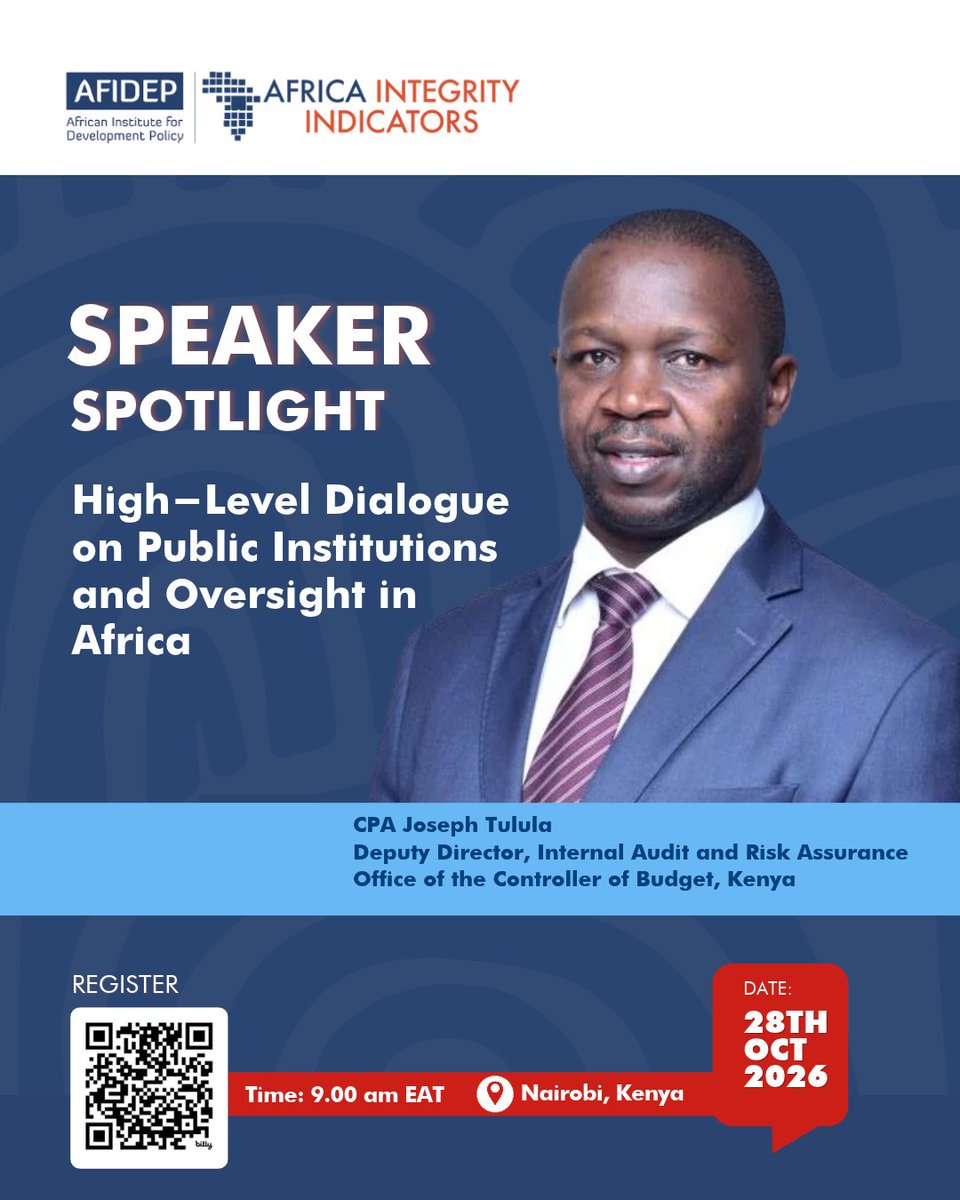
SPEAKER SPOTLIGHT | CPA Joseph Tulula
CPA Joseph Tulula, Deputy Director of Internal Audit and Risk Assurance, will be a speaker at the upcoming High-Level Dialogue on Public Institutions and Oversight in Africa.
With over 25 years of experience in auditing, finance and management, CPA Tulula brings extensive expertise in risk management, internal control systems and the implementation of computerised financial systems.
He holds a Master of Arts in Economics and a Bachelor of Commerce in Accounting from the University of Nairobi. He is also a member of the Institute of Certified Public Accountants of Kenya (ICPAK) and the Institute of Internal Auditors of Kenya.
Register through https://t.co/Hyrf6MDQ1F to join the conversation on strengthening accountability and democratic governance in Africa.
#AII13 #AfricaIntegrityIndicators #IntegrityNarratives #GovernanceInAfrica #Accountability
SPEAKER SPOTLIGHT | Arvind K. Jain
Arvind K. Jain, Senior Economist/Statistician at the @WorldBankGroup and Task Team Leader for the Worldwide Governance Indicators (WGI) project, will be a speaker at the upcoming High-Level Dialogue on Public Institutions and Oversight in Africa.
Arvind leads one of the leading global initiatives for measuring national governance. His experience at the World Bank includes managing firm-level surveys in diverse contexts, including fragile and conflict-affected states, and producing analytical reports to inform policy and decision-making.
Before joining the World Bank in 2008, he worked as a statistician at the RAND Corporation, focusing on project evaluation and statistical analysis. He holds a Master’s degree in Biostatistics from the University of Michigan.
Register through https://t.co/Hyrf6MDQ1F to join the conversation on strengthening accountability and democratic governance in Africa.
#AII13 #AfricaIntegrityIndicators #IntegrityNarratives #GovernanceInAfrica #Accountability
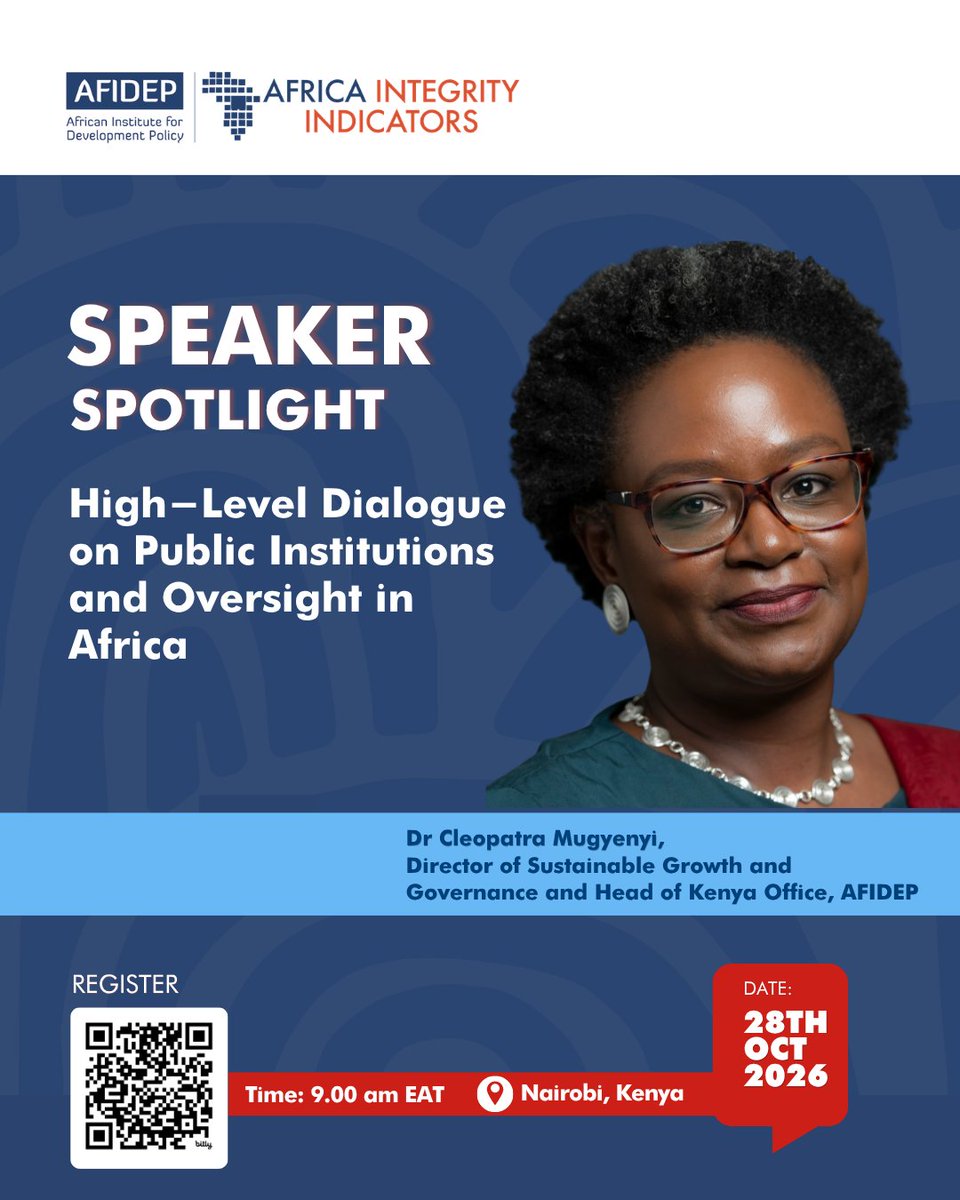
SPEAKER SPOTLIGHT | Dr Cleopatra Mugyenyi
Dr Cleopatra Mugyenyi, AFIDEP’s Director of Sustainable Growth and Governance and Head of the Kenya Office, will be a speaker at the upcoming High-Level Dialogue on Public Institutions and Oversight in Africa.
With over 20 years of experience in research, programme leadership and policy across Africa, Dr Mugyenyi has led more than 30 research, policy and capacity-strengthening projects. Her expertise spans governance and accountability, gender equality, youth development, social inclusion and health systems strengthening.
She brings extensive experience in building strategic partnerships, advancing evidence-informed advocacy and developing practical solutions to complex development challenges.
Register through https://t.co/Hyrf6MDQ1F to join the conversation on strengthening accountability and democratic governance in Africa.
#AII13 #AfricaIntegrityIndicators #IntegrityNarratives #GovernanceInAfrica #Accountability
After months of research, analysis, and review, the wait is almost over.
Tomorrow, we launch: Africa Integrity Indicators Round 13 Data and Integrity Narratives 2026
New evidence. New insights. New questions about governance and accountability across Africa.
One day to go!
Register through https://t.co/Hyrf6MDQ1F to join the conversation on strengthening accountability and democratic governance in Africa.
#AII13 #AfricaIntegrityIndicators #IntegrityNarratives #GovernanceInAfrica #Accountability
SPEAKER SPOTLIGHT | Dr. Rose Oronje
Dr Rose Oronje, Deputy Executive Director and Head of Programmes at the African Institute for Development Policy (AFIDEP), will be a speaker at the upcoming High-Level Dialogue on Public Institutions and Oversight in Africa.
With over 20 years of experience in development policy and strategic communications, Dr Oronje has led initiatives that have strengthened the use of research evidence in policymaking, supported legislative reforms and advanced more effective public spending across Africa.
Her work has contributed to institutionalising evidence use in government agencies in Kenya, Malawi, Nigeria and Uganda, as well as strengthening parliamentary independence and domestic health financing.
Register through https://t.co/Hyrf6MDQ1F to join the conversation on strengthening accountability and democratic governance in Africa.
#AII13 #AfricaIntegrityIndicators #IntegrityNarratives #GovernanceInAfrica #Accountability