Please Share the Video to help https://t.co/mES45rNLS9 (World Database of Christian Preachers-Positively Touching and Changing lives| It's a Great Christian Video Sharing Website) reach 100 Million People. Reducing Hell and Increasing Heaven.
A person's best qualities are not only what they see, but what they do with what they see.
Vision alone does not create greatness—action does.
Many people can recognize opportunities, identify problems, and dream about a better future. But the true measure of character is not merely in seeing possibilities; it is in responding to them with courage, faith, and determination.
Your best qualities are revealed when you act on what God has shown you.
Seeing potential is important, but developing it is greater.
Seeing a need is valuable, but meeting that need is even more powerful.
Seeing a dream is inspiring, but pursuing that dream with persistence is what produces results.
Great people are not simply observers; they are doers.
They do not wait for perfect conditions before taking action. They step forward in faith and turn vision into reality.
What you do with what you see reveals the depth of your character, the strength of your commitment, and the greatness hidden within you.
Do not merely admire greatness—become a contributor to it.
Do not only recognize purpose—live it.
Do not simply see change—be the change.
Because your greatest qualities are not only found in your ability to see, but in your willingness to act.
Your vision plus your action equals your impact.
— Aforen Samuel Onoganughene Greatness Igho
👍 Like, Share, and Follow me for more powerful nuggets.
Also visit https://t.co/RSFPfpfJWT
The World Database of Christian Preachers
EMBRACE THE GRACE AND WISDOM FROM WHICH YOU OPERATE, EVEN WHEN PEOPLE DON'T UNDERSTAND.
Not everyone will understand your journey.
Not everyone will recognize the depth of the grace God has placed upon your life.
Not everyone will comprehend the wisdom that guides your decisions.
But you do not need the approval of everyone to fulfill the assignment God has given you.
Embrace the grace that sustains you.
Embrace the wisdom that directs you.
Embrace the divine purpose that sets you apart.
People may question your path because they cannot see what God has shown you.
They may misunderstand your decisions because they do not understand the level from which you operate.
Do not allow misunderstanding to make you doubt what God has deposited within you.
Walk confidently in His grace.
Stand firmly in His wisdom.
Remain faithful to His calling.
Your value is not determined by human understanding but by divine purpose.
Keep growing.
Keep believing.
Keep moving forward.
In time, the same people who questioned your journey will witness the results of God's grace and wisdom at work in your life.
You do not have to explain everything God is doing in you.
You only have to remain obedient to Him.
Embrace the grace and wisdom from which you operate, even when people don't understand.
Your source is divine.
Your purpose is heavenly.
Your future is glorious.
— Aforen Samuel Onoganughene Greatness Igho
👍 Like, Share, and Follow me for more powerful nuggets.
Also visit https://t.co/RSFPfpfJWT
The World Database of Christian Preachers
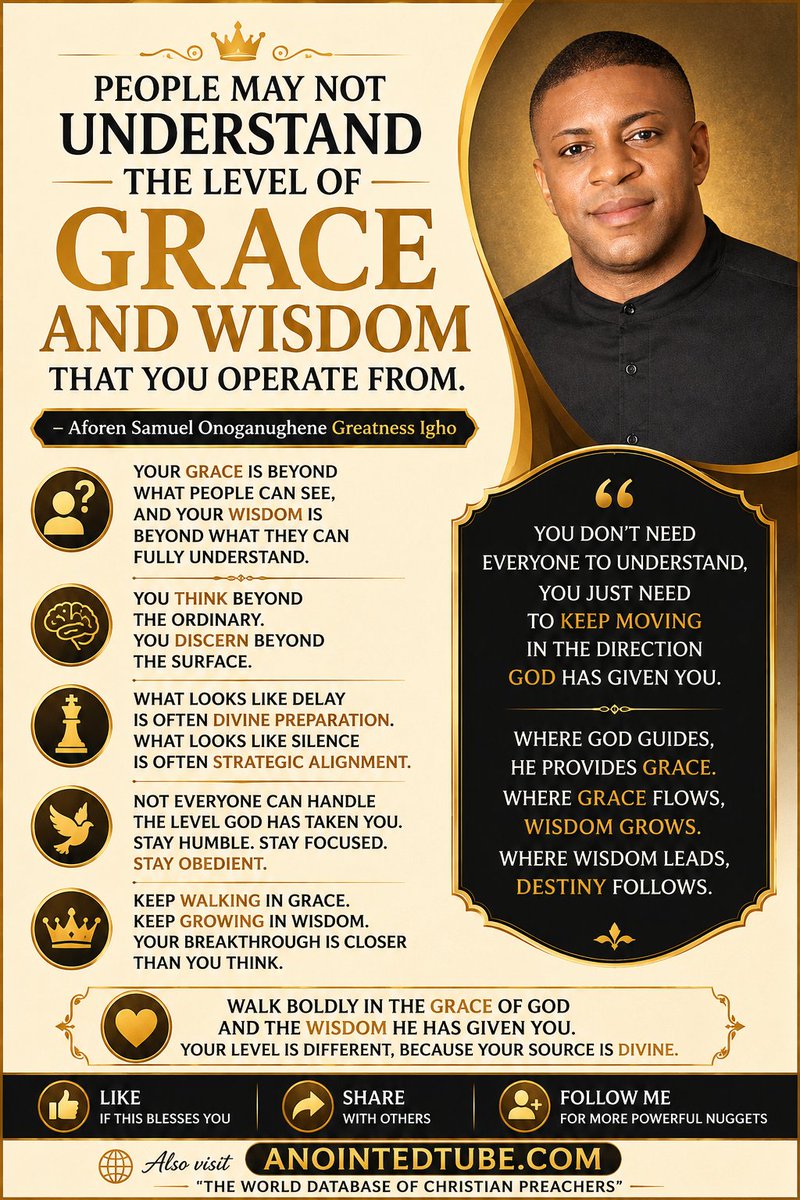
PEOPLE MAY NOT UNDERSTAND THE LEVEL OF GRACE AND WISDOM THAT YOU OPERATE FROM.
— Aforen Samuel Onoganughene Greatness Igho
Your Grace Is Beyond What People Can See
Your grace is beyond what people can see, and your wisdom is beyond what they can fully understand.
You Think Beyond The Ordinary
You think beyond the ordinary.
You discern beyond the surface.
What Looks Like Delay
What looks like delay is often divine preparation.
What looks like silence is often strategic alignment.
Not Everyone Can Handle Your Level
Not everyone can handle the level God has taken you.
Stay humble.
Stay focused.
Stay obedient.
Keep Walking In Grace
Keep walking in grace.
Keep growing in wisdom.
Your breakthrough is closer than you think.
You don't need everyone to understand, you just need to keep moving in the direction God has given you.
Where God guides, He provides grace.
Where grace flows, wisdom grows.
Where wisdom leads, destiny follows.
Final Charge
Walk boldly in the grace of God and the wisdom He has given you.
Your level is different because your source is divine.
👍 LIKE — If this blesses you
🔄 SHARE — With others
➕ FOLLOW ME — For more powerful nuggets
Also visit https://t.co/CPIT5xZGXf
The World Database of Christian Preachers
When you are consumed with love, the love of God and people becomes your highest priority.
The true measure of spiritual maturity is not how much you know, but how deeply you love.
When your heart is filled with the love of God, your perspective changes.
You begin to see people through the eyes of compassion rather than criticism.
You begin to see opportunities to serve rather than reasons to complain.
Love transforms your priorities.
What once seemed important becomes secondary, and what truly matters rises to the top.
When you are consumed with love, forgiveness becomes easier.
Kindness becomes natural.
Patience becomes stronger.
Mercy becomes your response.
A heart filled with God's love does not seek to destroy people—it seeks to restore them.
The love of God empowers you to put others before yourself, to lift the broken, encourage the discouraged, and bring hope where there is despair.
When love becomes your highest priority, selfishness loses its power.
Pride loses its influence.
Bitterness loses its grip.
Love is not merely something you do; it is something you become.
The more you are consumed with God's love, the more you reflect His heart.
And when you reflect His heart, you become a blessing to your generation and a testimony of His grace.
Let the love of God fill your heart so completely that loving God and loving people becomes your greatest passion and highest priority.
The Heart of God is revealed through the love we give.
— Aforen Samuel Onoganughene Greatness Igho
👍 Like | 🔄 Share | ➕ Follow me for more powerful nuggets.
Also visit https://t.co/RSFPfpfJWT
The World Database of Christian Preachers.
An essential power of love is the ability to understand what love is.
Many people talk about love.
Many people desire love.
Many people seek love.
But the true power of love begins when you understand what love really is.
Love is more than a feeling.
Love is more than words.
Love is more than emotions.
Love is understanding.
Love is sacrifice.
Love is patience.
Love is commitment.
Love is responsibility.
When you understand love, you stop using people and start valuing them.
When you understand love, you stop looking only at yourself and begin to see the needs of others.
When you understand love, forgiveness becomes possible, compassion becomes natural, and kindness becomes a lifestyle.
The strength of love is not found in what it receives but in what it gives.
The beauty of love is not found in convenience but in commitment.
The greatness of love is not found in emotions alone but in understanding its true purpose.
A person who understands love carries the power to heal broken hearts, restore relationships, unite people, and reflect the nature of God.
Never stop growing in your understanding of love, because the deeper your understanding of love becomes, the greater your impact on the lives of others.
Love understood is love empowered.
Love empowered is life transformed.
— Aforen Samuel Onoganughene Greatness Igho
👍 Like | 🔄 Share | ➕ Follow me for more powerful nuggets.
Also visit https://t.co/RSFPfpfJWT
The World Database of Christian Preachers.
EPISODE 8 — UNCONDITIONAL LOVE (AGAPE) In this powerful episode of the Love Series, we explore one of the highest and most transformative levels of love: Unconditional Love (Agape). Agape love goes beyond feelings, convenience, and conditions. It is steady, selfless, and rooted in truth. It gives without expecting return, forgives deeply, remains strong during difficult seasons, and reflects the very heart of God. In this episode, you will discover: • What unconditional (agape) love truly means • The difference between conditional love and unconditional love • Why agape love is the most powerful form of love • How to love deeply without accepting abuse or losing healthy boundaries • Practical ways to show unconditional love in marriage, family, friendships, and everyday life • How agape love brings healing, peace, freedom, and spiritual growth This Love Series is becoming more than a teaching—it is a **School of Love**, designed to transform your understanding, your relationships, and your heart. I encourage you to revisit **Episodes 3–7** to build a stronger foundation and deeper understanding of what love truly is. Take time to reflect: • Where am I still practicing conditional love? • How can I begin to love more deeply and selflessly? • Am I allowing God’s agape love to grow in me daily? **Declaration:** “I choose to love with maturity, wisdom, and grace. I will grow in God’s agape love and reflect it in every area of my life.” Watch, reflect, and let your heart be transformed. #UnconditionalLove #AgapeLove #HealthyRelationships #SchoolOfLove
https://t.co/ITGIKZFydM
Success has a divine element hidden within it.
True success is more than hard work, strategy, or human effort.
There is a divine hand at work behind every lasting and meaningful success.
Success is not only built by what you do—
it is strengthened by what God adds.
There is a wisdom that only God can give.
There is a favor that only God can release.
There is a grace that only God can provide.
The divine element in success
is what makes ordinary efforts produce extraordinary results.
It is the unseen power
that opens doors no man can shut.
It is the hidden strength
that sustains you when others give up.
It is the divine direction
that leads you where your own understanding cannot.
Success without God may be temporary,
but success with God carries peace, purpose, and lasting impact.
When God is in it,
success becomes more than an achievement—
it becomes a testimony.
Seek His wisdom.
Trust His timing.
Walk in obedience.
Depend on His grace.
Because success has a divine element hidden within it—
and that divine element
will always make the difference.
— Aforen Samuel Onoganughene Greatness Igho
👍 Like | 🔄 Share | ➕ Follow for more powerful nuggets
Also visit [AnointedTube](https://t.co/ZiHVXfk8oM
“The World Database of Christian Preachers”
Breaking new ground is what I’m doing.
You enter a new space
when you break new ground.
Progress does not happen
by staying in familiar territory.
Growth does not come
by remaining where you have always been.
To enter a new space,
you must be willing to step beyond comfort,
challenge limitations,
and break through old boundaries.
Breaking new ground means
daring to think differently,
believing beyond what you can see,
and moving forward with courage and faith.
Every breakthrough begins
with someone willing to dig deeper,
push harder,
and go where others have not gone.
Do not be afraid
to leave the old behind.
Do not fear unfamiliar territory.
The new ground you are breaking today
is preparing the new space
you are about to occupy tomorrow.
New levels.
New opportunities.
New influence.
New impact.
Breaking new ground
is not just an action—
it is a mindset.
And that is what I am doing.
I am breaking new ground.
I am entering new spaces.
I am stepping into greater possibilities.
— Aforen Samuel Onoganughene Greatness Igho
👍 Like | 🔄 Share | ➕ Follow for more powerful nuggets
Also visit [AnointedTube](https://t.co/ZiHVXfk8oM
“The World Database of Christian Preachers”
The gospel of Christ has completely captivated me.
I have come to know, to believe, and to stand firmly on this truth:
it is impossible for God to fail,
because He has no ability to fail.
Failure is not in His nature.
Defeat is not in His character.
Limitation is not in His power.
God is bigger than failure.
Greater than every obstacle.
Stronger than every impossibility.
And because I belong to Him,
failure is not part of my genetic make-up.
I carry the nature of victory.
I carry the mindset of faith.
I carry the DNA of divine possibility.
What defeats others
will not define me.
What stops others
will not stop me.
Why?
Because the God who cannot fail
lives and works in me.
I refuse to think failure.
I refuse to speak defeat.
I refuse to surrender to limitation.
My confidence is in Christ.
My strength is in His Word.
My future is secured in His unfailing power.
God is bigger than failure—
and through Him,
I am built to overcome.
— Aforen Samuel Onoganughene Greatness Igho
👍 Like | 🔄 Share | ➕ Follow for more powerful nuggets
Also visit [AnointedTube](https://t.co/ZiHVXfkGek
“The World Database of Christian Preachers”
Thank you again for your concern about being careful with words. I agree completely that we should be responsible in how we speak and avoid misleading anyone. Truth matters deeply.
However, we must also be careful not to confuse figurative language with falsehood. The use of metaphor, symbolism, and rhetorical expression is not deception—it is one of the primary ways the Creator Himself communicates throughout Scripture.
If using metaphor is “misleading,” then we would have to accuse the Creator, the Lord Jesus, and the apostles of misleading people—which, of course, would be a serious error.
The Creator Himself uses figurative expressions throughout the Old Testament:
“The Lord is my shepherd” (Psalm 23:1)
Is the Creator literally a shepherd holding sheep? No. This is metaphor, describing His guidance and care.
“The Lord is my rock and my fortress” (Psalm 18:2)
Is He literally a rock? No. This is figurative language expressing strength, stability, and protection.
“Under His wings you will find refuge” (Psalm 91:4)
Does the Creator literally have physical wings? No. This is symbolic language showing divine covering.
“Circumcise your hearts” (Deuteronomy 10:16)
This is not literal surgery—it is a spiritual metaphor for inner transformation.
“All flesh is grass” (Isaiah 40:6)
Humanity is not literally grass. This is metaphor showing the temporary nature of life.
“Your word is a lamp to my feet and a light to my path” (Psalm 119:105)
The Word is not a literal lamp. It is figurative for divine guidance.
The Lord Jesus also spoke constantly in metaphor and figurative expressions:
“I am the bread of life” (John 6:35)
Was He literal bread? No. He was speaking spiritually.
“I am the light of the world” (John 8:12)
Was He literal sunlight? No. This is metaphor.
“I am the good shepherd” (John 10:11)
Again, figurative language.
“I am the true vine, and you are the branches” (John 15:5)
Neither He nor believers are literal plants. This is metaphor about spiritual connection.
“You are the salt of the earth” (Matthew 5:13)
Believers are not literal salt. It is figurative language describing influence and preservation.
“You are the light of the world” (Matthew 5:14)
Again, metaphor.
Even the apostles used figurative language:
“Put on the whole armor of God” (Ephesians 6:11)
Believers are not literally wearing Roman military armor. Paul uses symbolism to describe spiritual readiness.
“Run in such a way as to win the prize” (1 Corinthians 9:24)
Paul compares the Christian life to an athletic race.
“Fight the good fight of faith” (1 Timothy 6:12)
Faith is not a literal boxing match. This is metaphor.
“You are living stones” (1 Peter 2:5)
Believers are not literal stones.
The Bible contains hundreds, even thousands, of figurative expressions across both the Old and New Testaments. Poetry, prophecy, wisdom literature, parables, and apostolic teaching all use metaphor extensively. It is one of the Creator’s chosen methods of revealing truth.
Historically, this was very common in both Jewish and Greek culture.
The Hebrews often communicated spiritual truths using agricultural, shepherding, family, and temple imagery because these were part of daily life. That is why Scripture speaks of seeds, harvest, vineyards, sheep, bread, water, and light.
The Greeks also highly valued rhetoric, symbolism, and philosophical illustration. Figurative speech was a respected and powerful tool for teaching and persuasion.
Even the Lord Jesus taught heavily through parables and figurative expressions. Scholars estimate that around one-third of His recorded teachings in the Gospels are given in parables, and much of the rest also contains symbolic and metaphorical language.
So when I say “reducing hell and increasing heaven,” I am using the same principle of figurative expression.
I am not saying hell physically shrinks. I am not saying people are pulled out of hell after entering it.
I am saying that through evangelism and salvation, fewer people will ultimately go there, and more people will enter eternal life.
That is not deception. That is rhetorical expression.
Respectfully, arguments should come from knowledge, understanding, and proper interpretation—not from misunderstanding figurative language.
The Bible says, “Let the word of Christ dwell in you richly” (Colossians 3:16).
It also says, “That the eyes of your understanding being enlightened…” (Ephesians 1:18).
It is not enough to merely read the Word; we must allow the Word to dwell richly in us, and we must ask for the Spirit’s illumination to enlighten our understanding.
There is a difference between reading words and understanding meaning.
I have explained the intended meaning clearly, and I have shown that the Creator, the Lord Jesus, and the apostles all used figurative language regularly.
So rather than calling something a lie simply because it is metaphorical, it is important to grow deeper in scriptural understanding and in the principles of language itself.
Truth requires both knowledge and discernment.
May the Word dwell richly in us all, and may the eyes of our understanding continually be enlightened.
Please Share the Video to help https://t.co/mES45rNLS9 (World Database of Christian Preachers-Positively Touching and Changing lives| It's a Great Christian Video Sharing Website) reach 100 Million People. Reducing Hell and Increasing Heaven.
Thank you again for your concern about being careful with words. I agree completely that we should be responsible in how we speak and avoid misleading anyone. Truth matters deeply.
However, we must also be careful not to confuse figurative language with falsehood. The use of metaphor, symbolism, and rhetorical expression is not deception—it is one of the primary ways the Creator Himself communicates throughout Scripture.
If using metaphor is “misleading,” then we would have to accuse the Creator, the Lord Jesus, and the apostles of misleading people—which, of course, would be a serious error.
The Creator Himself uses figurative expressions throughout the Old Testament:
“The Lord is my shepherd” (Psalm 23:1)
Is the Creator literally a shepherd holding sheep? No. This is metaphor, describing His guidance and care.
“The Lord is my rock and my fortress” (Psalm 18:2)
Is He literally a rock? No. This is figurative language expressing strength, stability, and protection.
“Under His wings you will find refuge” (Psalm 91:4)
Does the Creator literally have physical wings? No. This is symbolic language showing divine covering.
“Circumcise your hearts” (Deuteronomy 10:16)
This is not literal surgery—it is a spiritual metaphor for inner transformation.
“All flesh is grass” (Isaiah 40:6)
Humanity is not literally grass. This is metaphor showing the temporary nature of life.
“Your word is a lamp to my feet and a light to my path” (Psalm 119:105)
The Word is not a literal lamp. It is figurative for divine guidance.
The Lord Jesus also spoke constantly in metaphor and figurative expressions:
“I am the bread of life” (John 6:35)
Was He literal bread? No. He was speaking spiritually.
“I am the light of the world” (John 8:12)
Was He literal sunlight? No. This is metaphor.
“I am the good shepherd” (John 10:11)
Again, figurative language.
“I am the true vine, and you are the branches” (John 15:5)
Neither He nor believers are literal plants. This is metaphor about spiritual connection.
“You are the salt of the earth” (Matthew 5:13)
Believers are not literal salt. It is figurative language describing influence and preservation.
“You are the light of the world” (Matthew 5:14)
Again, metaphor.
Even the apostles used figurative language:
“Put on the whole armor of God” (Ephesians 6:11)
Believers are not literally wearing Roman military armor. Paul uses symbolism to describe spiritual readiness.
“Run in such a way as to win the prize” (1 Corinthians 9:24)
Paul compares the Christian life to an athletic race.
“Fight the good fight of faith” (1 Timothy 6:12)
Faith is not a literal boxing match. This is metaphor.
“You are living stones” (1 Peter 2:5)
Believers are not literal stones.
The Bible contains hundreds, even thousands, of figurative expressions across both the Old and New Testaments. Poetry, prophecy, wisdom literature, parables, and apostolic teaching all use metaphor extensively. It is one of the Creator’s chosen methods of revealing truth.
Historically, this was very common in both Jewish and Greek culture.
The Hebrews often communicated spiritual truths using agricultural, shepherding, family, and temple imagery because these were part of daily life. That is why Scripture speaks of seeds, harvest, vineyards, sheep, bread, water, and light.
The Greeks also highly valued rhetoric, symbolism, and philosophical illustration. Figurative speech was a respected and powerful tool for teaching and persuasion.
Even the Lord Jesus taught heavily through parables and figurative expressions. Scholars estimate that around one-third of His recorded teachings in the Gospels are given in parables, and much of the rest also contains symbolic and metaphorical language.
So when I say “reducing hell and increasing heaven,” I am using the same principle of figurative expression.
I am not saying hell physically shrinks. I am not saying people are pulled out of hell after entering it.
I am saying that through evangelism and salvation, fewer people will ultimately go there, and more people will enter eternal life.
That is not deception. That is rhetorical expression.
Respectfully, arguments should come from knowledge, understanding, and proper interpretation—not from misunderstanding figurative language.
The Bible says, “Let the word of Christ dwell in you richly” (Colossians 3:16).
It also says, “That the eyes of your understanding being enlightened…” (Ephesians 1:18).
It is not enough to merely read the Word; we must allow the Word to dwell richly in us, and we must ask for the Spirit’s illumination to enlighten our understanding.
There is a difference between reading words and understanding meaning.
I have explained the intended meaning clearly, and I have shown that the Creator, the Lord Jesus, and the apostles all used figurative language regularly.
So rather than calling something a lie simply because it is metaphorical, it is important to grow deeper in scriptural understanding and in the principles of language itself.
Truth requires both knowledge and discernment.
May the Word dwell richly in us all, and may the eyes of our understanding continually be enlightened.
Thank you again for your concern about being careful with words. I agree completely that we should be responsible in how we speak and avoid misleading anyone. Truth matters deeply.
However, we must also be careful not to confuse figurative language with falsehood. The use of metaphor, symbolism, and rhetorical expression is not deception—it is one of the primary ways the Creator Himself communicates throughout Scripture.
If using metaphor is “misleading,” then we would have to accuse the Creator, the Lord Jesus, and the apostles of misleading people—which, of course, would be a serious error.
The Creator Himself uses figurative expressions throughout the Old Testament:
“The Lord is my shepherd” (Psalm 23:1)
Is the Creator literally a shepherd holding sheep? No. This is metaphor, describing His guidance and care.
“The Lord is my rock and my fortress” (Psalm 18:2)
Is He literally a rock? No. This is figurative language expressing strength, stability, and protection.
“Under His wings you will find refuge” (Psalm 91:4)
Does the Creator literally have physical wings? No. This is symbolic language showing divine covering.
“Circumcise your hearts” (Deuteronomy 10:16)
This is not literal surgery—it is a spiritual metaphor for inner transformation.
“All flesh is grass” (Isaiah 40:6)
Humanity is not literally grass. This is metaphor showing the temporary nature of life.
“Your word is a lamp to my feet and a light to my path” (Psalm 119:105)
The Word is not a literal lamp. It is figurative for divine guidance.
The Lord Jesus also spoke constantly in metaphor and figurative expressions:
“I am the bread of life” (John 6:35)
Was He literal bread? No. He was speaking spiritually.
“I am the light of the world” (John 8:12)
Was He literal sunlight? No. This is metaphor.
“I am the good shepherd” (John 10:11)
Again, figurative language.
“I am the true vine, and you are the branches” (John 15:5)
Neither He nor believers are literal plants. This is metaphor about spiritual connection.
“You are the salt of the earth” (Matthew 5:13)
Believers are not literal salt. It is figurative language describing influence and preservation.
“You are the light of the world” (Matthew 5:14)
Again, metaphor.
Even the apostles used figurative language:
“Put on the whole armor of God” (Ephesians 6:11)
Believers are not literally wearing Roman military armor. Paul uses symbolism to describe spiritual readiness.
“Run in such a way as to win the prize” (1 Corinthians 9:24)
Paul compares the Christian life to an athletic race.
“Fight the good fight of faith” (1 Timothy 6:12)
Faith is not a literal boxing match. This is metaphor.
“You are living stones” (1 Peter 2:5)
Believers are not literal stones.
The Bible contains hundreds, even thousands, of figurative expressions across both the Old and New Testaments. Poetry, prophecy, wisdom literature, parables, and apostolic teaching all use metaphor extensively. It is one of the Creator’s chosen methods of revealing truth.
Historically, this was very common in both Jewish and Greek culture.
The Hebrews often communicated spiritual truths using agricultural, shepherding, family, and temple imagery because these were part of daily life. That is why Scripture speaks of seeds, harvest, vineyards, sheep, bread, water, and light.
The Greeks also highly valued rhetoric, symbolism, and philosophical illustration. Figurative speech was a respected and powerful tool for teaching and persuasion.
Even the Lord Jesus taught heavily through parables and figurative expressions. Scholars estimate that around one-third of His recorded teachings in the Gospels are given in parables, and much of the rest also contains symbolic and metaphorical language.
So when I say “reducing hell and increasing heaven,” I am using the same principle of figurative expression.
I am not saying hell physically shrinks. I am not saying people are pulled out of hell after entering it.
I am saying that through evangelism and salvation, fewer people will ultimately go there, and more people will enter eternal life.
That is not deception. That is rhetorical expression.
Respectfully, arguments should come from knowledge, understanding, and proper interpretation—not from misunderstanding figurative language.
The Bible says, “Let the word of Christ dwell in you richly” (Colossians 3:16).
It also says, “That the eyes of your understanding being enlightened…” (Ephesians 1:18).
It is not enough to merely read the Word; we must allow the Word to dwell richly in us, and we must ask for the Spirit’s illumination to enlighten our understanding.
There is a difference between reading words and understanding meaning.
I have explained the intended meaning clearly, and I have shown that the Creator, the Lord Jesus, and the apostles all used figurative language regularly.
So rather than calling something a lie simply because it is metaphorical, it is important to grow deeper in scriptural understanding and in the principles of language itself.
Truth requires both knowledge and discernment.
May the Word dwell richly in us all, and may the eyes of our understanding continually be enlightened.
Thank you again for your concern about being careful with words. I agree completely that we should be responsible in how we speak and avoid misleading anyone. Truth matters deeply.
However, we must also be careful not to confuse figurative language with falsehood. The use of metaphor, symbolism, and rhetorical expression is not deception—it is one of the primary ways the Creator Himself communicates throughout Scripture.
If using metaphor is “misleading,” then we would have to accuse the Creator, the Lord Jesus, and the apostles of misleading people—which, of course, would be a serious error.
The Creator Himself uses figurative expressions throughout the Old Testament:
“The Lord is my shepherd” (Psalm 23:1)
Is the Creator literally a shepherd holding sheep? No. This is metaphor, describing His guidance and care.
“The Lord is my rock and my fortress” (Psalm 18:2)
Is He literally a rock? No. This is figurative language expressing strength, stability, and protection.
“Under His wings you will find refuge” (Psalm 91:4)
Does the Creator literally have physical wings? No. This is symbolic language showing divine covering.
“Circumcise your hearts” (Deuteronomy 10:16)
This is not literal surgery—it is a spiritual metaphor for inner transformation.
“All flesh is grass” (Isaiah 40:6)
Humanity is not literally grass. This is metaphor showing the temporary nature of life.
“Your word is a lamp to my feet and a light to my path” (Psalm 119:105)
The Word is not a literal lamp. It is figurative for divine guidance.
The Lord Jesus also spoke constantly in metaphor and figurative expressions:
“I am the bread of life” (John 6:35)
Was He literal bread? No. He was speaking spiritually.
“I am the light of the world” (John 8:12)
Was He literal sunlight? No. This is metaphor.
“I am the good shepherd” (John 10:11)
Again, figurative language.
“I am the true vine, and you are the branches” (John 15:5)
Neither He nor believers are literal plants. This is metaphor about spiritual connection.
“You are the salt of the earth” (Matthew 5:13)
Believers are not literal salt. It is figurative language describing influence and preservation.
“You are the light of the world” (Matthew 5:14)
Again, metaphor.
Even the apostles used figurative language:
“Put on the whole armor of God” (Ephesians 6:11)
Believers are not literally wearing Roman military armor. Paul uses symbolism to describe spiritual readiness.
“Run in such a way as to win the prize” (1 Corinthians 9:24)
Paul compares the Christian life to an athletic race.
“Fight the good fight of faith” (1 Timothy 6:12)
Faith is not a literal boxing match. This is metaphor.
“You are living stones” (1 Peter 2:5)
Believers are not literal stones.
The Bible contains hundreds, even thousands, of figurative expressions across both the Old and New Testaments. Poetry, prophecy, wisdom literature, parables, and apostolic teaching all use metaphor extensively. It is one of the Creator’s chosen methods of revealing truth.
Historically, this was very common in both Jewish and Greek culture.
The Hebrews often communicated spiritual truths using agricultural, shepherding, family, and temple imagery because these were part of daily life. That is why Scripture speaks of seeds, harvest, vineyards, sheep, bread, water, and light.
The Greeks also highly valued rhetoric, symbolism, and philosophical illustration. Figurative speech was a respected and powerful tool for teaching and persuasion.
Even the Lord Jesus taught heavily through parables and figurative expressions. Scholars estimate that around one-third of His recorded teachings in the Gospels are given in parables, and much of the rest also contains symbolic and metaphorical language.
So when I say “reducing hell and increasing heaven,” I am using the same principle of figurative expression.
I am not saying hell physically shrinks. I am not saying people are pulled out of hell after entering it.
I am saying that through evangelism and salvation, fewer people will ultimately go there, and more people will enter eternal life.
That is not deception. That is rhetorical expression.
Respectfully, arguments should come from knowledge, understanding, and proper interpretation—not from misunderstanding figurative language.
The Bible says, “Let the word of Christ dwell in you richly” (Colossians 3:16).
It also says, “That the eyes of your understanding being enlightened…” (Ephesians 1:18).
It is not enough to merely read the Word; we must allow the Word to dwell richly in us, and we must ask for the Spirit’s illumination to enlighten our understanding.
There is a difference between reading words and understanding meaning.
I have explained the intended meaning clearly, and I have shown that the Creator, the Lord Jesus, and the apostles all used figurative language regularly.
So rather than calling something a lie simply because it is metaphorical, it is important to grow deeper in scriptural understanding and in the principles of language itself.
Truth requires both knowledge and discernment.
May the Word dwell richly in us all, and may the eyes of our understanding continually be enlightened.
Thank you again for your concern about being careful with words. I agree completely that we should be responsible and avoid misleading people. Truth matters deeply.
However, we must also recognize that Scripture itself is filled with metaphor, symbolism, parables, and figurative expressions used by the Creator, by the Lord Jesus, and by the apostles to communicate spiritual truth.
Using metaphor does not mean someone is lying or misleading people. If that were true, then we would have to accuse Scripture itself of being misleading—which would be incorrect.
For example, the Lord Jesus said:
“You are the salt of the earth” (Matthew 5:13).
Was He saying believers are literal salt? No. It is a metaphor.
“You are the light of the world” (Matthew 5:14).
Was He saying believers are literal light bulbs? No. It is figurative language.
“I am the door” (John 10:9).
Was the Lord saying He is a literal wooden door? No. He was using metaphor to reveal spiritual truth.
“I am the vine, you are the branches” (John 15:5).
Was He literally a plant? Were believers literal branches? No. This is metaphor.
“Beware of the leaven of the Pharisees” (Matthew 16:6).
At first, even the disciples misunderstood and thought He was talking about bread. But He was speaking figuratively about false teaching.
“Lift up your eyes, and look on the fields; for they are white already to harvest” (John 4:35).
He was not speaking of literal crops, but of souls ready to receive truth.
The Creator also used figurative language throughout Scripture:
“The Lord is my rock” (Psalm 18:2).
Is the Creator literally a stone? No. It is metaphor describing strength and refuge.
“Under His wings you will find refuge” (Psalm 91:4).
Does the Creator literally have physical wings? No. This is symbolic language expressing divine protection.
“Circumcise your hearts” (Deuteronomy 10:16).
This was not about physical surgery on the heart, but spiritual transformation.
The apostles also used metaphor:
“Put on the whole armor of God” (Ephesians 6:11).
Are believers literally wearing helmets and shields? No. It is spiritual imagery.
“I have fought the good fight” (2 Timothy 4:7).
Paul was not speaking of a literal boxing match, but of faithfully finishing his spiritual assignment.
So respectfully, using the phrase “reducing hell and increasing heaven” is simply another figurative way of expressing a spiritual reality: that through evangelism, fewer people will ultimately face eternal separation, and more people will receive eternal life.
To suggest that figurative language is automatically misleading would mean questioning the very way Scripture often communicates truth.
Of course, we should all be careful with our words. But careful interpretation also requires recognizing when language is metaphorical, symbolic, or rhetorical.
No one is saying hell itself physically shrinks. The meaning is clear: we labor so that fewer souls are lost and more souls are saved.
Let us be careful not only in speaking, but also in understanding—rightly discerning both the letter and the spirit of what is being communicated.
Thank you again for your concern about being careful with words. I agree completely that we should be responsible and avoid misleading people. Truth matters deeply.
However, we must also recognize that Scripture itself is filled with metaphor, symbolism, parables, and figurative expressions used by the Creator, by the Lord Jesus, and by the apostles to communicate spiritual truth.
Using metaphor does not mean someone is lying or misleading people. If that were true, then we would have to accuse Scripture itself of being misleading—which would be incorrect.
For example, the Lord Jesus said:
“You are the salt of the earth” (Matthew 5:13).
Was He saying believers are literal salt? No. It is a metaphor.
“You are the light of the world” (Matthew 5:14).
Was He saying believers are literal light bulbs? No. It is figurative language.
“I am the door” (John 10:9).
Was the Lord saying He is a literal wooden door? No. He was using metaphor to reveal spiritual truth.
“I am the vine, you are the branches” (John 15:5).
Was He literally a plant? Were believers literal branches? No. This is metaphor.
“Beware of the leaven of the Pharisees” (Matthew 16:6).
At first, even the disciples misunderstood and thought He was talking about bread. But He was speaking figuratively about false teaching.
“Lift up your eyes, and look on the fields; for they are white already to harvest” (John 4:35).
He was not speaking of literal crops, but of souls ready to receive truth.
The Creator also used figurative language throughout Scripture:
“The Lord is my rock” (Psalm 18:2).
Is the Creator literally a stone? No. It is metaphor describing strength and refuge.
“Under His wings you will find refuge” (Psalm 91:4).
Does the Creator literally have physical wings? No. This is symbolic language expressing divine protection.
“Circumcise your hearts” (Deuteronomy 10:16).
This was not about physical surgery on the heart, but spiritual transformation.
The apostles also used metaphor:
“Put on the whole armor of God” (Ephesians 6:11).
Are believers literally wearing helmets and shields? No. It is spiritual imagery.
“I have fought the good fight” (2 Timothy 4:7).
Paul was not speaking of a literal boxing match, but of faithfully finishing his spiritual assignment.
So respectfully, using the phrase “reducing hell and increasing heaven” is simply another figurative way of expressing a spiritual reality: that through evangelism, fewer people will ultimately face eternal separation, and more people will receive eternal life.
To suggest that figurative language is automatically misleading would mean questioning the very way Scripture often communicates truth.
Of course, we should all be careful with our words. But careful interpretation also requires recognizing when language is metaphorical, symbolic, or rhetorical.
No one is saying hell itself physically shrinks. The meaning is clear: we labor so that fewer souls are lost and more souls are saved.
Let us be careful not only in speaking, but also in understanding—rightly discerning both the letter and the spirit of what is being communicated.
Thank you again for your concern about being careful with words. I agree completely that we should be responsible and avoid misleading people. Truth matters deeply.
However, we must also recognize that Scripture itself is filled with metaphor, symbolism, parables, and figurative expressions used by the Creator, by the Lord Jesus, and by the apostles to communicate spiritual truth.
Using metaphor does not mean someone is lying or misleading people. If that were true, then we would have to accuse Scripture itself of being misleading—which would be incorrect.
For example, the Lord Jesus said:
“You are the salt of the earth” (Matthew 5:13).
Was He saying believers are literal salt? No. It is a metaphor.
“You are the light of the world” (Matthew 5:14).
Was He saying believers are literal light bulbs? No. It is figurative language.
“I am the door” (John 10:9).
Was the Lord saying He is a literal wooden door? No. He was using metaphor to reveal spiritual truth.
“I am the vine, you are the branches” (John 15:5).
Was He literally a plant? Were believers literal branches? No. This is metaphor.
“Beware of the leaven of the Pharisees” (Matthew 16:6).
At first, even the disciples misunderstood and thought He was talking about bread. But He was speaking figuratively about false teaching.
“Lift up your eyes, and look on the fields; for they are white already to harvest” (John 4:35).
He was not speaking of literal crops, but of souls ready to receive truth.
The Creator also used figurative language throughout Scripture:
“The Lord is my rock” (Psalm 18:2).
Is the Creator literally a stone? No. It is metaphor describing strength and refuge.
“Under His wings you will find refuge” (Psalm 91:4).
Does the Creator literally have physical wings? No. This is symbolic language expressing divine protection.
“Circumcise your hearts” (Deuteronomy 10:16).
This was not about physical surgery on the heart, but spiritual transformation.
The apostles also used metaphor:
“Put on the whole armor of God” (Ephesians 6:11).
Are believers literally wearing helmets and shields? No. It is spiritual imagery.
“I have fought the good fight” (2 Timothy 4:7).
Paul was not speaking of a literal boxing match, but of faithfully finishing his spiritual assignment.
So respectfully, using the phrase “reducing hell and increasing heaven” is simply another figurative way of expressing a spiritual reality: that through evangelism, fewer people will ultimately face eternal separation, and more people will receive eternal life.
To suggest that figurative language is automatically misleading would mean questioning the very way Scripture often communicates truth.
Of course, we should all be careful with our words. But careful interpretation also requires recognizing when language is metaphorical, symbolic, or rhetorical.
No one is saying hell itself physically shrinks. The meaning is clear: we labor so that fewer souls are lost and more souls are saved.
Let us be careful not only in speaking, but also in understanding—rightly discerning both the letter and the spirit of what is being communicated.
Thank you again for your concern about being careful with words. I agree completely that we should be responsible and avoid misleading people. Truth matters deeply.
However, we must also recognize that Scripture itself is filled with metaphor, symbolism, parables, and figurative expressions used by the Creator, by the Lord Jesus, and by the apostles to communicate spiritual truth.
Using metaphor does not mean someone is lying or misleading people. If that were true, then we would have to accuse Scripture itself of being misleading—which would be incorrect.
For example, the Lord Jesus said:
“You are the salt of the earth” (Matthew 5:13).
Was He saying believers are literal salt? No. It is a metaphor.
“You are the light of the world” (Matthew 5:14).
Was He saying believers are literal light bulbs? No. It is figurative language.
“I am the door” (John 10:9).
Was the Lord saying He is a literal wooden door? No. He was using metaphor to reveal spiritual truth.
“I am the vine, you are the branches” (John 15:5).
Was He literally a plant? Were believers literal branches? No. This is metaphor.
“Beware of the leaven of the Pharisees” (Matthew 16:6).
At first, even the disciples misunderstood and thought He was talking about bread. But He was speaking figuratively about false teaching.
“Lift up your eyes, and look on the fields; for they are white already to harvest” (John 4:35).
He was not speaking of literal crops, but of souls ready to receive truth.
The Creator also used figurative language throughout Scripture:
“The Lord is my rock” (Psalm 18:2).
Is the Creator literally a stone? No. It is metaphor describing strength and refuge.
“Under His wings you will find refuge” (Psalm 91:4).
Does the Creator literally have physical wings? No. This is symbolic language expressing divine protection.
“Circumcise your hearts” (Deuteronomy 10:16).
This was not about physical surgery on the heart, but spiritual transformation.
The apostles also used metaphor:
“Put on the whole armor of God” (Ephesians 6:11).
Are believers literally wearing helmets and shields? No. It is spiritual imagery.
“I have fought the good fight” (2 Timothy 4:7).
Paul was not speaking of a literal boxing match, but of faithfully finishing his spiritual assignment.
So respectfully, using the phrase “reducing hell and increasing heaven” is simply another figurative way of expressing a spiritual reality: that through evangelism, fewer people will ultimately face eternal separation, and more people will receive eternal life.
To suggest that figurative language is automatically misleading would mean questioning the very way Scripture often communicates truth.
Of course, we should all be careful with our words. But careful interpretation also requires recognizing when language is metaphorical, symbolic, or rhetorical.
No one is saying hell itself physically shrinks. The meaning is clear: we labor so that fewer souls are lost and more souls are saved.
Let us be careful not only in speaking, but also in understanding—rightly discerning both the letter and the spirit of what is being communicated.
Thank you for your perspective. I understand the distinction you are making, and I appreciate your concern for precision and logic.
However, the phrase “reducing hell and increasing heaven” is not meant to be taken as a literal mathematical statement, but as a figurative expression—a rhetorical way of describing the impact of evangelism on people’s eternal destinies.
Of course, we are not pulling anyone out of hell after they are already there. That is not the meaning. The idea is that through sharing truth and leading people to salvation, fewer people will ultimately enter hell, and more people will enter heaven.
In that sense, one could also say “preventing hell from increasing,” and that would be valid. But saying “reducing hell” communicates the same intended meaning from a figurative standpoint: reducing the number of souls who would otherwise have gone there.
Language often uses metaphor to communicate spiritual realities. Just as people say “plundering the kingdom of darkness” or “taking territory for the Kingdom,” no one assumes those phrases are meant in a strictly literal or mathematical sense.
And yes, the Creator is a God of order and logic—but also a God who communicates through imagery, parables, symbolism, and figurative expressions.
So the phrase is simply a ministry expression pointing to one mission: helping more people choose eternal life, resulting in fewer souls lost and more souls saved.
I appreciate the dialogue and your desire for clarity.
The phrase “reducing hell and increasing heaven” can be understood as using several figures of speech:
Metaphor
This is the main figure of speech.
It does not literally mean changing the size of hell or heaven. Instead, it is a metaphorical way of saying:fewer people are going to hell (reducing hell), and
more people are going to heaven (increasing heaven).
Contrast (Antithesis)
The phrase puts two opposite ideas side by side:hell vs heaven
reducing vs increasing
This contrast makes the message stronger and more memorable.
SymbolismHell symbolizes eternal separation or loss.
Heaven symbolizes eternal life, salvation, and hope.
So the words represent something bigger than just the places themselves.
Mission-oriented rhetorical expression
It is also a powerful ministry phrase or slogan—a concise way of expressing the goal of evangelism: winning souls and leading people to salvation.
So, the main figure of speech is metaphor, supported by antithesis (contrast) and symbolism.